
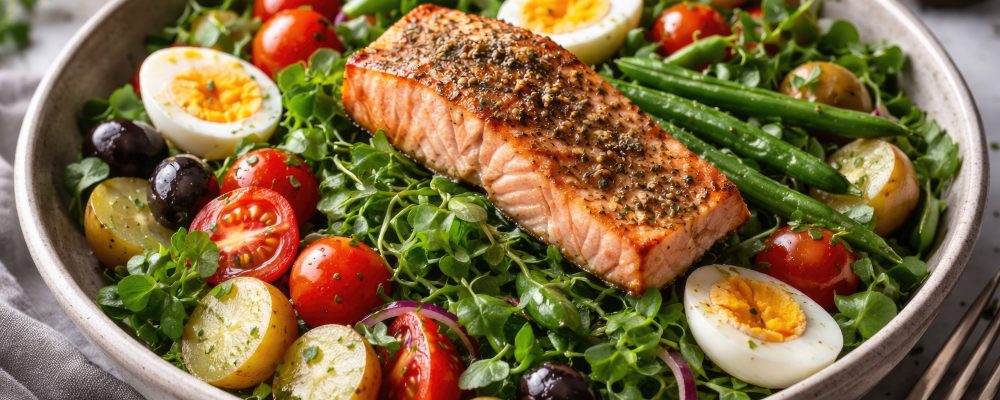

There is a category of salad that has almost nothing in common with the bowl of dressed greens that the word salad typically conjures.
Not the side salad — the handful of lettuce that accompanies the main event, there to add a vegetable component to a plate that is organized around something else. Not the starter salad — the light, palate-opening preparation that precedes the serious cooking. Not the salad as virtuous compromise — the thing eaten when the thing wanted is something else.
The composed salad. The salad that is itself a meal — complete, satisfying, carefully constructed from components that have been cooked or prepared separately and arranged with specific intention on the plate or the platter, each element contributing something distinct to the whole.
The composed salad is one of the highest expressions of the cook’s fundamental skill — the ability to think about food in terms of balance, contrast, and completion, to assemble components that are each excellent in themselves into something that is more excellent together.
It is also one of the most underestimated categories in home cooking — treated as a salad rather than as the complete, satisfying meal it is capable of being.
What Makes a Salad Composed
The distinction between a tossed salad and a composed salad is not primarily visual — though composed salads are typically more deliberately arranged than their tossed counterparts. It is structural.
A tossed salad is a collection of ingredients combined and dressed together, the components losing their individual identity in the mixing. The flavors blend. The textures merge. The result is a unified dish where no single element is meant to be encountered distinctly.
A composed salad is an arrangement of components that retain their individual identity — each element placed separately, each contributing a distinct flavor and texture and visual quality that the eater encounters individually and in combination as they move through the plate. The protein is distinct from the vegetable, which is distinct from the starch, which is distinct from the garnish. The dressing ties them together without erasing their individual character.
The composition — the specific decision about which elements to include, how to prepare each one, how to arrange them in relation to each other — is the work of the dish. The cooking of the individual components is often simple. The intelligence is in how they are assembled.
This assembly requires thinking about the plate in terms of the same principles that govern any good dish: balance, contrast, and completion.
The Architecture of a Composed Salad
Every composed salad that works — that satisfies as a complete meal rather than as an interesting combination of things — has a structure that can be analyzed and replicated.
It has a base: the foundation element that anchors the plate and provides the primary textural and flavor context for everything placed on top of it. The base might be a bed of dressed greens, a layer of cooked grains, a smear of something creamy, or the plate itself, simply dressed with olive oil. The base is not always present in every composed salad, but when it is, it provides the continuity that ties the other elements together.
It has a primary element: the component that defines the character of the salad, that gives it its identity, that is the thing the eater would name if asked what the salad was. The Niçoise is a tuna salad — the tuna is the primary element. The Lyonnaise is a bacon and egg salad — both are the primary element, indivisible. The roasted beet salad is — the beet is primary. Everything else in these salads serves the primary element, provides contrast and support and completeness, but does not compete with it for the role of defining what the dish is.
It has contrasting elements: the components that provide textural, flavor, and temperature contrast to the primary element and to each other. The crisp against the tender. The acidic against the rich. The raw against the cooked. The warm against the cold. These contrasts are not accidental — they are the specific choices that make a composed salad interesting rather than monotonous.
It has a dressing: the acidic element that ties all the components together, that seasons the plate as a whole rather than any individual component, that provides the brightness that keeps the salad vivid rather than heavy.
And it has a finish: the garnish, the final addition, the element applied last that adds something that none of the other components provides — a crunch, a fresh herb note, a textural surprise, a visual signal that the dish is complete.
The Niçoise and What It Teaches
Of all the composed salads in the classical repertoire, the Salade Niçoise — the Provençal composition of tuna, hard-boiled eggs, green beans, potatoes, olives, and anchovies, dressed with a simple vinaigrette — is the one that most clearly demonstrates the principles of composition and from which the most can be learned.
Every element of the Niçoise has a specific role. The tuna — traditionally packed in olive oil, with a character that differs entirely from the water-packed version — provides the primary protein, the meaty, savory foundation that makes the salad a meal. The hard-boiled eggs add a secondary protein, a creaminess from the yolk, a visual element that contrasts with everything around it. The green beans provide the textural element — the specific crunch that the other components don’t offer. The potatoes provide starch and substance, the element that makes the salad genuinely filling rather than merely interesting. The olives provide brininess and fat. The anchovies — which many versions of the recipe omit, to their detriment — provide a concentrated umami depth that ties the other flavors together in a way that nothing else on the plate achieves.
The vinaigrette that dresses the Niçoise is not applied uniformly — each component benefits from a slightly different treatment. The potatoes, still warm, absorb the vinaigrette as it is applied and become seasoned throughout. The green beans, briefly dressed, are seasoned at the surface. The tuna, the eggs, the anchovies may be simply placed and allowed to absorb the dressing as the salad is eaten.
This differentiated dressing is one of the most sophisticated elements of composed salad making — the understanding that different components need different amounts and different application of the dressing, and that tossing everything together produces a less interesting result than considering each element individually.
The Summer Composed Salad: Building From What Is Best
In summer, the composed salad reaches its highest expression — because summer provides the widest range of peak-quality ingredients that can be combined without the intervention of long cooking, allowing each component to speak for itself at the height of its season.
The summer composed salad built around peak-season tomatoes — the tomatoes sliced and seasoned separately with salt and olive oil, combined with torn burrata or fresh ricotta, with basil cut just before serving, with whatever contrast is needed — is a dish that requires nothing but the tomatoes to be extraordinary. The cook’s job is selection and restraint, not transformation.
The summer grain salad — farro or wheat berries or cooked barley combined with roasted or raw summer vegetables, with a protein element added separately, with fresh herbs and a vinaigrette that ties the components together — is the composed salad in its most versatile form. It accommodates whatever is at its best at the market this week. It is more satisfying than it looks, more complete than any single component suggests, and better the next day when the grain has absorbed the dressing and the flavors have integrated overnight.
The summer bean salad — cooked or canned white beans combined with summer vegetables, with a protein element if desired, dressed with good vinegar and olive oil — demonstrates how a composed salad can achieve the satisfaction of a complete meal from the most modest of ingredients when they are arranged with thought rather than simply combined without it.
The Temperature Contrast That Makes a Composed Salad Extraordinary
Of all the contrasts available to the composed salad maker, temperature contrast is the one that is most underused and most transformative when it is employed.
The warm element against the cool element — a piece of just-seared fish placed on a bed of dressed greens that remain cool from the refrigerator, the greens wilting slightly where the warm fish contacts them while remaining crisp elsewhere. The warm roasted vegetables placed alongside raw vegetables dressed with the same vinaigrette, the contrast between the concentrated sweetness of the roasted and the freshness of the raw creating a plate with more interest than either alone would provide. The warm soft-boiled egg broken over a cool salad, the yolk running into the dressing and becoming part of it.
Temperature contrast works in composed salads because it adds a dimension that flavor and texture contrasts alone cannot provide — a physical sensation that makes the eating experience more vivid and more engaging. The contrast between warm and cool registers on the palate and in the mouth in ways that amplify the perception of both temperatures simultaneously.
Professional composed salads are frequently built around this principle — the warm protein element placed on a cool dressed base at the last possible moment, the contrast preserved through the brief transit from kitchen to table. Home cooks rarely employ it because it requires that the components be ready simultaneously — the greens dressed and cool, the protein cooked and warm — which requires more planning than composing everything ahead of time and serving at a single temperature.
The planning is worth it. The temperature contrast it enables is one of the most significant improvements available to any composed salad.
The Dressing That Unifies Without Dominating
The dressing of a composed salad is different in character and in application from the dressing of a tossed salad — and getting this difference right is one of the more important technical decisions in composed salad making.
A tossed salad dressing coats every component uniformly — it is the binding agent that makes the disparate components into a unified whole. A composed salad dressing must do the same unifying work without obscuring the individual character of each component that the composition was designed to showcase.
This means the dressing should be applied with restraint — enough to season and unify, not enough to overwhelm. It means the dressing should be simple enough in character that it complements rather than competes — a clean vinaigrette, a simple lemon and olive oil, a light tahini or yogurt dressing that adds creaminess without aggression.
And it means the dressing should be applied selectively — more to components that need it, less to components that are already vivid and well-seasoned. The tomato that has been dressed separately with salt and olive oil before the main dressing is applied needs almost nothing more. The cooked grain or the protein element that has little inherent flavor needs the dressing most.
The Takeaway
The composed salad is one of the most rewarding categories in summer cooking — a complete meal that can be assembled from whatever is best at the market this week, that rewards the specific intelligence of good composition over the specific skill of technical cooking, and that can be as simple or as elaborate as the occasion and the cook’s ambition require.
Think about the components before the recipe. Identify the primary element — what is best this week, what will define the character of the dish. Build the contrasts — what provides crunch, what provides creaminess, what provides the acid that lifts the whole plate. Apply the dressing with restraint. Finish with the element that completes rather than clutters.
The composed salad done well is a meal that looks like more than it is and tastes like exactly what it is — a collection of excellent things arranged with thought, dressed with care, and served at the right moment.
That is enough.














