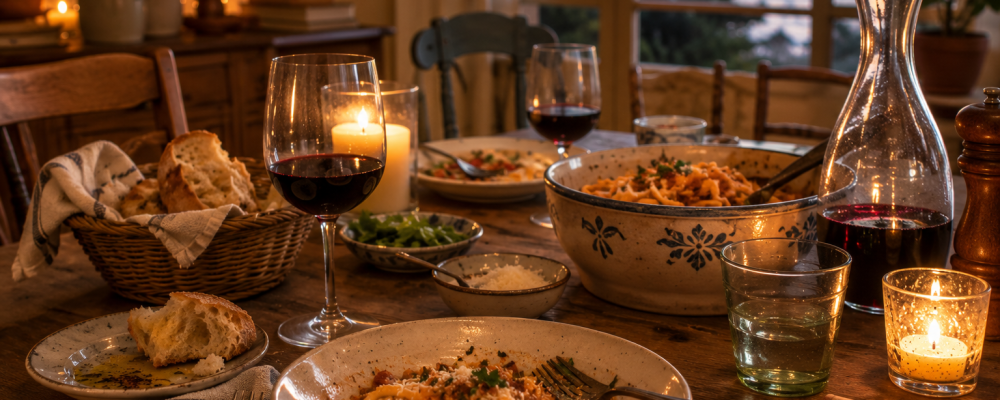

There is a meal that exists in almost every life.
Not a specific meal — not a dish or a restaurant or an occasion that is the same for everyone. But a meal that functions as a return — a specific eating experience that connects the person at the table to something earlier in their life, something that the years between cannot fully separate them from.
It might be a dish eaten in childhood that appears again decades later and produces an immediate and specific transport — not just a memory of the taste but a memory of the specific quality of being a child in a specific place at a specific time, eating something made by hands that are no longer there to make it. It might be a meal in a restaurant encountered years ago and returned to, finding that the return produces both the pleasure of the familiar and the discovery that what has changed is not the restaurant but the person eating there. It might be the specific meal that marks the annual reunion — the dish that appears every year at the same table and that carries, in its specific flavor, the weight of every previous occasion at which it was served.
The table we return to is not always a literal table. It is a flavor, a combination, a specific sensory experience that connects the present moment of eating to the past — that collapses the years between the first encounter and the current one into a single moment that contains both.
This is one of the most extraordinary things that food can do.
And it is one of the most ordinary.
Why Food Returns Us
The neurological relationship between food and memory is more direct than any other sensory modality — and this directness is responsible for the specific quality of food memory that makes certain eating experiences so distinctly transportive.
The olfactory system — which drives approximately eighty percent of what we experience as flavor, the rest being taste — connects directly to the hippocampus and the amygdala, the brain structures responsible for memory formation and emotional processing. This connection is more direct than any other sensory system’s connection to these structures. Visual memories, auditory memories, tactile memories — all of these are processed through additional neural relays before reaching the memory centers. Smell, and therefore flavor, reaches them more immediately.
This directness is why Proust’s madeleine — the famous literary instance of a flavor producing an involuntary memory — resonates with such universal recognition. The experience it describes is not a literary device. It is a neurological phenomenon that most people have encountered in their own lives, usually without the vocabulary to name it.
The flavor of a specific dish encountered in childhood, when the emotional associations were being formed alongside the sensory memory, is encoded in the brain with an intensity and a completeness that later memories rarely match — because the emotional state of childhood eating, combined with the novelty of the food experiences, produces a particularly durable encoding.
When that flavor is encountered again — years or decades later — the encoding activates not just the memory of the flavor but the memory of the emotional state that accompanied its formation. The flavor carries the feeling. The eating produces the transport.
The Tables That Cannot Be Returned To
Not every table that we would return to is available for return.
The restaurant that closed. The house that was sold. The kitchen of the person who is gone. The specific combination of people and place and season and occasion that produced a meal which exists now only in memory — which cannot be reproduced because too many of the elements that produced it are no longer available.
These tables are the most poignant category in any serious eater’s experience — the meals that were extraordinary in ways that could not have been fully appreciated at the time and that have grown in significance with the distance of years.
The lunch eaten at a table in a city first visited at twenty-two, before the city changed or the restaurant closed or the companions of that meal became people who are no longer in regular contact. The Christmas dinner at the house of a grandparent who died two years later, at a table that was sold with the house and scattered to different rooms in different cities. The birthday dinner at a restaurant that seemed ordinary at the time and that the diner would now cross a continent to revisit.
These tables cannot be returned to. But they can be honored — by the specific quality of attention brought to the meals that are still available, by the recognition that the meal happening right now is the meal that will be remembered in the same way as the ones that are now irretrievably past.
The most important thing that the inaccessible table teaches is the importance of being present at the accessible one.
The Meal That Becomes Tradition
Of all the forms that the returnable table takes, the meal that has become tradition — the dish or the occasion or the specific gathering that repeats at regular intervals and that accumulates, with each repetition, a weight of association and meaning that the original meal didn’t carry — is the form most available to the deliberate cultivation of anyone who chooses to cultivate it.
Tradition is not something that arrives fully formed. It is something that is made — through repetition, through consistency, through the specific decision to serve the same dish at the same occasion year after year until the dish and the occasion have become inseparable.
The cook who decides that a specific dish will be made every year for a specific occasion — not because the dish is the most impressive or the most technically ambitious but because it is the right dish for this table and these people and this moment — is making a tradition. Not declaring one, but making one. With each repetition, the dish accumulates meaning. With each year, the specific flavor of the dish becomes more closely associated with the specific occasion, until the dish is no longer simply itself but the taste of this time of year and these people and the specific quality of being together at this table.
This is how the most durable food traditions are created — not through grand design but through the accumulated repetitions of ordinary cooking done with consistency and care.
What Returning Teaches
The meal returned to — the dish made again after years, the restaurant revisited, the table occupied again by the same people in the same configuration — teaches something that the original meal could not.
It teaches what has changed.
Not just in the food, though sometimes the food has changed. But in the person eating it. The specific flavor of a dish encountered twenty years later than its first encounter produces a comparison — not just of the flavor itself but of the person who tasted it then and the person tasting it now. What is different in the way it registers. What nuance is detectable now that was invisible to the earlier palate. What association has accumulated that was not present in the first eating.
This comparison is one of the specific pleasures of revisiting foods that carry long histories — the pleasure of meeting something familiar with the different eyes of a different stage of life and discovering that both the familiarity and the difference are informative.
The wine that was extraordinary at thirty tastes different at fifty — not necessarily better or worse, but differently. The dish that was ambitious and new at twenty is comfortable and known at forty. The food carries the memory of who the eater was and provides, in the comparison with who they are, a specific and personal form of self-knowledge that no other experience quite provides.
The Table Worth Returning To Every Day
There is a form of the returnable table that is more ordinary and more continuously available than the specific meals of memory and tradition — and worth naming precisely because its ordinariness makes it easy to overlook.
The daily table.
The specific table — literal or metaphorical — where eating happens regularly, with the people who are most continuously present in the eater’s life, with the food that is made from the ingredients of the current season and the current week and the current circumstances.
This table is not dramatic. It does not produce the vivid memories that the exceptional meals produce. It is the backdrop of the eating life rather than its high points.
And yet it is, in the long run, the most important table in any life — because it is where most of the eating actually happens, where the habits of attention and presence are practiced or not practiced, where the relationship between food and daily life is either cultivated or neglected.
The cook who brings genuine attention to the daily table — who treats Tuesday’s dinner as worth the specific care that the memorable occasions receive, who sets the table when it would be easier not to, who uses the good ingredients when the convenient ones would do, who stays at the table long enough for the meal to be a meal rather than a refueling stop — is building the table they will want to return to.
Not because every Tuesday dinner will be memorable. But because the accumulated quality of the Tuesday dinners — the practice of attention and care sustained over years — is what produces the specific quality of life at the table that makes the table worth returning to.
The Final Table
There is a thought experiment that reveals what any person actually values in their eating life — what their relationship with food has actually been at its most essential.
Imagine the last meal. Not in a morbid sense but in the sense of: if you knew that the next meal was the last one, what would you want it to be?
The answers to this question, as noted earlier in these pages, are almost never the most technically impressive meals or the most expensive restaurants or the most elaborate preparations. They are the meals most charged with meaning — the dish that tastes of a specific person or a specific place or a specific period in a life that was worth having.
They are the tables that were returned to.
Which means that the most important work of any eating life is not the accumulation of impressive meals or the development of sophisticated taste or the acquisition of culinary knowledge — though none of these are without value.
The most important work is the cultivation of the tables worth returning to.
The relationships that make a table what it is. The consistency that transforms a meal into a tradition. The specific quality of presence that makes any meal — the extraordinary and the ordinary equally — into something that will be worth remembering.
This is what the table we return to is made of.
Not the food, though the food matters.
The people. The presence. The specific quality of attention brought to the specific moment of being together, eating something made with care, at a table that was worth setting.
The Takeaway
The table we return to is not found. It is made — through repetition and consistency and the specific quality of presence that transforms the meal from a feeding into an occasion, from an occasion into a memory, from a memory into the thing we reach for when we want to return to the feeling of being exactly where we belong.
Set the table. Make the dish. Stay at it long enough for it to matter.
The tables worth returning to are being built right now — at every meal that is attended to with genuine care, in every kitchen where the cooking is done with the specific intention of feeding people who matter, at every ordinary Tuesday dinner that is treated as worth doing well.
The extraordinary meal is the exception.
The ordinary meal is the practice.
And the practice, sustained over years with genuine presence and genuine care, produces the table that no distance of time or geography fully separates us from.
The one we always want to return to.
The one we are always, in some sense, still at.