
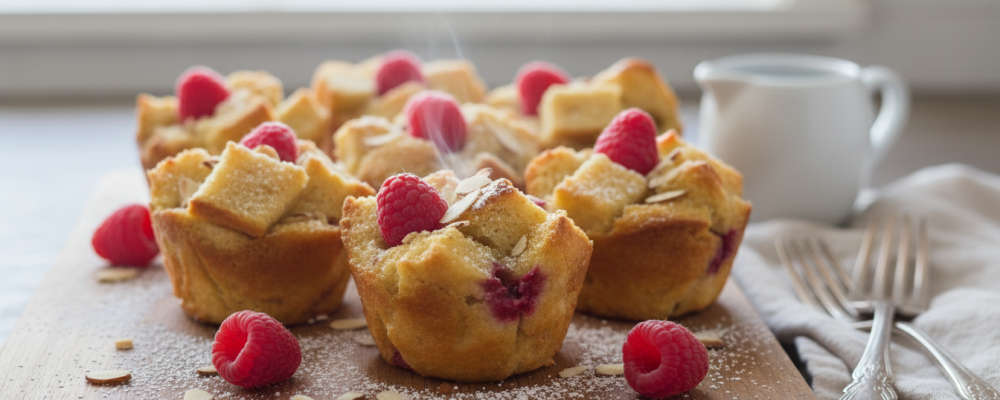

There is a moment, about twenty-two minutes into the baking time for these French Toast Cups, when the kitchen begins to smell like somewhere you’d wait in line for. Warm vanilla. The nutty, toasted fragrance of almonds browning against golden egg-soaked bread. The specific and deeply comforting smell of custard setting in an oven—that faint sweetness that belongs entirely to the intersection of egg and milk and heat. And underneath all of it, just beginning to warm and release their juice into the cups around them, fresh raspberries doing what raspberries do best: making everything smell like the best version of summer.
I’ve spent a significant portion of my professional life around ovens and pastry and the specific joy of something browning toward perfection, and I want to be clear: this kitchen moment is a genuinely good one. It arrives while you’re doing something else entirely on a Sunday morning, and it stops you in your tracks every time, because it smells like a bakery decided to move in.
The cups themselves, pulled from the oven and cooled slightly on the tin, are beautiful in that particular rustic way that baked custard things always are—golden and puffed at the edges, with the raspberries visible through the crust in jeweled flashes of red and pink, and the sliced almonds toasted to a perfect pale gold along the top. They look considered. They look like something that took skill. They required a muffin tin, a bowl, and twenty-five minutes in an oven. That ratio of appearance to effort is, I maintain, one of the great gifts of the baked French toast format.
─────────────────────────────────────────
The Inspiration Behind This Recipe
This recipe was born from a very specific desire: to bring the experience of a really good bakery breakfast into a meal prep format without sacrificing any of the qualities that make bakery breakfasts worth seeking out in the first place. The warmth. The fragrance. The particular satisfaction of something that tastes like it was made with intention and butter and a full commitment to deliciousness rather than mere nutrition delivery.
French toast was the obvious starting point, because French toast is already almost perfect—egg-soaked bread, pan-fried in butter, crisp on the outside and custardy within. The adaptation here is structural: rather than making individual slices to order in a skillet, the egg-soaked bread is cubed, mixed with raspberries and almonds, and baked in a muffin tin in a single batch that produces twelve individual, self-contained cups. The baked version achieves something the pan-fried original can’t in a meal prep context: it holds its shape, it reheats without losing its texture, and it produces twelve identical portions from a single unattended oven session.
The almond extract was the flavor decision I’m most pleased with. Vanilla extract is the expected choice for French toast—and it’s here, doing its warm and necessary work in the background—but almond extract introduces a faintly floral, marzipan-like quality that transforms the whole cup from familiar to distinctive. It is the difference between a French toast cup that tastes pleasant and one that tastes like something you’d specifically request at a café by name. Paired with the brightness of fresh raspberries, it creates a flavor profile that is both warmly comforting and genuinely surprising.
─────────────────────────────────────────
A Brief History of French Toast
French toast—bread soaked in a sweetened egg-and-milk custard and then cooked until golden—is a preparation so ancient and so universal that its name is the least reliable thing about it. In France, it is called pain perdu—lost bread—a name that reveals its true origin: a practical use for stale or leftover bread that would otherwise be discarded. The egg and milk mixture revives the stale bread by rehydrating it and saturating it with custard, which then sets during cooking into something far more delicious than the original fresh bread ever was. It is one of cooking’s great transformations—something that begins as a use-it-or-lose-it solution and arrives as a genuinely celebrated dish.
Versions of this preparation appear across European culinary history as far back as the 4th and 5th centuries, with Roman cookbook records describing a preparation of bread soaked in egg and milk before pan-frying. Medieval European cookbooks contain similar recipes under various names—pain perdu in France, Arme Ritter (Poor Knights) in Germany, torrijas in Spain—each culture developing its own variation on the same foundational technique. The American name “French toast” emerged in the 18th century, though the preparation itself had been known and loved on this continent long before it acquired that particular label.
The muffin tin adaptation—baking cubed, custard-soaked bread in individual cups rather than frying flat slices—is a home cook innovation that emerged from the meal prep and batch cooking movement of recent years. It applies the French toast technique to a format that is simultaneously more practical, more portable, and arguably more beautiful than the original: each cup a self-contained individual portion, golden-edged and puffed from the oven, with its embedded raspberries and almonds making every exterior as visually interesting as the interior is satisfying to eat.
─────────────────────────────────────────
Why This Cooking Method Works for Meal Prep
The muffin tin format is what makes French toast viable as a meal prep breakfast, and the reasons are both structural and practical. Pan-fried French toast is cooked to order—it is at its best in the minute after it leaves the pan, and it deteriorates meaningfully from that point forward as the exterior loses its crispness and the interior settles into a denser, less custardy texture. Baked French toast cups set through the application of dry oven heat rather than direct pan contact, which produces a different and more meal-prep-stable result: a fully set custard interior that holds its structure through cooling, refrigeration, and reheating without the textural collapse that pan-fried French toast undergoes.
The bread cube format—rather than intact slices—is the specific structural decision that makes these cups work as individual baked portions. Cubed bread has dramatically more surface area than a flat slice, which means a higher ratio of egg-and-milk saturation throughout the bread mass. Every cube is coated on multiple sides, ensuring that the custard sets evenly and uniformly throughout the cup rather than concentrating at the base where pooled liquid settles during the soak. The result is a cup that is consistently custardy from edge to edge rather than dense at the base and dry at the top.
Greasing the muffin tin generously with butter serves a dual purpose: it prevents the cups from adhering to the tin during baking, and it contributes a browning at the exterior of each cup—where the egg mixture contacts the buttered metal surface—that produces the golden, slightly crisp outer edge that distinguishes these cups from a simply baked bread pudding. That exterior texture is what makes them feel like something baked with intention rather than simply cooked through.
─────────────────────────────────────────
Flavor Profile: What to Expect
These cups operate in the warmly sweet, faintly floral register of the very best bakery pastries—familiar and surprising at the same time:
- Warm, custardy depth – The egg-and-milk base, fully set by the oven, produces a rich, creamy interior that is the essential character of every great French toast preparation—soft, yielding, and deeply satisfying
- Floral almond sweetness – Almond extract is the flavor signature of these cups—a faintly marzipan-like quality that is distinctly more interesting than vanilla alone, threading through every bite with an aromatic warmth that lingers
- Warm vanilla foundation – Vanilla extract provides the familiar, bakery-like depth beneath the almond—present everywhere, noticed most in its absence
- Bright, tart raspberry bursts – Fresh raspberries provide the essential counterpoint to the custard’s richness—their juice, released during baking, creates pockets of bright, slightly jammy acidity throughout each cup that makes the sweet base taste more complex
- Toasted, nutty almond crunch – Sliced almonds browned on the surface during baking add a satisfying textural contrast and a toasted nuttiness that reinforces the almond extract flavor at a completely different register
- Gentle caramel sweetness – The sugar in the custard caramelizes at the edges during baking, producing a faintly golden sweetness at the exterior crust that makes the first bite of each cup particularly compelling
The flavor is warm and cohesive immediately from the oven and equally good—arguably better—after reheating, when the custard has fully set and the raspberry-almond balance has had time to integrate. The almond fragrance is noticeably more prominent the next morning, when it has had time to bloom through the refrigerated cups overnight.
─────────────────────────────────────────
Tips for Making the Best Raspberry Almond Baked French Toast Cups
A few technique decisions separate excellent French toast cups from very good ones:
- Use slightly stale bread – Day-old bread absorbs the egg custard without becoming waterlogged or falling apart. Fresh bread is too moist and may result in a dense, wet center that doesn’t set cleanly. If using fresh bread, cube it and leave it uncovered for 30 minutes before soaking to dry slightly.
- Soak the bread cubes thoroughly – Ensure every bread cube is fully coated in the egg mixture before portioning into the muffin tin. Under-soaked cubes produce dry spots in the finished cup; fully saturated cubes set into a uniform, cohesive custard throughout.
- Fold raspberries gently – Raspberries are delicate and will break apart and bleed into the custard if stirred aggressively. A gentle fold with a spatula preserves their shape within the cup and keeps the custard base from turning entirely pink before it bakes.
- Don’t overbake – The cups are done when the surface is golden and the center no longer jiggles visibly when the tin is gently shaken. Overbaking dries out the custard interior and toughens the egg proteins—a fully set but still moist center is the target.
- Cool in the tin before removing – These cups need 5–10 minutes of cooling in the tin before they can be removed cleanly. The custard is still slightly fragile immediately out of the oven; cooling firms the structure enough for the cups to release intact rather than breaking apart.
- Reserve a few whole raspberries – Set aside several fresh raspberries to place on top of each cup just before the final minute of baking rather than folding all of them into the batter. Surface raspberries caramelize slightly under the oven heat and create a visually striking, jammy top layer that makes each cup look professionally finished.
Optional: A dusting of powdered sugar over the cooled cups immediately before serving adds the finishing touch that makes these look like they came from a very good brunch menu—and it costs approximately four seconds of effort.
─────────────────────────────────────────
Portioning and Container Suggestions
A standard 12-cup muffin tin produces twelve individual French toast cups—three cups per serving is a generous breakfast portion, yielding four complete servings from a single batch. Two cups alongside a piece of fresh fruit or a small yogurt makes a slightly lighter but equally satisfying morning meal that builds in nutritional variety without requiring any additional prep.
Once fully cooled, the cups release cleanly from the tin and stack carefully in a wide, flat airtight container with a piece of parchment paper between layers to prevent sticking. Individual daily portions—three cups per container, sealed and labeled—allow for grab-and-reheat efficiency each morning without any measuring or decision-making. Glass containers are particularly well-suited here, allowing the golden tops and visible raspberry and almond detail to show through the lid in a way that makes the refrigerator shelf look genuinely appealing.
For a particularly beautiful brunch presentation—because these cups absolutely belong on a weekend table as much as a weekday prep lineup—arrange them on a serving platter dusted with powdered sugar, with a small bowl of fresh raspberries alongside for garnish. The golden, jewel-studded cups arranged together are the kind of presentation that makes people ask what you made, and the answer—French toast cups, forty-five minutes, one bowl—is one of cooking’s best-kept secrets.
─────────────────────────────────────────
Storage, Reheating, and Shelf Life Tips
- Refrigerator storage: Cooled cups keep in an airtight container for up to 4 days. The custard texture remains consistent through day four; the raspberry pockets deepen in flavor as their juice continues to slowly infuse the surrounding bread.
- Freezer storage: These cups freeze exceptionally well for up to 2 months. Cool completely, wrap each cup individually in plastic wrap, and transfer to a freezer bag. Thaw overnight in the refrigerator or directly from frozen using the oven method below.
- Oven reheating (best method): Place cups on a baking sheet in a 325°F oven for 10–12 minutes from refrigerated, or 18–20 minutes from frozen. This method restores the golden exterior texture and warms the custard interior gently without drying it out—the most authentic result of any reheating method.
- Microwave reheating: Wrap in a damp paper towel and microwave at 50% power for 60–90 seconds. Full power toughens the egg custard; low power preserves the soft, creamy interior. The exterior will not re-crisp in the microwave—use the oven method when texture matters most.
- Serving suggestion: A small drizzle of maple syrup or a spoonful of fresh raspberry jam over a reheated cup adds a bright, sweet finish that makes a weekday refrigerator breakfast feel like a weekend treat—with zero additional prep required.
- Almond tip: The toasted almond slices on the surface soften slightly in refrigerated storage. For a crunch refresh, place cups under the broiler for 60–90 seconds after reheating to re-toast the surface almonds before eating.
─────────────────────────────────────────
Why This Recipe Deserves a Spot in Your Meal Prep Rotation
There is a category of meal prep recipe that earns its place not by being the most practical or efficient option, but by being the one that makes the entire prep session feel worth it—the recipe you make on Sunday that makes Monday morning feel like something to look forward to. The Raspberry Almond Baked French Toast Cup is that recipe. It is warm and golden and fragrant and genuinely, unmistakably delicious in a way that no overnight oat or reheated egg muffin can quite replicate—and it arrives in your week with all the make-ahead ease of the most practical prep recipes in the collection.
It also makes the practical arguments convincingly: twelve cups from a single muffin tin, four days of storage, two-month freezer life, and a reheating process that takes less time than toasting a slice of bread. But the real case for keeping it in the rotation is simpler than any of that. Some mornings deserve a breakfast that tastes like it was made with love, even when it was made on Sunday and reheated on Wednesday. This recipe delivers that experience, reliably and beautifully, every single time it’s pulled from the oven. That is worth a permanent spot on any Sunday prep list.
─────────────────────────────────────────
Meal Prep Pairing Suggestions
Raspberry Almond Baked French Toast Cups pair most naturally with breakfast recipes that provide contrast in temperature and flavor character—ensuring the week’s mornings feel genuinely varied rather than returning to the same warm, sweet register every day. Our Peach Ginger Overnight Oat Jars are the ideal cool counterpart—fruit-forward and creamy where these cups are warm and custardy, requiring zero morning effort where the cups need a brief reheat. Rotating between them gives the breakfast rotation two fruit-based, naturally sweetened options that are completely distinct in format, temperature, and eating experience.
For a complete three-breakfast week, our Smashed Avocado Egg Toast Cups provide the savory anchor that rounds out the rotation—warm, egg-based, and muffin-tin-baked like these cups, but bright and herb-forward where these are sweet and almond-scented. The structural similarity of the format makes the two recipes natural companions in a prep session: one muffin tin for the avocado cups, one for the French toast cups, both in the same oven at the same temperature for roughly the same time. A single Sunday baking session, two complete breakfast options, and a week of mornings that covers every possible mood between indulgent and fresh. That is, in the most practical and pleasurable sense, exactly what a well-designed breakfast prep rotation is supposed to deliver.
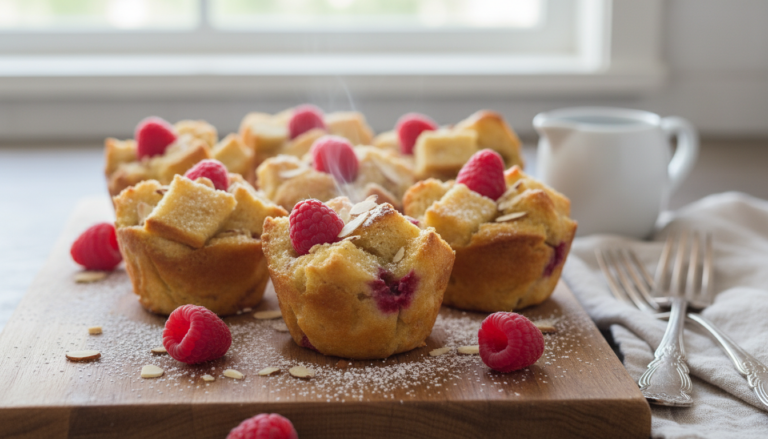
Raspberry Almond Baked French Toast Cups
These Raspberry Almond Baked French Toast Cups are a warmly spiced, golden-baked breakfast that turns a classic French toast into individual, portable, make-ahead cups—studded with bright raspberries and toasted almonds and ready to reheat all week long.
4
servings30
minutes40
minutes300
kcal1
hour10
minutesIngredients
8 slices bread
4 large eggs
1 cup milk
1/4 cup sugar
1 tsp vanilla extract
1/2 tsp almond extract
1 cup raspberries
1/4 cup sliced almonds
1 tbsp butter
Directions
- Preheat your oven to 350°F (175°C).
- Lightly grease a muffin tin with butter.
- Cut bread slices into cubes and set aside.
- In a bowl, beat eggs, milk, sugar, vanilla, and almond extract together.
- Mix bread cubes into the egg mixture, ensuring they are well-coated.
- Gently fold in raspberries and sliced almonds.
- Spoon the mixture into the prepared muffin tin evenly.
- Bake for 25 minutes or until golden brown.
- Allow to cool slightly before serving.
Nutrition Facts
- Total number of serves: 4
- Calories: 280kcal
- Cholesterol: 0mg
- Sodium: 620mg
- Potassium: 400mg
- Sugar: 8g
- Protein: 6g
- Calcium: 60mg
- Iron: 2mg
About This Author

Aurora Wright
Pastry Chef u0026 Dessert Editor
Aurora is the sweet side of Daily Dish. A trained pastry chef and dessert stylist, she’s responsible for our mouth-watering cakes, cookies, and confections. She brings precision, artistry, and a touch of whimsy to every recipe she creates — and taste-tests more chocolate than she’ll admit.
Favorite dish: Flourless dark chocolate torte.
Kitchen motto: “Life’s too short to skip dessert.”















