
Most home cooks have made a curry that tasted flat—that delivered heat and color but not the deep, layered aromatic complexity that makes a good curry genuinely satisfying. Most of the time, the problem is not the spices themselves. It is the sequence. Specifically: whether the spices were bloomed.
Blooming is the technique of adding dry spices to hot fat and allowing them to cook—briefly, approximately sixty seconds—before any liquid is introduced. During that window, the fat-soluble aromatic compounds in the spice are extracted from the dried plant material and released into the oil, where they become available to coat every subsequent ingredient that enters the pan. Spices added directly to liquid achieve only partial extraction of their aromatics—the fat-soluble compounds remain partially locked in the dried material because water cannot dissolve them effectively. Spices bloomed in fat deliver their full aromatic range to the dish.
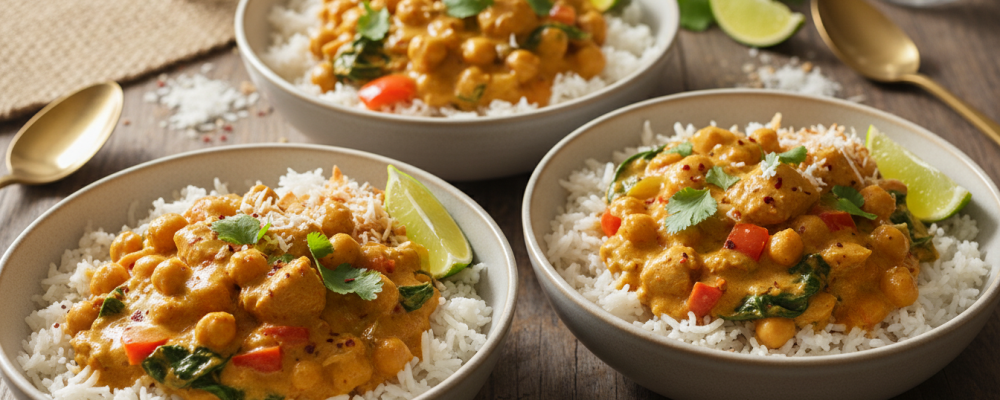
In this recipe, the curry powder, cumin, and coriander are added to the softened onion-garlic base and cooked for exactly one minute before the coconut milk goes in. That one minute is where the bowl’s flavor complexity is built. The curry’s turmeric, its fenugreek, its coriander and cumin and chili—each one releases its aromatic compounds into the olive oil and onion fat that coat the pan. When the coconut milk arrives, it suspends all of those released compounds in an emulsified fat-and-liquid medium that coats every chickpea as it simmers and distributes through every grain of rice as the finished curry is spooned over. The entire bowl’s flavor architecture is determined in that sixty-second window. This is not a step to rush, and it is not a step to skip.
─────────────────────────────────────────
The Inspiration Behind This Recipe
The design objective for this recipe was to produce a meal prep curry that answered the most common complaint about prepped curries: that they taste fine on day one and progressively less interesting on subsequent days. Most curries prepared for meal prep suffer from the same underlying issue—the sauce sits on top of the protein and grain rather than penetrating them, which means the first serving is properly flavored and every subsequent serving is increasingly sauce-depleted as the liquid phase absorbs into the grain base and the concentrated spice sits at the bottom of the container.
The solution is a sauce-to-solid ratio and a simmering time calibrated specifically for meal prep rather than immediate service. This recipe simmers the chickpeas in the coconut curry sauce for ten to fifteen minutes—long enough for the chickpeas’ porous structure to absorb a meaningful amount of the sauce’s flavor compounds, so that they taste of curry throughout rather than only at their surface. This also means the sauce concentrates slightly during the simmer, becoming thicker and more intensely flavored than a curry pulled from the heat immediately after the liquids are combined.
Basmati rice cooked in vegetable broth rather than water is the second design decision that addresses the flavor distribution problem. Broth-cooked basmati absorbs seasoned liquid as it cooks, producing a grain that is already flavorful before the curry is added—which means the bowl as a whole tastes more uniformly seasoned throughout rather than only in the bites that happen to contain a large amount of sauce. The rice is contributing flavor, not just bulk.
─────────────────────────────────────────
A Brief History of Coconut Curry
Coconut milk-based curries are among the most geographically diverse preparations in world cooking—appearing across South Asia, Southeast Asia, East Africa, and the Caribbean in forms that share a fundamental structure (spice, fat, coconut liquid, protein or legume) while reflecting entirely distinct regional traditions. In South Indian cooking, coconut milk curries—particularly the Kerala tradition of ishtu and various coconut-based vegetable preparations—have been central to the regional culinary identity for centuries, where the coconut palm’s abundance made it the natural fat and liquid medium for cooking. In Thai cuisine, coconut milk-based red, green, and yellow curries are among the country’s most widely exported culinary traditions. In Sri Lankan cooking, the coconut milk curry reaches its most complex expression in preparations that layer multiple spice pastes across extended cooking times.
The specific spice blend used in this recipe—curry powder, cumin, coriander—reflects the British colonial synthesis of South Asian spice traditions into a single standardized blend that was developed in India during the Raj period and exported globally. Curry powder as a pre-mixed product is a British invention, created to approximate the flavor profile of South Indian spice-heavy cooking for a European market unfamiliar with individual spice layering. In contemporary cooking, this British-Indian hybrid spice blend has become so widely distributed and so thoroughly integrated into global home cooking that it functions as a flavor tradition in its own right—a bridge ingredient that makes South Asian-inspired cooking accessible without requiring the pantry depth of regional Indian spice methodology.
Chickpeas in a coconut curry represents the meeting of two distinct ingredient traditions—the chickpea, which is native to South Asia and the Middle East, and coconut milk, which is native to the tropical coastal regions of South and Southeast Asia—that became natural companions through the geographic and cultural cooking exchanges of the spice trade era. Their flavor and textural compatibility is the product of centuries of culinary convergence rather than contemporary recipe invention.
─────────────────────────────────────────
Why This Cooking Method Works for Meal Prep
The stovetop simmer method—onion sauté, spice bloom, coconut milk addition, chickpea simmer—produces the best meal prep result for this specific recipe because it achieves the sauce concentration and chickpea saturation that oven-based or slow-cooker methods cannot match within a practical time window. The active, moderate heat of a stovetop simmer evaporates the coconut milk’s surface water progressively, concentrating the fat phase and the dissolved spice compounds into a progressively thicker sauce that coats the chickpeas with increasing intensity as the simmer time extends. Fifteen minutes of active simmering achieves a sauce concentration that a slow cooker’s lower temperature would require hours to replicate.
Rinsing the basmati rice before cooking is a technique decision with specific functional importance for this bowl. Basmati rice has a higher surface starch content than most long-grain varieties—a result of its milling process—and that surface starch, if not rinsed away, gelatinizes during cooking and causes the grains to stick together in a clumped, dense mass that holds the coconut curry sauce on top of it rather than allowing it to penetrate between grains. Rinsed basmati cooks to individual, separated grains that the curry can distribute through as it’s spooned over, producing a bowl where every forkful is evenly sauced rather than unevenly distributed.
The simmering of chickpeas directly in the coconut curry sauce rather than adding them pre-cooked at the end is the technique decision that most distinguishes this from a quickly assembled curry. Canned chickpeas added without simmering taste of their canning liquid and of the sauce surface that coats them; chickpeas simmered for ten to fifteen minutes in the curry absorb the coconut milk’s fat phase and the bloomed spices’ aromatics into their interior, producing a chickpea that tastes of the curry throughout. The texture also improves: simmered chickpeas have a slightly softer exterior and a more yielding texture than cold-added ones, which makes them more pleasant to eat in a bowl context and more effectively absorptive of any additional sauce applied at reheating.
─────────────────────────────────────────
Flavor Profile: What to Expect
This bowl is warm, rich, and deeply aromatic—the flavor profile of a properly constructed curry in every meaningful sense:
- Bloomed curry powder complexity – The foundational flavor of the entire bowl: warm, slightly bitter turmeric, sweet coriander, earthy cumin, and the full spice range of the curry blend, extracted into fat and fully distributed throughout every component
- Rich coconut milk creaminess – Full-fat coconut milk provides the emulsified fat phase that carries all other flavors—its mild, slightly sweet tropical richness tempering the spice’s intensity and making the sauce feel luxurious rather than merely hot
- Bright lime acidity – Lime juice cuts through the coconut’s richness with a clean, citrus sharpness that keeps the curry tasting vivid and alive rather than heavy—applied after simmering to preserve its volatile aromatic character
- Gentle red pepper heat – Red pepper flakes provide a slow, building warmth that arrives after the primary flavors and lingers without overwhelming—present as a finishing note rather than a dominant character
- Earthy, protein-dense chickpeas – Simmered until saturated with the curry sauce, the chickpeas deliver a dense, slightly nutty chew that makes the bowl genuinely filling and carries the spice compounds into every bite
- Fragrant, grain-forward basmati – Cooked in vegetable broth, the basmati contributes its characteristic floral fragrance and elongated grain texture—the most aromatic rice base available and the most compatible with curry’s complex spice profile
- Fresh cilantro brightness – The finishing garnish introduces a clean, herbal, citrus-adjacent freshness at the surface that lifts the whole bowl and resets the palate between bites
The curry’s flavor intensifies measurably over the first twenty-four to forty-eight hours of refrigeration as the bloomed spice compounds continue to distribute through the coconut fat phase and further permeate the chickpeas. Day-two and day-three bowls are the peak—more cohesive, more deeply spiced, and more balanced than the freshly cooked version.
─────────────────────────────────────────
Tips for Making the Best Coconut Curry Chickpea & Basmati Rice Bowls
Execution at the spice-blooming and simmering stages determines the quality ceiling of the finished bowl:
- Don’t rush the spice bloom – One minute at medium heat with active stirring is the minimum. The spices should be visibly fragrant and slightly darkened before the coconut milk goes in. Under-bloomed spices produce a flat, raw spice flavor that simmering time cannot fully correct.
- Use full-fat coconut milk – Lite coconut milk has a significantly lower fat content and produces a thinner, less richly flavored sauce that doesn’t coat the chickpeas as effectively during simmering. Full-fat is the correct choice for both texture and flavor.
- Add lime juice at the end – Lime juice added before or during simmering loses most of its aromatic brightness as its volatile compounds evaporate. Added after the simmer is complete and the heat is off, it retains the fresh, vivid citrus character that makes the bowl taste balanced rather than only rich.
- Rinse basmati until the water runs clear – The rinse is done when the water draining from the rice shows no visible cloudiness. This degree of rinsing removes enough surface starch to produce genuinely separated, fluffy cooked grains. A partial rinse produces partial improvement—the full rinse is worth the extra thirty seconds.
- Simmer with the lid partially off – A fully covered simmer traps steam and prevents sauce concentration; a fully uncovered simmer evaporates liquid too quickly and can burn at the base. A lid set slightly ajar produces the correct rate of evaporation—gentle concentration without scorching.
- Taste and adjust before portioning – Curry powder salt content and heat level varies between brands. Taste the finished curry before dividing into containers and adjust salt, lime, and red pepper flakes to achieve the correct balance for your specific ingredients.
Optional: A tablespoon of natural peanut butter stirred into the simmering curry adds a subtle nuttiness and additional body to the sauce that makes the bowl feel even more substantial and cohesive—an undetectable addition that improves both texture and flavor.
─────────────────────────────────────────
Portioning and Container Suggestions
This recipe produces four generous bowls from a single batch—one per day for a four-day lunch or dinner rotation. A two-container system works best per serving: the coconut curry chickpea mixture in one container and the basmati rice in a second. Storing separately prevents the rice from absorbing all of the sauce’s liquid during refrigeration and arriving dry at the base of the bowl by day three—the curry is best spooned over the reheated rice at serving time, which preserves the sauce’s consistency and the rice’s texture independently.
The curry stores beautifully in glass containers—the sauce’s deep amber-orange color is unaffected by glass (which doesn’t stain the way some plastics do), and glass reheats the sauce more evenly than plastic, preventing the hot spots that can cause the coconut fat to separate at the edges before the center is warmed through. A wide, shallow container for the rice and a deeper container for the curry is the most practical vessel combination for this preparation.
Fresh cilantro stored separately in a small sealed bag or container and added at serving time maintains its bright green color and clean herbal character far better than cilantro stored on the assembled curry, which darkens and loses its aromatics quickly in the refrigerator’s humid environment. The thirty seconds of garnishing at serving time produces a bowl that looks and tastes fresher than one assembled and sealed on Sunday.
─────────────────────────────────────────
Storage, Reheating, and Shelf Life Tips
- Coconut curry storage: Keeps in an airtight container for up to 5 days in the refrigerator. The flavor peaks at days two and three as the bloomed spice compounds fully distribute through the coconut fat phase and the chickpeas continue absorbing the sauce.
- Basmati rice storage: Keeps for 4–5 days refrigerated. Add a teaspoon of water or vegetable broth before reheating to restore moisture absorbed during storage.
- Coconut fat separation: The coconut milk’s fat phase will solidify and separate from the liquid phase during refrigeration—this is normal and does not indicate spoilage. Stir thoroughly before reheating and the sauce will re-emulsify smoothly.
- Freezer storage: Coconut curry freezes exceptionally well for up to 3 months—the fat phase re-emulsifies fully after thawing and reheating. Basmati rice freezes equally well for up to 2 months in portioned bags. Thaw both overnight in the refrigerator before reheating.
- Reheating the curry: Microwave at full power for 90 seconds to 2 minutes, stirring once halfway through. Alternatively, reheat in a small saucepan over medium-low heat with a splash of water or coconut milk to restore the sauce’s original consistency if it has thickened significantly in storage.
- Reheating the rice: Add a teaspoon of liquid, cover loosely, and microwave at full power for 60–90 seconds, fluffing with a fork after reheating.
- Cilantro: Always add fresh at serving. Never store on the assembled bowl.
─────────────────────────────────────────
Why This Recipe Deserves a Spot in Your Meal Prep Rotation
The compounding flavor argument—the observation that this bowl is measurably better on day three than day one—is one of the strongest practical cases for keeping any recipe in a regular meal prep rotation. A preparation that improves with time is a preparation that rewards the discipline of prepping ahead rather than merely tolerating it. Most meal prep recipes hold their quality across the storage window; this one actively accumulates it, as the bloomed spice compounds continue their distribution through the fat phase and the chickpeas reach their full saturation point. By Wednesday, the bowl you portioned on Sunday is the best version of itself—a quiet inversion of the usual meal prep quality curve that makes the back half of the week the most satisfying rather than the least.
From a practical standpoint: plant-based, high-fiber, nutritionally complete, produced in under forty minutes from a short pantry-based ingredient list, and providing four generous servings at a cost per bowl that is among the lowest in this collection. The efficiency argument is compelling on its own. But the flavor argument is the one worth leading with, because a bowl that earns its best reviews at day three is a bowl that produces a specific and genuinely useful outcome: the anticipation of a good lunch on a day when the week has already gone on long enough to make good lunches matter.
─────────────────────────────────────────
Meal Prep Pairing Suggestions
Coconut Curry Chickpea & Basmati Rice Bowls pair most naturally with other boldly flavored grain bowls that provide genuine protein and flavor contrast across the week. Our Gochujang Glazed Tofu & Jasmine Rice Bowls are the natural plant-based rotation partner—both are rice-based plant protein bowls built around a bold, sauce-forward preparation, but the gochujang bowl’s Korean-inspired sweet heat is completely distinct in character and spice tradition from the curry’s South Asian warmth. Alternating between them across the week delivers two genuinely different plant-based bowl experiences that share a format and a philosophy without repeating a flavor note.
For a rotation that introduces an animal protein option alongside two plant-based bowls, our Za’atar Roasted Chicken & Bulgur Bowls provide the spiced, grain-based protein option that gives the week genuine variety in both protein source and spice tradition—Middle Eastern and herbaceous where this bowl is South Asian and coconut-rich. A week that rotates between coconut curry chickpeas, gochujang tofu, and za’atar chicken covers three distinct culinary traditions, three different grain bases, and the full range from fully plant-based to animal protein—assembled across a single Sunday session and delivering more flavor variety than most weekly prep rotations achieve in twice the effort. That is the efficiency that a well-designed prep system should aspire to, and these three bowls achieve it.
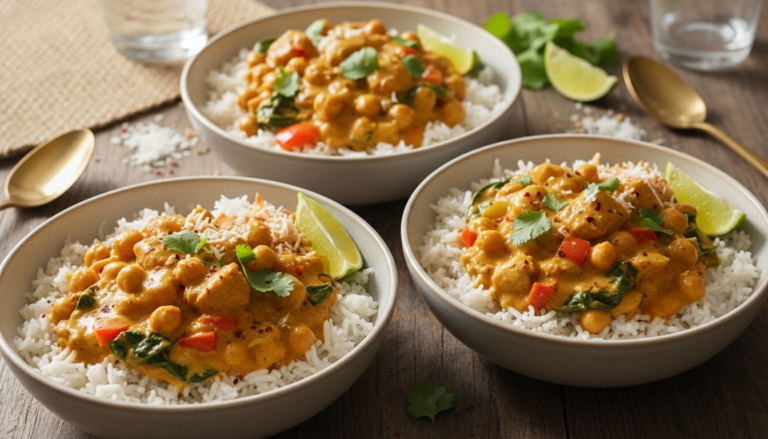
Coconut Curry Chickpea & Basmati Rice Bowls
These Coconut Curry Chickpea & Basmati Rice Bowls are a richly spiced, plant-based meal prep bowl built on a bloomed spice base, full-fat coconut milk, and chickpeas simmered until they absorb the curry’s full depth—a genuinely delicious bowl that earns better reviews at day three than at day one.
4
servings15
minutes30
minutes450
kcal45
minutesIngredients
1 tablespoon olive oil
1 large onion, diced
3 cloves garlic, minced
1 tablespoon curry powder
1 teaspoon ground cumin
1 teaspoon ground coriander
1 can (400ml) coconut milk
1 can (400g) chickpeas, drained and rinsed
1 cup basmati rice
2 cups vegetable broth
1 tablespoon lime juice
1 teaspoon salt
1 pinch red pepper flakes
1 handful fresh cilantro, chopped
Directions
- Heat olive oil in a large pan over medium heat.
- Add diced onion and sauté until translucent, about 5 minutes.
- Stir in minced garlic, curry powder, cumin, and coriander; cook for 1 minute until fragrant.
- Add coconut milk and bring to a simmer.
- Stir in chickpeas, lime juice, salt, and red pepper flakes.
- Simmer for 10-15 minutes, stirring occasionally.
- Meanwhile, rinse basmati rice under cold water.
- In a separate pot, bring vegetable broth to a boil.
- Add rice to broth, cover, and reduce heat to low.
- Simmer rice for 15 minutes, or until liquid is absorbed and rice is tender.
- Fluff the rice with a fork and divide into bowls.
- Top with the coconut curry chickpea mixture.
- Garnish with chopped fresh cilantro before serving.
Nutrition Facts
- Total number of serves: 4
- Calories: 450kcal
- Cholesterol: 0mg
- Sodium: 620mg
- Potassium: 400mg
- Sugar: 8g
- Protein: 6g
- Calcium: 60mg
- Iron: 2mg
About This Author

Benjamin Brown
Recipe Developer
Benjamin is our flavor engineer. A classically trained chef turned recipe developer, he’s obsessed with balancing taste, texture, and creativity. He ensures that every recipe we publish is not only delicious but also reliable, approachable, and repeatable — even for beginners.
Favorite dish: Slow-braised short ribs with red wine reduction.
Kitchen motto: “Cooking is part science, part soul.”