
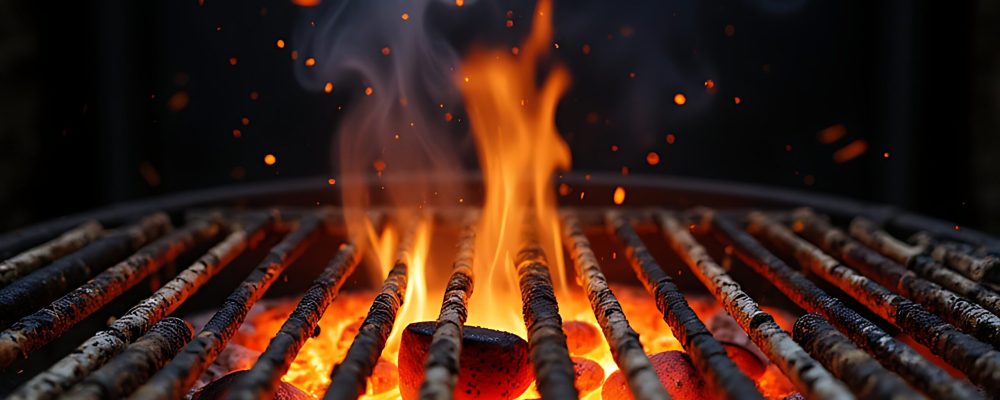

There is a cooking surface that strips away every convenience of the modern kitchen and returns the cook to the most fundamental relationship in all of food.
The relationship between fire and food.
The grill — whether charcoal or wood, whether a backyard kettle or a simple arrangement of stones with a grate laid across them — is the oldest cooking technology available to any cook today. Its principles have not changed since the first human placed food over a flame. The heat radiates up. The food responds. The cook watches, adjusts, and develops, over time, an instinct for what is happening that no thermometer fully captures.
The grill is not a sophisticated tool. It is, by the standards of modern kitchen equipment, a primitive one. It has no temperature display, no timer, no automatic adjustment. It produces heat that is uneven and variable and responsive to wind and fuel and the specific arrangement of coals in ways that cannot be entirely controlled — only managed.
And yet the grill teaches things about cooking that no other surface teaches in quite the same way.
Fire as a Living System
The first thing the grill teaches is that heat is not a setting.
In the modern kitchen, heat is a dial — a number selected and maintained by a thermostat or a calibrated burner. The cook sets the heat and the equipment maintains it, removing from the equation the ongoing relationship between the fire and the cook that open-flame cooking requires.
On the grill, heat is a living system. It begins at one intensity — the high, direct heat of freshly lit coals or a newly started fire — and evolves over time as the fuel burns and the fire settles and the coals develop the specific quality of heat that experienced grillers call “ready.” It has zones — areas of more and less intense heat that the cook creates and uses deliberately. It responds to what is placed on it — a large, cold piece of meat drops the temperature of its immediate zone, which the experienced griller accounts for in their timing. It is affected by the lid — open for direct, high heat; closed to create an oven effect for larger cuts that need to cook through.
Managing this living system is the primary skill of grilling — not the recipes, not the specific marinades or rubs, but the ongoing read of what the fire is doing and what it needs to do for the specific cooking that is happening.
This skill is transferable. The cook who has spent enough time managing a charcoal fire — who has developed the instinct for when the coals are ready, when the heat is too high, when a particular piece of food needs to be moved to the cooler zone before the exterior outpaces the interior — has developed a quality of heat awareness that improves their cooking on every other surface.
The grill teaches that heat is something to be read and managed, not set and forgotten.
The Two-Zone Fire and What It Makes Possible
The most important technical concept in grilling is also the most underutilized by home grillers.
The two-zone fire — the arrangement of coals so that one side of the grill is directly over heat and the other side is not — creates two fundamentally different cooking environments on a single surface.
The hot side produces direct, radiant heat that sears the exterior of food — that drives the Maillard reaction and produces the specific crust and char and caramelization that makes grilled food distinctly grilled. The cool side produces indirect, convective heat — more like an oven than a grill — that cooks food through gently without the risk of burning the exterior before the interior is done.
The two-zone fire allows the cook to use both environments deliberately — to sear over direct heat and finish over indirect, to start indirect when a large piece of food needs time and move to direct at the end for color and crust, to keep finished food warm on the cool side while other elements are completing their cooking.
Without the two-zone setup, grilling is a binary proposition — on the fire or off it, burning or not burning. With it, grilling becomes a nuanced, flexible cooking method capable of producing results as controlled and precise as any indoor technique.
The specific arrangement of coals that produces the two-zone fire is simple: pile all the coals on one side of the grill. Leave the other side empty. That is the entire technique. What it enables is far more than the simplicity of the setup suggests.
What Char Actually Is
There is a flavor that exists only on the grill — the specific, slightly bitter, deeply complex taste of properly developed char on the exterior of food.
This flavor is the product of the Maillard reaction and caramelization occurring at higher temperatures than most indoor cooking produces, combined with the specific pyrolysis — the partial combustion — of the exterior of the food that produces the characteristic black spots and lines that define the appearance of well-grilled food.
Char is not burning. The distinction matters, and experienced grillers understand it instinctively. Burning produces acrid, uniformly blackened food with a bitterness that overwhelms everything else. Char produces specific, controlled areas of caramelized-then-slightly-scorched surface surrounded by the deeply Maillard-browned exterior that makes grilled food so flavorful.
The technique that produces char rather than burning is heat management — using high enough heat to develop the exterior quickly, before the prolonged exposure that would turn char into burning, and removing the food at the moment when the char is developed rather than holding it over the fire until it is overdone.
The specific pattern of grill marks — the crosshatch that appears on properly grilled food — is not primarily aesthetic, though it is visually satisfying. It is the visual record of the grill grate conducting intense heat into the food at the points of contact, producing the maximum Maillard reaction at those points and developing the most flavor exactly where the metal touched the food.
Smoke as a Flavor Ingredient
Beyond heat, the grill offers an ingredient that no indoor cooking surface provides: smoke.
The smoke produced by burning wood or charcoal — and particularly the smoke produced when fat drips from cooking food onto the hot coals and vaporizes, rising back up through the food in a process called flare-up contribution — adds a flavor dimension to grilled food that is as specific and as distinctive as any spice or herb.
Different woods produce different smoke with different flavor profiles. The smoke from fruit woods — apple, cherry, peach — is mild and slightly sweet. The smoke from hickory and oak is more assertive, with a specific density that makes it appropriate for robust proteins like pork and beef but potentially overwhelming for delicate ones. The smoke from mesquite is the most intense, with a specific character that is iconic in Texas barbecue but that requires careful management to avoid overwhelming the food.
The management of smoke on a home grill does not require a dedicated smoker or elaborate equipment. A handful of wood chips soaked in water and placed on the coals at the beginning of cooking, the lid closed to trap the smoke, produces a meaningful amount of smoke flavor in a preparation as simple as a grilled chicken breast.
The specific technique of the indirect smoke cook — keeping the food on the cool side of the grill, away from direct flames, with a small amount of smoking wood producing gentle smoke over a longer cooking time — produces results that approximate the slow-smoked barbecue of professional pitmasters at a fraction of the complexity and time investment.
The Grill as a Vegetable Kitchen
The grill’s greatest and most underappreciated application is vegetables.
The vegetable that meets high, direct grill heat undergoes a transformation that is categorically different from what roasting or sautéing produces. The intense dry heat drives off surface moisture almost immediately, allowing caramelization to occur at the exterior while the interior steams slightly in its own moisture. The smoke adds an aromatic dimension. The specific char that develops on the cut surfaces of grilled vegetables — the dark, slightly blistered edges of a halved zucchini, the blackened corners of a slab of eggplant, the char on a scallion — is a flavor that cannot be reproduced by any other cooking method.
The vegetables that respond best to grilling are those with sufficient moisture and sugar content to caramelize without drying out entirely — the corn still in its husk, the thick-sliced eggplant, the halved bell pepper, the summer squash, the asparagus spear, the scallion. Each of these becomes something richer, more complex, and more deeply flavored when it meets the grill than it is in its raw state or in any other cooking preparation.
The grilled vegetable dressed simply with good olive oil and salt and perhaps a squeeze of lemon — a preparation so simple it barely qualifies as a recipe — is one of the most delicious things available in summer cooking. Its pleasure comes entirely from what the grill did to the ingredient: the concentration, the char, the smoke, the specific quality of direct flame applied to the specific sugars and proteins of a summer vegetable at its peak.
The Patient Cook and the Grill
The grill does not reward impatience.
This is perhaps the deepest thing it teaches — the specific form of patience that comes from understanding that the fire does the work and the cook’s job is to manage the conditions and trust the process rather than to intervene constantly.
The griller who flips their food every thirty seconds is preventing the Maillard reaction from fully developing at the contact point. The crust needs sustained contact with the hot surface to form. Each flip interrupts the process, extending the total cooking time and producing a less developed exterior for the same internal result.
The griller who presses down on their burgers — compressing them with a spatula to accelerate cooking — is squeezing out the moisture that would have kept the interior juicy. The compressed burger cooks faster and dries out faster, the two consequences arriving together in a way that produces a less satisfying result in less time.
The griller who cuts into their protein to check doneness before resting — before the muscle fibers have relaxed and the moisture has redistributed — sees the juice run out onto the grill grate and wonders why the meat was dry.
Each of these impulses comes from the same place: the desire to do something rather than waiting for the fire to do its work. The grill teaches the patience to resist these impulses — to flip once, to leave the meat alone while it rests, to trust that the process is working even when it is not immediately visible.
This patience, practiced over many sessions at the grill, develops into a generalized quality of trust in the process of cooking — a willingness to let things take the time they need rather than forcing them to happen on the cook’s preferred schedule. It is one of the most transferable skills the grill produces.
The Takeaway
The grill is not a sophisticated tool. It does not produce more refined results than a properly managed professional stove or a precisely calibrated oven. What it produces is different — food with the specific character of fire and smoke and direct heat that no other surface provides, and a cook with the specific knowledge that comes from managing a living system rather than operating a calibrated machine.
Learn the two-zone fire. Let the coals develop fully before cooking. Flip once. Rest the meat. Use smoke deliberately.
And pay attention to what the fire is teaching while the food is cooking — because the fire has been teaching these lessons since the first human learned to cook with it, and the lessons have not changed.
The grill is the oldest classroom in cooking.
It is worth attending.














