
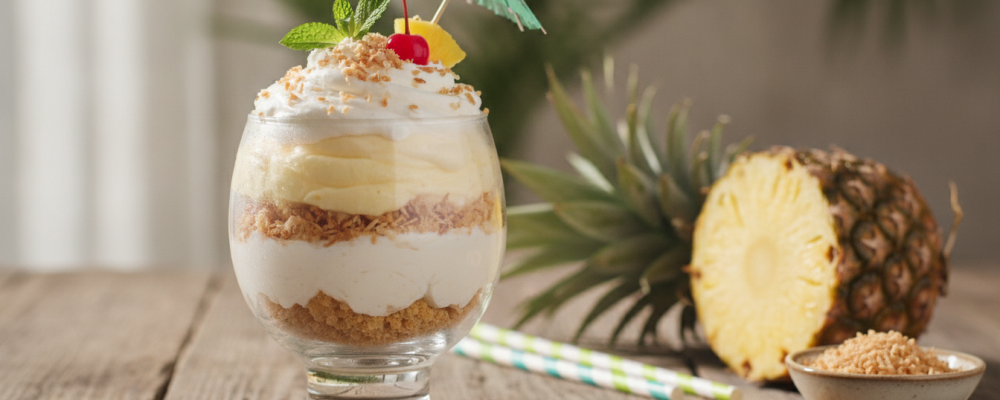

Mousse is one of my favorite dessert formats because it perfectly demonstrates how technique transforms simple ingredients into something extraordinary. Take cream cheese—dense, tangy, substantial—and combine it with properly whipped cream, and you create a texture that’s simultaneously rich and weightless. That transformation, where something heavy becomes light without losing its character, is what great mousse is all about. Piña Colada Cheesecake Mousse takes that principle and applies it to the most joyful flavor combination imaginable: pineapple, coconut, and lime in creamy, cloud-like form.
What makes this mousse technically interesting is how it achieves stability without gelatin or baking. Traditional mousse often requires gelatin to hold its structure, but this version relies on two stabilizing elements: the natural fat and protein structure of cream cheese, and properly whipped heavy cream beaten to stiff peaks. The cream cheese provides a dense, stable base that can support the weight of the whipped cream without it deflating. The whipped cream adds air and lightness while the cream cheese structure prevents it from weeping or collapsing. Together they create something that holds beautifully in glasses for hours without any additional stabilizers.
The pineapple and lime combination is brilliant from a flavor chemistry perspective. Pineapple is acidic and aromatic, with volatile compounds that evaporate quickly—which is why fresh pineapple smells so intensely tropical. Lime juice adds different citrus notes (more bitter, more floral) that complement pineapple without duplicating its flavor. Both fruits’ acidity also interacts with the cream cheese proteins, slightly tightening the mixture’s structure and contributing to its stability. This isn’t just delicious—it’s functionally smart pastry chemistry at work.
─────────
The Inspiration Behind This Recipe
Piña Colada Cheesecake Mousse emerged from my ongoing exploration of cocktail-to-dessert translations. The piña colada—created in 1954 at the Caribe Hilton in Puerto Rico—is one of the world’s most beloved cocktails precisely because its flavors are so fundamentally appealing: sweet pineapple, rich coconut, citrus brightness. These flavors work in liquid form because of balance and contrast, and they work equally well in dessert form for exactly the same reasons.
The challenge in translating cocktail flavors to dessert is that alcohol performs multiple functions in cocktails—it carries aromatic compounds, provides texture, adds complexity, and creates warmth. Without alcohol, you need other elements to provide complexity. In this mousse, that comes from the interplay of granulated sugar (straightforward sweetness) and confectioners’ sugar (more delicate, with a slight starchy quality), vanilla extract (aromatic depth), lime juice (brightness and acidity), and the cream cheese’s characteristic tang. Together these elements create the kind of flavor complexity that makes you think “there’s something special here” without being able to identify any single component.
The mousse format specifically was chosen over ice cream, bars, or cake because it best captures the cocktail’s light, refreshing quality. A dense cake version of piña colada flavors feels heavy and loses that tropical airiness. An ice cream version is wonderful but requires special equipment. Mousse achieves that perfect balance of richness and lightness that feels most true to the cocktail’s spirit.
─────────
A Brief History of Mousse Desserts & Tropical Flavors in American Baking
Mousse as a dessert format originated in France in the 18th century, where chefs discovered that whipping air into various bases—chocolate, fruit, cream—created textures that were simultaneously rich and light. The word “mousse” simply means “foam” in French, accurately describing the aerated texture that defines the format. Classic French chocolate mousse, made by folding whipped cream and egg whites into melted chocolate, became the gold standard of elegant desserts and influenced generations of pastry chefs.
American variations of mousse emerged in the mid-20th century, often using cream cheese as a base instead of the traditional egg yolk and chocolate foundation. Cream cheese mousse had several advantages for American home bakers: no raw eggs, no tempering chocolate, greater stability without gelatin, and simpler technique. The Philadelphia Cream Cheese company promoted numerous cream cheese-based mousse and cheesecake recipes throughout the 1950s and 1960s, creating an entirely American dessert idiom.
Tropical flavors entered American mainstream cooking in earnest during the mid-20th century as air travel made the Caribbean and Hawaii more accessible. The piña colada itself was declared Puerto Rico’s national drink in 1978, but its flavors had been beloved in American cocktail culture for decades prior. The combination of pineapple and coconut became shorthand for vacation, relaxation, and tropical pleasure—associations that persist today and make piña colada-flavored desserts perpetually appealing.
This mousse represents the convergence of French technique (whipped cream mousse), American adaptation (cream cheese base), and Caribbean flavors (pineapple, coconut, lime), creating something that’s genuinely multicultural in its heritage while being purely delicious in its execution.
─────────
Why This No-Bake Mousse Method Works
Cream cheese provides stable structure without gelatin. Traditional mousse requires gelatin or cooking to set because whipped cream alone will eventually deflate. Cream cheese solves this problem through its natural fat and protein content—it’s dense enough to support whipped cream without any additional stabilizers. The proteins in cream cheese form a matrix that holds the air bubbles incorporated by the whipped cream, preventing the mousse from weeping or collapsing over time.
Two sugars serve distinct purposes. The granulated sugar beaten into the cream cheese dissolves fully into the fat-protein matrix, providing sweetness and helping to break down the cream cheese proteins for a smoother texture. The confectioners’ sugar added to the whipping cream provides sweetness plus stability—the small amount of cornstarch in powdered sugar helps stabilize the foam structure of the whipped cream, preventing it from weeping.
Draining pineapple thoroughly is essential. Canned crushed pineapple contains significant liquid. If not properly drained, this liquid will weep into the mousse over time, creating a watery texture and diluting the flavors. Properly drained pineapple adds fruit flavor and texture without compromising structure.
Lime juice performs multiple functions. The acidity in lime juice brightens all the tropical flavors—it makes the pineapple taste more intensely pineapple-y and the coconut taste fresher. It also interacts with the proteins in cream cheese, slightly tightening the mixture’s structure. And it provides that essential cocktail-like brightness that makes this dessert feel refreshing rather than heavy.
Folding preserves the whipped cream’s air structure. The folding technique—using a spatula to cut down through the mixture and fold up—incorporates the whipped cream into the cream cheese base while preserving the air bubbles that create the mousse’s light texture. Stirring or beating would pop these bubbles and create a denser, less elegant result.
Chilling allows flavors to develop and structure to set. During the two-hour refrigeration, the cream cheese and whipped cream structure firms slightly as fats solidify in the cold. More importantly, the flavors meld—the vanilla, lime, pineapple, and cream cheese integrate into a cohesive flavor rather than tasting like separate components. The mousse also reaches its optimal serving temperature, which enhances the refreshing, tropical quality.
Coconut topping provides essential textural contrast. The soft, slightly chewy texture of shredded coconut contrasts with the airy mousse beneath it. The coconut’s flavor also becomes the first thing you taste, priming your palate for the tropical flavors in the mousse. Toasting the coconut briefly in a dry pan before topping creates even more flavor depth.
─────────
Flavor Profile: What to Expect
Bright, sweet pineapple is the star tropical note—it’s fruity, slightly tart, and unmistakably tropical. Crushed canned pineapple has concentrated sweetness and soft texture that distributes evenly throughout the mousse, ensuring pineapple flavor in every spoonful.
Creamy, tangy cheesecake base provides sophisticated richness. The cream cheese contributes that characteristic tang that prevents the dessert from being one-dimensionally sweet. It’s the grown-up element that elevates this beyond simple whipped cream desserts into something more complex and satisfying.
Fresh lime brightness cuts through the richness and adds cocktail-like freshness. The lime doesn’t announce itself as “lime”—it works behind the scenes to lift all the other flavors and make everything taste more vibrant. It’s the element that makes you think “this tastes fresh” without being able to identify why.
Coconut’s tropical sweetness provides the final flavor note—chewy, sweet, and distinctly tropical. Whether used plain or toasted, the coconut echoes the piña colada identity and adds welcome textural contrast to the smooth mousse.
Airy, cloud-like texture defines the eating experience. This mousse isn’t dense or heavy—it’s light and yielding, almost dissolving on your tongue while leaving a lingering richness. Each spoonful feels both substantial and ethereal simultaneously.
The overall experience is refreshing and transporting. These flavors are tropical vacation in dessert form—they’re bright, sweet, creamy, and immediately evocative of warm weather, beach settings, and relaxation. The mousse format keeps everything light and elegant, making it perfect for ending meals on a high, refreshing note.
─────────
Tips for Making the Best Piña Colada Cheesecake Mousse
Cream Cheese Preparation:
- Room temperature is essential—cream cheese should be fully softened (30-60 minutes at room temperature) for smooth, lump-free mousse. Cold cream cheese creates lumps that no amount of beating will fix.
- Beat until completely smooth before adding any other ingredients—every lump at this stage will remain in the final mousse.
- Use full-fat cream cheese for best flavor and structure. Reduced-fat versions are softer and can compromise the mousse’s stability.
- Scrape down the bowl several times during beating to ensure all the cream cheese is incorporated.
Pineapple Preparation:
- Drain thoroughly—place crushed pineapple in a fine-mesh strainer and press firmly with the back of a spoon to remove as much liquid as possible.
- Pat dry with paper towels after straining for even less moisture.
- Reserve the juice for smoothies, cocktails, or drizzling over the finished mousse.
- Use crushed pineapple, not chunks or tidbits—crushed distributes more evenly and creates better texture in the mousse.
Whipping Perfect Cream:
- Everything must be cold: heavy cream, bowl, and beaters should all be chilled. Put bowl and beaters in the freezer for 10-15 minutes before whipping.
- Use heavy whipping cream (36-40% fat)—light cream won’t whip properly.
- Start on medium speed, increasing to medium-high as cream thickens—starting too fast creates large unstable bubbles.
- Add confectioners’ sugar gradually once the cream starts to thicken.
- Whip to stiff peaks—peaks should stand straight up without drooping when beaters are lifted. Under-whipped cream will make the mousse too loose; over-whipped cream becomes grainy.
- Stop immediately at stiff peaks—over-whipping creates grainy texture and can separate into butter.
Folding Technique:
- Use a large rubber spatula for folding, not a whisk or spoon.
- Add whipped cream in thirds: fold in the first third to lighten the cream cheese mixture, then add remaining whipped cream in two additions.
- Fold gently with a “cut down, sweep along bottom, fold over top” motion. Rotate the bowl a quarter turn after each fold.
- Stop when just combined—a few white streaks are fine and will even out during chilling. Overfolding deflates the mousse.
Presentation Tips:
- Clear glasses are ideal—they showcase the beautiful texture and any visible pineapple pieces.
- A piping bag with a large round tip creates the most elegant, consistent filling for glasses.
- Fill to within half an inch of the glass rim to leave room for coconut topping.
- Tap glasses gently on the counter after filling to settle the mousse and release any large air pockets.
- Toast the coconut in a dry skillet over medium heat until golden (3-4 minutes, stirring constantly) for deeper flavor and better crunch.
- Add coconut just before serving if possible—it softens slightly from the mousse’s moisture over time.
Flavor Variations:
- Boozy version: Add 2 tablespoons coconut rum to the cream cheese mixture for authentic piña colada flavor
- Extra tropical: Layer with a tablespoon of mango puree between mousse portions for additional fruit dimension
- Graham cracker base: Add 2 tablespoons graham cracker crumbs at the bottom of each glass for a cheesecake-style foundation
- Toasted coconut chips: Use large coconut chips (toasted) instead of shredded coconut for more dramatic presentation
─────────
Serving Suggestions and Presentation Ideas
Classic Cocktail Glass: Serve in martini glasses or coupe glasses for maximum piña colada cocktail vibes. Top with toasted coconut, a small pineapple wedge on the rim, and a cocktail umbrella for whimsical tropical presentation. This serves the dessert-cocktail connection explicitly and makes guests smile before they taste it.
Elegant Parfait: Layer mousse in tall clear glasses or parfait glasses with alternating layers of mousse and additional crushed pineapple for visual interest. Top with toasted coconut chips, a lime wheel, and mint leaves for a sophisticated, restaurant-quality presentation.
Individual Mason Jars: Serve in 4-ounce mason jars with lids for easy transport and charming rustic presentation. These travel beautifully to parties and picnics and eliminate the need for serving utensils at the event. Stack in a cooler with ice packs for outdoor events.
Dessert Shot Glasses: For parties with multiple desserts, serve in small shot glasses for two-bite portions that allow guests to sample without committing to a full serving. Arrange on a tray with coconut garnish and tiny pineapple pieces for a beautiful dessert station display.
Tropical Parfait Bar: For interactive gatherings, set out the mousse in a large bowl with small glasses and let guests build their own parfaits. Provide toppings bar: toasted coconut, fresh pineapple chunks, graham cracker crumbs, lime zest, macadamia nuts, and maraschino cherries. This is perfect for showers, birthday parties, or casual entertaining.
Deconstructed Cheesecake: Create a more formal plated presentation by quenelling the mousse onto a flat white plate beside a graham cracker tuile (thin baked graham cracker sheet), pineapple compote, coconut soil (toasted desiccated coconut), and lime gel dots. This restaurant-inspired presentation showcases all the flavors while demonstrating genuine pastry skill.
─────────
Storage, Make-Ahead, and Serving Tips
Storage:
- Refrigerator: Store covered with plastic wrap for up to 3 days. The mousse maintains its structure beautifully thanks to the cream cheese base. The flavors actually improve after 24 hours.
- Freezer: Not recommended—freezing alters the texture of whipped cream and creates an icy rather than mousse-like result when thawed.
- With coconut topping: The coconut softens over time from the mousse’s moisture. For best texture, add coconut within 2 hours of serving. If topping ahead, use toasted coconut chips rather than shredded coconut—they maintain crunch longer.
Make-Ahead Strategy: This mousse is perfectly suited for advance preparation:
- Make up to 2 days ahead—spoon into glasses, cover tightly, and refrigerate
- Add coconut topping 1-2 hours before serving for ideal texture
- Garnish with fresh pineapple and lime just before serving for the freshest appearance
The make-ahead capability makes this ideal for dinner parties—prepare completely the day before, then simply garnish and serve when needed.
Flavor Development: Like many cream cheese-based desserts, this mousse improves after 12-24 hours in the refrigerator. The vanilla, lime, and pineapple flavors meld and deepen, and the texture becomes slightly firmer and more cohesive. Making it the day before your event isn’t just convenient—it’s optimal.
Serving Temperature: This dessert is best served cold from the refrigerator—the chilled temperature enhances the refreshing, tropical quality and maintains the mousse’s structure. Remove from refrigerator just before serving. Don’t let it sit at room temperature for more than 30 minutes or the structure will begin to soften.
Portion Planning: Plan on ½ cup to ¾ cup per person for standard dessert portions. For a recipe serving 6-8:
- 6 generous portions in standard dessert glasses
- 8 moderate portions for gatherings with multiple desserts
- 12-16 small portions in shot glasses for cocktail-party service
─────────
Why This Recipe Deserves a Spot in Your Rotation
Piña Colada Cheesecake Mousse solves a specific and common problem: the need for an impressive, elegant, make-ahead dessert that’s genuinely easy to make, requires no oven, comes together in under 30 minutes, and delivers a flavor experience that feels special and transportive. This is the dessert for summer dinner parties, tropical-themed gatherings, or any occasion when you want to bring sunshine and vacation vibes to the table.
What makes this mousse genuinely special is the texture achievement. Creating something that’s simultaneously rich and airy, substantial and light, creamy and refreshing requires proper technique—the folding method, the cream cheese foundation, the properly whipped cream. When you execute this correctly, the result feels almost magical: it’s rich enough to feel indulgent but light enough to eat after a full meal. That balance is rare and valuable in dessert making.
The no-bake, no-cook format is genuinely freeing. Summer entertaining shouldn’t mean a hot kitchen and stressed-out hosts. This mousse requires no oven, no heat, and no stress. The only equipment needed is a hand mixer or stand mixer and a spatula. The entire process from start to refrigerator takes about 20 minutes, leaving you time to enjoy your own party rather than laboring over dessert.
The presentation is inherently elegant. Clear glasses showing off creamy, fruit-studded mousse topped with golden toasted coconut look beautiful with zero additional effort. You don’t need piping skills, decorating tools, or pastry training to create a dessert that looks like it came from a restaurant. The mousse’s texture and the color contrast with the coconut do all the visual work for you.
From a flavor perspective, these are universally beloved ingredients. Pineapple, coconut, and cream are crowd-pleasing at their core. The cheesecake dimension adds sophistication that makes adults appreciate it while the tropical sweetness delights everyone. I’ve served this to guests who claim not to like cheesecake, and they love it because the mousse format is so much lighter than traditional cheesecake.
If you’re looking for a dessert that feels like a tropical vacation, that’s genuinely easy and quick to prepare, that looks beautiful with minimal effort, and that can be made entirely in advance—this is it. Piña Colada Cheesecake Mousse proves that the most refreshing and elegant desserts are often the ones that let beautiful ingredients speak for themselves, handled with just enough technique to showcase their best qualities.
─────────
Recommended Drink Pairing
Piña Colada – Classic or Virgin: The obvious and perfect pairing—serve an actual piña colada (rum, pineapple juice, coconut cream) alongside for the ultimate meta-dessert experience. For non-drinkers, a virgin piña colada creates the same flavor echo. The pairing fully commits to the tropical theme and creates a cohesive, vacation-inspired experience.
Coconut Water or Coconut Sparkling Water: Fresh coconut water provides natural sweetness and coconut flavor that echoes the mousse without adding alcohol or extra calories. Coconut sparkling water adds refreshing effervescence that cleanses the palate between spoonfuls. Both options feel appropriate and tropical for all ages.
Sparkling Rosé or Moscato: A chilled sparkling rosé with its berry notes and effervescence provides refreshing contrast to the creamy mousse while the bubbles cut through richness. Moscato d’Asti offers similar gentle bubbles with honeyed sweetness and tropical fruit notes that harmonize with pineapple and coconut. Both feel celebratory and appropriate for warm weather entertaining.
Riesling – Off-Dry: An off-dry German Riesling with its characteristic tropical fruit notes (pineapple, mango, citrus) creates a harmonious pairing where the wine’s flavors mirror the mousse’s tropical character. The wine’s acidity balances the cream’s richness while its slight sweetness complements without overwhelming.
Iced Green Tea with Lime: For a non-alcoholic option that’s refreshing and sophisticated, iced green tea with fresh lime provides gentle tannins and citrus brightness that complement the mousse beautifully. The lime in the tea echoes the lime juice in the mousse, and the tea’s slight bitterness balances the sweetness. This is a particularly elegant non-alcoholic pairing for formal events.
Piña Colada Cheesecake Mousse
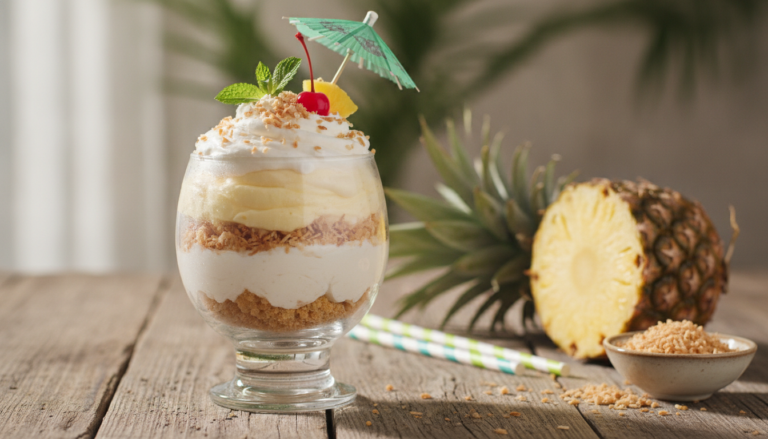
Piña Colada Cheesecake Mousse captures the beloved cocktail in dessert form—airy, cloud-like cream cheese mousse swirled with crushed pineapple and brightened with lime, served in glasses and topped with toasted coconut for a no-bake tropical escape.
4
servings30
minutes40
minutes300
kcal1
hour10
minutesIngredients
8 oz cream cheese, softened
1/4 cup granulated sugar
1/2 tsp vanilla extract
1 cup canned crushed pineapple, drained
1 cup heavy whipping cream
1/2 cup sweetened shredded coconut
1 tbsp lime juice
1/4 cup confectioners’ sugar
Directions
- In a large bowl, beat the softened cream cheese until smooth.
- Mix in granulated sugar and vanilla extract until well combined.
- Gently fold in the crushed pineapple and lime juice.
- In a separate bowl, whip heavy cream until soft peaks form.
- Gradually add confectioners’ sugar, continuing to whip until stiff peaks form.
- Fold whipped cream into the cream cheese mixture until combined.
- Spoon mousse into serving glasses and sprinkle with shredded coconut.
- Chill in the refrigerator for at least two hours before serving.
Nutrition Facts
- Total number of serves: 4
- Calories: 320kcal
- Cholesterol: 0mg
- Sodium: 620mg
- Potassium: 400mg
- Sugar: 8g
- Protein: 6g
- Calcium: 60mg
- Iron: 2mg
About This Author

Aurora Wright
Pastry Chef & Dessert Editor
Aurora is the sweet side of Daily Dish. A trained pastry chef and dessert stylist, she’s responsible for our mouth-watering cakes, cookies, and confections. She brings precision, artistry, and a touch of whimsy to every recipe she creates — and taste-tests more chocolate than she’ll admit.
Favorite dish: Flourless dark chocolate torte.
Kitchen motto: “Life’s too short to skip dessert.”















