
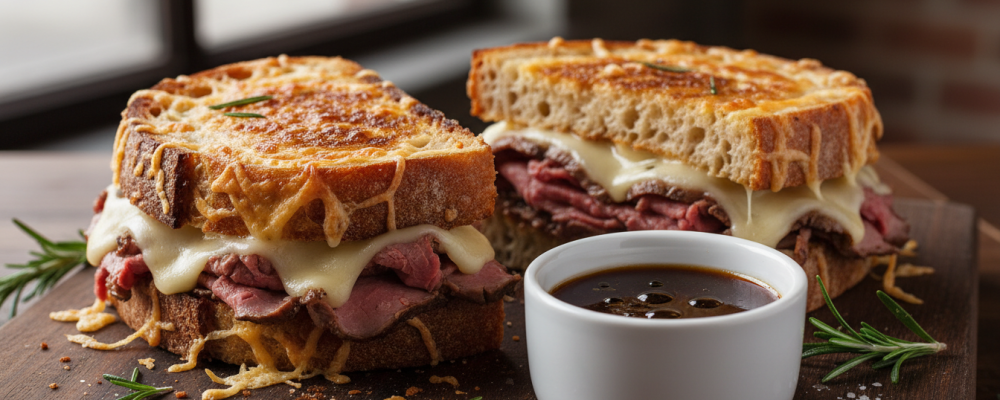

Every once in a while, two great things come together in a way that makes you wonder how they ever existed separately—and the Crispy French Dip Grilled Cheese is exactly that kind of combination. It takes the rich, savory satisfaction of a classic French dip sandwich and merges it with the golden, buttery, melted-cheese comfort of a perfect grilled cheese, producing something that manages to be greater than both originals. This is the sandwich I reach for when I want something that feels genuinely indulgent without requiring a complicated production.
From a recipe development standpoint, what fascinates me about this sandwich is how much technique is packed into what appears to be a simple, casual lunch. The caramelized onions alone represent one of the most flavor-transformative processes in cooking—raw onions spending thirty or more minutes over low heat until their harsh bite completely surrenders to deep, jammy sweetness. Layering those onions between roast beef and Swiss cheese, then pressing the whole assembly into a buttered skillet until golden and crispy, builds flavors at every stage that result in a final sandwich of remarkable depth and satisfaction.
The au jus dipping sauce is what elevates this from a great grilled cheese to a genuinely memorable meal. That warm, savory, Worcestershire-spiked beef broth alongside every crispy, cheesy bite is one of the most satisfying flavor combinations I know.
The Inspiration Behind This Recipe
The inspiration here came from a deep appreciation for both the French dip sandwich and the grilled cheese—two American lunchtime icons that each excel in their own right but have never quite received the credit they deserve for how well their flavor profiles align. Roast beef and Swiss cheese is already a classic pairing. Add caramelized onions, a buttered crust, and a warm beef broth dipping sauce, and you have something that feels simultaneously nostalgic and genuinely exciting.
There’s also a practical inspiration behind this recipe. French dip sandwiches are typically made on hoagie rolls and served open-faced or assembled without the structural integrity and textural interest that a properly executed grilled cheese provides. Switching to thick-cut bread and cooking the whole sandwich in a buttered skillet adds a golden, crispy exterior that makes every bite more satisfying while keeping the interior layers warm, melty, and cohesive.
It’s a recipe born from the belief that classic comfort food combinations are worth revisiting with fresh eyes and a little extra technique.
A Brief History of the French Dip and Grilled Cheese
The French dip sandwich has one of the most delightfully contested origin stories in American food history. Two Los Angeles restaurants—Philippe the Original and Cole’s Pacific Electric Buffet—both claim to have invented the sandwich in the early twentieth century, with each telling a slightly different version of the story involving a cook who accidentally dropped a French roll into a pan of meat drippings. Whatever the true origin, the result was one of the great American sandwiches: thinly sliced roast beef on a crusty roll, served with a side of rich beef broth for dipping.
The grilled cheese sandwich has equally deep American roots, rising to widespread popularity during the 1920s and 1930s when processed American cheese became widely available and affordable. By the mid-twentieth century, the grilled cheese had become a staple of school cafeterias, diners, and home kitchens across the country—a simple, satisfying combination of butter, bread, and melted cheese that has endured across generations precisely because it’s so perfectly executed in its simplicity.
Bringing these two beloved American classics together in a single recipe feels like a natural and long-overdue reunion.
Why This Cooking Method Works
The technique behind this sandwich is built on a series of deliberate, flavor-building decisions. Starting with softened butter rather than melted butter allows for an even, controlled spread across the bread that produces uniform browning across the entire surface of the sandwich rather than uneven, spotty color. Medium heat is the critical variable—hot enough to develop a deep golden crust in about three minutes per side, but gentle enough to allow the cheese to melt completely before the exterior burns.
The double layer of Swiss cheese—one layer directly on the bread, one layer on top of the roast beef—creates a melting situation where the cheese functions both as a binder and as a flavor element, keeping the roast beef and caramelized onions cohesively in place while adding creaminess and that characteristic Swiss nuttiness to every bite.
The au jus, built from beef broth, Worcestershire sauce, and garlic powder, is simple but precise—the Worcestershire adds umami depth and a subtle complexity that plain beef broth alone doesn’t achieve, while the garlic powder adds a quiet aromatic warmth that ties the dipping sauce to the seasoning profile of the sandwich itself.
Flavor Profile: What to Expect
This sandwich delivers a layered, deeply satisfying flavor and texture experience from first bite to last:
Crispy, deeply golden buttered crust that shatters slightly with each bite and gives way to a warm, soft interior
Nutty, melted Swiss cheese that pulls and stretches with every bite, adding creaminess and a mild tanginess throughout
Tender, savory roast beef that provides a rich, meaty foundation and soaks up the surrounding flavors beautifully
Deep, jammy caramelized onions that add a concentrated sweetness and silky texture that elevates every layer of the sandwich
Warm, savory au jus with Worcestershire depth that transforms each dipped bite into something richer and more complex than the sandwich alone
The overall effect is indulgent, layered, and deeply comforting—a sandwich that rewards every single bite with something new and satisfying.
Tips for Making the Best Crispy French Dip Grilled Cheese
Attention to a few key details makes a significant difference in the finished sandwich:
Take the time to properly caramelize the onions: This is not a step that can be rushed. True caramelization takes a minimum of 25 to 30 minutes over low heat, stirring occasionally. The deeply sweet, jammy result is worth every minute.
Use thick-cut bread: Thin sandwich bread won’t hold up to the weight and moisture of the fillings. A sturdy sourdough, thick-cut white, or brioche loaf provides the structure and crust the sandwich needs.
Keep the heat at medium: Too high and the bread burns before the cheese melts. Too low and the sandwich steams rather than crisps. Medium heat is the non-negotiable sweet spot.
Press gently while cooking: A light press with a spatula during cooking ensures even contact between the bread and the skillet for consistent browning across the entire surface.
Build the cheese layers strategically: Cheese directly against both slices of bread creates a seal that holds the fillings in place and ensures maximum melt throughout the sandwich.
Season the au jus to taste: Taste the dipping sauce before serving and adjust with a pinch of salt or an extra splash of Worcestershire if needed. A well-seasoned au jus makes the entire experience significantly better.
Serving Suggestions and Side Pairings
This sandwich is hearty and complete on its own, but the right sides turn it into a truly satisfying full meal:
A classic tomato soup for a deeply comforting, French bistro-inspired pairing that complements the sandwich perfectly
Crispy French fries or thin-cut potato chips for a diner-style lunch that leans into the casual, indulgent character of the meal
A simple arugula salad with lemon and olive oil for a fresh, bright contrast to the richness of the melted cheese and beef
Pickles or a quick pickle slaw on the side for acidity and crunch that cuts through the butteriness of the grilled bread
A cup of the au jus served in a small ramekin alongside each sandwich—presented properly, the dipping experience is half the pleasure of this meal.
Storage, Reheating, and Make-Ahead Tips
This sandwich is best made and served immediately, but a few components can be prepared in advance to make assembly faster.
Caramelize the onions up to 5 days in advance and refrigerate in an airtight container—they reheat beautifully in a skillet over low heat in just a few minutes.
The au jus can be made up to 3 days ahead and refrigerated, then reheated gently on the stovetop before serving.
Assembled and cooked sandwiches can be kept warm in a 200°F oven for up to 20 minutes without losing significant quality—ideal for serving a group where not everyone can eat simultaneously.
Avoid refrigerating and reheating fully assembled cooked sandwiches, as the bread loses its crispness and the texture suffers considerably.
Why This Recipe Deserves a Spot in Your Rotation
The Crispy French Dip Grilled Cheese earns its place in regular rotation by delivering one of the most satisfying lunch or dinner experiences achievable in under thirty minutes of active cooking—assuming the onions are caramelized ahead of time. It’s the kind of recipe that feels special and indulgent without being complicated, and it consistently produces the kind of deeply satisfied silence at the table that every cook recognizes as the highest possible compliment. Comforting, clever, and completely delicious, this sandwich is a reminder that the best cooking often comes from honoring great classics and trusting that bringing them together will produce something even better than either original.
Make it once and it becomes your go-to answer for every occasion that calls for something warm, satisfying, and a little bit extraordinary.
Recommended Drink Pairing
The rich, savory, beef-forward character of this sandwich calls for a drink with enough body and depth to complement it without overwhelming the subtle nuttiness of the Swiss cheese or the sweetness of the caramelized onions. A cold amber ale or a dark lager is the ideal casual pairing—malty, slightly sweet, and perfectly suited to the flavors at play. For wine, a medium-bodied Merlot or a Côtes du Rhône brings the right combination of fruit and earthiness to stand up to the roast beef and au jus.
For non-alcoholic options, a sparkling water with lemon, a rich black iced tea, or a dark cherry sparkling juice all provide satisfying contrast to the warm, buttery richness of the sandwich.
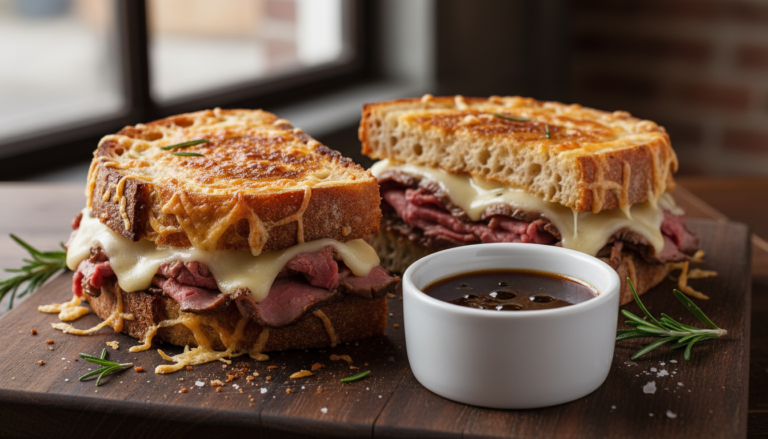
Crispy French Dip Grilled Cheese
A golden, buttery grilled cheese loaded with roast beef, Swiss, and caramelized onions—served with a warm Worcestershire au jus for dipping.
4
servings15
minutes15
minutes650
kcal30
minutesIngredients
8 slices thick-cut bread
12 slices Swiss cheese
8 slices roast beef
4 tablespoons butter, softened
1 cup onions, caramelized
1 cup beef broth
2 tablespoons Worcestershire sauce
1 teaspoon garlic powder
1 pinch salt
1 pinch black pepper
Directions
- Preheat a skillet over medium heat.
- Butter one side of each bread slice.
- Place 4 slices of bread, butter-side down, in the skillet.
- Top each slice with 2 slices of cheese and 2 slices of roast beef.
- Add caramelized onions on top of the roast beef.
- Top with the remaining cheese slices.
- Place a bread slice, butter-side up, on each sandwich.
- Cook until golden brown, about 3 minutes per side.
- In a small saucepan, combine beef broth, Worcestershire sauce, garlic powder, salt, and pepper.
- Bring to a simmer and serve as a dip alongside the grilled cheese.
Nutrition Facts
- Total number of serves: 4
- Calories: 650kcal
- Cholesterol: 0mg
- Sodium: 620mg
- Potassium: 400mg
- Sugar: 8g
- Protein: 6g
- Calcium: 60mg
- Iron: 2mg
About This Author

Benjamin Brown
Recipe Developer
Benjamin is our flavor engineer. A classically trained chef turned recipe developer, he’s obsessed with balancing taste, texture, and creativity. He ensures that every recipe we publish is not only delicious but also reliable, approachable, and repeatable — even for beginners.
Favorite dish: Slow-braised short ribs with red wine reduction.
Kitchen motto: “Cooking is part science, part soul.”















