
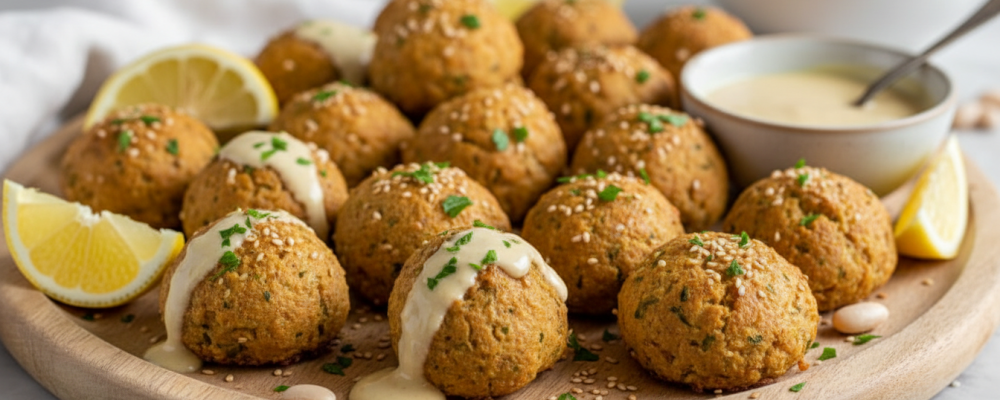

Most baked bean-based snack preparations fail for the same reason: the mixture is too wet, the binding ratio is wrong, or the baking temperature is calibrated for a different outcome than the one the recipe is trying to achieve. The result is a snack ball that is soft rather than set, that falls apart when picked up, or that develops an unappealing dry, crumbly exterior while the interior remains dense and paste-like. The problem is almost always structural, and the solution—as it is in most food chemistry challenges—lies in understanding what each ingredient is doing before you ask it to do something specific.
In this recipe, tahini is the binding agent, and it is doing significantly more work than its role in a standard hummus would suggest. Tahini is an emulsified fat—sesame seeds ground until their oil distributes evenly through the paste rather than separating—and when incorporated into a legume base and subjected to oven heat, it behaves similarly to an egg in a baked preparation: it coats the starch granules in the white beans, sets under heat, and produces a matrix that holds the bites together through cooling and subsequent handling. The lemon juice’s acidity assists this process by slightly tightening the proteins in the tahini, and the olive oil contributes a fat phase that keeps the exterior from drying out during the baking window.
Understanding this mechanism is what allows you to execute the recipe correctly at every step: why the food processor is used rather than a fork or potato masher (emulsification requires more mechanical force than mashing can provide), why the parsley is pulsed in briefly rather than fully incorporated (intact herb cells in the matrix provide moisture-retaining pockets that keep the interior tender), and why the bites are formed by hand rather than scooped directly onto the sheet (hand-forming compresses the mixture more uniformly than a scoop and produces a bite with better internal cohesion). Each step follows from the physics of the preparation.
─────────────────────────────────────────
The Inspiration Behind This Recipe
The design target for this recipe was a plant-based snack that occupied the specific nutritional and functional territory between a dip and a protein bar—something with more substance and staying power than a hummus-and-vegetable preparation, but in a more snackable, portable format than a grain bowl or a wrap. The baked bean bite format addresses that requirement directly: it is self-contained, portable without a vehicle, satisfying enough to stand alone, and structured around a macronutrient profile—protein, fiber, healthy fat—that actually delays the return of hunger rather than simply bridging the gap between it.
White beans were the legume choice for their flavor neutrality and their starch composition. White beans—cannellini or Great Northern—have a mild, creamy flavor that functions as a blank canvas for the stronger ingredients around them: the tahini’s nuttiness, the lemon’s brightness, the garlic’s aromatic heat. Their starch content is also meaningfully higher than that of chickpeas or lentils, which means they contribute more binding capacity to the baked preparation and produce a firmer, more cohesive bite than a chickpea-based equivalent at the same ratio.
The lemon zest is the ingredient that makes this recipe distinctive rather than simply functional. Lemon juice brightens the overall flavor profile; lemon zest does something more specific and more interesting—it introduces the essential oils from the lemon’s pith into the mixture, which are fat-soluble and distribute throughout the tahini phase rather than remaining in the water phase the way juice does. The result is a citrus note that is more persistent and more aromatic than juice alone can produce—present in every bite as a fragrance as much as a flavor, and one that becomes more pronounced after the bites have had time to rest.
─────────────────────────────────────────
A Brief History of Baked Legume Preparations
The tradition of processing legumes into formed, baked preparations extends across much of the Mediterranean and Middle Eastern world, where legumes have been a dietary staple for thousands of years and the challenge of making them portable, practical, and interesting has produced a remarkable diversity of approaches. Falafel—perhaps the most globally recognized expression of this tradition—is a deep-fried preparation of ground chickpeas or fava beans seasoned with herbs and spices, formed into balls or patties and cooked until crisp. Its origins are disputed among Egyptian, Levantine, and broader Middle Eastern culinary traditions, but its fundamental logic—process a legume with aromatics and fat, form it, and apply heat—is thousands of years old.
The baked rather than fried adaptation of this format is a more recent evolution driven by both practical home cooking considerations and the broader shift in contemporary cuisine toward oven-based preparations that deliver similar textural outcomes with less active cooking attention. Baked legume bites sacrifice the specific crisp-exterior quality of deep-fried falafel but gain the practical advantages of batch cooking: an entire sheet pan of bites bakes simultaneously with no monitoring required, and the finished result is more uniform in size, easier to portion, and better suited to refrigerator storage than anything fried.
Tahini’s specific role as the binding agent in this baked preparation reflects a culinary logic that has existed in Levantine cooking for centuries—tahini sauce has always been the natural companion to both white bean and chickpea preparations in the regional tradition, appearing as a drizzle over falafel, as a component of hummus, and as a dressing for roasted vegetables. Using it structurally within the bite rather than as a sauce served alongside is a contemporary reformulation of that tradition, one that integrates the sauce into the preparation itself rather than keeping it separate.
─────────────────────────────────────────
Why This Cooking Method Works for Meal Prep
The food processor is not interchangeable with any other preparation method for this recipe, and the reason is emulsification. A fork or potato masher breaks down the white beans mechanically but cannot emulsify the tahini and olive oil into the starch matrix—the fats remain as discrete pockets rather than distributing evenly throughout. A food-processed base has the tahini’s fat distributed at a molecular level through the bean starch, producing a uniform matrix that holds together under mechanical pressure (forming) and thermal stress (baking) in a way that a coarsely mashed mixture cannot. The food processor is doing chemistry, not just chopping.
The two-stage pulsing approach—beans and binding agents first, parsley added afterward—preserves the parsley’s structural integrity within the finished bite rather than reducing it to a green paste throughout. Intact parsley cells within the matrix serve two functions: they provide small pockets of moisture that keep the interior of each bite tender during baking, and they contribute visible flecks of green to the cross-section of each bite that make the finished preparation more visually appealing than a uniformly pale-beige ball. The two-stage pulse is a texture and appearance decision as much as a timing one.
Baking at 375°F for fifteen minutes achieves the specific surface-set outcome that makes these bites snackable rather than fragile. Lower temperatures produce a bite that is cooked through but never develops the dry, slightly firm exterior that makes it handleable without falling apart. Higher temperatures risk over-drying the exterior before the interior starch has fully gelatinized, producing a bite with a crumbly surface and an under-set center. The fifteen-minute window at 375°F produces a bite with a lightly golden exterior that sets the tahini-starch matrix cleanly and retains interior moisture—the correct outcome for a snack that needs to survive portioning, stacking, and five days of refrigerator storage.
─────────────────────────────────────────
Flavor Profile: What to Expect
These bites operate in a clean, savory, Mediterranean register—layered with more nuance than their simple ingredient list suggests:
- Nutty, earthy tahini depth – Sesame paste provides the foundational richness of the bite’s flavor—present everywhere in the matrix, adding a warm, slightly bitter nuttiness that makes the whole preparation taste more substantial than a plain bean snack ever could
- Bright, aromatic lemon – The zest’s essential oils and the juice’s acidity together create a citrus note that is more complex than either alone—fragrant, sharp, and persistent through every bite
- Assertive garlic warmth – Raw garlic processed into the matrix distributes its pungent, aromatic heat evenly throughout, mellowing slightly under oven heat into something warm and savory rather than aggressively sharp
- Fresh, herbal parsley – The briefly pulsed parsley provides a clean, green brightness at the finish that keeps the overall profile feeling light rather than dense
- Fruity olive oil richness – Extra virgin olive oil adds a quiet, peppery richness that rounds the harder edges of the lemon and garlic into a more cohesive flavor profile
- Clean seasoning finish – Salt and black pepper do their essential work of sharpening every other flavor and giving the finished bite the clean, complete quality that makes it feel satisfying rather than flat
The lemon fragrance deepens overnight as the essential oils from the zest continue to distribute through the refrigerated bites. Day-two bites are noticeably more aromatic and citrus-forward than day-one bites eaten warm from the oven—a consistent and pleasing development that makes the refrigerator snack arguably better than the freshly baked one.
─────────────────────────────────────────
Tips for Making the Best Lemon Tahini White Bean Bites
Execution in the food processor stage and precision in the forming step determine the quality and consistency of the finished batch:
- Dry the beans thoroughly before processing – Excess moisture from rinsing dilutes the tahini emulsion and produces a mixture that is too wet to hold its shape when formed. Drain, rinse, and pat the beans dry with a paper towel before adding to the food processor—or spread on a clean towel and allow to air-dry for five minutes.
- Use well-stirred tahini – Tahini separates in the jar, with oil pooling at the surface and a dry, dense paste at the base. Thoroughly stir before measuring to ensure a consistent fat-to-solids ratio. Unstirred tahini produces uneven binding and can make the mixture either too oily or too dry.
- Pulse, don’t process continuously – Continuous processing overheats the mixture and can turn the beans from a slightly textured paste to a completely smooth one, which reduces the bites’ internal structure. Pulse in two-to-three-second bursts until just smooth—some very fine texture is acceptable and preferable to total uniformity.
- Chill the mixture before forming if necessary – If the mixture feels too soft to form cleanly after processing, refrigerate it for fifteen minutes before rolling. Cold fat (the tahini and olive oil) firms slightly and makes the mixture more cohesive and easier to handle without sticking.
- Form with firmly compressed, uniform balls – Compress each ball firmly between your palms rather than loosely rolling. A firmly compressed bite maintains its shape through baking and holds together when picked up; a loosely rolled one develops cracks and can separate along the fault lines.
- Don’t overbake – The bites should be lightly golden when pulled from the oven, not deeply browned. Overbaking continues to dry the interior beyond the target moisture level and produces a bite that is crumbly rather than tender. When the surface looks set and just golden, they’re done.
Optional: A small drizzle of tahini thinned with lemon juice and water—three parts tahini, one part lemon, one to two parts water until pourable—served alongside as a dipping sauce doubles down on the flavor profile and turns a simple snack preparation into something that looks and functions like a composed appetizer.
─────────────────────────────────────────
Portioning and Container Suggestions
A standard batch yields approximately sixteen to twenty bites depending on the size formed—four to five bites per serving as a snack, or six to eight as a more substantial appetizer portion. The compact, self-contained format of each bite makes portioning extremely efficient: pre-portion daily servings into individual snack containers or zip bags on Sunday, and each day’s snack requires nothing beyond opening the container.
These bites stack well in a flat, wide airtight container with a single piece of parchment paper between layers—enough to prevent sticking without adding bulk. A single layer per container is ideal for the top layer, where weight from above can compress the bites slightly if they haven’t fully cooled and set before stacking. For grab-and-go use, a small container with four or five bites travels cleanly and requires no utensils, no refrigeration for up to four hours, and no assembly. They are one of the most genuinely portable snack preps in the collection.
For a visually appealing appetizer presentation—these bites are entirely appropriate for a gathering as well as a solo snack rotation—arrange them on a serving board alongside the optional tahini dipping sauce in a small bowl, with a scatter of fresh parsley leaves and a pinch of smoked paprika or sumac over the top. The presentation takes thirty seconds and produces something that looks like it required considerably more effort than a food processor and a sheet pan.
─────────────────────────────────────────
Storage, Reheating, and Shelf Life Tips
- Refrigerator storage: Baked bites keep in an airtight container for up to 5 days. The lemon and herb flavor deepens through the first two to three days—peak flavor window is days two through four.
- Freezer storage: These bites freeze exceptionally well for up to 3 months. Freeze in a single layer on a sheet pan before transferring to a freezer bag to prevent clumping. Thaw overnight in the refrigerator or at room temperature for thirty to forty-five minutes.
- Room temperature serving: These bites are excellent at room temperature—the lemon zest fragrance is most pronounced without refrigerator suppression, and the tahini’s flavor is at its most forward when not cold. No reheating is required for snacking.
- Oven reheating (recommended for best texture): Place bites on a baking sheet at 325°F for 6–8 minutes from refrigerated, or 12–15 minutes from frozen. This method refreshes the exterior’s slight firmness and restores the baked quality that makes these bites most satisfying.
- Microwave reheating: Microwave at 50% power for 30–45 seconds per serving. Full power heats unevenly and can make the exterior rubbery. Low power and a short time produces a warm, tender result.
- Moisture note: If bites have dried slightly in refrigerator storage, a brief thirty-second rest with a damp paper towel over the container before serving restores surface moisture without affecting flavor.
─────────────────────────────────────────
Why This Recipe Deserves a Spot in Your Meal Prep Rotation
From an efficiency standpoint, the Lemon Tahini White Bean Bite delivers a genuinely unusual combination of qualities: it is plant-based and nutritionally complete, it bakes in fifteen minutes, it keeps for five days without quality degradation, it requires no vehicle or assembly at snack time, and it occupies a functional territory—satisfying, protein-and-fiber-dense, genuinely flavorful—that most snack preparations don’t reach. The cost per serving is low, the ingredient list is short, and the preparation requires nothing more specialized than a food processor and a sheet pan.
The deeper case for keeping this recipe in a regular rotation is the same argument that applies to any genuinely well-designed snack: it makes the gap between meals not just tolerable but actually good. A snack that tastes of lemon and tahini and fresh parsley, that has enough protein and fiber to hold until the next meal without a crash, and that takes no preparation at the moment of eating is a snack that supports the week rather than simply filling it. That combination of nutrition, flavor, and convenience is the standard any meal prep snack should be held to—and this one meets it without compromise.
─────────────────────────────────────────
Meal Prep Pairing Suggestions
Lemon Tahini White Bean Bites pair most naturally with other Mediterranean-inspired snack preparations that share the same flavor ecosystem while offering different formats and textures. Our Roasted Red Pepper Hummus & Veggie Cups are the ideal companion—both are legume-and-tahini based, both draw from the same aromatic tradition of garlic, lemon, and olive oil, and both are built for grab-and-go snacking with no assembly required. Where the hummus cup offers a dipping format with the fresh crunch of vegetables, these bites offer a self-contained, baked format with a warm, structured texture—complementary rather than duplicative in every dimension.
For a broader weekly snack spread, our Cucumber Cream Cheese Bites provide a cool, fresh contrast that shares the light, vegetable-forward character of the Mediterranean snack category while offering a completely different flavor profile—creamy and dill-forward where these bites are nutty and herb-bright. Three snack options covering baked-and-savory, fresh-and-dippable, and cool-and-creamy means the full week’s snacking is handled with genuine variety and consistent nutritional quality—all from preparations that share a pantry logic and a flavor sensibility that makes the whole collection feel, as the best meal prep always should, like it was designed rather than assembled.
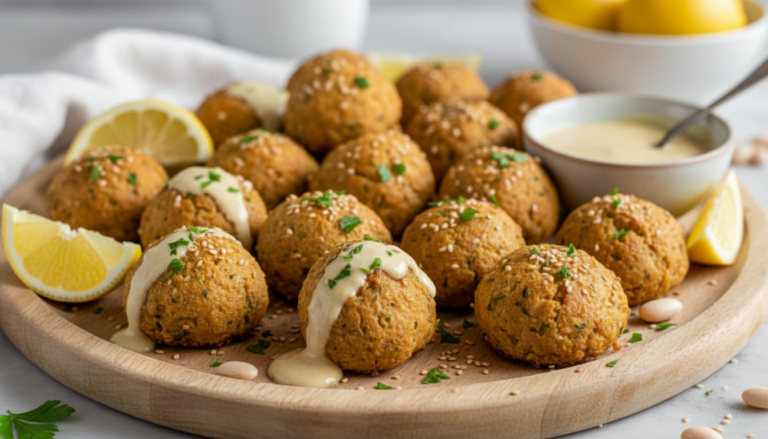
Lemon Tahini White Bean Bites
These Lemon Tahini White Bean Bites are a baked, plant-based snack built on white beans and tahini, brightened with lemon and fresh parsley—satisfying enough to stand in for a full snack, elegant enough to serve as an appetizer, and easy enough to make every week without a second thought.
8
servings20
minutes15
minutes110
kcal35
minutesIngredients
1 can white beans
2 tablespoons tahini
1 lemon juice and zest
1 clove garlic
2 tablespoons olive oil
1/4 cup chopped parsley
1/2 teaspoon salt
1/4 teaspoon black pepper
Directions
- Preheat the oven to 375°F (190°C) and line a baking sheet with parchment paper.
- Rinse and drain the white beans thoroughly.
- In a food processor, combine white beans, tahini, lemon juice and zest, garlic, olive oil, salt, and black pepper.
- Pulse until the mixture is smooth and well combined.
- Add chopped parsley and pulse briefly to incorporate.
- Using your hands, form the mixture into bite-sized balls and place them on the prepared baking sheet.
- Bake for 15 minutes or until lightly golden.
- Allow to cool slightly before serving as a snack or appetizer.
Nutrition Facts
- Total number of serves: 4
- Calories: 110kcal
- Cholesterol: 0mg
- Sodium: 620mg
- Potassium: 400mg
- Sugar: 8g
- Protein: 6g
- Calcium: 60mg
- Iron: 2mg
About This Author

Benjamin Brown
Recipe Developer
Benjamin is our flavor engineer. A classically trained chef turned recipe developer, he’s obsessed with balancing taste, texture, and creativity. He ensures that every recipe we publish is not only delicious but also reliable, approachable, and repeatable — even for beginners.
Favorite dish: Slow-braised short ribs with red wine reduction.
Kitchen motto: “Cooking is part science, part soul.”















