
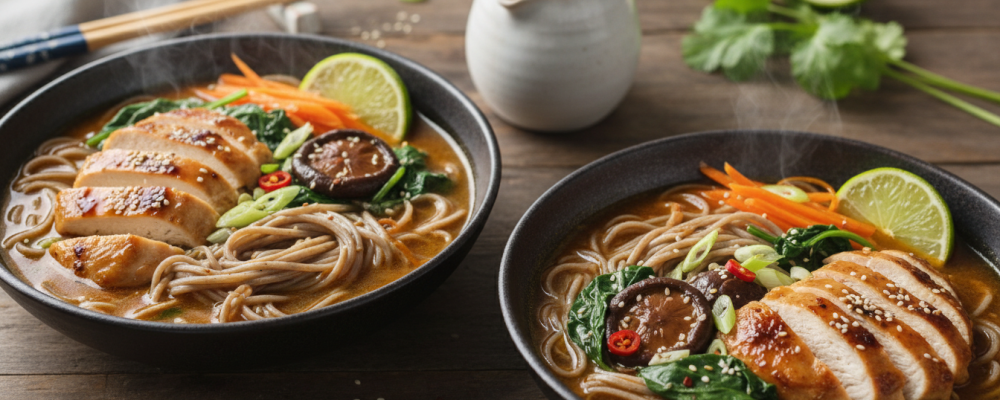

There are flavor combinations that feel like sustenance in a way that goes beyond calories—combinations that seem to nourish something beyond the physical the moment they reach the palate. Miso is one of those flavors for me. It is deeply, quietly warming in a way I find difficult to articulate precisely but easy to recognize immediately: a richness that is more than salt, a depth that is more than savory, something umami and fermented and ancient that makes everything it touches taste more fully of itself. A spoonful of white miso paste stirred into a sauce is not a seasoning choice. It is a decision to make the whole bowl feel like it was made with intention.
This Miso Ginger Chicken & Soba Noodle Bowl is the kind of recipe I return to when I want a meal prep week that feels genuinely nourishing rather than merely adequate—the kind of week where opening the lunch container is something I look forward to rather than simply rely on. The miso-ginger sauce, which takes three minutes to whisk together and then does everything, carries every component of this bowl into a coherent, deeply satisfying whole. The chicken, the broccoli, the julienned carrot, the earthy soba noodles—each one distinct before the sauce, unified afterward. There’s something almost meditative about watching the sauce coat everything in the skillet, the kitchen filling with the fragrance of ginger and sesame and that particular toasted, saline depth of miso under heat.
This is the recipe for the weeks when you need your food to work as hard as you do—to be genuinely nourishing and genuinely delicious, to make Tuesday lunch feel like more than a midday interruption. In my experience, that is exactly what this bowl does. Every time.
─────────────────────────────────────────
The Inspiration Behind This Recipe
This recipe was inspired by the conviction that umami-forward cooking—the specific richness that fermented and soy-based ingredients produce—is one of the most underused flavor philosophies in a Western meal prep repertoire. Most home cooks reach for salt, pepper, and dried herbs as their seasoning vocabulary, and the results are competent but rarely compelling across an entire week. Miso changes that equation completely. It introduces a depth and a complexity that makes a bowl taste not just seasoned but deeply, specifically flavored—the kind of flavor that makes you want to figure out what’s in it rather than simply enjoying that something is present.
The sauce here—miso, ginger, soy, sesame oil, rice vinegar, honey, garlic—was designed to function as a complete flavor system rather than a collection of individual seasonings. The miso provides the umami foundation. The ginger adds aromatic warmth and slight heat. The soy deepens the salt and adds its own fermented complexity. The sesame oil carries the nutty, toasted richness that is one of Asian cooking’s most distinctive aromatics. The rice vinegar brightens and lifts. The honey balances and rounds. The garlic anchors and deepens. No single ingredient in the list is doing more than its specific job, and together they produce a sauce that is more harmonious and more complete than any simpler combination could be.
Soba noodles were chosen as the base because they carry this sauce in a way that rice simply doesn’t. Their slightly rough surface texture—a result of the buckwheat flour in their composition—grips the miso sauce as they’re tossed in the skillet, coating every strand with an even layer of flavor rather than allowing the sauce to pool at the base of the bowl. Every forkful of well-tossed soba noodles in this sauce is evenly and generously seasoned—a quality of uniform flavor distribution that is one of the most genuinely satisfying things a bowl can offer.
─────────────────────────────────────────
A Brief History of Miso and Soba in Japanese Cuisine
Miso is among the oldest and most fundamental ingredients in Japanese cooking—a fermented paste made from soybeans and typically a grain (rice or barley), inoculated with the mold Aspergillus oryzae and aged for anywhere from weeks to years depending on the variety. Its origins in Japan trace to the 7th century, when fermented soybean preparations arrived from China and Korea and were rapidly adopted into the Japanese culinary tradition. By the Nara period (710–794 CE), miso had become a staple of the Japanese diet, and by the Edo period it was so central to everyday eating that the morning bowl of miso soup was essentially synonymous with breakfast itself.
White miso—shiro miso—is the youngest and mildest variety, fermented for a shorter period than red or mixed miso. Its flavor is sweet, gentle, and subtly complex—less assertive than its aged counterparts and more versatile as a component in sauces, marinades, and dressings where balance and integration matter more than intensity. It is the variety best suited to a Western pantry unfamiliar with miso’s range, and the one that produces the most immediately approachable result in a recipe like this one.
Soba noodles—made from buckwheat flour, sometimes combined with wheat flour—have an equally long history in Japanese culinary tradition, with the first documented references to soba as a noodle preparation appearing in the 17th century. Buckwheat, which had been used in Japan for centuries before the noodle tradition developed, gives soba its characteristic earthy, slightly nutty flavor and its warm, grayish-brown color that distinguishes it visually and in flavor from wheat-based noodles. Soba is associated in Japanese culture with longevity and resilience—it is eaten at New Year in many regions as a symbol of long life—which makes it, in its own small way, a profoundly appropriate foundation for a bowl that is designed to nourish and sustain across a long, demanding week.
─────────────────────────────────────────
Why This Cooking Method Works for Meal Prep
Cooking the soba noodles separately before adding them to the skillet is the most important sequencing decision in this recipe, and it has a specific technical rationale. Soba noodles cooked directly in the miso-ginger sauce absorb the sauce’s liquid as they cook, concentrating the salt and flavors to levels that become unbalanced in the final bowl—and they also break down more quickly under direct heat, losing the slight chew that makes them satisfying. Pre-cooked and drained, the noodles are added in their final state and tossed only briefly to coat, preserving both their texture and the sauce’s calibrated balance.
Rinsing the cooked soba noodles under cold water immediately after draining is equally important. Soba noodles, like most starchy noodles, continue to cook and to stick to each other after draining from hot water—the surface starch is still tacky and active at that temperature. Cold water stops both processes simultaneously: it halts cooking at the desired texture and rinses away the surface starch that would otherwise cause the noodles to clump into a solid mass by the time they are added to the skillet or stored in the refrigerator. This step takes ten seconds and determines the texture quality of the noodles across every subsequent day of the week.
The stir-fry sequence—chicken first, vegetables added afterward—ensures that both protein and vegetables are cooked to the right degree without either being sacrificed for the other. Chicken cooked in a hot skillet before the vegetables are added has time to brown rather than steam, developing the slightly caramelized exterior that adds flavor depth. The vegetables, added while the skillet is still hot, cook quickly in the residual heat and fat without needing additional time—tender but maintaining the slight crispness that makes them more enjoyable to eat and better textured after a day in the refrigerator than fully softened vegetables would be.
─────────────────────────────────────────
Flavor Profile: What to Expect
This bowl is rich, deeply umami, and warmly aromatic—a flavor profile that feels simultaneously energizing and comforting:
- Silky, complex miso depth – White miso provides the foundational umami note of the entire bowl—sweet, slightly fermented, deeply savory in a way that salt alone can never replicate, and present in every strand of noodle and every piece of chicken
- Warm, aromatic ginger – Fresh grated ginger threads through the sauce with its characteristic clean heat and citrus-adjacent fragrance—alive and distinct even in a sauce with as many other strong flavors competing for attention
- Toasted, nutty sesame – Sesame oil and sesame seed garnish create a persistent nuttiness that is the secondary flavor signature of the bowl—aromatic, slightly smoky, and deeply satisfying in both its liquid and solid forms
- Bright, balancing rice vinegar – The vinegar’s clean acidity lifts the miso’s heaviness and keeps the overall sauce profile from tipping into cloying richness, providing the brightness that makes the bowl easy to eat all the way through
- Earthy soba noodle body – Buckwheat soba contributes a mild, nutty earthiness that is perceptible beneath the sauce’s assertiveness—a grounding quality that makes the bowl feel substantial rather than light
- Clean vegetable freshness – Tender-crisp broccoli and julienned carrot provide texture, color, and a mild sweetness that breaks the bowl’s umami depth with something green and straightforwardly good
- Allium brightness at the finish – Sliced green onion over the finished bowl adds a clean, mild sharpness at the surface that refreshes the palate between bites
The sauce deepens and integrates overnight as the miso’s fermented compounds continue to distribute through the noodles and the chicken. Day-two bowls taste more cohesive and more deeply flavored than day-one—one of this recipe’s most consistent and quietly rewarding qualities.
─────────────────────────────────────────
Tips for Making the Best Miso Ginger Chicken & Soba Noodle Bowls
A few specific technique choices will produce a noticeably better bowl at every stage:
- Rinse soba noodles in cold water immediately after draining – This is not optional. Unrinsed soba noodles clump irreversibly within minutes of draining. Cold water arrests cooking, removes surface starch, and produces noodles that remain separate, pliable, and ready to coat evenly in the sauce.
- Whisk the sauce until fully smooth before using – Miso paste doesn’t dissolve in cold liquid; it needs active whisking to incorporate fully. A sauce with undissolved miso clumps will distribute unevenly in the skillet, producing pockets of intense saltiness rather than an evenly seasoned bowl.
- Don’t overcook the chicken – Sliced chicken breast cooks quickly. Four to five minutes in a hot skillet, stirred occasionally, is sufficient to cook it through without drying it out. Overcooked chicken in this preparation becomes stringy under the sauce rather than tender.
- Add vegetables before the sauce, not after – Broccoli and carrot added before the sauce get the benefit of direct skillet heat, which develops a slight char and tenderness that the sauce, once added, would prevent by dropping the skillet temperature and creating a steaming environment. Sequence matters.
- Toss noodles gently – Soba noodles are more delicate than wheat noodles and break apart with aggressive stirring. Fold them into the skillet with a gentle tossing motion rather than stirring vigorously—the goal is to coat, not to break.
- Taste and adjust before serving – The miso sauce is calibrated for balance, but miso paste varies in saltiness by brand. Taste the finished bowl before portioning and add a splash more rice vinegar for brightness, honey for sweetness, or soy for salt as needed.
Optional: A soft-boiled egg halved and placed over the finished bowl adds richness, protein, and the kind of visual finishing touch that makes a weekday noodle bowl look genuinely composed. Cook eggs for six to seven minutes from boiling water, then ice bath and peel—a preparation that keeps in the refrigerator for four days and adds thirty seconds to any morning assembly.
─────────────────────────────────────────
Portioning and Container Suggestions
This recipe produces four generous bowls from a single batch—one per serving day across a four-day lunch or dinner rotation, with the option to scale by a quarter for five complete servings. A two-container system works best per day: the noodle, chicken, and vegetable mixture together in one container (the sauce has already coated everything evenly, so no component separation is required) and garnishes—sesame seeds and green onion—stored separately to be added fresh at serving.
Wide, flat glass containers are the ideal vessel for soba noodle bowls—they allow the noodles to rest in a single, even layer rather than compressing into a dense ball at the bottom of a tall container, which both preserves the noodles’ texture and ensures the sauce remains evenly distributed rather than pooling beneath a compressed noodle mass. A portion of noodles stored flat in a glass container, glazed in miso sauce and visible through the glass, is one of the more visually satisfying contents of a meal prep refrigerator—a small but genuine pleasure of the weekly setup.
For the most consistent reheating result, add a teaspoon of water to the container before microwaving and cover loosely—the water reintroduces moisture that the noodles absorb from the sauce during refrigeration, restoring the original, silky-coated consistency that distinguishes a well-reheated soba bowl from a dry one.
─────────────────────────────────────────
Storage, Reheating, and Shelf Life Tips
- Refrigerator storage: Assembled bowls keep in airtight containers for up to 4 days. The miso sauce deepens in flavor and the noodles continue to absorb it slightly over time—day-two and day-three bowls are the flavor peak.
- Freezer storage: Not recommended for assembled bowls. Soba noodles become waterlogged and lose their texture when frozen and thawed. The cooked chicken and sauce can be frozen separately for up to 2 months, with fresh soba noodles cooked when needed.
- Reheating: Add 1–2 teaspoons of water to the container, cover loosely, and microwave at full power for 90 seconds to 2 minutes, stirring gently halfway through. The water is essential—it rehydrates the noodles and prevents the sauce from over-concentrating under microwave heat.
- Do not overheat – Miso’s probiotic benefits are destroyed at high temperatures, and the sauce can become overly salty if overheated and reduced. Warm to eating temperature, not steaming hot.
- Garnish fresh: Sesame seeds and green onion are best added at serving time rather than stored on assembled bowls—the seeds can soften and the onion’s bright, sharp freshness fades considerably overnight.
- Noodle texture note: Soba noodles that have been refrigerated overnight are slightly softer than freshly cooked noodles—this is normal and does not indicate a problem with the preparation. The brief reheat with water restores them to a pliable, well-sauced consistency that is genuinely satisfying.
─────────────────────────────────────────
Why This Recipe Deserves a Spot in Your Meal Prep Rotation
The best argument for keeping this bowl in a weekly rotation is the experience of eating it. There is a specific quality that miso-based preparations have—a deep, warming, fundamentally comforting richness—that makes a bowl of miso-glazed chicken and soba noodles feel, at the moment of eating it, like exactly what was needed. That quality is not accidental; it is the product of a specific fermented ingredient with a specific flavor tradition that has been part of Japanese daily cooking for over a thousand years. It is, in the most literal sense, food that has been proven to sustain and satisfy across generations.
Practically speaking, this bowl delivers complete protein, complex carbohydrates from buckwheat soba, fiber and vitamins from the broccoli and carrot, and the gut health benefits of fermented miso—all in a single bowl that costs very little, preps in under thirty minutes, and reheats to a genuinely delicious result in under two minutes. The week that contains this bowl in the refrigerator is a week with something warm and nourishing waiting in it—and in my experience, that is always, quietly, one of the most valuable things a meal prep session can produce.
─────────────────────────────────────────
Meal Prep Pairing Suggestions
Miso Ginger Chicken & Soba Noodle Bowls pair most naturally with other protein-forward, grain or noodle-based bowls that offer distinct flavor contrast within an umami-rich, Asian-inspired ecosystem. Our Teriyaki Salmon Rice Bowls are the ideal rotation partner—both are built on Japanese-inspired sauce traditions with soy and sesame as foundational flavors, but the teriyaki’s sweet, caramelized glaze over salmon and rice is completely distinct in texture, protein, and sweetness level from the miso-ginger’s complex, fermented depth over soba. Alternating between them across the week delivers two genuinely different flavor experiences that share a culinary philosophy without ever tasting like repetitions of each other.
For a complete three-bowl weekly spread, our Harissa Chicken & Roasted Cauliflower Grain Bowls provide the flavor contrast that takes the rotation in an entirely different direction—North African rather than Japanese, bold and spiced rather than umami-deep, roasted rather than stir-fried. A week that moves between miso-ginger soba, teriyaki salmon, and harissa cauliflower covers three of the world’s most distinctive sauce traditions in three completely different grain or noodle formats—assembled on a single Sunday and delivered to the week with the quiet, generous abundance of a meal prep rotation that was genuinely made to be enjoyed. That is, in the end, what this collection is for.
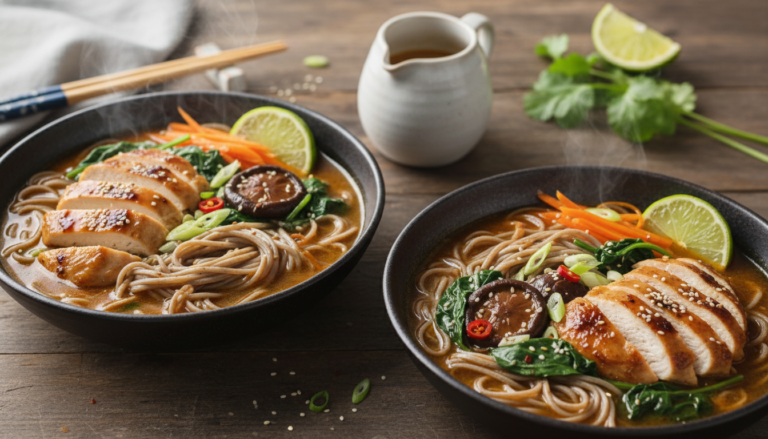
Miso Ginger Chicken & Soba Noodle Bowls
These Miso Ginger Chicken & Soba Noodle Bowls are a warmly umami-rich, Japanese-inspired meal prep recipe built around a silky miso-ginger sauce that ties every component together into one of the most satisfying bowls in the weekly rotation.
4
servings20
minutes30
minutes400
kcal50
minutesIngredients
200 grams soba noodles
500 grams chicken breast, sliced
2 tablespoons white miso paste
1 tablespoon grated ginger
2 tablespoons soy sauce
1 tablespoon sesame oil
1 cup broccoli florets
1 cup carrot, julienned
2 tablespoons rice vinegar
2 teaspoons honey
2 cloves garlic, minced
1 tablespoon sesame seeds
3 stalks green onions, sliced
Directions
- Cook soba noodles according to package instructions, then drain and set aside.
- In a small bowl, mix miso paste, ginger, soy sauce, sesame oil, rice vinegar, honey, and garlic until well combined.
- Heat a large skillet over medium heat and add the chicken slices. Cook until browned and cooked through.
- Add the broccoli and carrot to the skillet and stir-fry for about 5 minutes until tender.
- Pour the miso mixture over the chicken and vegetables, stirring to coat everything evenly.
- Add the cooked soba noodles to the skillet and toss gently to combine all ingredients.
- Serve the noodle bowls hot, garnished with sesame seeds and green onions.
Nutrition Facts
- Total number of serves: 4
- Calories: 400kcal
- Cholesterol: 0mg
- Sodium: 620mg
- Potassium: 400mg
- Sugar: 8g
- Protein: 6g
- Calcium: 60mg
- Iron: 2mg
About This Author

Amelia Grace
Editor-in-Chief & Culinary Director
The heart and guiding voice of Daily Dish, Amelia leads our editorial vision and recipe development. With a background in food journalism and over a decade spent in professional kitchens, she has a knack for blending gourmet technique with real-world accessibility. Her goal? To make every reader feel like a confident cook, one dish at a time.
Favorite dish: Creamy lemon risotto with a sprinkle of fresh thyme.
Kitchen motto: “Good food doesn’t have to be complicated — it just has to be made with heart.”















