
The aji verde — Peru’s ubiquitous green sauce — is one of the most intelligently constructed condiments in any culinary tradition, and the reason for that intelligence is largely the role mayonnaise plays in its architecture. Most herb-based sauces in the global repertoire — chimichurri, salsa verde, Italian gremolata — are built on oil as their fat phase, which produces a sauce that is bright and assertive but thin, prone to separating, and limited in its capacity to carry flavor compounds in a cohesive, coating-weight form. Aji verde uses mayonnaise as its fat phase, and that substitution changes the sauce’s behavior in every meaningful way.
Mayonnaise is already an emulsion — oil droplets stabilized in a water phase by egg lecithin. When blended with cilantro, jalapeño, garlic, and lime juice, the mayonnaise’s existing emulsion structure accepts these additions without breaking, producing a sauce that remains stably emulsified through blending, storage, and repeated refrigerator cycling without the separation that oil-based herb sauces undergo within hours. The sauce you drizzle on Sunday is structurally identical to the sauce you drizzle on Thursday — same consistency, same coating weight, same creamy body.
The fat content of the mayonnaise also performs specific flavor work that oil-based sauces cannot match. The cilantro’s primary aromatic compounds — linalool and decanal — are fat-soluble, which means they distribute into and remain stable within the mayo’s fat phase rather than dispersing into the water phase and volatilizing. The jalapeño’s capsaicin is similarly fat-soluble and distributes evenly through the mayo matrix rather than concentrating in hot spots. And the garlic’s allicin precursors, activated by the blending process, are carried by the fat phase through the entire sauce rather than remaining localized to individual garlic pieces. The result is a sauce where every compound is in its optimal distribution medium, producing a flavor that is remarkably uniform and remarkably durable — the same in the last spoonful as in the first, and as vivid on day four as on day one.
─────────────────────────────────────────
The Inspiration Behind This Recipe
The design objective for this bowl was to build a meal prep preparation around aji verde specifically — not as a condiment added at the table but as the sauce that defines the entire bowl’s flavor identity and whose volume, composition, and storage properties were calibrated for a five-day prep context from the beginning. Most recipes that feature aji verde treat it as a finishing sauce applied at serving time; this recipe treats it as the bowl’s architectural center, with every other component chosen for its compatibility with the sauce rather than independently.
Quinoa cooked in chicken broth was the grain choice that best supports the green sauce’s flavor logic. Quinoa’s mild, slightly nutty character is neutral enough to carry the sauce without competing with it, and its slightly rough texture — compared to the smoother surface of rice or couscous — provides more mechanical grip for the mayo-based sauce, coating more evenly and holding the sauce in contact with each grain rather than allowing it to pool at the container base. Broth-cooked quinoa adds a savory depth that keeps the grain base from tasting bland alongside the sauce’s assertiveness — a detail that matters most on the days when the bowl has been in the refrigerator for a few days and the components need every available flavor advantage.
The chicken’s browning is the protein decision that most determines the bowl’s quality across the storage window. Golden-browned chicken has a more complex, more meal-prep-stable surface than pale, steamed chicken — the Maillard reaction products at the surface are structurally different from the underlying muscle protein and carry flavor that persists through refrigeration and reheating. Against the aji verde‘s green freshness, properly browned chicken provides the savory depth that makes the bowl feel complete rather than one-dimensional.
─────────────────────────────────────────
A Brief History of Aji Verde
Aji verde — literally “green pepper sauce” — is one of the foundational condiments of Peruvian cuisine, appearing on nearly every table in the country with the same ubiquity that salt and pepper occupy in Western dining. Its origins are in the broader Peruvian tradition of aji preparations — sauces and pastes built around Peru’s extraordinary diversity of native chili peppers, which number in the hundreds of varieties across the country’s distinct geographic zones: the coast, the highlands, and the jungle. Peru is, in the estimation of many culinary historians, the world’s greatest chili pepper culture, with a spice tradition predating the Inca Empire by centuries.
The specific combination of cilantro with chili pepper in a creamy sauce reflects the colonial-era convergence of indigenous Peruvian ingredients with the dairy and herb traditions brought by Spanish colonizers — a culinary exchange that produced, over several centuries, the mestizo cooking tradition that defines contemporary Peruvian cuisine. Cilantro arrived in the Americas through Spanish trade routes but was rapidly adopted into Andean cooking traditions where it paired naturally with the native chile peppers. Mayonnaise — a European emulsified sauce — arrived later and was incorporated into aji verde preparations as a texture and stability modifier that the original oil-based versions lacked.
Contemporary Peruvian cuisine — recognized internationally as one of the world’s great culinary traditions, led by chefs like Gastón Acurio who have brought Lima’s cooking to global prominence — has elevated aji verde from a humble table condiment to a studied and celebrated preparation whose variations, ratios, and ingredient sourcing are debated with the seriousness that wine regions receive in French culinary culture. The version in this bowl is a simplified, home-kitchen adaptation of that tradition — honest in its ingredients and calibrated for meal prep rather than restaurant service, but rooted in the same fundamental flavor logic that makes the original so compelling.
─────────────────────────────────────────
Why This Cooking Method Works for Meal Prep
The blender method for the aji verde is not interchangeable with a food processor or mortar and pestle in a meal prep context, and the reason is emulsion stability. A blender’s high-speed blade produces a finer particle distribution of the cilantro, jalapeño, and garlic than either alternative can achieve, which means a greater surface area of plant material is exposed to the mayonnaise’s emulsifying lecithin. More surface area means more complete encapsulation of the aromatic compounds within the mayo’s fat phase, which means a more stable emulsion that resists separation over the five-day storage window. A food processor-blended sauce separates faster; a mortar-blended sauce is structurally unstable from the beginning. The blender is the correct tool.
Cooking the quinoa in chicken broth rather than water is the grain preparation decision with the highest return on effort — essentially no additional work for a significant flavor upgrade. Quinoa’s starch granules absorb whatever liquid surrounds them as they gelatinize during cooking, and the flavor compounds in a well-seasoned chicken broth become permanently embedded in the grain’s structure rather than remaining in the cooking liquid that is subsequently drained. The result is a grain that tastes specifically and consistently of chicken and seasoning in every forkful, which means the bowl’s components are more unified in flavor even when the green sauce’s volume on any given bite is lower than ideal.
Storing the aji verde separately from the assembled bowl components is the most important meal prep decision in this recipe. The sauce’s acidity — from the lime juice — will progressively soften the quinoa’s texture and alter the chicken’s surface protein if stored in direct contact over multiple days. Stored separately in a sealed jar, the sauce maintains its fresh flavor and the bowl components maintain their intended textures independently, with the sauce applied fresh at each serving producing the same bright, vivid result on Thursday as on Sunday.
─────────────────────────────────────────
Flavor Profile: What to Expect
This bowl is bright, creamy, and herbaceous — a flavor profile led entirely by one of the most vivid sauces in any culinary tradition:
- Vivid, herbaceous cilantro – The green sauce’s defining flavor: abundantly herbal, slightly citrusy, and present throughout every component the sauce touches — the most generously applied aromatic in the collection and the reason the bowl tastes specifically of Peru rather than generically of herb sauce
- Jalapeño warmth – A clean, building heat that is distributed evenly through the mayo’s fat phase rather than concentrating in specific bites — present throughout as a warmth that builds pleasantly rather than arriving unpredictably
- Creamy mayo emulsion – The sauce’s fat phase and structural medium: present as the quality that makes the sauce coat and cling rather than drip and pool — contributing a richness that deepens the cilantro’s character without dulling its brightness
- Bright lime acidity – The acid component that cuts through the mayo’s fat and keeps the sauce tasting vivid and fresh rather than merely rich — essential for balance and present in every bite as a clean, citrusy finish
- Savory browned chicken – The protein’s Maillard-developed surface providing the deeply savory, slightly caramelized character that makes the bowl taste complete alongside the sauce’s brightness
- Nutty, broth-infused quinoa – The grain base carrying the bowl’s savory foundation in every forkful — more aromatic and more specifically flavored than water-cooked quinoa and more texturally compatible with the mayo-based sauce
The sauce’s flavor is most vivid on day one and remains clearly present and compelling through day four — the mayo emulsion’s stability being the practical mechanism that makes this bowl’s signature element more durable through the prep week than most herb-based sauces would be.
─────────────────────────────────────────
Tips for Making the Best Peruvian Green Sauce Chicken & Quinoa Bowls
The sauce is where this recipe rewards the most attention:
- Use a full bunch of cilantro — stems and all – The stems contain the same aromatic compounds as the leaves and provide additional volume and flavor to the sauce. Recipes that call for leaves only are optimizing for color rather than flavor; stems included produces a more robustly flavored, more authentically proportioned sauce.
- Blend the sauce until completely smooth – Visible cilantro pieces in the finished sauce indicate incomplete emulsification — the plant material’s cell walls have not been fully disrupted and its aromatic compounds have not fully distributed into the mayo’s fat phase. A fully smooth sauce is a fully emulsified sauce, and a fully emulsified sauce is a more flavorful and more stable one.
- Taste and adjust the jalapeño – Jalapeños vary significantly in heat level between individual peppers. Blend with half the jalapeño first, taste the sauce, and add more heat incrementally. A sauce that is too spicy cannot be corrected without diluting the entire preparation.
- Brown the chicken properly – Medium-high heat, minimal movement during the first two to three minutes of contact, and patience with the sizzle produce the surface browning that makes the chicken taste specifically of something rather than simply of cooked poultry. Pale, un-browned chicken disappears into the bowl’s flavor profile rather than contributing to it.
- Store sauce separately in a sealed jar – This is the single most important storage instruction. Lime juice in direct contact with quinoa and chicken over multiple days changes both components’ textures and flavors in ways that are not improvements. A jar of sauce, applied fresh each day, preserves every component at its best for the full week.
- Rinse quinoa before cooking – Even in a broth preparation, saponin residue on unrinsed quinoa produces a bitter, soapy undertone that the broth’s flavor cannot fully mask. A thirty-second rinse is non-negotiable.
Optional: A tablespoon of fresh aji amarillo paste blended into the sauce alongside the jalapeño adds the specific Peruvian chili character — fruity, aromatic, moderately hot — that distinguishes a restaurant aji verde from a home approximation. Available in Latin grocery stores and increasingly in mainstream grocery stores, it is the one additional ingredient most worth sourcing for this recipe.
─────────────────────────────────────────
Portioning and Container Suggestions
This recipe produces four generous bowls from a single batch — one per day for a four-day lunch or dinner rotation. A two-container system works best per daily serving: quinoa and sliced chicken together in one flat, wide container, and the aji verde in a separate sealed jar that serves as the week’s communal sauce supply.
The sauce jar system is the most practical and most quality-preserving approach for this recipe — a single jar of blended aji verde provides sauce for four to five bowls applied fresh at each serving rather than portioning into four individual small containers. This approach also allows flexible sauce volume per serving — some days call for a generous drizzle, others for a more restrained application — without the waste that pre-portioned sauce containers can produce.
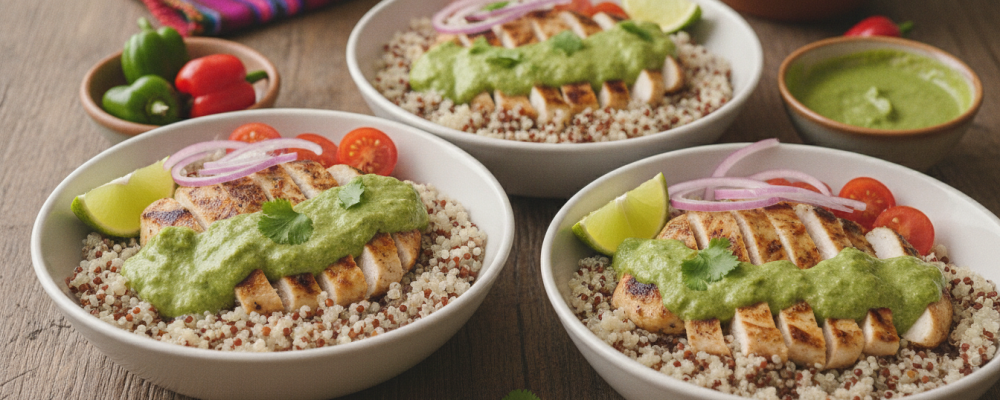
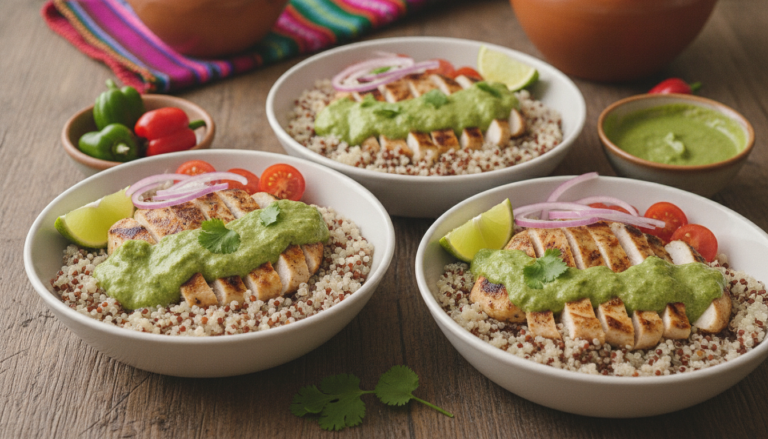
Wide, flat glass containers for the quinoa and chicken allow the components to rest in a single layer that reheats evenly and allows the sauce to be drizzled across the full surface area of the bowl at serving rather than pooling on a compressed mass of grain. A flat bowl presentation is the aji verde‘s best setting — the sauce’s vivid green color against the pale quinoa and golden chicken is one of the more striking visual presentations in the collection, and a flat surface maximizes that visual impact.
─────────────────────────────────────────
Storage, Reheating, and Shelf Life Tips
- Quinoa and chicken storage: Keeps in an airtight container for up to 4 days in the refrigerator. The quinoa’s broth flavor deepens slightly through day two; the chicken’s browned surface maintains its character through day three.
- Aji verde storage: Keeps in a sealed jar for up to 5 days in the refrigerator. The sauce may darken slightly in color as the cilantro oxidizes — stir well before each use and add a few drops of fresh lime juice if the color or brightness has diminished.
- Freezer storage: Chicken and quinoa freeze well for up to 2 months in separate portioned bags. The aji verde does not freeze well — the mayo emulsion breaks at freezer temperatures and does not re-emulsify on thawing. Make fresh sauce when thawed chicken and quinoa are used from the freezer.
- Reheating chicken: Microwave at 50–60% power for 60–90 seconds, or warm briefly in a lightly oiled skillet over medium heat. The skillet method re-activates the surface browning compounds and produces a result noticeably closer to freshly cooked.
- Reheating quinoa: Add a teaspoon of water or chicken broth, cover loosely, and microwave at full power for 60–90 seconds, stirring halfway through.
- Apply sauce cold: The aji verde is at its most vivid and most fresh-tasting when applied cold to the warm bowl components. Heating the sauce — even briefly — diminishes the cilantro’s volatile aromatic compounds. Always drizzle cold sauce over warm protein and grain.
- Color note: The sauce’s green color will gradually deepen toward olive during refrigerator storage as chlorophyll in the cilantro slowly degrades. The flavor remains excellent; the color change is cosmetic.
─────────────────────────────────────────
Why This Recipe Deserves a Spot in Your Meal Prep Rotation
The practical argument for this bowl is efficient: a sauce made once on Sunday that provides four to five days of finishing flavor, a grain base that cooks itself in the same time as the chicken, and a total preparation window of under thirty minutes for a bowl with flavor complexity that most more elaborate preparations can’t match. The emulsion stability of the mayo-based sauce is the practical advantage that makes this recipe perform specifically well as a meal prep option — a sauce this vivid and this well-structured remaining unchanged from Sunday to Thursday is not something most herb sauces can claim.
The deeper argument is the flavor one. Aji verde is one of the great sauces of the world — a preparation whose simplicity is misleading and whose flavor impact is immediate and specific. A bowl that is defined by a sauce of this quality is a bowl that tastes like the product of knowledge and intention even when the preparation required less than thirty minutes of active kitchen time. The bowl you eat on Wednesday that still tastes specifically, vividly of cilantro and jalapeño and lime and specifically of Peru is the bowl that earns a permanent place on the weekly prep list — not through efficiency alone, but through the genuine pleasure it delivers at every lunch it appears. That is the correct reason to make something every week. This recipe provides it.
─────────────────────────────────────────
Meal Prep Pairing Suggestions
Peruvian Green Sauce Chicken & Quinoa Bowls pair most naturally with other Latin American-inspired grain bowls that offer genuine protein and sauce contrast across the week. Our Cilantro Lime Shrimp Rice Bowls are the natural rotation partner — both are herb-and-lime-forward bowls built around a quickly cooked protein over grain, but the shrimp bowl’s citrus-forward simplicity and rice base are completely distinct in character from the aji verde bowl’s creamy, mayo-emulsified herb sauce and quinoa base. Alternating between them across the week delivers two genuinely different Latin American flavor experiences that share a culinary heritage without sharing a single sauce or ingredient.
For a complete three-bowl weekly spread, our Chimichurri Steak & Roasted Pepper Rice Bowls provide the third Latin American sauce tradition that rounds out the rotation — Argentinian where the aji verde is Peruvian, herb-and-oil-based where this sauce is mayo-emulsified, and beef-protein where this bowl is chicken. Three bowls covering three distinct Latin American culinary traditions — Peruvian, Argentine, and Mexican-inspired — each defined by its sauce and assembled from a single Sunday session: a rotation that covers more genuine culinary range than most meal prep collections achieve across their entire lineup, delivered efficiently and without compromise across every day of the week.
Peruvian Green Sauce Chicken & Quinoa Bowls
These Peruvian Green Sauce Chicken & Quinoa Bowls are built around aji verde—the iconic Peruvian green sauce—blended smooth with cilantro, jalapeño, garlic, lime, and mayonnaise into a bright, creamy, herbaceous drizzle that makes every component of the bowl taste like it was made for exactly this purpose.
4
servings20
minutes30
minutes450
kcal50
minutesIngredients
1 pound chicken breast
1 cup quinoa
2 cups chicken broth
1 cup cilantro leaves
1 seeded jalapeño pepper
3 tablespoons olive oil
2 cloves garlic
0.5 cup mayonnaise
2 tablespoons lime juice
1 teaspoon salt
0.5 teaspoon black pepper
Directions
- Cook quinoa in chicken broth until fluffy.
- Season chicken with salt and pepper and cook until golden brown, then slice.
- Blend cilantro, jalapeño, garlic, mayonnaise, lime juice, and olive oil into a smooth sauce.
- Assemble bowls with quinoa, chicken, and drizzle with green sauce.
- Serve immediately and enjoy.
Nutrition Facts
- Total number of serves: 4
- Calories: 450kcal
About This Author

Benjamin Brown
Recipe Developer
Benjamin is our flavor engineer. A classically trained chef turned recipe developer, he’s obsessed with balancing taste, texture, and creativity. He ensures that every recipe we publish is not only delicious but also reliable, approachable, and repeatable — even for beginners.
Favorite dish: Slow-braised short ribs with red wine reduction.
Kitchen motto: “Cooking is part science, part soul.”