
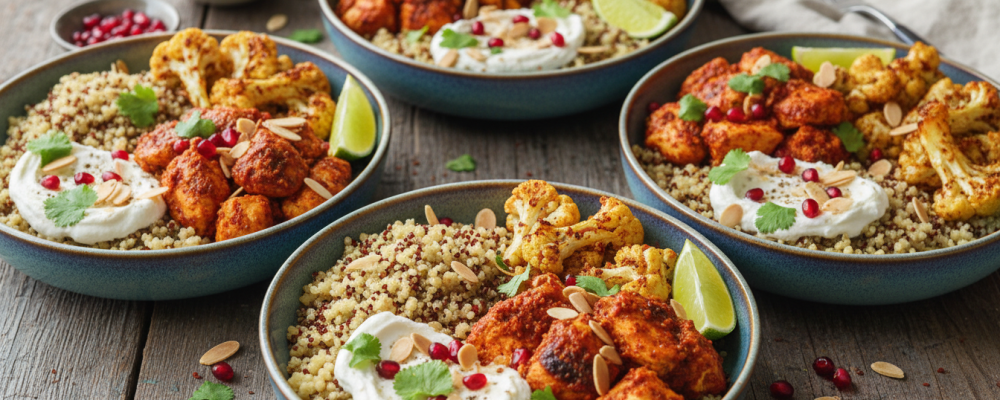

There are recipes that come into a meal prep rotation and do their job quietly—reliable, nourishing, efficient—and there are recipes that arrive and immediately change the temperature of the whole week. This Harissa Chicken & Roasted Cauliflower Grain Bowl is the second kind. It is the bowl that, on a Tuesday at lunch, makes you stop for a moment and actually taste what you’re eating—because harissa doesn’t let you rush through a bowl without noticing it, and golden roasted cauliflower doesn’t go unappreciated when you’re eating it, and quinoa cooked in chicken broth with ground cumin smells so good reheating that the person at the next desk will ask what you brought.
I love recipes that carry a sense of place—that taste like somewhere with a different light and a different rhythm from wherever you happen to be eating them. Harissa does that more efficiently than almost any other ingredient I know. One tablespoon of that smoky, complex chile paste and the whole bowl shifts—becomes warmer, more aromatic, more compelling. It is the kind of ingredient that makes a simple weekday lunch feel like something you would have sought out and paid for somewhere, and that experience of being surprised and delighted by your own meal prep is, I think, one of the best arguments for cooking at all.
This bowl is a recipe built around that surprise. Not through complexity—the method is straightforward and the ingredients are few—but through the specific, deeply considered choice of harissa as the spice vehicle. That single choice does everything: it seasons the chicken, it perfumes the whole bowl when it’s reheated, and it creates the kind of meal prep that you look forward to rather than simply rely on. And that distinction—between a lunch you tolerate and one you genuinely want—is worth building an entire Sunday prep session around.
─────────────────────────────────────────
The Inspiration Behind This Recipe
This recipe was born from an honest acknowledgment that spice is one of the most underused tools in a meal prep repertoire. Home cooks reach for salt and pepper out of habit, olive oil and garlic out of routine, and the result is a rotation full of competently seasoned but fundamentally similar-tasting food. The challenge was to design a bowl around a single bold, distinctive spice component that would give the week’s lunches a genuinely memorable identity—something that tasted specifically of itself rather than generically of “seasoned chicken over grain.”
Harissa was the answer that arrived most naturally. It is a prepared paste rather than a spice blend, which means it brings not just heat but a fully developed flavor profile—the sweetness of roasted red pepper, the warmth of caraway and cumin and coriander, the garlic’s depth, the brightness of preserved lemon in some versions—all concentrated into a preparation that does the work of a complex spice blend in a single tablespoon. It is efficient and bold in equal measure, and it behaves beautifully as a marinade: its oil content adheres to the chicken’s surface and creates a lacquered, fragrant crust under heat that keeps the protein moist in the refrigerator in the same way that any fat-based marinade does.
The cauliflower was chosen as the vegetable component because it does something under high-heat roasting that no other common vegetable quite replicates: it caramelizes at its edges into a deep, slightly nutty sweetness that mirrors the warm tones of the harissa rather than competing with them. Roasted cauliflower and harissa share a flavor logic—both are warm, slightly earthy, built on the same aromatic register—and they make the bowl feel cohesive in a way that a more neutral vegetable wouldn’t quite achieve.
─────────────────────────────────────────
A Brief History of Harissa
Harissa is North Africa’s most essential condiment—a paste so fundamental to Tunisian, Moroccan, Libyan, and Algerian cooking that it functions less as a seasoning than as a culinary identity. Its origins are traced to Tunisia, where it has been a staple of the kitchen since at least the 16th century, when the Columbian Exchange brought chili peppers from the Americas to the Mediterranean world and they were adopted with remarkable speed and enthusiasm into the region’s cooking. Before chili peppers arrived, North African cooking relied on black pepper and long pepper for heat; afterward, the vivid, fruity heat of fresh and dried chilis became inseparable from the region’s flavor vocabulary.
The word harissa derives from the Arabic root meaning “to crush” or “to pound”—a reference to the traditional preparation method of grinding dried chilies with garlic, olive oil, and spices using a mortar and pestle into a smooth, deep-red paste. The spice combination varies by region and tradition: Tunisian versions tend to emphasize heat and simplicity, with dried chilies, garlic, and olive oil as the foundation; Moroccan versions often incorporate preserved lemon, caraway, and coriander for additional complexity. What is consistent across all variations is the paste’s function as the essential bridge between ingredients in a dish—the flavor compound that ties a preparation together and gives it a specifically North African character.
Harissa’s global popularity beyond its regional origins is a recent phenomenon, accelerated by the growth of restaurant culture celebrating North African and Levantine cooking in Europe and North America. It is now available in most grocery stores in jarred or tube form, which makes the intense, complex flavor profile it took generations to develop accessible to a home cook with a bowl of quinoa and a chicken breast on a Sunday afternoon—a genuinely remarkable culinary convenience, and one worth using with full appreciation for the tradition behind it.
─────────────────────────────────────────
Why This Cooking Method Works for Meal Prep
Roasting the cauliflower at 200°C / 400°F is the temperature that achieves the specific caramelization that makes it worth including in this bowl rather than simply steaming it. At this temperature, the natural sugars at the cut surface of the florets caramelize—the Maillard reaction transforms pale, mild cauliflower into something golden-edged and nutty in flavor that is, in the best possible sense, a different ingredient from the one that went into the oven. That caramelized surface also acts as a partial moisture barrier, slowing the softening that roasted vegetables undergo during refrigeration and keeping the florets at a more pleasant texture through day three or four of the week.
Cooking the quinoa in chicken broth rather than water is the decision that transforms the grain base from neutral to flavorful. Quinoa cooked in water tastes clean and mild—suitable for anything, distinctive of nothing. Quinoa cooked in chicken broth with ground cumin tastes specifically of this bowl—warm, savory, aromatic—and it carries those flavors through the refrigerator intact, contributing to the cohesive, fully seasoned quality that distinguishes this bowl from one where every component was cooked in isolation and assembled afterward. The broth and the cumin make the grain base a component rather than a vehicle.
The harissa marinade applied to the chicken before cooking does two things that make it specifically well-suited to meal prep. First, the olive oil in the paste coats the chicken’s exterior and creates the protective fat layer that seals in moisture during cooking and through subsequent refrigeration—the same mechanism that makes any oil-based marinade produce a more refrigerator-stable result than a dry-seasoned protein. Second, the chili compounds in harissa are fat-soluble, which means they continue to migrate through the olive oil coating even after cooking, distributing their flavor more deeply into the chicken’s surface over the first day or two of storage. Day-two harissa chicken is noticeably more deeply seasoned than day-one—a quiet reward for the patience of refrigerator storage.
─────────────────────────────────────────
Flavor Profile: What to Expect
This bowl is warm, bold, and aromatic—built on a flavor tradition that is more layered and complex than its simple ingredient list suggests:
- Smoky, complex harissa heat – The paste’s distinctive combination of roasted chile, garlic, and warm spices provides the defining flavor of the entire bowl—present in every bite of the chicken and infusing the surrounding grain with its aromatic warmth
- Sweet, caramelized cauliflower – High-heat roasting transforms mild cauliflower into something nutty and gently sweet, its golden-edged florets providing a warm, earthy counterpoint to the harissa’s heat
- Savory, cumin-spiced quinoa – The grain base, cooked in chicken broth and seasoned with cumin, contributes a warm, earthy depth that ties the bowl’s components together at the foundation rather than remaining neutral beneath them
- Bright citrus lift – Fresh lemon juice applied at assembly cuts through the richness of the harissa and the broth-cooked grain with a clean, vivid acidity that keeps the overall bowl feeling balanced rather than heavy
- Clean, herbal parsley – Fresh parsley scattered over the assembled bowl introduces a green, slightly peppery brightness at the surface that lifts the warm, earthy tones of every component beneath it
- Aromatic garlic and olive oil – Threading through the harissa paste and the cauliflower toss, these foundational Mediterranean flavors provide the savory backbone that makes every other flavor in the bowl feel fully supported
The bowl’s flavors deepen and integrate measurably over the first twenty-four hours as the harissa continues to season the chicken through its fat coating and the cumin in the quinoa blooms further in the cold. Day-two bowls are reliably the most cohesive and satisfying—the point at which all the bowl’s individual decisions have had time to become one unified flavor story.
─────────────────────────────────────────
Tips for Making the Best Harissa Chicken & Roasted Cauliflower Grain Bowls
A few choices at the key preparation stages will ensure this bowl performs at its best across the full week:
- Use good harissa – The quality of the harissa paste directly determines the quality of the bowl. A good-quality jarred harissa—rose harissa, if available, adds additional floral complexity—tastes genuinely of roasted pepper, garlic, and spice. A mediocre one tastes primarily of chili heat without the depth that makes harissa worth using. Read the ingredient list and choose one with a short, recognizable list.
- Marinate the chicken for at least 15 minutes – Even a brief marination allows the harissa’s fat-soluble flavor compounds to begin penetrating the chicken’s surface and adherents strongly enough that the paste doesn’t all slide off during cooking. Longer is better—up to overnight in the refrigerator if time allows.
- Don’t crowd the cauliflower – Florets that overlap or touch during roasting steam each other rather than caramelizing independently. Spread them in a single, generous layer with space between each floret. Two sheet pans if necessary—the caramelization is worth the extra pan.
- Season the quinoa generously – Grain that tastes under-seasoned will make every other component in the bowl work harder to compensate. Taste the quinoa after cooking and add salt if needed before assembling. A well-seasoned grain base makes the bowl feel unified; an under-seasoned one makes it feel disjointed.
- Apply lemon juice at serving, not at assembly – If storing assembled bowls, hold the lemon juice until eating. Acid applied to quinoa during refrigerator storage can change its texture slightly over time. A fresh squeeze at the moment of eating delivers the brightest, most vivid citrus note and keeps the grain texture consistent.
- Slice chicken against the grain and on a diagonal – Diagonal cross-grain slices produce a larger surface area per piece, which means more harissa-seasoned crust per bite and a more visually appealing bowl arrangement. It’s a presentation detail that also improves the eating experience.
Optional: A dollop of cool, plain Greek yogurt alongside or over the assembled bowl provides a creamy, tangy contrast that tempers the harissa’s heat and adds a richness that makes the bowl feel like a complete, restaurant-quality preparation rather than a weekday meal prep.
─────────────────────────────────────────
Portioning and Container Suggestions
This recipe produces four generous bowls from a single batch—one per lunch or dinner day across a four-day rotation, or scaled by a quarter for five complete servings. A two-container system works best per day: quinoa and cauliflower together in one wide, flat container—where they can sit alongside each other without one component softening the other—and sliced chicken stored separately to prevent its harissa marinade from further saturating the grain base overnight.
Fresh parsley stores best in a small sealed bag or container on its own, added at serving time for maximum herbal brightness. The lemon is best cut fresh at eating time rather than stored as juice—a half-lemon kept in a small bag alongside the daily containers takes no space and delivers a significantly fresher result than pre-squeezed juice that has been sitting for three days.
Wide glass containers are the ideal vessel for both storage and reheating—they accommodate the assembled bowl’s generous volume, display the golden cauliflower and the harissa-stained chicken through the glass in a way that makes the refrigerator shelf look genuinely appealing, and distribute microwave heat more evenly than plastic containers for a more consistent reheating result. A week of lunches that look this good before they’ve even been reheated is, quietly, one of the best arguments for Sunday prep.
─────────────────────────────────────────
Storage, Reheating, and Shelf Life Tips
- Chicken storage: Harissa-coated sliced chicken keeps in an airtight container for up to 4 days refrigerated. The harissa’s oil continues to season and protect the chicken in storage—day-two and day-three portions are often more flavorful than the freshly cooked chicken.
- Quinoa and cauliflower storage: Cumin-broth quinoa keeps for 5 days refrigerated. Roasted cauliflower keeps for 4 days—it softens slightly over time but retains its caramelized flavor character throughout.
- Fresh parsley: Store in a sealed bag in the refrigerator for 4–5 days. Add fresh at serving time rather than storing on assembled bowls.
- Freezer storage: Chicken and quinoa both freeze well for up to 2 months in separate portioned containers. Roasted cauliflower freezes adequately but loses some of its caramelized texture upon thawing—fresh-roasted is preferable for the best result.
- Reheating the chicken: Microwave at 50–60% power for 60–90 seconds. Harissa-marinated chicken can dry out quickly at full power—low heat and a slightly longer time preserves the moisture that makes it so good.
- Reheating quinoa and cauliflower: Add a teaspoon of water or a small drizzle of olive oil to the container, cover loosely, and microwave at full power for 90 seconds to 2 minutes, stirring halfway through.
- Cold serving option: This bowl is excellent at room temperature—the harissa’s flavor is most vivid without heat suppression, and the roasted cauliflower and quinoa are pleasant at any temperature. A genuinely good no-reheat option for desk lunches or on-the-go eating.
─────────────────────────────────────────
Why This Recipe Deserves a Spot in Your Meal Prep Rotation
The best case for keeping this bowl in a weekly rotation is the simplest and most honest one: it makes lunch genuinely interesting. Not in the way that a complicated recipe with twelve components can be interesting—this is a straightforward preparation that comes together in under an hour—but in the way that a single well-chosen ingredient can be interesting. Harissa changes the character of the entire bowl. It carries a specific flavor tradition, a specific warmth, a specific aromatic intensity that no other common condiment quite replicates. In a rotation full of familiar flavors, it is the bowl that feels like a discovery.
It also earns its practical credentials without compromise: complete protein, a fiber-rich ancient grain, a brassica vegetable with impressive nutritional depth, and a preparation method that scales, stores, and reheats as reliably as any bowl in this collection. But the reason to make it week after week is the experience, not the nutrition label. The way the kitchen smells when the cauliflower and the harissa chicken are in the oven at the same time. The way the lemon cuts through the warmth of the harissa when you squeeze it over the assembled bowl. The way a Tuesday lunch at a desk can taste, briefly, like somewhere else entirely—somewhere warm and fragrant and worth arriving at. That is what this bowl does, every week, without fail. That is why it deserves to stay.
─────────────────────────────────────────
Meal Prep Pairing Suggestions
Harissa Chicken & Roasted Cauliflower Grain Bowls pair most naturally with other boldly flavored grain bowls that offer genuine protein and flavor contrast across the week. Our Chimichurri Steak & Roasted Pepper Rice Bowls bring the same herb-and-spice intensity in a Latin American direction—bold, saucy, and built around a quickly cooked steak protein that is completely distinct from the harissa chicken in character and flavor tradition. Alternating between them gives the week’s lunches two assertively flavored bowls that share no seasoning logic, keeping the rotation genuinely varied rather than simply repeated with different proteins.
For a complete three-bowl weekly spread, our Mediterranean Chickpea Couscous provides the lighter, plant-based option that completes the flavor ecosystem this bowl belongs to—both are rooted in Mediterranean and North African culinary traditions, both are built on clean, herb-bright flavors, and both offer a coherence of seasoning philosophy that makes them feel like they belong to the same thoughtfully designed week. Together, these three bowls—spiced and roasted, herb-sauced and grilled, and fresh and grain-tossed—cover every dimension of a well-varied lunch rotation, assembled in a single Sunday session that rewards every minute invested in it.
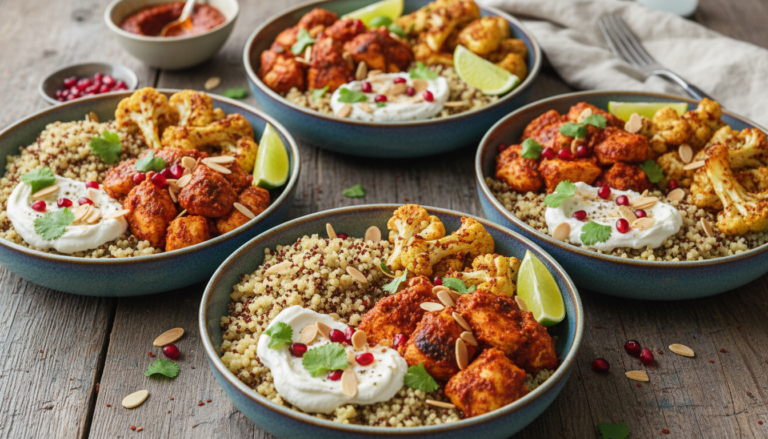
Harissa Chicken & Roasted Cauliflower Grain Bowls
These Harissa Chicken & Roasted Cauliflower Grain Bowls are a boldly spiced, deeply satisfying meal prep bowl built on the North African heat of harissa, golden oven-roasted cauliflower, and quinoa cooked in chicken broth—a complete, nourishing lunch or dinner with a flavor profile that makes every bowl feel like a genuine occasion.
4
servings20
minutes40
minutes540
kcal1
hourIngredients
500 g chicken breast
2 tbsp harissa paste
1 head cauliflower
2 tbsp olive oil
1 cup quinoa
500 ml chicken broth
1 tsp ground cumin
1 tsp salt
0.5 tsp black pepper
0.5 cup fresh parsley
1 tbsp lemon juice
Directions
- Preheat oven to 200°C (392°F).
- Cut cauliflower into florets and toss with olive oil, salt, and pepper.
- Bake cauliflower on a baking sheet for 30 minutes or until roasted.
- Cook quinoa in chicken broth, cumin, and salt for 15 minutes.
- Mix harissa paste, olive oil, salt, and pepper with chicken breasts.
- Grill or pan-fry chicken breasts until cooked through, about 10 minutes.
- Assemble bowls with quinoa, roasted cauliflower, sliced chicken, parsley, and lemon juice.
Nutrition Facts
- Total number of serves: 4
- Calories: 540kcal
- Cholesterol: 0mg
- Sodium: 620mg
- Potassium: 400mg
- Sugar: 8g
- Protein: 6g
- Calcium: 60mg
- Iron: 2mg
About This Author

Amelia Grace
Editor-in-Chief & Culinary Director
The heart and guiding voice of Daily Dish, Amelia leads our editorial vision and recipe development. With a background in food journalism and over a decade spent in professional kitchens, she has a knack for blending gourmet technique with real-world accessibility. Her goal? To make every reader feel like a confident cook, one dish at a time.
Favorite dish: Creamy lemon risotto with a sprinkle of fresh thyme.
Kitchen motto: “Good food doesn’t have to be complicated — it just has to be made with heart.”















