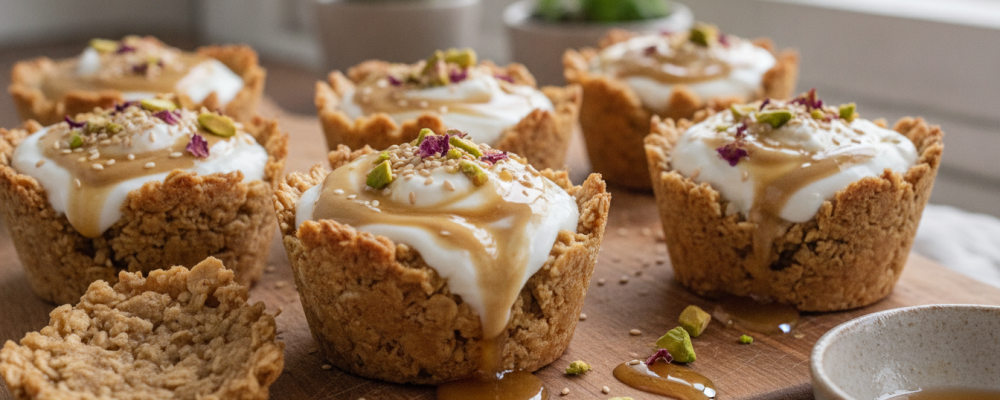

I want to begin with the granola, because the granola is the reason this cup exists and the reason it is worth making every week rather than simply buying a jar of something from a store shelf. Homemade granola is one of those preparations that is genuinely, categorically different from its commercial equivalent in ways that matter immediately and perceptibly in the eating—and tahini-and-honey granola specifically produces something that no commercial version I have ever encountered comes close to replicating.
Here is what happens when tahini meets honey and oats in a hot oven. The tahini’s sesame oil coats each oat and nut with a fat layer that conducts heat evenly and promotes deep, uniform toasting rather than the uneven, pale-and-burnt patchwork that oil-only granolas can produce. The tahini’s natural bitterness—mild, slightly mineral, the faintest edge of roasted sesame seed—caramelizes under heat into something nutty and deep and complex that honey alone could never achieve. And the honey, concentrating as its water content evaporates in the oven’s dry heat, caramelizes at the granola’s edges into clusters with the specific amber sweetness and slight bitter back-note that distinguishes properly caramelized honey from simply sweet honey. The result is golden, aromatic, and specifically, memorably delicious.
Then you layer it over Greek yogurt—cool, thick, slightly tangy—and scatter the mixed nuts and dried fruits over the top, and the whole thing becomes a texture study: creamy beneath, crunchy above, with the occasional chewy burst of dried fruit and the satisfying resistance of a whole nut. I find this kind of layered texture composition genuinely exciting to eat, and I have been making composed yogurt cups in one form or another for most of my professional life. This is one of the best ones.
─────────────────────────────────────────
The Inspiration Behind This Recipe
The inspiration was the specific and persistent frustration of the store-bought granola situation. Purchased granola is almost always either too sweet—built primarily on refined sugar with just enough oat to qualify as granola—or too bland, its flavors flattened by the processing requirements of commercial shelf stability. Neither version behaves well in a yogurt cup context: too-sweet granola makes the whole cup taste like dessert, while bland granola disappears into the yogurt’s flavor and contributes texture without interest.
Tahini-and-honey granola solves both problems simultaneously. The tahini’s natural bitterness moderates the honey’s sweetness, producing a finished granola that is sweet but not aggressively so—present enough to make the cup feel indulgent without overwhelming the yogurt’s own slight tang. And the tahini’s roasted sesame character provides a flavor identity that is genuinely interesting rather than generically sweet—the granola tastes specifically of something, which means the cup it sits on top of tastes specifically of something, which means the breakfast experience has a character rather than simply a form.
The dried fruits and mixed nuts complete the composition not simply as toppings but as textural and flavor contributors. Dried fruit’s chewy sweetness provides the flavor counterpoint that fresh fruit would provide if this were being assembled to order—and in a meal prep context, dried fruit has the considerable advantage of not deteriorating in the refrigerator. Mixed nuts’ varying sizes, shapes, and flavors—the different toasting levels, the different fat contents, the different levels of natural sweetness—make each bite slightly unpredictable and slightly different from the last, which is the quality that keeps a composed breakfast interesting across the full eating experience.
─────────────────────────────────────────
A Brief History of Granola and Yogurt
Granola’s origins are deeply and amusingly American—it was developed in the 1860s by Dr. James Caleb Jackson at a sanitarium in New York as a health food preparation made from baked graham flour, and the name was later adapted by John Harvey Kellogg (of Kellogg’s breakfast cereal fame) for a similar oat-based preparation at his own sanitarium. The concept of a baked, sweetened grain preparation eaten as a health breakfast has remained remarkably stable across the century and a half since, even as the granola itself has evolved from a strictly puritanical health food into one of the most flavor-forward and creatively varied preparations in the contemporary breakfast landscape.
Greek yogurt—straggisto in Greek, meaning strained—has a history that stretches back centuries in the Eastern Mediterranean and Middle East, where straining yogurt through cloth to remove the whey and produce a thicker, more concentrated dairy preparation was standard practice long before it became a global breakfast category. Its adoption as a breakfast base in Western markets is a relatively recent phenomenon, accelerating in the early 2000s as its higher protein content became a recognized nutritional advantage. The combination of Greek yogurt with granola—creamy below, crunchy above—is a contemporary pairing that draws on two food traditions centuries apart in origin and somehow produces something that seems like it was always meant to exist.
Tahini’s role in sweet preparations has deep roots in the Levantine and North African pastry traditions—sesame paste combined with honey or molasses appears as a confection (dibs w tahini in Arabic, sesame paste with grape molasses) that has been eaten across the region for centuries. Its translation into granola baking is a more recent innovation but one that fits logically within that long tradition of sesame and honey as natural partners in sweetened preparations.
─────────────────────────────────────────
Why This Cooking Method Works for Meal Prep
Baking the granola at 325°F rather than a higher temperature is the precise calibration that produces the most meal-prep-stable result. Higher temperatures would caramelize the honey faster than the oats can toast evenly—producing a batch with burnt edges and pale centers that neither tastes as good nor clusters as reliably as a slower, more controlled bake. At 325°F, the honey has time to concentrate and caramelize gradually while the oats toast to a consistent, deep golden color throughout. The tahini’s fat also distributes more evenly at lower heat, coating each oat fully before the caramelization begins rather than beading at the surface and producing patchy coverage.
Stirring the granola halfway through the baking window—rather than leaving it undisturbed—is the technique that produces the most evenly toasted batch across the full sheet pan. The granola at the pan’s edges experiences more heat than the granola at the center; stirring redistributes the material so that every portion spends equal time at the edges and the center, producing a batch where every cluster has the same toasting depth and the same honey caramelization level. A granola stirred once at the halfway point outperforms an unstirred granola in color consistency, flavor uniformity, and clustering tendency—all qualities that matter across a week of breakfast cups.
Allowing the granola to cool completely on the sheet pan before breaking into clusters or storing is the final step that the caramelized honey matrix requires to fully set. The honey’s sugars are still liquid and pliable when the granola first leaves the oven; disturbing it at this stage breaks the cluster bonds before they have hardened and produces loose, individual oat pieces rather than the satisfying, breakable clusters that make this granola texturally exceptional. Twenty minutes of patience produces a granola that snaps cleanly and clusters beautifully; impatience produces a granola that is still delicious but texturally indistinct from a lesser preparation.
─────────────────────────────────────────
Flavor Profile: What to Expect
These cups are warmly complex and texturally layered—a breakfast with enough going on in each spoonful to remain genuinely interesting all the way through:
- Nutty, caramelized tahini granola – The defining flavor of the entire cup: the roasted, faintly bitter depth of sesame paste caramelized with honey into a toasty, warmly complex cluster that is immediately, specifically recognizable as something better than what comes from a store
- Floral, concentrated honey caramel – The honey caramelizes at the granola’s cluster edges into a deep amber sweetness with slight bitterness—more interesting and more complex than simply sweet, with the specific character of properly caramelized honey
- Warm vanilla depth – Threading through both the granola and into every component’s perception of the others, vanilla extract rounds the tahini’s bitterness and the honey’s sharpness into a bakery-warm whole
- Cool, tangy Greek yogurt – The creamy, protein-dense base that anchors every other flavor with its clean tang—its slight acidity playing against the granola’s sweetness in a way that keeps the cup tasting balanced rather than one-dimensional
- Chewy, sweet dried fruit – Concentrated fruit flavor in a texture that contrasts with the granola’s crunch—jewels of sweetness that provide unpredictable moments of fruit richness throughout each cup
- Varied nut richness and crunch – Different nuts at different toasting levels produce slightly different flavor notes in each bite—the cup’s most texturally variable element and one of its most satisfying
The tahini granola’s flavor deepens slightly after the first day as the caramelized honey sets more fully and the sesame’s aromatic compounds bloom at room temperature. Day-two granola is often the best version—worth making a large batch and storing separately from the assembled cups for a consistent supply.
─────────────────────────────────────────
Tips for Making the Best Honey Tahini Baked Granola Yogurt Cups
The granola is where this recipe rewards the most attention:
- Stir tahini before measuring – Tahini separates in the jar with oil pooling at the surface. Stir thoroughly until fully recombined before measuring; unstirred tahini produces an inconsistent fat distribution in the granola, resulting in uneven toasting and coverage.
- Mix thoroughly before spreading – Every oat should be coated with the tahini-honey mixture before the sheet pan sees the oven. An under-mixed batch has dry oat pockets that toast faster and become bitter at the edges while the coated oats are still pale. A full minute of mixing ensures even coverage.
- Spread thinly and evenly – A thin, even layer on the sheet pan produces the most uniform toasting and the best cluster formation. A thick, uneven layer creates hot spots and cool spots that produce inconsistent results across the batch.
- Watch the color, not the clock – Oven temperatures vary. The granola is done when it is deep golden throughout—the color of a well-toasted almond—and fragrant. Pale granola will not have fully caramelized; dark granola will be bitter at the edges. Use color as the primary doneness indicator.
- Store granola separately from the yogurt – This is the single most important assembly instruction. Granola stored on assembled yogurt cups absorbs the yogurt’s moisture overnight and loses its defining crunch by morning. A sealed jar of granola at room temperature, added to each day’s cup at serving, maintains the textural contrast across the full week.
- Use full-fat Greek yogurt – Full-fat Greek yogurt has a creamier, more satisfying texture and a richer flavor than low-fat or non-fat varieties, and it provides the fat context that makes the tahini granola’s flavors register most fully. It is the correct choice for a cup built around pleasure as much as nourishment.
Optional: A small drizzle of honey and an additional pinch of flaky sea salt scattered over the assembled cup immediately before eating amplifies both the sweetness and the salt contrast at the surface—making the first bite the best version of what the cup is building toward.
─────────────────────────────────────────
Portioning and Container Suggestions
The tahini granola yields approximately three to four cups of finished clusters from a standard batch—enough for four to five generous breakfast cup toppings with a small reserve for snacking straight from the jar, which will inevitably happen and should be planned for. Store the granola in a sealed glass jar at room temperature where it keeps for up to two weeks—one of the longest shelf lives of any preparation in this collection—and assemble each day’s cup fresh at breakfast time.
Greek yogurt portions most efficiently into individual wide-mouth jars or cups—approximately three-quarters cup per serving is the correct base volume for a yogurt cup that feels substantial without being excessive. Portioning into individual sealed jars on Sunday produces a refrigerator that looks organized and intentional, with each jar a complete breakfast unit waiting for its granola crown.
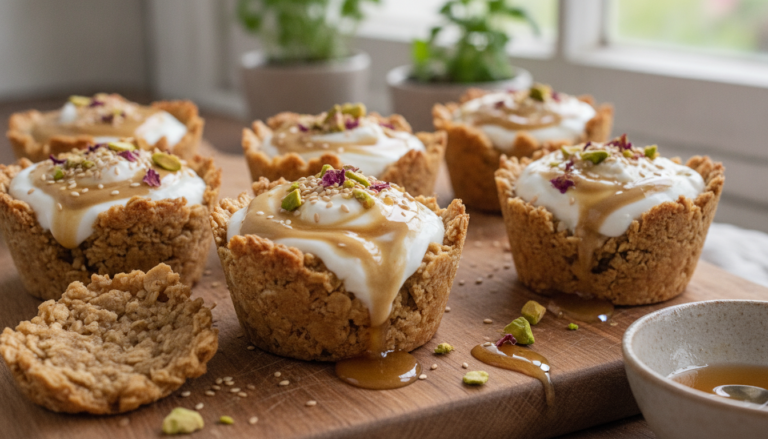
For the most visually beautiful assembled cup—and these cups earn the effort—layer the yogurt into the jar, scatter a generous layer of granola over the surface, add a small cluster of mixed nuts arranged by size and color rather than randomly scattered, and place the dried fruits deliberately rather than dropping them. Thirty additional seconds of attention produces a cup that looks like something from a very good café counter. The granola’s golden-amber color against the white yogurt, the varying colors of the nuts and dried fruits, and the occasional cluster edge visible above the surface makes this one of the most naturally photogenic breakfasts in the collection—and one of the most genuinely worth photographing.
─────────────────────────────────────────
Storage, Reheating, and Shelf Life Tips
- Granola storage: Keeps in a sealed glass jar at room temperature for up to 2 weeks. Do not refrigerate—the humidity softens the caramelized honey matrix. Store away from direct sunlight to preserve the honey’s color and flavor.
- Greek yogurt storage: Portioned into individual sealed jars, keeps refrigerated for 5–7 days depending on the yogurt’s freshness. Check the use-by date on purchase and plan the prep window accordingly.
- Dried fruits and nuts: Store in separate sealed bags or containers at room temperature for up to 2 weeks alongside the granola. Add fresh to each assembled cup at serving time.
- Assembly timing: Assemble each cup immediately before eating—granola on yogurt for no more than 15–20 minutes before serving produces the best textural contrast. Granola on yogurt stored for hours produces soft, moisture-absorbed granola by serving time.
- No reheating required: These cups are a cold breakfast by design. The granola can be served at room temperature or slightly warmed in a 300°F oven for 3–4 minutes if a warm breakfast is preferred, but the textural contrast between warm granola and cold yogurt is genuinely one of the most pleasurable temperature contrasts in the breakfast category.
- Granola re-crisping: If the granola has softened slightly due to humidity exposure, spread on a parchment-lined sheet pan and warm at 300°F for 5 minutes. Cool completely before storing—it will re-crisp as it cools.
─────────────────────────────────────────
Why This Recipe Deserves a Spot in Your Meal Prep Rotation
There are breakfast preparations in this collection that earn their place through efficiency, and some that earn it through nutritional completeness, and some—the very best ones—that earn it through the specific joy they produce at the moment of eating. These cups are in the last category. The homemade tahini granola is the kind of thing that makes breakfast feel like a decision you made deliberately rather than a meal that happened to you—something you specifically want because it specifically tastes like something, rather than generically like breakfast.
The granola’s two-week shelf life also gives it a compounding advantage that few other meal prep preparations can match: one Sunday batch covers two full weeks of morning cups without any additional effort, which means the active prep investment is even lower per serving than it appears. Thirty minutes of Sunday baking—the granola, the yogurt portioning—produces fourteen potential breakfasts. That is an exceptional return on a single afternoon’s attention, delivered in a cup that is beautiful, nourishing, and genuinely worth opening the refrigerator for every single morning it appears. That combination is worth making room for on every Sunday prep list, permanently and without reservation.
─────────────────────────────────────────
Meal Prep Pairing Suggestions
Honey Tahini Baked Granola Yogurt Cups pair most naturally with breakfast preparations that offer genuine contrast in temperature, format, and flavor character—ensuring the week’s mornings feel genuinely varied rather than returning to the same crunchy, layered register every day. Our Coconut Matcha Overnight Oat Jars make the ideal companion—both are visually striking, ingredient-forward breakfast jars with a distinct and specific flavor identity, but where these cups are warm-and-nutty from the tahini granola, the matcha jars are cool and vivid and earthy. The two breakfasts share a commitment to beautiful, considered presentation while occupying completely different flavor territories.
For a complete three-breakfast rotation, our Peach Ginger Overnight Oat Jars provide the warm-spiced, fruit-forward option that rounds out the week with stone-fruit richness and ginger warmth alongside these cups’ nutty, honey-caramelized depth. Three breakfast preparations—layered and granola-crunchy, vivid and matcha-earthy, and creamy and peach-spiced—assembled across a single Sunday and delivering a morning rotation that is consistently, specifically beautiful in three entirely different ways. A refrigerator that holds all three is a refrigerator that is genuinely prepared for any morning the week can produce. That is what Sunday prep is for.
Honey Tahini Baked Granola Yogurt Cups
These Honey Tahini Baked Granola Yogurt Cups are a layered, texturally spectacular breakfast built around a homemade tahini-and-honey granola that is nutty, golden, and deeply fragrant—assembled over creamy Greek yogurt and finished with mixed nuts and dried fruit for a breakfast that earns its place on the weekly prep list.
6
servings20
minutes25
minutes350
kcal45
minutesIngredients
2 cups oats
1/2 cup tahini
1/2 cup honey
1 teaspoon vanilla extract
1 cup Greek yogurt
1/2 cup mixed nuts
1/4 teaspoon salt
1/4 cup dried fruits
Directions
- Preheat oven to 325°F (165°C) and line a baking sheet with parchment paper.
- In a mixing bowl, combine oats, tahini, honey, vanilla, and salt.
- Spread the mixture evenly onto the prepared baking sheet.
- Bake for 20-25 minutes, stirring halfway through, until golden brown.
- Allow the granola to cool completely on the baking sheet.
- In serving cups, layer Greek yogurt, baked granola, and mixed nuts.
- Top with dried fruits. Serve immediately or store in the fridge.
Nutrition Facts
- Total number of serves: 4
- Calories: 350kcal
- Cholesterol: 0mg
- Sodium: 620mg
- Potassium: 400mg
- Sugar: 8g
- Protein: 6g
- Calcium: 60mg
- Iron: 2mg
About This Author

Aurora Wright
Pastry Chef & Dessert Editor
Aurora is the sweet side of Daily Dish. A trained pastry chef and dessert stylist, she’s responsible for our mouth-watering cakes, cookies, and confections. She brings precision, artistry, and a touch of whimsy to every recipe she creates — and taste-tests more chocolate than she’ll admit.
Favorite dish: Flourless dark chocolate torte.
Kitchen motto: “Life’s too short to skip dessert.”