
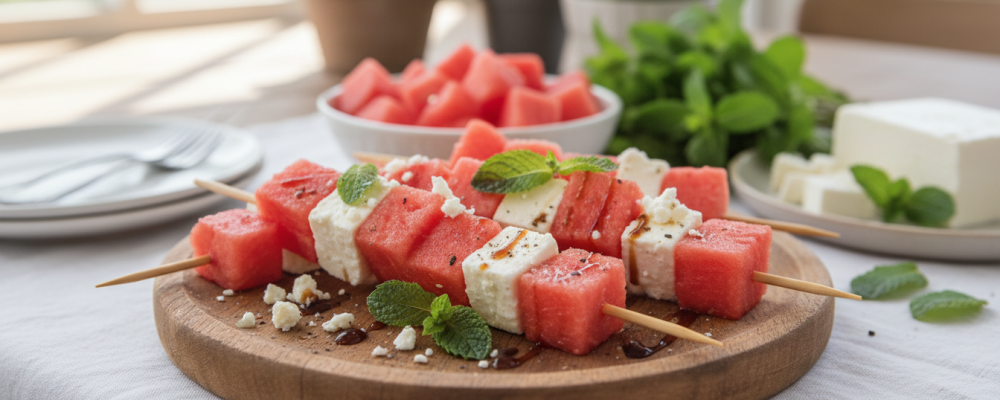

I want to take a moment before we talk about technique or assembly or meal prep strategy to simply describe what these skewers look like, because the visual case for making them is—genuinely, with no exaggeration—almost as compelling as the flavor case.
You have the watermelon: that specific, irreplaceable shade of deep coral-pink that exists nowhere else in nature with quite this much saturated confidence. Beside it on the skewer, a cube of feta the color of fresh snow—stark white, with its characteristic irregular surface catching the light like something that belongs on a very good cheese board. And between them, folded gently around the skewer: a mint leaf, so vividly, purely green that it looks almost artificially colored. Then over all of it, a drizzle of pale golden honey and olive oil that catches the light in a way that makes the whole skewer gleam. Finish with a pinch of black pepper—small dark flecks that add the visual punctuation the composition needs.
This is a snack that is, without any irony at all, beautiful. It is one of the most naturally photogenic things you can assemble in a home kitchen, and it achieves that beauty the same way the best food always does: not through decoration or artifice, but through the honest, vivid colors of excellent ingredients placed in the right relationship to each other. I’ve plated a great many things in my professional life that required considerably more effort and produced considerably less visual impact. These skewers are a reminder that nature already did most of the work.
─────────────────────────────────────────
The Inspiration Behind This Recipe
The inspiration for this recipe is as old as the combination itself: a summer afternoon, a ripe watermelon, and the discovery—made independently by cooks in Greece, Turkey, and the broader Mediterranean world long before it became a fashionable pairing in contemporary Western cooking—that watermelon and feta taste extraordinary together. The sweetness and water content of the melon against the salt and funk of the cheese is one of those flavor contrasts that seems surprising in description and completely inevitable in the eating.
What this recipe adds to that foundational pairing is structure and presentation—the transformation of a casual plate into something that travels, portions, and impresses with equal ease. Threading the components onto skewers turns a combination that might otherwise be served casually in a bowl into something that functions perfectly as an individual-portion grab-and-go snack, an effortless party appetizer, or a daily refrigerator offering that looks like it was assembled with care rather than simply portioned out.
The honey and olive oil drizzle—seemingly the smallest detail—is what elevates the assembled skewer from a good snack to a great one. The honey deepens the watermelon’s natural sweetness and bridges the gap between the fruit and the salty feta, while the olive oil adds a richness and a slight fruitiness that gives the whole skewer body. The black pepper, finally, is the finisher that makes the sweet and the salty both taste more vivid—the same role it plays in virtually every context it appears in, and a role it performs here with characteristic quiet efficiency.
─────────────────────────────────────────
A Brief History of Watermelon and Feta
The pairing of sweet, juicy fruit with brined, salty cheese is one of the oldest and most geographically distributed flavor instincts in Mediterranean and Middle Eastern culinary tradition. In Greece, where feta has been produced for centuries from the milk of sheep and goats grazing on the hillsides of Epirus and Macedonia, the combination of the cheese’s sharp, salty brine with sweet summer produce—figs, melon, stone fruit—has been a feature of warm-weather eating since ancient times. The specific pairing of feta with watermelon is particularly beloved in Greek island cooking, where both the melon and the cheese arrive at their peak in the same hot summer months and share a natural flavor affinity that requires no embellishment to be extraordinary.
Watermelon itself has a history of cultivation stretching back nearly five thousand years, with its origins traced to the Kalahari Desert of southern Africa. By 2000 BCE it had been cultivated across northeastern Africa, and by antiquity it was a prized crop throughout the Mediterranean basin—valued as much for its water content in hot, dry climates as for its sweetness. The specific coral-fleshed, sweet varieties we know today are the result of centuries of selective cultivation, each generation of farmers selecting the sweetest, the firmest, the most vibrantly colored specimens for the following year’s planting.
The contemporary skewer format—threading components onto sticks for individual serving—is a presentation technique with roots in Middle Eastern and Mediterranean mezze traditions, where small, varied individual portions have always been the preferred format for communal eating and entertaining. Applied to watermelon and feta, it transforms a beloved regional pairing into a self-contained portion that is equally at home at a dinner party, in a meal prep container, or at a desk in the middle of a Wednesday afternoon.
─────────────────────────────────────────
Why This Preparation Method Works for Meal Prep
The skewer format, beyond its visual appeal, solves a practical challenge that the same components served in a bowl cannot: moisture management. Watermelon releases liquid continuously once cut, and that liquid, pooled at the base of a bowl, will slowly soften the feta and dilute any dressing applied to the surface within a few hours. On a skewer, the components are elevated above the container surface—the watermelon’s liquid drains away from the feta rather than saturating it, and each component remains structurally intact for longer than it would in direct contact with the pooled juice below.
The olive oil drizzle applied before refrigeration acts as a light coating on the exposed surfaces of the feta and watermelon cubes, creating a thin barrier that slightly delays moisture exchange between the components and keeps the feta from absorbing the watermelon’s sweetness too aggressively during storage. This is the same principle that makes an oil-based marinade more effective than a water-based one at preserving surface integrity—fat doesn’t mix with the watermelon’s aqueous juice, so it sits at the interface and slows the exchange.
Storing the assembled skewers horizontally on a flat surface in a shallow airtight container—rather than upright in a jar—distributes the honey and olive oil evenly across all components rather than allowing them to pool at the skewer’s lower end. A brief return to room temperature for five minutes before eating allows the olive oil, which can firm slightly in the refrigerator, to loosen back to its proper pourable consistency, and brings the watermelon’s fragrance forward in a way that cold suppresses. These are small details, but they are the small details that distinguish a snack that is still good on Wednesday from one that was only excellent on Sunday.
─────────────────────────────────────────
Flavor Profile: What to Expect
These skewers are a masterclass in contrast—every component exists in direct and productive tension with the one beside it:
- Juicy, sweet watermelon – The melon leads with a light, refreshing sweetness and an extraordinary amount of cool liquid that makes each bite feel hydrating in a way almost no other snack can replicate
- Salty, creamy feta – The cheese answers immediately with its sharp, briny character—dense and slightly crumbly, with a richness that anchors the sweetness of the melon and keeps every bite feeling substantial
- Cool, herbal mint – Fresh mint threads through the combination with a clean, slightly sweet, intensely aromatic freshness that lifts both the melon and the cheese and gives each skewer an element of brightness that neither ingredient provides alone
- Floral honey depth – The honey drizzle reinforces the melon’s sweetness with its own layered complexity—floral, slightly caramel, deepening in flavor wherever it pools against the feta
- Fruity olive oil richness – Extra virgin olive oil rounds the whole combination with a quiet, slightly peppery richness that gives the skewer body and makes every flavor taste more fully realized
- Sharp black pepper finish – The black pepper provides a final, clean heat that makes the sweet taste sweeter, the salt taste saltier, and the mint taste mintier—a finisher that the skewer would miss considerably in its absence
The flavor is at its most vivid within the first few hours of assembly and remains excellent through day two. Beyond that, the watermelon softens slightly and the mint darkens—still very much worth eating, but the peak window for this recipe is shorter than most.
─────────────────────────────────────────
Tips for Making the Best Watermelon Feta Mint Skewers
The components are simple enough that every small choice registers clearly in the finished skewer:
- Choose a ripe, firm watermelon – A ripe watermelon that still has structural integrity is critical for skewering. Overripe watermelon is too soft to thread cleanly onto a skewer without breaking. Look for a melon that sounds hollow when tapped and has a firm, uniform flesh with no soft spots.
- Cut components uniformly – One-inch cubes of both watermelon and feta produce the most balanced skewer—equal surface area means an even ratio of sweet to salty in every bite. Uneven cuts produce skewers where one component dominates.
- Use block feta, not crumbled – Pre-crumbled feta has been broken down too finely to cube for skewering and tends to be drier and less flavorful than block feta stored in brine. Block feta cubes cleanly, holds its shape on the skewer, and tastes noticeably more complex and creamy.
- Fold mint leaves, don’t pierce them flat – A mint leaf folded gently and threaded onto the skewer through its fold stays on more securely than a flat-pierced leaf, which splits and falls away. The folded leaf also presents more visually—a fuller, more dimensional green shape that photographs and presents beautifully.
- Drizzle just before serving when possible – If making ahead, hold the honey and olive oil drizzle until immediately before eating. Applied at assembly and refrigerated, the honey firms slightly and the visual clarity of the drizzle is partially lost. Applied fresh, it creates the gleaming, golden effect that makes these skewers so visually striking.
- Chill the skewers before serving – Even a brief 15-minute refrigerator rest after assembly allows the honey and olive oil to settle into the components and the flavors to begin integrating. A fully chilled skewer tastes more cohesive than one eaten immediately after threading.
Optional: A small amount of balsamic glaze—or a few drops of aged balsamic—drizzled over the finished skewers alongside the honey adds a deep, slightly acidic sweetness that plays beautifully against the feta’s saltiness and makes the color story even more dramatic: dark mahogany balsamic against coral watermelon and snow-white cheese.
─────────────────────────────────────────
Portioning and Container Suggestions
These skewers portion naturally and elegantly—three to four skewers per serving is a satisfying snack amount, and they store most effectively in a wide, shallow airtight container where they can lie flat in a single layer without stacking. Stacking skewers compresses the components, crushes the mint, and creates an uneven honey distribution as everything settles—flat storage preserves the visual integrity and the structural clarity of each individual skewer.
For grab-and-go use, a flat rectangular container that accommodates the full length of the skewers without requiring them to be tilted or broken is the ideal vessel. A piece of parchment paper laid over the top layer before sealing protects the drizzled surface and prevents the lid from dragging honey across the components when opened. It’s a thirty-second addition that keeps the skewers looking as carefully assembled when the container is opened as they did when it was sealed.
For entertaining—because these skewers genuinely belong on a party platter as much as in a meal prep container—arrange them on a long rectangular board or platter with the skewer tips all pointing the same direction, the components aligned in their alternating pattern of pink, white, and green. A final drizzle of honey at serving, scattered mint leaves, and a light crack of black pepper over the whole platter produces a presentation that requires almost no effort and generates an entirely disproportionate amount of admiration. These are that kind of snack.
─────────────────────────────────────────
Storage, Reheating, and Shelf Life Tips
- Refrigerator storage: Assembled skewers keep in an airtight flat container for up to 2 days at peak quality. By day three, the watermelon begins to soften slightly and release more liquid, and the mint darkens—still enjoyable, but noticeably less vibrant than the first two days.
- Component prep strategy (recommended): For a full five-day prep, cut and store the watermelon cubes and feta cubes separately in airtight containers—watermelon for up to 4 days, feta for up to 7 days—and assemble fresh skewers every two days. Daily assembly takes under three minutes and produces skewers that are consistently at peak freshness.
- Mint storage: Fresh mint keeps for 4–5 days stored loosely in a small jar with the stems in a finger of water, covered with a loose plastic bag in the refrigerator—like a small bouquet. This method keeps the leaves vivid green and aromatic far longer than storing them sealed in a bag.
- Watermelon tip: Store cut watermelon cubes in a container lined with a paper towel to absorb excess juice, which keeps the cubes firmer and less waterlogged through storage.
- No reheating required: These are a cold snack by design—serve directly from the refrigerator or at room temperature after a brief five-minute rest.
- Freezer storage: Not suitable. Watermelon freezes but becomes entirely limp and watery upon thawing; feta changes texture unpleasantly. Both components are best prepared fresh within the week.
─────────────────────────────────────────
Why This Recipe Deserves a Spot in Your Meal Prep Rotation
There are recipes that justify themselves through nutrition, and recipes that justify themselves through efficiency, and recipes that justify themselves through flavor—and then there are recipes like these skewers, which justify themselves through the experience of eating them. The way a cold, honey-drizzled watermelon cube tastes on a warm afternoon. The way the feta’s saltiness makes the melon taste sweeter than it actually is. The way the mint, folded between them, makes the whole combination taste like it was assembled somewhere beautiful—a terrace somewhere, with a view of the sea and a glass of something cold nearby.
That experience—the specific pleasure of eating something that tastes as good as it looks and looks as good as it tastes—is worth building into a meal prep rotation even when the recipe is this simple. Perhaps especially when the recipe is this simple. Some of the best things in a week are the ones that take three minutes to make and manage, somehow, to feel like a gift every single time you reach for one. These skewers are exactly that kind of thing. Put them in the rotation and you’ll understand immediately why they stay there.
─────────────────────────────────────────
Meal Prep Pairing Suggestions
Watermelon Feta Mint Skewers pair most naturally with snack recipes that offer textural richness or flavor warmth alongside this combination’s cool, fresh, and light character. Our Mango Tajín Fruit Cups make the ideal fruit-forward companion—both are visually stunning, both are built on fresh fruit as the primary component, and both require almost no preparation time—but where these skewers are cool, herbal, and sweet-salty, the mango cups are bold, spicy, and tropical. Together they form a fruit-focused snack pairing that covers every possible fresh snacking mood across the week without a single ingredient overlapping.
For a complete three-option snack spread, our Cucumber Cream Cheese Bites round out the lineup with a creamy, savory option that shares this skewer’s Mediterranean-inspired character and vegetable-forward lightness while adding the herb-and-lemon richness of the cream cheese base. Three no-cook, fresh, visually beautiful snacks covering sweet-and-salty, bold-and-tropical, and cool-and-creamy means the entire snack rotation is handled in less than twenty minutes of combined prep time—and every single day’s snack is, genuinely and without exaggeration, something worth looking forward to.
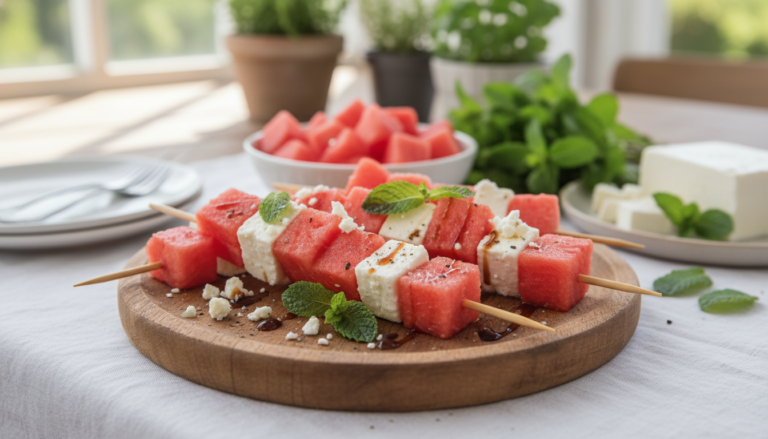
Watermelon Feta Mint Skewers
These Watermelon Feta Mint Skewers are a stunning, no-cook snack that comes together in minutes—a sweet, salty, herbal combination that is as visually striking as it is effortlessly delicious all week long.
4
servings30
minutes40
minutes300
kcal1
hour10
minutesIngredients
1 kg watermelon
200 g feta cheese
20 leaves fresh mint
2 tbsp extra virgin olive oil
1 tbsp honey
1 pinch black pepper
Directions
- Cut the watermelon into 1-inch cubes.
- Cut the feta cheese into 1-inch cubes.
- Thread watermelon, feta, and mint leaves onto skewers, alternating each component.
- Drizzle with olive oil and honey.
- Finish with a pinch of black pepper.
- Serve immediately or chill for later.
Nutrition Facts
- Total number of serves: 4
- Calories: 150kcal
- Cholesterol: 0mg
- Sodium: 620mg
- Potassium: 400mg
- Sugar: 8g
- Protein: 6g
- Calcium: 60mg
- Iron: 2mg
About This Author

Aurora Wright
Pastry Chef & Dessert Editor
Aurora is the sweet side of Daily Dish. A trained pastry chef and dessert stylist, she’s responsible for our mouth-watering cakes, cookies, and confections. She brings precision, artistry, and a touch of whimsy to every recipe she creates — and taste-tests more chocolate than she’ll admit.
Favorite dish: Flourless dark chocolate torte.
Kitchen motto: “Life’s too short to skip dessert.”















