
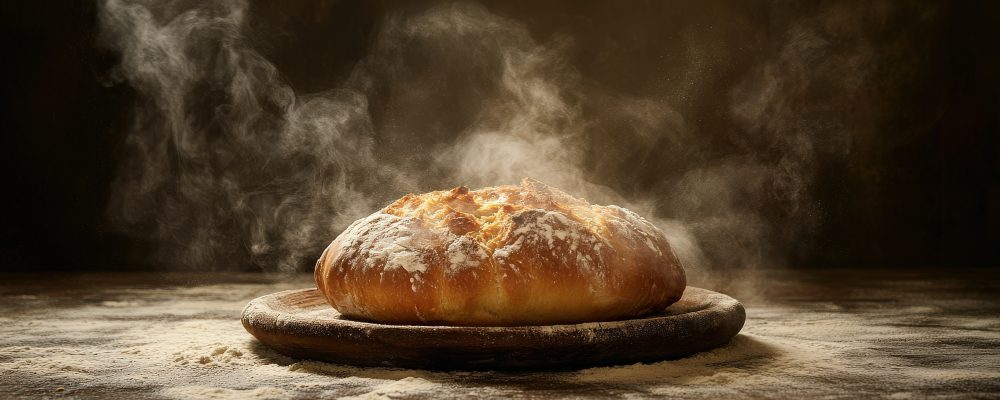

Baking has a reputation for being the precise science of the kitchen.
Measure carefully. Follow the recipe. Don’t substitute. Don’t improvise. And most home bakers do all of that — they weigh their flour, they bring their eggs to room temperature, they set a timer and pull the pan at exactly the right moment.
And then they cut into the cake while it’s still steaming. They pull the bread apart before the crumb has set. They slice the cookies off the pan the moment the oven clicks off.
All that precision, undone in the last five minutes.
Resting in baking is not downtime. It is an active, essential phase of the cooking process — one that professional bakers treat with the same seriousness as every step that came before it. Understanding what happens during a rest, and why skipping it changes the outcome, is one of the most valuable things a home baker can learn.
What’s Actually Happening Inside a Hot Loaf of Bread
Pull a loaf of bread from the oven and it looks done. The crust is set. The color is deep and even. The internal temperature reads correctly on a thermometer. Everything signals completion.
But inside that loaf, the process is still very much underway.
The starches in bread — gelatinized during baking when heat and moisture transformed them from raw flour into the structure of the crumb — are still in a semi-fluid state when the bread comes out of the oven. They need time to cool and set into a stable structure. During this process, called retrogradation, the crumb firms from a wet, gummy texture into the distinct, sliceable interior that bread is supposed to have.
Cut into a loaf too early and the steam that’s still moving through the crumb escapes all at once. The interior, which was moments away from setting properly, collapses slightly into a dense, gummy texture at the cut surface. The bread isn’t underbaked. It’s been interrupted at the worst possible moment.
Professional bakers rest their bread on a wire rack for a minimum of thirty minutes for smaller loaves and up to two hours for large, dense ones. The wire rack is not incidental — it allows air to circulate under the loaf so the bottom crust doesn’t steam itself soft against a flat surface. Both details are deliberate.
Cake Cooling Is a Structural Issue, Not a Patience Test
The impulse to frost a cake while it’s still warm is understandable. The cake is done. The frosting is ready. The occasion doesn’t wait.
But a warm cake is a structurally compromised cake. The crumb is still soft and fragile from the heat, which means any pressure — from a spatula, from the weight of a second layer, from frosting being spread across the surface — risks tearing, compressing, or crumbling the interior. The steam still releasing from the cake will melt buttercream, cause ganache to slide, and turn a clean frosting job into a streaky, uneven mess within minutes.
Professional bakers cool their cakes completely before any frosting is applied — and for layer cakes intended to be frosted cleanly and stacked precisely, many go further. The layers go into the refrigerator, wrapped tightly, for an hour or more before assembly. A cold cake is firm, stable, and far easier to work with than a room-temperature one. The crumb doesn’t tear. The frosting stays where it’s put. The layers stack cleanly without sliding.
The extra wait produces a fundamentally better result. It also produces a cleaner slice — because a properly cooled and set cake cuts without the crumb dragging and compressing the way it does when the interior is still warm and fragile.
Cookie Carryover Is the Difference Between Chewy and Overdone
Cookies present a different version of the same resting principle — and it’s one that confuses home bakers because the signals are counterintuitive.
A cookie pulled from the oven at the right moment looks underdone. The center is soft, slightly puffed, and hasn’t fully set. The edges are just beginning to color. Everything about it says it needs more time.
Professional bakers know that the cookie isn’t done in the oven — it finishes on the pan. Carryover cooking from the residual heat of the hot sheet pan continues to set the center for several minutes after the oven door closes. A cookie that looks perfect when it comes out will be overdone by the time it cools. A cookie that looks slightly underdone will be exactly right.
The rest on the pan — five minutes minimum before any attempt to move the cookies — allows this carryover to do its work and allows the structure of the cookie to firm enough to be transferred without breaking. Cookies moved too early fall apart not because the recipe is wrong but because the rest was skipped.
The same principle applies to brownies with particular force. A pan of brownies that appears underdone in the center when it comes out of the oven will, if rested properly for at least twenty to thirty minutes before cutting, reveal a perfectly fudgy interior. Cut immediately and the unset center flows out, the structure collapses, and what should have been a dense, clean square becomes a formless mess.
Pie Filling Needs Time to Become Pie Filling
Of all the baked goods that suffer most from impatience, fruit pie may be the most dramatic example.
The filling of a fruit pie is thickened with starch — cornstarch, flour, or tapioca — that activates during baking as the fruit releases its liquid and the heat causes the starch granules to swell and gel. When the pie comes out of the oven, that thickening process is complete — but the gel hasn’t fully set. The filling is still semi-liquid at temperature, held together by a fragile structure that hasn’t had time to stabilize.
Cut a fruit pie hot and the filling runs. Not because the recipe failed — because physics hasn’t had time to finish. The pie needs to cool to room temperature, or close to it, for the starch gel to fully set into a sliceable, cohesive filling that holds its shape when the slice is lifted from the pan.
Professional bakers and pastry cooks know this. They bake pies hours before service. A pie that comes out of the oven at noon is ready to slice at dinner. The time between isn’t waiting — it’s the last stage of the recipe.
Dough Resting Is as Important as Dough Mixing
Resting in baking isn’t only a post-oven concern. It shapes the outcome of the dough itself before baking ever begins.
When flour is mixed with water, gluten develops — a network of proteins that gives bread and pastry their structure and texture. Fresh gluten is tight and elastic. It springs back when stretched, resists rolling, and produces baked goods with a tougher, chewier texture than most recipes intend.
Resting the dough allows the gluten to relax. A pie dough that rests in the refrigerator for at least an hour after mixing rolls out without springing back, holds its shape in the pan, and produces a more tender, flaky crust than dough rolled immediately after mixing. A bread dough that rests between shaping steps is more extensible, easier to handle, and develops better structure during baking.
Professional bakers build rest periods into their workflow as deliberately as they build mixing times. Bench rests, overnight refrigerations, final proofs — these aren’t scheduling conveniences. They’re technique decisions that shape the final product.
The Takeaway
Baking is a science — but the science doesn’t stop when the oven timer goes off.
The resting phase is where starch sets, structure firms, carryover heat finishes what the oven started, and fillings stabilize into something sliceable. Skipping it doesn’t just cost you a few minutes of patience. It costs you the result that all the precise measuring and careful technique was building toward.
The recipe ends at the oven. The baking doesn’t.














