
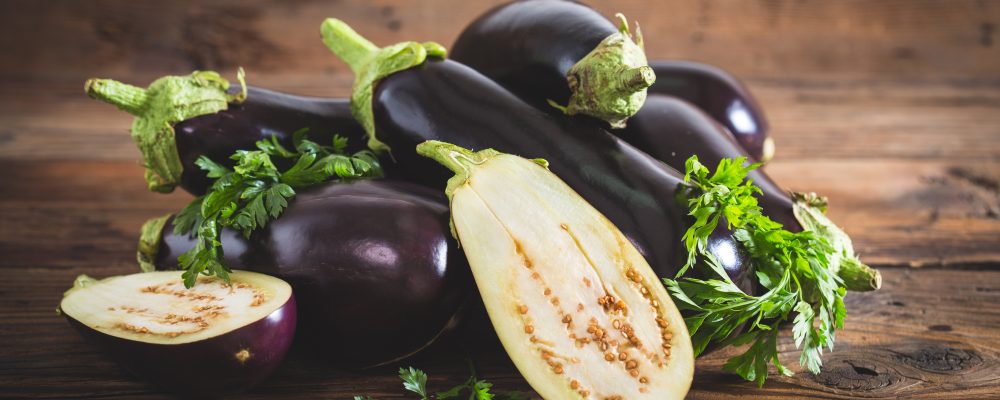

There is a vegetable that has a reputation problem.
Not a deserved one. Not a reputation built on honest encounters with the vegetable at its best, prepared with the specific techniques that reveal what it is capable of. A reputation built on bad versions — the soggy, oil-saturated eggplant of the underprepared kitchen, the bitter, undercooked eggplant of the recipe followed without understanding, the grey, textureless eggplant of the vegetable that was treated as a protein substitute rather than as the extraordinary ingredient it actually is.
The eggplant deserves better.
In August, when eggplant is at its genuine peak — its skin taut and glossy with a depth of purple that seems almost implausible for a vegetable, its flesh dense and white and free of the bitterness that plagues out-of-season specimens, its specific rich, meaty quality at its most pronounced — the case for the eggplant is easy to make to anyone willing to encounter it properly.
The difficulty is that encountering eggplant properly requires understanding several things about it that most people who have had bad eggplant experiences were never taught.
It requires understanding why eggplant behaves the way it does. Why it absorbs oil the way it does. Why it becomes bitter under certain conditions. Why it becomes silky and extraordinary under others. Why the technique matters more with eggplant than with almost any other summer vegetable.
Once these things are understood, the eggplant stops being the vegetable that disappoints and becomes one of the most rewarding ingredients of the August kitchen.
The Oil Problem and Its Solution
The eggplant’s most notorious quality — its apparently limitless ability to absorb oil during cooking — is responsible for more failed eggplant preparations than any other single characteristic, and it is misunderstood in a way that makes the failure predictable and avoidable.
The eggplant’s flesh is composed of a sponge-like cellular structure with large air pockets between the cells. When raw eggplant is placed in a pan with oil, the air pockets immediately begin absorbing the oil from their surfaces — producing the effect of an apparently bottomless container that soaks up every bit of oil added and demands more.
The conventional response to this — adding more oil — produces the soggy, oil-saturated eggplant that is the source of most eggplant disappointment. The oil that was absorbed in the early cooking fills the cellular structure and then, as the cells collapse from heat, is released back into the pan and into the mouth of the person eating the finished dish. The result is heavy, greasy, fundamentally unpleasant.
The correct response is based on understanding what the sponge-like structure actually requires: the collapse of the cellular structure before oil is added.
When eggplant is salted — generously, with coarse salt, left to sit for thirty minutes to an hour — osmosis draws moisture from the cells to the surface, which is then pressed or blotted away. The cells partially collapse. The air pockets that would have absorbed oil are reduced. The eggplant that goes into the pan after this treatment absorbs significantly less oil than the unsalted eggplant — not because the salting changes the fundamental physics of oil absorption, but because it reduces the amount of air space available to absorb it.
The roasted eggplant — placed whole in a high oven or directly on a gas flame until completely collapsed and charred — bypasses the oil absorption problem entirely. The heat collapses the cellular structure before any oil is involved, and the eggplant that emerges from the heat is already a transformed ingredient — silky, smoky, ready to be combined with oil and flavoring rather than absorbing it during cooking.
The Bitterness That Isn’t Always There
The bitter quality that many people associate with eggplant is real — but it is not a fixed property of the ingredient. It is a variable quality that depends on the specific variety, the ripeness at harvest, the age of the vegetable after harvest, and the specific preparation.
The bitterness in eggplant comes primarily from solanine and other alkaloids that are present in higher concentrations in certain varieties, in overripe specimens, and in eggplant that has been stored for an extended period after harvest. The peak-season August eggplant purchased from a farmers market vendor who harvested it yesterday is a fundamentally less bitter ingredient than the eggplant that has been sitting in a grocery store display for several days — because the alkaloid concentrations increase with age after harvest.
The salting process that addresses the oil absorption problem also reduces bitterness — because the osmotic process draws some of the bitter compounds to the surface along with the moisture, where they are removed when the surface liquid is pressed away.
But the most reliable solution to eggplant bitterness is the most direct one: buy the freshest eggplant available, at the peak of its season, from a source with high turnover. The peak-season fresh eggplant is not a bitter vegetable. The out-of-season or over-stored eggplant is — and no technique fully compensates for the starting quality of the ingredient.
The Global Eggplant: Every Cuisine Has Found It
Of all the summer vegetables, the eggplant is the one with the widest global culinary distribution — the one that appears, in different preparations and different forms, in the most different food cultures simultaneously.
This universality is not coincidental. The eggplant’s specific qualities — its ability to absorb flavors deeply, its transformation under heat from firm and slightly bitter to silky and rich, its substantial, meaty quality that makes it a satisfying primary ingredient rather than a supporting one — make it useful across the full range of culinary approaches that different food cultures bring to their vegetables.
The Mediterranean tradition has the moussaka of Greece and the Middle East, the caponata of Sicily, the imam bayildi of Turkey, the escalivada of Catalonia — each a different expression of the eggplant’s relationship with olive oil, with aromatics, with the slow heat that produces its best texture.
The South Asian tradition has the baingan bharta of North India — the roasted and mashed eggplant preparation that is one of the most deeply flavored vegetable dishes in any culinary tradition, the charring of the whole eggplant over direct flame producing a smokiness that runs through the entire preparation. And the baigan chokha of Bihar and the begun pora of Bengal and the vangyache bharit of Maharashtra — each regional expression of the roasted eggplant concept adapted to the specific aromatics and the specific technique of the specific tradition.
The East Asian tradition has the Japanese nasu dengaku — the eggplant halved and roasted until just tender, then glazed with sweet miso and broiled until caramelized, one of the most elegant and most specific eggplant preparations in any tradition. And the Chinese preparation of yu xiang qie zi — the eggplant braised in a garlic and chili and vinegar sauce that produces a sweet-sour-spicy-savory combination that demonstrates how thoroughly the eggplant can absorb and carry complex flavor combinations.
Each of these traditions found the eggplant and recognized in it something that repaid the specific approach that tradition brought to its ingredients. Each developed preparations that are specific to their culinary context and that reveal different aspects of what the eggplant is capable of.
The cook who knows even a few of these preparations has a far richer relationship with the eggplant than the cook who knows it only in the context of the preparation that failed.
The Techniques That Reveal the Eggplant
Of the specific techniques that produce genuinely excellent eggplant, three are worth knowing in detail — because each produces a fundamentally different result and each is suited to different culinary applications.
The flame-roasted technique — the eggplant placed directly on a gas burner or under a broiler and cooked, turning occasionally, until completely collapsed and charred on the outside — produces the most dramatic transformation available from the ingredient. The flesh inside the charred exterior becomes silky and smoky, with a specific depth of flavor that no other technique produces. This is the technique that produces baba ghanoush and baingan bharta and the puree that forms the base of numerous preparations across the Middle Eastern and South Asian traditions. The charred skin is removed — it has done its work of imparting smokiness to the flesh — and what remains is the eggplant at its most transformed.
The high-heat roasting technique — the eggplant cubed or sliced, tossed with oil and salt, roasted in a hot oven on a sheet pan with significant space between the pieces — produces a different result. Rather than the silky collapse of the flame-roasted eggplant, the high-heat roasted eggplant develops caramelized edges while retaining some structure in the interior. The result is more textural than the flame-roasted version — useful in preparations where the eggplant needs to hold its shape rather than melt into a puree.
The braised technique — the eggplant cut into pieces and cooked slowly in liquid with aromatics until completely tender and the flavors of the braising liquid have penetrated throughout — produces the most flavor-absorbent result. This is the technique of the caponata and the imam bayildi and the Japanese agedashi-style preparations — the eggplant as a sponge, now used deliberately and with control, absorbing the specific flavors of the braising liquid rather than random quantities of cooking oil.
The Eggplant Variety Worth Knowing
The eggplant most commonly available in grocery stores — the large, dark purple Globe variety — is not the only eggplant available at the peak of summer, and it is not always the best choice for every preparation.
The Japanese eggplant — long, slender, with thinner skin and a more delicate flavor and a flesh that cooks faster and more evenly than the larger Globe variety — is the best choice for preparations that require the eggplant to be cooked quickly or that benefit from its more refined flavor. The nasu dengaku preparation is specifically suited to the Japanese eggplant.
The Italian or Rosa Bianca eggplant — round, pale purple to white, with a particularly creamy flesh and a mild flavor that is among the least bitter of the common varieties — is the best choice for preparations where the eggplant’s flavor is the primary note and where the mildest possible expression is wanted.
The Thai eggplant — small, round, green or white, with a slightly bitter flavor and a firm texture that holds up to long cooking — is the specific variety that appears in Thai curries and that provides the slightly bitter counterpoint to the rich curry base that the recipe was designed around.
And the Chinese eggplant — long, with a lighter purple color and a thin skin, similar to the Japanese variety but with a slightly different flavor profile — is the specific variety best suited to the Chinese braised preparations that depend on its particular texture and flavor.
The Takeaway
The eggplant is not the difficult, disappointing vegetable that bad preparation has made it seem for too many people. It is one of the August kitchen’s most rewarding ingredients — one that repays understanding and technique with results that few other vegetables can match.
Salt it before cooking. Buy it fresh from a source with high turnover. Flame-roast it whole for the silky, smoky preparations. Roast it at high heat in cubes for the caramelized, textural ones. Braise it slowly for the flavor-saturated applications.
And seek out the variety that the specific preparation requires rather than defaulting always to the largest purple Globe at the front of the produce section.
The eggplant done right is one of summer’s most satisfying ingredients.
It has simply been waiting for someone to do it right.














