
There is a question worth asking at the end of anything.
Not a question about what was accomplished or what was learned or what the numbers show. A quieter question. One that only makes sense after enough time has passed that the individual moments can be seen as part of something larger.
What kind of relationship did we build with food?
This newsletter has spent months exploring what happens in professional kitchens and at farmers markets and in the chemistry of browning reactions and the history of spice routes and the psychology of cravings and the science of fermentation. It has followed the arc of a cook’s development from the first uncertain meal to the quiet confidence of someone who has made it before and knows it will work out. It has told the stories of the dishes that changed the world and the meals that can only exist once and the food that belongs to the places that produced it.
All of it, in the end, points in the same direction.
Not toward the technically perfect dish. Not toward the most informed palate or the most comprehensive pantry or the most accomplished knife skills. Toward a specific quality of relationship with food — honest, attentive, generous, curious — that makes cooking and eating genuinely worth doing rather than merely worth doing adequately.
That relationship is what this is really about.
What the Year Taught
There is something that emerges from a year spent paying close attention to food — not as a series of techniques to be mastered or a collection of facts to be accumulated, but as a subject that opens outward the more carefully it is examined.
Food is never just food.
It is chemistry and history and culture and memory and politics and ecology and the specific human need for connection that has organized itself around the shared meal for as long as humans have been gathering in groups. Every ingredient in every dish carries a history. Every meal at every table carries a meaning. Every act of cooking is simultaneously a technical act and a relational one — an expression of attention paid to the people who will eat what is being made.
This is what makes food worth taking seriously beyond the level of nutrition and convenience. Not because it is the most important thing — it is not — but because it is one of the most consistently available things. Three times a day, every day, there is an opportunity to do something with intention rather than out of habit. To choose an ingredient with awareness of what it is and where it came from. To cook with the specific attention that turns an ordinary meal into something that the people eating it will remember. To sit at a table with genuine presence rather than with attention distributed across the devices and demands that compete with it.
The opportunity is always there. The question is whether it is taken.
The Cook at the End of the Year
The cook who has been paying attention for a year — who has been cooking with genuine curiosity, who has been reading and thinking and experimenting and making mistakes and correcting them and making them again and learning something different the second time — is a different cook than the one who started.
Not necessarily more technically accomplished, though technique improves with practice. Not necessarily more knowledgeable, though knowledge accumulates. Different in a more fundamental way.
More present.
The quality of presence at the stove — the specific attention that notices what the pan is saying and responds to what the food needs rather than executing instructions and hoping for the best — is the quality that distinguishes genuinely good cooking from cooking that is merely competent. It cannot be faked and it cannot be rushed. It develops through the accumulated experience of showing up at the stove with genuine intention rather than going through the motions.
The cook who has developed this presence cooks differently. The food they make tastes different — not because the recipes are better or the ingredients are higher quality, but because genuine attention paid to any endeavor changes its outcome in ways that are immediately perceptible even when the mechanism is not fully understood.
And they eat differently. The meal made with presence is experienced with presence — attended to, noticed, tasted fully rather than consumed while attending to something else. The relationship between cooking with attention and eating with attention is not coincidental. Each reinforces the other.
What the Table Is For
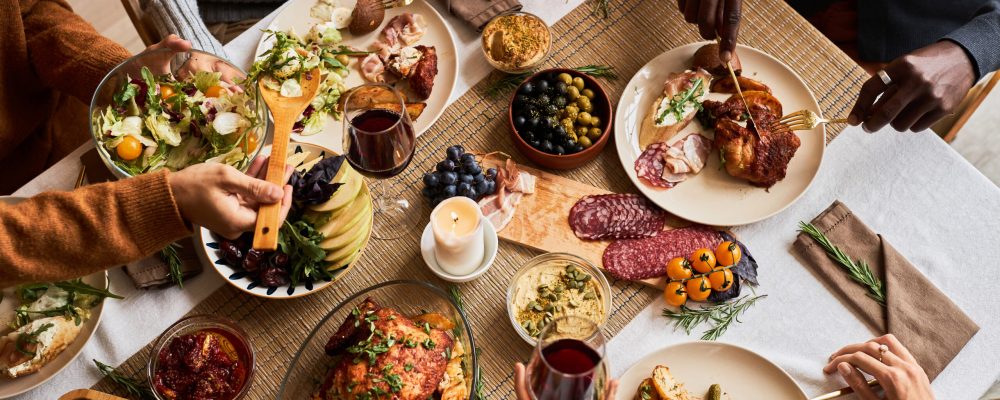
The table — the specific piece of furniture around which people gather to eat, which appears in some form in every food culture in every part of the world — is one of the oldest technologies of human connection that exists.
It is older than most of what we use to connect with each other. Older than the written word. Older than the city. Older than almost every institution that has shaped human civilization.
It has survived the competition of every new form of connection that technology has produced — the telephone, the television, the internet, the smartphone — not by being more efficient or more convenient than any of those things, but by offering something none of them provide.
Physical presence. Shared food. The specific ease that comes from sitting down together without any agenda other than to eat and to be with each other.
This is not sentimental. It is structural. The shared meal does things to human relationships and human bodies and human brains that other forms of connection do not do. It produces the specific quality of togetherness that sustained human communities before any other technology existed for that purpose. It is the original social technology — the first and most durable mechanism for turning a collection of individuals into a group.
The table set with care, the food made with attention, the meal eaten with genuine presence — these are not small things. They are the continuation of something very old and very important that has somehow survived every force in modern life that might have ended it.
The Letter to the Serious Eater
To anyone who has been reading, cooking, and eating with genuine curiosity —
You are part of something worth being part of.
Not a movement or a trend or a cultural moment. Something older and more durable than any of those things. The human practice of caring about what we eat and how we prepare it and who we eat it with — the practice that has produced every great culinary tradition the world has ever developed, that has sustained communities through scarcity and abundance and every condition in between, that has found expression in the grandmother’s kitchen and the street food stall and the professional kitchen and the home table set for Tuesday dinner.
The cook who is curious about why things work the way they do, who wants to understand the food they make rather than just execute it, who finds the history and the science and the culture of food genuinely interesting rather than merely useful — that cook is keeping something alive that deserves to be kept alive.
The eater who pays attention — who tastes what is actually in front of them rather than what they expect to be there, who can be surprised by food, who finds genuine pleasure in the seasonal ingredient at its peak and the simple meal made well and the specific satisfaction of a dish that did exactly what it was supposed to do — that eater is living more fully in one of the most consistently available dimensions of human experience.
This is worth continuing.
Not every meal needs to be extraordinary. Not every ingredient needs to be the best available. Not every cooking session needs to produce something memorable. The ordinary Tuesday dinner matters too — the meal that is nothing special and is eaten without particular ceremony and that keeps the daily practice of cooking and eating together alive in a household that might otherwise drift toward convenience and distraction.
The extraordinary meal is the exception. The ordinary meal is the practice. And the practice, sustained over time, is what produces the knowledge and the confidence and the specific quality of presence that makes the extraordinary meal possible when it arrives.
What Comes Next
Food culture is not static. It will continue to change in ways that are difficult to predict from where we stand — new ingredients will enter the mainstream, new culinary traditions will be encountered and absorbed, new scientific understanding will revise what we know about nutrition and cooking, new technologies will alter the relationship between cooking and convenience in ways that raise the same questions each previous generation has faced about what is gained and what is lost.
The specific questions that will matter in the next decade of food culture are already forming — around the environmental implications of what we eat, around the cultural politics of cuisine and appropriation and authenticity, around the specific ways that technology is changing the relationship between cooking and eating and the social fabric that the shared meal has always sustained.
These questions are worth engaging with seriously. Not with anxiety or with the specific food culture moralism that treats every eating decision as a political statement, but with the genuine curiosity that serious engagement with any important subject requires.
The relationship with food that is worth building is not a perfect one. It is not a consistent one, or a fully informed one, or one that resolves every tension between pleasure and ethics and convenience and health. It is a genuine one — a relationship characterized by real attention and real curiosity and the willingness to be changed by what that attention and curiosity reveals.
That relationship, built over years of ordinary cooking and ordinary eating with genuine presence, produces something that no other approach to food quite provides.
It produces a cook who loves to cook.
And an eater who loves to eat.
And that, in the end, is exactly enough.
The Takeaway
The table we set for ourselves — the specific relationship with food and cooking and eating that we build over the course of a life — is one of the most significant and most consistently available expressions of how we choose to live.
Set it with care. Fill it with food made with attention. Eat at it with genuine presence. Share it with people who matter.
And keep showing up for it — on the ordinary Tuesdays and the extraordinary occasions and every meal in between.
The table is always there.
The question is always whether we are.