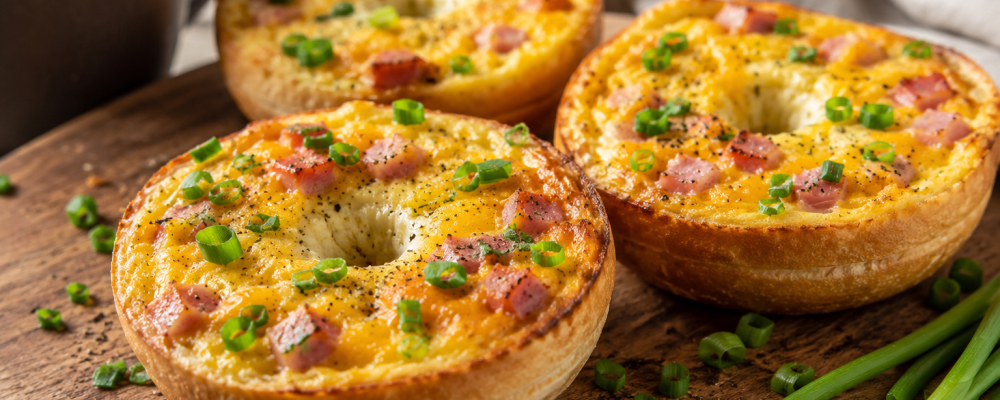

There’s a particular kind of recipe joy that comes from the moment a simple idea clicks into place—when you look at two things you already love and suddenly see how perfectly they belong together. That’s exactly how I feel about these Quiche Stuffed Bagels. A bagel is already a beautifully structured thing, with that chewy, golden exterior and the soft interior that practically asks to be scooped out and filled with something wonderful. And quiche—creamy, savory egg custard with cheese and ham—is one of those endlessly satisfying brunch classics that never goes out of style. Putting one inside the other feels, once you’ve seen it, like the most natural thing in the world.
What makes me love this recipe beyond the clever concept is how well it actually works in practice. The bagel isn’t just a container—it becomes part of the dish, its chewiness contrasting with the silky, set egg custard in a way that makes every bite texturally interesting. The edges of the bagel toast and crisp slightly during baking, while the quiche filling inside stays tender and creamy. You get that satisfying combination of toasted bread and savory egg in every single mouthful, which is really just a more elegant version of what we’re all doing when we eat a breakfast sandwich anyway.
I also love that these are genuinely practical in a way that feels rare for something this impressive-looking. They hold together beautifully for eating out of hand, they reheat well, they can be made ahead, and they’re endlessly customizable based on what you have in your refrigerator. These are the qualities I look for in recipes that actually earn a place in regular rotation rather than just being tried once for novelty. These stuffed bagels have earned that place, and I have a feeling they’ll earn it in your kitchen too.
─────────
The Inspiration Behind This Recipe
This recipe came to me during a morning when I had leftover quiche filling and day-old bagels and very little patience for wasting either. I’d been thinking about the relationship between containers and fillings in food—the way a taco shell, a bread bowl, or a hollowed-out pepper fundamentally changes the experience of eating the food inside it. Bagels have such beautiful structural integrity; they’re designed to hold things. The question was just whether they could hold something more interesting than cream cheese.
The quiche filling turned out to be the perfect answer. The egg and cream mixture sets firmly enough during baking to stay in the bagel without spilling, while the cheese and ham distribute evenly through the cavity and create that familiar, satisfying quiche flavor in every bite. The green onions add freshness that keeps the overall dish from feeling heavy despite the richness of the custard. Everything works together not just conceptually but practically—this isn’t a recipe that sounds better than it tastes.
What I discovered in testing was that different bagel varieties create genuinely different results. Plain bagels let the quiche filling take center stage. Everything bagels add a wonderful savory spice note that complements the ham and cheese beautifully. Onion bagels amplify the green onion flavor throughout. This recipe invites that kind of experimentation and personalization, which is one of my favorite qualities in any recipe—when the basic structure is so sound that variations and adaptations feel natural and encouraged rather than risky.
─────────
A Brief History of Stuffed Breads
The concept of using bread as an edible vessel is ancient and deeply human—appearing across cultures and centuries as cooks recognized that hollowed bread could contain, protect, and enhance the foods placed inside it. Medieval European trenchers—thick slices of stale bread used as plates—evolved into bread bowls that were eaten alongside or after their contents. French vol-au-vents, Italian panzerotti, Indian bread bowls filled with chaat—every culinary tradition has its own version of this fundamental, practical idea.
The bagel itself has Eastern European Jewish origins, likely emerging in Polish Jewish communities in the 17th century before traveling with immigrants to America in the late 19th and early 20th centuries. New York City became the bagel’s spiritual home, where traditional boiling-before-baking methods created the characteristic dense, chewy texture that distinguishes authentic bagels from softer imitations. The bagel’s circular shape with its hollow center makes it uniquely suited to being hollowed and filled—a structural invitation that creative cooks have been accepting with increasing enthusiasm.
The stuffed bagel as a deliberate recipe concept represents modern food culture’s love of mashup cooking—taking established dishes and reimagining them in new formats. The bagel-meets-quiche innovation is part of a broader trend of breakfast creativity that has flourished alongside brunch culture’s expansion. It honors both traditions—the bagel’s New York deli heritage and quiche’s French bistro elegance—while creating something entirely new that belongs fully to neither and beautifully to both.
─────────
Why This Cooking Method Works
Scooping out the bagel interior creates the cavity that makes this recipe possible while serving a secondary structural purpose. The remaining bagel wall needs to be substantial enough to hold the liquid egg mixture without leaking but scooped enough to provide meaningful volume for the filling. Removing roughly the top third of the interior bread achieves this balance—enough space for a generous portion of quiche filling while maintaining the structural integrity that keeps everything contained during baking and eating.
Whisking the eggs thoroughly with the heavy cream before adding other ingredients creates a uniform, emulsified custard base that sets evenly throughout the bagel. The heavy cream’s fat content provides the silky, tender texture that distinguishes proper quiche from egg bake—it prevents the eggs from becoming rubbery or grainy during baking. The salt and pepper go into the custard rather than being added later so they distribute evenly through every bite rather than sitting on the surface.
Baking at 350°F for 25-30 minutes provides the gentle, consistent heat that egg custard requires. Higher temperatures would cook the outside of the custard before the center sets, creating that unpleasant rubbery texture we associate with overcooked eggs. This moderate temperature allows the custard to coagulate slowly and evenly throughout, while simultaneously toasting the bagel exterior to golden perfection. The parchment-lined baking sheet prevents sticking and makes cleanup simple—practical considerations that make this recipe as approachable as it is delicious.
─────────
Flavor Profile: What to Expect
These stuffed bagels deliver familiar, comforting flavors in a satisfying new format:
- Chewy toasted bagel – Dense, golden exterior with that characteristic bagel chew and slight crust
- Silky egg custard – Creamy, tender, and richly flavored with that classic quiche texture
- Sharp cheddar melt – Pronounced cheese flavor distributed throughout the custard
- Savory ham – Salty, smoky pieces that provide protein and concentrated flavor
- Fresh green onion – Mild, bright aromatics that add freshness and color
- Heavy cream richness – The fat that creates that luxurious, silky custard texture
- Black pepper warmth – Subtle but essential, lifting the other flavors throughout
The overall experience is one of comforting familiarity in a format that feels cleverly new. Each bite delivers toasted bagel and creamy quiche simultaneously—that combination of chew and creaminess, bread and egg, that makes breakfast sandwiches so universally appealing but presented in a more elegant, cohesive way. The filling stays tender and moist, the bagel provides structure and satisfying chew, and the whole thing holds together beautifully in your hands.
─────────
Tips for Making the Best Quiche Stuffed Bagels
Choose bagels with substantial, dense interiors—thin, airy bagels won’t have enough structure to hold the filling properly without leaking.
- Scoop evenly but carefully – Leave at least half an inch of bagel wall on all sides for structural integrity
- Don’t overfill – Fill to just below the rim; the custard expands slightly as it sets
- Press cheese into the corners – Ensures even cheese distribution rather than all cheese on top
- Whisk custard thoroughly – No streaks of white or yolk should remain before adding other ingredients
- Use room temperature eggs – They incorporate more smoothly into the cream for a more uniform custard
- Check doneness gently – The custard should be just set with no jiggle in the center; slight underdone is better than overcooked
- Rest before serving – Five minutes allows the custard to firm slightly for cleaner eating
- Experiment with bagel varieties – Everything, onion, or sesame bagels add wonderful additional flavor
For a beautiful finishing touch, add a small sprinkle of extra cheddar and green onions on top of the filled bagels before baking—they create an attractive, golden-topped presentation that looks genuinely impressive with minimal effort.
─────────
Serving Suggestions and Side Pairings
These stuffed bagels are substantial enough to be a complete breakfast on their own, but they welcome simple accompaniments that add brightness and balance. A simple green salad with light vinaigrette provides fresh contrast that makes the meal feel complete without adding heaviness. Sliced tomatoes with sea salt and fresh basil echo the quiche’s savory character while adding juicy, acidic relief. Fresh fruit—particularly berries or citrus segments—adds sweetness and color that makes the plate visually beautiful.
For brunch service, arrange the stuffed bagel halves on a large wooden board surrounded by small bowls of complementary additions: hot sauce, sour cream, extra green onions, or sliced avocado. This creates a build-your-own element that encourages guests to customize and makes the presentation feel generous and welcoming. The bagels can also be sliced in half for easier sharing, revealing the beautiful cross-section of set custard and cheese that makes them so visually appealing.
These shine at weekend brunch gatherings, holiday breakfasts, or office morning meetings where portable, self-contained food makes practical sense. They’re particularly wonderful for situations where you want to offer something impressive and homemade without the complexity of plating individual portions—everyone gets their own complete, beautiful little vessel.
─────────
Storage, Reheating, and Make-Ahead Tips
- Make custard filling ahead: Whisk together up to 24 hours ahead; store covered in refrigerator, stir before using
- Prep bagels early: Scoop and hollow bagels up to 1 day ahead; store in an airtight container
- Bake and refrigerate: Fully baked stuffed bagels keep refrigerated for up to 3 days
- Reheat in oven: 300°F for 10-12 minutes covered with foil restores texture without drying the custard
- Microwave carefully: 45-60 seconds works for individual portions but can make custard slightly rubbery
- Freeze baked portions: Wrap individually and freeze for up to 2 months; thaw overnight before reheating
- Transport beautifully: These travel exceptionally well—the bagel structure keeps everything contained
- Serve at room temperature: Like quiche, these are genuinely delicious slightly cooled, not just piping hot
The make-ahead quality is one of this recipe’s genuine strengths. Fully baked, refrigerated, and reheated the next morning, they taste almost as good as fresh from the oven—which makes them excellent for meal prepping a week of impressive, protein-rich breakfasts from a single baking session.
─────────
Why This Recipe Deserves a Spot in Your Rotation
This recipe earns its place because it solves multiple breakfast challenges simultaneously: it’s portable, protein-rich, make-ahead friendly, endlessly customizable, and genuinely impressive looking despite being remarkably simple to execute. Once you understand the technique—hollow, fill, bake—you have a format you can adapt endlessly with different cheeses, proteins, vegetables, and bagel varieties based on what you have available and what sounds good. That kind of flexible, reliable structure is exactly what makes recipes genuinely useful rather than just interesting to try once.
Beyond practicality, there’s something simply lovely about these stuffed bagels—the way they take two beloved breakfast things and create something that honors both while being entirely its own. Good food does that, I think: it makes you feel the care and thought that went into it while also feeling like it was always meant to exist. These Quiche Stuffed Bagels feel that way to me. They’re clever without being showy, satisfying without being heavy, familiar without being ordinary—and those qualities, reliably delivered in a recipe you can actually make on a regular Tuesday morning, are what make something truly worth keeping.
─────────
Recommended Drink Pairing
The savory, egg-rich flavors and chewy bagel base of these stuffed bagels pair beautifully with beverages that provide either complementary richness or refreshing contrast. Coffee is the natural companion—a medium roast with enough body to stand up to the cheddar and ham without overwhelming the delicate custard. A classic café au lait adds creamy texture that harmonizes with the heavy cream in the quiche filling, while a simple black coffee provides the slight bitterness that balances the cheese’s richness.
For something more celebratory, mimosas bring sparkling wine and orange juice together in a pairing that’s almost synonymous with brunch—the citrus acidity cuts through the egg custard beautifully while the bubbles refresh the palate between bites. Fresh-squeezed orange juice works just as well without the champagne, providing that same bright citrus contrast in a straightforward, classic format.
For tea drinkers, a robust English Breakfast or Assam provides the tannins needed to complement rather than be overwhelmed by the savory, cheesy filling. Earl Grey’s bergamot adds an unexpected but genuinely lovely citrus note that lifts the whole meal. Sparkling water with lemon offers the simplest possible palate-cleansing option for those who want to keep the focus entirely on the food. A good Bloody Mary, if the occasion calls for it, brings savory depth and tomato’s natural affinity for eggs and cheese in the most satisfying way—arguably the most natural pairing of all for a dish that’s essentially a quiche in a bagel, the brunchiest possible thing in the brunchiest possible vessel.
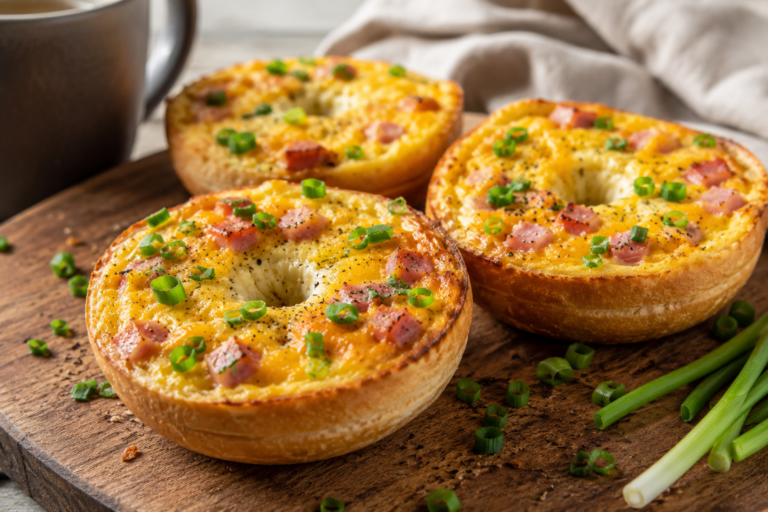
Quiche Stuffed Bagels
These Quiche Stuffed Bagels hollow out chewy bagels and fill them with a silky egg custard loaded with ham, cheddar, and green onions—creating a handheld brunch that’s equal parts clever, satisfying, and absolutely delicious.
6
servings20
minutes30
minutes350
kcal50
minutesIngredients
6 pieces bagels
4 large eggs
1/2 cup heavy cream
1 cup shredded cheddar cheese
1 cup diced cooked ham
1/4 cup chopped green onions
1/4 teaspoon salt
1/4 teaspoon black pepper
Directions
- Preheat your oven to 350 degrees Fahrenheit (175 degrees Celsius).
- Slice the bagels in half and carefully scoop out some of the bread to create a deep pocket.
- In a mixing bowl, whisk together the eggs, heavy cream, salt, and black pepper.
- Stir in the shredded cheddar cheese, diced ham, and chopped green onions.
- Spoon the quiche mixture into each bagel half, filling it evenly.
- Place the filled bagel halves onto a baking sheet lined with parchment paper.
- Bake in the preheated oven for 25-30 minutes until the egg mixture is set and the tops are golden brown.
- Allow to cool slightly before serving warm.
Nutrition Facts
- Total number of serves: 4
- Calories: 350kcal
- Cholesterol: 0mg
- Potassium: 400mg
- Sugar: 8g
- Protein: 6g
- Calcium: 60mg
- Iron: 2mg
About This Author

Amelia Grace
Editor-in-Chief & Culinary Director
The heart and guiding voice of Daily Dish, Amelia leads our editorial vision and recipe development. With a background in food journalism and over a decade spent in professional kitchens, she has a knack for blending gourmet technique with real-world accessibility. Her goal? To make every reader feel like a confident cook, one dish at a time.
Favorite dish: Creamy lemon risotto with a sprinkle of fresh thyme.
Kitchen motto: “Good food doesn’t have to be complicated — it just has to be made with heart.”