
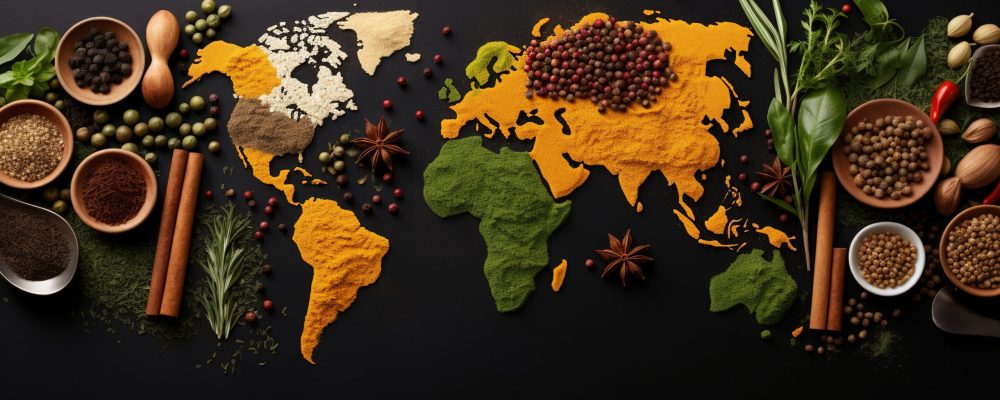

Every meal is an autobiography.
Not literally — not in the sense that a plate of food contains a legible narrative that any observer can decode. But in the sense that what a person chooses to eat, how they eat it, what they eat it with and when and where and why, reflects something about who they are and where they came from that is as specific and as revealing as any other form of self-expression.
Food is identity. Not the only expression of identity — not the most important one — but one of the most consistent, most intimate, and most revealing.
The food a person reaches for when no one is watching. The dishes associated with specific people who are no longer alive. The meals that mark the transitions of a life — the birthdays, the graduations, the weddings, the funerals, the quiet Tuesdays that somehow became significant. The flavors that feel like home and the flavors that feel like elsewhere and the flavors that feel like both simultaneously because home is complicated.
These are not just preferences. They are a kind of evidence — about family and culture and memory and the specific circumstances of a life lived in a particular place at a particular time.
The Food That Came Before You
The food on the table is almost never invented by the person who made it.
It came from somewhere — from a parent or a grandparent or a great-grandparent, from a country of origin or a regional tradition or the specific circumstances of migration that deposited a family in a place where certain ingredients were available and others weren’t and the cooking adjusted accordingly.
The dish that a family calls its own — the recipe that is understood to belong to the family in some proprietary way, that is made by a specific person and that no one else quite gets right — is almost always a dish that arrived through inheritance. Not legal inheritance. The inheritance of embodied knowledge — the knowledge carried in hands that learned from other hands, in the particular adjustment made automatically because that’s how it was always done, in the specific flavor memory that constitutes the family’s standard for what the dish is supposed to be.
This inheritance is rarely documented. It exists in practice rather than in writing — in the act of cooking rather than in the recipe. And when the person who carries it is gone, the knowledge they carried is gone with them unless it was transmitted while it was possible.
The food historian Psyche Williams-Forson has written about the role of food in preserving cultural memory — about the way that cooking traditions carry knowledge about a culture’s values, its history, its relationship with specific ingredients and specific places, that might not survive in any other form. The dish is a document. The act of making it is an act of historical preservation.
Every cook who learns a family recipe from the person who carried it is doing something that has significance beyond the immediate meal.
The Flavors of Displacement
For people whose families have moved — across borders, across oceans, across the significant distances that immigration and migration create — food is often the most durable connection to what was left behind.
The cooking of diaspora communities around the world reflects this durability in ways that are both heartbreaking and remarkable. The adaptation that occurs when a family tries to cook the food of their origin in a new place — with different ingredients, different equipment, different available substitutes — produces dishes that are neither entirely the original nor entirely new. They are something in between: the original filtered through the specific constraints and opportunities of the new place.
The Chinese American food of the nineteenth and twentieth centuries — adapted from Cantonese cooking to the ingredients available in California and the American West, shaped by the specific needs of feeding Chinese workers in a country that was hostile to their presence — is not Chinese food and is not American food. It is its own thing: a culinary tradition created by the specific circumstances of a specific community in a specific historical moment.
The same is true of the Tex-Mex tradition, of soul food, of the Creole and Cajun cooking of Louisiana, of the Jewish American deli tradition, of every other culinary hybrid produced by the encounter between a migrating culture and a new place. Each of these traditions carries the story of the displacement that produced it — the original culture, the new context, the specific adaptations made at the intersection of the two.
Eating these foods is eating their history. The specific flavors of displacement — the ingredient that was substituted because the original wasn’t available, the technique that was adapted to a different stove, the dish that was invented because two traditions met at a table and produced something neither had before — are the flavors of a specific human story.
The Meals That Mark Time
There is a category of food whose primary function is not nutrition or pleasure but commemoration — the marking of time and transition through the specific act of eating.
Every culture has these dishes. The foods that appear only at specific moments in the annual or life cycle — at holidays, at births, at deaths, at the transitions that mark the passage from one stage of life to another. Their appearance is not primarily about the food itself. It is about what the food means — what its presence on the table signals about the occasion and about the community that assembled to mark it.
The Thanksgiving turkey is not, in any objective culinary sense, an extraordinary preparation. The food is not the point. The point is the gathering — the specific assembly of people, the specific occasion, the specific set of associations that the food activates in everyone who eats it. The meal is doing social and emotional work that has nothing to do with its nutritional or culinary value.
This is true of the Passover seder and the Christmas pudding and the birthday cake and the wedding cake and the food at a funeral reception. Each of these dishes is a vehicle — for memory, for community, for the marking of time, for the specific expression of continuity between the past and the present that ritual food provides.
The child who eats their grandmother’s cake at every birthday grows up with an association between that taste and that occasion and that person that persists long after the grandmother is gone. The taste activates the memory. The memory activates the feeling. The feeling is the real content of the meal.
The Politics on the Plate
Food is not only personal and familial and cultural. It is political — in ways that are sometimes explicit and sometimes invisible but that are always present.
What is available to eat, and at what price, and in what circumstances, is not a neutral function of supply and demand. It is the product of agricultural policy, of trade relationships, of the specific history of land use and labor exploitation and environmental impact that produced the food system as it currently exists.
The food choices available to a person of limited means in a food desert — a neighborhood without a grocery store, surrounded by fast food and convenience stores — are not the same as the food choices available to a person in a wealthy neighborhood with a farmers market and a Whole Foods within walking distance. These are not different expressions of personal preference. They are different material conditions produced by specific policy decisions and specific distributions of resources.
The specific foods that were available to enslaved people in the American South — the parts of the animal that were not valued by enslavers, the greens that could be foraged, the crops that could be grown in small personal plots — produced a culinary tradition of extraordinary creativity and depth that is now recognized as the foundation of Southern American cooking. Soul food is not just a cuisine. It is a document of survival and creativity under conditions of extreme constraint — of the specific human capacity to make something meaningful from whatever is available, regardless of how little that is.
The story that food tells about who we are includes the story of what we were allowed to have. And reading that story honestly requires acknowledging the conditions that shaped it.
The Table as Mirror
There is a specific quality of self-knowledge available in paying attention to what we eat and why — in looking at the food choices we make, the dishes we reach for, the meals we remember, as evidence of something about ourselves that we might not otherwise examine.
The cook who makes the same dish their mother made when they were sick is not just making soup. They are expressing something about what care means to them, about the specific form that nurturing takes in their understanding of it, about the relationship between food and love that their early experience established.
The person who cannot eat certain foods without specific memories arising — who cannot smell a particular spice without being transported to a specific kitchen in a specific time — is experiencing the particular intimacy of the relationship between food and autobiographical memory that makes eating one of the most psychologically loaded of all daily activities.
And the person who has moved away from the food of their upbringing — who has deliberately chosen a different way of eating from the one they were raised with, whether for health reasons or ethical ones or simply because their taste has changed — is also expressing something. About the relationship between choice and inheritance. About what it means to construct an identity rather than simply inherit one.
Food tells the story. The question is whether we’re paying enough attention to read it.
The Takeaway
The food on the table is not just food. It is the accumulated evidence of a life — of where a person came from, what their family carried, what their culture values, what their circumstances allowed, what their memory treasures, what their politics reflect.
Paying attention to this evidence — to the stories that the food on the table tells about who we are and where we came from — does not make the eating more complicated. It makes it more resonant.
Every meal is an opportunity to know something about ourselves. The cook who pays attention to what they make and why, the eater who notices what they reach for and when, the family that tells the stories behind the dishes on the table — all of them are reading a text that is always there, always specific, always worth reading.
The food tells the story.
We just have to be willing to hear it.














