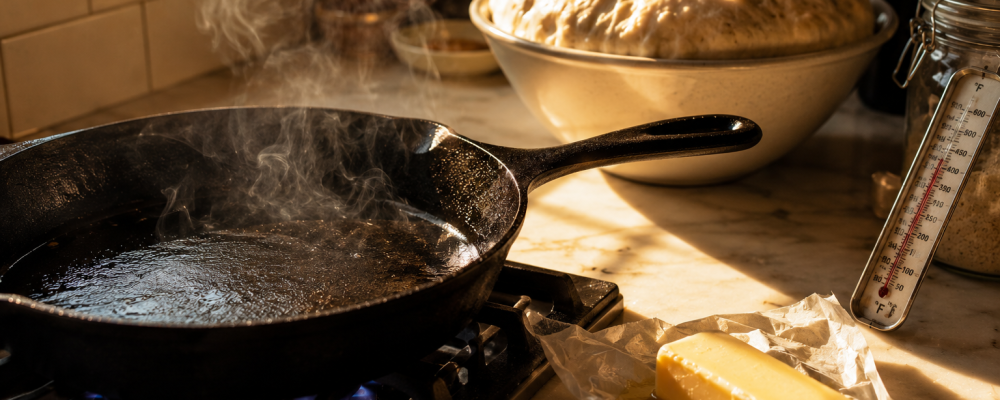

There is a laboratory that most people have in their home and never think of as one.
The kitchen.
Every time a cook lights a burner or opens an oven or drops something into boiling water, they are initiating a series of chemical and physical transformations that are as specific and as measurable as anything that happens in a research facility — with the difference that the goal is not data but dinner, and the instruments of measurement are not thermometers and spectrometers but hands and noses and tongues.
In August, the kitchen laboratory operates under a specific set of conditions that don’t exist in other months — conditions that affect not just the comfort of the cook but the actual chemistry of what is being cooked. The ambient temperature is higher. The humidity is different. The ingredients themselves are at a different stage of their biological development than they were in April or will be in October.
These conditions change what happens in the kitchen in ways that are worth understanding — not as abstract science but as practical knowledge that makes August cooking more intentional and more successful.
What Ambient Temperature Does to Fermentation
Of all the cooking processes affected by the August kitchen’s ambient temperature, fermentation is the most sensitive and the most significantly altered.
Fermentation is driven by microorganisms — yeast and bacteria whose metabolic activity is temperature-dependent in ways that are precisely measurable. The general principle: warmer temperatures accelerate fermentation, cooler temperatures slow it. The specific implications of this principle for August cooking are significant enough that the cook who ignores them produces consistently unpredictable results.
The sourdough starter that requires twelve hours to peak in a sixty-eight degree February kitchen may peak in four to six hours in an eighty-two degree August kitchen. The same feeding schedule that produced reliable, predictable results through the winter produces an overfermented, collapsed starter in summer — not because the starter has changed but because the temperature at which it is fermenting has changed dramatically.
The sourdough bread made with this misunderstood starter rises faster than the baker anticipated, overproofs before the baker has managed the baking schedule, and produces a loaf with a dense, gummy crumb and a sour flavor that is more aggressive than intended — because the extended fermentation at high temperature has produced more acetic acid than the recipe was designed to accommodate.
The adjustment is straightforward once the principle is understood: in August, reduce the quantity of starter in the bread dough, reduce the fermentation temperature by using the refrigerator for part of the process, or shorten the fermentation time and increase the observation frequency to catch the dough at the right moment before it overproofs.
The same temperature-fermentation relationship affects yogurt, kimchi, kombucha, and any other fermentation project happening in the August kitchen. Each of these will proceed faster than it does in cooler months — and the cook who doesn’t account for this produces results that are inconsistent with what the recipe and the previous experience of the same preparation suggested.
The Butter That Behaves Differently
Butter is one of the ingredients most specifically and most immediately affected by the August kitchen’s ambient temperature — and the specific ways it behaves differently in heat change the techniques required to work with it successfully.
At refrigerator temperature, butter is firm — solid enough to hold its shape and to be cut cleanly. At room temperature in a cool kitchen, butter softens to the pliable consistency that is ideal for creaming — the stage at which it incorporates air most efficiently when beaten and produces the specific texture in baked goods that properly softened butter creates.
In an August kitchen at eighty-five degrees, butter at room temperature is no longer at the creaming stage. It is approaching the point of separation — the stage at which the water in the butter begins to separate from the fat, producing an oily, greasy texture that is fundamentally different from properly softened butter. Butter creamed at this stage does not incorporate air efficiently. The resulting cake or cookie has a different texture — denser, greasier, less well-risen — than the same preparation made in a cooler kitchen.
The practical adjustment for August baking is to work with butter that is cooler than would be appropriate in other months — to pull it from the refrigerator later, to work quickly before it warms beyond the optimal stage, and in some cases to partially chill the mixing bowl to keep the butter at the right temperature through the creaming process.
The pie crust that is famously temperature-sensitive — requiring cold butter and cold water and cold hands and a cold work surface to produce the specific flakiness that comes from fat remaining solid in distinct layers throughout the dough — is the most extreme case of this butter-temperature relationship. In August, the pie crust maker works against the ambient temperature at every stage. The butter must be frozen rather than merely refrigerated. The water must be ice water. The dough must be chilled after mixing and again after rolling. The work must be done quickly.
The cook who understands why the temperature matters — who knows that the flakiness of pie crust comes from fat remaining solid and distinct through baking, creating steam pockets that produce layers, and that any warming that causes the fat to melt into the flour before baking destroys this mechanism — can make the specific adjustments that the August kitchen requires rather than simply following instructions designed for a different ambient temperature.
The Sugar That Behaves Differently
Candy making and sugar work — the specific set of cooking techniques that depend on bringing sugar solutions to precise temperatures to produce specific crystalline or non-crystalline structures — are among the most significantly affected August kitchen processes.
The behavior of a sugar solution being cooked to a specific temperature depends not just on the temperature of the sugar itself but on the humidity of the surrounding environment. Humid air — which August consistently provides — contains water vapor that interferes with the crystallization process that certain candies depend on and that affects the temperature readings of sugar solutions in ways that can cause confusion.
Specifically: in humid conditions, the boiling point of water — which is the reference point for the temperature stages of candy making — is effectively lower than the standard 212°F because the water vapor in the air reduces the evaporation rate from the boiling solution. This means that the thermometer reading that indicates soft ball stage in a dry kitchen indicates something slightly different in the August humidity.
The fudge that refuses to set properly despite being cooked to what the thermometer indicated was the correct temperature. The caramel that stays soft when it should be firm. The toffee that is sticky rather than brittle. Each of these is a characteristic August candy making failure — the result of humidity interfering with the specific chemistry that candy making depends on.
The practical response to this is to cook sugar to slightly higher temperatures in August than the recipe specifies — accounting for the humidity’s effect — and to work on the lowest-humidity days available rather than the hottest or most convenient ones. Professional confectioners have air-conditioned, humidity-controlled production spaces precisely because the specific sensitivity of sugar work to ambient conditions makes consistency impossible without environmental control.
The Bread That Rises Too Fast
Beyond the sourdough complications described above, all yeast-leavened bread behaves differently in the August kitchen — and the specific ways it behaves differently are worth understanding as a unified phenomenon rather than as individual recipe problems.
Commercial yeast — the dried or fresh yeast used in most quick bread preparations — has an optimal temperature range for fermentation activity of approximately 75 to 85°F. Below this range, fermentation is slower than the recipe assumes. Above it, fermentation accelerates. In the August kitchen, which often exceeds this range, the fermentation is faster than the recipe was designed for.
The practical consequences are the same as the sourdough overfermentation problem: bread that has risen too fast, beyond the window of optimal gluten development, with a structure that has been weakened by the extended fermentation or has peaked and begun to collapse before baking.
The specific visual cue of overproofed bread — the dough that has expanded beyond the doubled volume that recipes specify as the endpoint, that has lost the surface tension that gives it its shape, that sags when handled — is a cue that arrives faster in August than in other months.
The August bread baker watches the dough rather than the clock — tasting and touching and observing rather than relying on the time specified in a recipe written for a different temperature environment. They reduce the quantity of yeast slightly. They use cooler water to mix the dough. They proof in the refrigerator rather than at room temperature for the extended first rise.
The Ice Cream That Melts Too Fast
Ice cream, which has appeared in these pages in the context of its production challenges, presents in August a specific service challenge that is worth understanding as science rather than simply as frustration.
Ice cream melts because heat transfers from the surrounding environment into the cold of the ice cream, raising its temperature toward equilibrium. The rate of this heat transfer depends on the temperature differential between the ice cream and the surrounding air — the greater the differential, the faster the transfer.
In August, when the surrounding air is at eighty-five or ninety degrees rather than the sixty-eight degrees of a temperate indoor environment, the temperature differential is significantly larger, and the heat transfer is significantly faster. The ice cream that holds its shape for fifteen minutes at a table in May is melting within five minutes at an outdoor August table.
The practical responses to this are both serving-side and recipe-side. On the serving side: smaller scoops served in chilled bowls, eaten immediately rather than photographed and then eaten. On the recipe side: the specific sugar management discussed in the ice cream article — the use of invert sugars and higher sugar concentrations that depress the freezing point and produce a softer, slower-melting product at warmer temperatures.
The stabilizers that commercial ice cream uses — the guar gum and locust bean gum and carrageenan that are present in most commercial ice cream — serve primarily this function: slowing the melt rate by interfering with the ice crystal structure in ways that make the ice cream more resistant to the temperature changes of serving. The home ice cream maker who wants similar melt resistance can use a small amount of commercial stabilizer or can rely on higher egg yolk content — the lecithin in the yolks providing some of the same structural benefit.
The Oil That Smokes Too Early
The August kitchen’s ambient heat affects the behavior of cooking oils in a way that is subtle but practically significant — and that is responsible for a specific category of August cooking failure that is common enough to be worth explaining.
Cooking oils have smoke points — the temperatures at which they begin to break down and produce visible smoke and the acrolein and other compounds that indicate degradation. These smoke points are measured at the temperature of the oil itself, not the ambient temperature of the kitchen.
However: oil in a pan in an eighty-five degree kitchen begins at a higher temperature than oil in a pan in a sixty-eight degree kitchen — because the ambient heat has warmed the oil before the burner is even turned on. The pan itself is warmer. Everything in the August kitchen begins from a higher baseline temperature.
The practical effect is that oil reaches its smoke point faster in August than in other months — not because the smoke point has changed but because the starting temperature is higher. The cook who adds oil to a pan and turns the burner on high in August reaches the smoking point of the oil faster than the same action produces in March.
This is not a major adjustment — but it is worth knowing, particularly for the cook who is searing at high heat and who needs to manage the time between adding oil and adding food to avoid the degradation that smoking oil produces.
The Takeaway
The August kitchen is a different laboratory than the February kitchen or the May kitchen — not because the fundamental chemistry of cooking has changed but because the specific conditions under which that chemistry is occurring have changed in ways that affect the outcomes.
Fermentation is faster. Butter softens more quickly. Sugar work is more humidity-sensitive. Bread rises faster than recipes assume. Ice cream melts sooner. Oil reaches its smoke point from a higher starting temperature.
Each of these is a specific, addressable phenomenon — a case where understanding the science produces the specific adjustment that keeps the cooking consistent and successful regardless of the temperature outside.
The August kitchen is not harder than other kitchens. It is different. And the cook who understands how it is different works with its specific conditions rather than against them — producing results that honor both the science of what is happening and the season that is making it happen.