
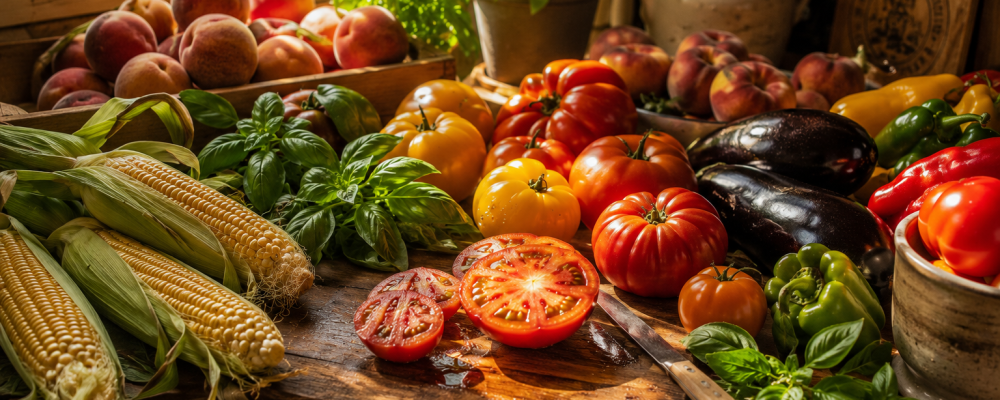

There is a month that exists in a category of its own in the culinary year.
Not spring, with its hopeful firsts and its tentative arrivals. Not the long middle of summer, generous and abundant but without the specific urgency that makes abundance feel like a gift rather than a given. Not autumn, with its deepening flavors and its turn toward warmth and slow cooking.
August.
August is the month when everything that summer has been building toward arrives simultaneously — when the tomatoes and the corn and the peppers and the eggplant and the stone fruit and the beans and the herbs are all at their peak at the same time, when the farmers market table is so loaded with the best versions of everything that choosing what to buy feels like an embarrassment of riches, when the cook who has been waiting for this moment since last October finds it fully arrived and almost overwhelming in its abundance.
August is also the month that contains, somewhere in its middle or its final week, the first suggestion that this will not last. The day that is slightly cooler than the ones before it. The morning light that is different — still warm, still generous, but arriving at a slightly different angle that signals the season’s turn. The awareness that the fullness of the moment is also the beginning of its passing.
This combination — peak abundance and the awareness of its impermanence — is what makes August the most intensely flavored month in the culinary year. Not just in the literal sense that the ingredients are at their most flavorful, though they are. In the sense that every meal made from August ingredients, attended to with genuine presence, carries both the specific pleasure of the thing at its best and the specific pleasure of knowing that this is the best it will be.
The August Tomato and What It Demands
The August tomato is not an ingredient. It is an event.
The cook who encounters genuinely peak-season tomatoes in August — who holds in their hand a tomato that was on the vine yesterday and that has been growing in real summer heat and that has developed, over weeks of sun and warmth, the specific concentration of sugars and aromatic compounds that make it extraordinary — is holding something that the rest of the year cannot provide.
What this tomato demands from the cook is restraint.
Not the restraint of someone holding back from something they want. The restraint of someone who recognizes that the thing in their hands is already complete — already at the fullest expression of what it is — and that the cook’s job is to present it rather than transform it.
The August tomato sliced thick and salted generously and drizzled with the best olive oil available and eaten with good bread — this is not a simple meal. It is the most complete expression of what the August tomato is capable of, presented without the mediation of any preparation that would add to it while subtracting from it. The cook who makes this understands something fundamental about peak ingredients: they do not need improvement. They need respect.
The specific preparations that honor the August tomato beyond the simple raw treatment are the ones that either concentrate its flavor through heat — the slow-roasted tomato, the long-cooked sauce — or combine it with ingredients of equally peak quality in ways that allow each component to remain distinctly itself. The summer tomato salad with burrata and basil. The tomato bruschetta on bread that is itself worth eating. The cold tomato soup that uses the tomato’s own juice as the primary liquid.
Each of these honors the tomato by giving it a context rather than a transformation.
The August Table: Cooking Without Heat
August is the month when the cook’s relationship with heat changes — when the kitchen that has been a place of pleasure through the spring and the early summer becomes, in the peak of the heat, something to minimize rather than inhabit.
The August kitchen is a quick kitchen — the kitchen of preparations that use the stove for minutes rather than hours, that move quickly through the high heat required for the sear or the sauté and then out of the kitchen before the accumulated warmth becomes oppressive.
Or it is no kitchen at all — the kitchen of preparations that require no heat, that assemble from peak-quality ingredients without the mediation of fire, that celebrate the fact that what is available right now needs nothing added to it.
The no-cook August meal is not a compromise. It is its own category — the meal that could only be made in August because August is the only time the ingredients are sufficient to the task of carrying a meal without cooking.
A plate of sliced summer tomatoes, ripe avocado, good cheese, and the best prosciutto or jamón available — dressed with nothing but olive oil and salt — is a meal that requires no heat and that produces more pleasure than most cooked preparations. The cook’s contribution is curation rather than cooking: the selection of ingredients that are each excellent in themselves and that compose into something complete when placed on the plate together.
The summer grain bowl assembled from components made earlier in the week — the farro cooked on Sunday, the roasted vegetables made in the morning before the day’s heat arrived, the soft-boiled egg, the vinaigrette prepared in advance — is the August meal that shows its work: the Sunday cook producing, in one unhurried morning session, the components that make the rest of the week’s eating fast, easy, and excellent without requiring the kitchen to be inhabited during the hottest hours.
The Abundance That Must Be Preserved
August is the month when the serious cook divides their kitchen time between eating and preserving — between the immediate pleasure of peak ingredients consumed at their best and the longer investment of capturing their flavor in forms that extend their usefulness past the season’s end.
This is not a compromise. The preserved tomato made in August from peak-season fruit is a genuinely different product from the preserved tomato made from commercial processing — because the quality of the raw fruit is the primary determinant of the preserved product’s quality, and the peak-season August tomato is the best raw material for preservation available in any year.
The frozen corn — cut from the cob at peak sweetness, blanched briefly, cooled in ice water, packed into bags and frozen before the day is out — produces a frozen corn that is more flavorful than any commercially frozen alternative because it was frozen at peak ripeness rather than at the stage of ripeness that survives commercial processing and distribution.
The pickled peppers — the Hungarian wax peppers and the sweet banana peppers and the occasional shishito, packed into jars with vinegar and garlic and herbs and processed according to proper canning technique — are a preserved product that carries August’s pepper season into the months when fresh peppers are no longer at their best.
And the herb vinegars and the herb oils and the compound butters made from August herbs frozen in portions — each of these is a form of preservation that requires an afternoon of attention in August and produces months of reward in the kitchen.
The August Dinner Party
The peak of the summer produce season is also, naturally, the most generous time of year to feed people — because the abundance of excellent ingredients makes extraordinary cooking available to any cook who is willing to simply select well and intervene minimally.
The August dinner party does not need to be elaborate. It needs to be generous — in the specific sense of setting before guests ingredients that are at their absolute best, prepared in ways that honor their quality rather than obscure it.
The summer antipasto table — the long board of peak-season tomatoes and good cheese and cured meat and roasted peppers and good olives and the best bread available — is a dinner party centerpiece that requires no cooking and that produces, from the quality of its components, a hospitality more genuine than a technically ambitious meal made from mediocre ingredients.
The grilled thing — the leg of lamb or the fish or the whole chicken placed on the grill in the long August evening light, cooked slowly over indirect heat until the skin is crackling and the interior is exactly right, brought to the table on the board that will serve as the cutting surface — is the August dinner party’s dramatic centerpiece. Its preparation happens largely without the cook’s active attention, which means the cook is at the table with the guests when it matters.
And the summer dessert that requires no cooking — the ripe peaches with good vanilla ice cream, the berries with cream whipped only to the point of soft folds, the figs with honey and a piece of good aged cheese — is the dessert that honors the month that produced these ingredients by presenting them in the form they most want to take.
The Morning Light That Changes Everything
There is a moment in August — usually in the final week, sometimes earlier depending on the latitude and the year — when the morning light arrives at a different angle than it has all summer.
The quality of the light is not dramatically different. The temperature is still high. The tomatoes are still perfect. The corn is still sweet. But something in the angle of the morning light signals that the season has turned — not yet, not today, but soon — and the cook who notices this signal cooks differently for the rest of the month.
Not with sadness, though there is something in the awareness of ending that resembles it. With a specific quality of attention and gratitude that the apparently endless abundance of July doesn’t produce in the same form.
This is the attention that August deserves. The full inhabiting of the moment — the eating of the peak-season tomato with the awareness that this is what it tastes like at its best and that best is also brief — is the attention that makes August the most intensely flavored month in the culinary year.
Not because the ingredients are more extraordinary in the final week than in the first — they are the same tomatoes, the same corn, the same peaches. But because the awareness of their passing makes them taste more completely like themselves to the eater who is present for it.
The Last Farmers Market of Peak Season
There is a specific farmers market visit that is different from all the others.
Not announced as such. Not labeled or marked or otherwise distinguished from the visit the week before or the visit that will follow. But recognizable to the attentive eater as the last visit before something changes — before the tomato vendor has a smaller table, before the corn is finished, before the peaches give way to the first apples of the year.
This visit is worth treating differently from the routine ones.
Buy more than can be immediately eaten — knowing that the excess will be preserved, roasted, jammed, or frozen. Buy the variety that has been resisted all summer in favor of the familiar — the unusual tomato, the heirloom pepper, the small basket of something that has been at the edge of the table for weeks without being selected. Talk to the vendors about what is finishing and what is coming — about the transition they are already anticipating from the summer crops to the autumn ones.
And walk the market more slowly than usual. Look at what is on the tables with the specific quality of attention that knowing it won’t be this way much longer produces.
This is the August farmers market visit worth making deliberately.
The produce on those tables, at that moment, is the best it will be all year.
It deserves that attention.
The Takeaway
August is the month when the culinary year reaches its peak — when everything that summer has been building toward arrives simultaneously and briefly, when the cook who has been paying attention finds the ingredients at the level of quality that all the previous months were promising.
Cook in August with restraint and with generosity simultaneously — the restraint of not overcomplicating what is already complete, the generosity of feeding people from the best ingredients available in any month of the year.
Eat the tomato. Preserve the corn. Make the pesto. Grill the fish in the long evening light. Set the table outside and stay at it until the dark comes.
August is not the whole year. But it is the month that makes the whole year worth cooking through.
Be in it completely.














