
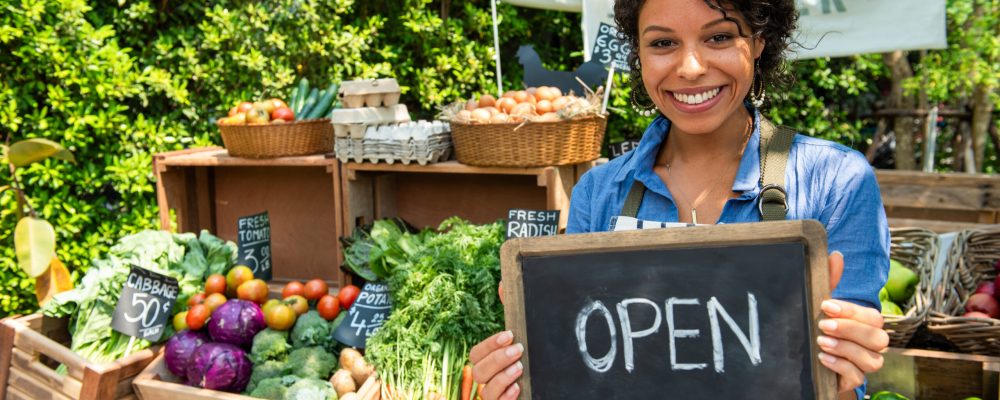

There is a person who arrives at the farmers market before dawn.
Not before the market opens. Before dawn. In the dark, often in the cold — because the cold is when farmers markets happen in the seasons when the best produce grows — with a truck loaded the night before, driving from a farm that may be thirty minutes away or two hours away, to set up a table that will be dismantled six hours later and reloaded and driven back.
This person is at the market before the first customer arrives and after the last one leaves. They have been awake since four in the morning and will not sit down for the duration of the market. They will answer the same questions about their tomatoes or their cheese or their bread dozens of times, with a patience and a genuine enthusiasm that is either remarkable or performed depending on the vendor and the day.
Most farmers market shoppers know this person as the face behind the table — as the source of the thing they came to buy. Very few know anything about who this person actually is, what their week looked like before the Saturday market, what it cost them to produce what they are selling, and what happens to what isn’t sold when the market closes.
Understanding the life of the farmers market vendor changes the relationship with the farmers market in ways that go beyond the practical.
The Week Before the Saturday Market
The Saturday farmers market is the visible end of a process that began the previous Saturday afternoon when the market closed and the vendor returned to the farm.
Sunday is not a day off. It is the day the week’s growing and production work begins again — or more accurately, the day it continues, because the rhythms of a farm don’t observe weekends. Animals need to be fed. Crops need to be watered. Whatever was planted the previous week needs to be checked. Whatever is approaching harvest needs to be assessed.
For the market vegetable farmer, the week before the market is organized around the harvest that will happen on Friday — the specific calculation of what is ready, what will be at its peak on Saturday morning, what can be harvested Thursday and held in cold storage without quality loss, and what must wait until Saturday morning’s earliest-possible harvest to be genuinely fresh at the market.
This calculation is more complex than it sounds. Different crops have different harvest windows. Lettuces and herbs are best harvested in the cool of early morning, the morning before the market rather than days before. Root vegetables can be harvested earlier without significant quality loss. Summer squash, which grows overnight in a way that seems almost implausible, must be checked daily or the appropriately sized harvest of Monday becomes the overgrown zucchini of Wednesday.
The vendor who arrives at the market on Saturday with genuinely fresh produce has spent the week in a constant negotiation with the specific growing conditions of their land — the heat that accelerated the tomato ripening, the unexpected cold that slowed the pepper harvest, the rain that made the lettuces bitter, the drought that concentrated the flavor in the strawberries.
Every table at the farmers market is the end of a week of this negotiation.
What the Price Actually Covers
The price of a farmers market vegetable or fruit or product is one of the things most commonly commented on by people who shop there for the first time and find it higher than the supermarket equivalent.
The price difference is real. The reasons for it are worth understanding — not as an argument for why the price is justified in a moral sense, but because understanding what the price covers changes the relationship with both the market and the product.
The supermarket tomato arrived through a supply chain that involved large-scale industrial agriculture, mechanical harvesting, long-distance transport, refrigerated storage, and a retail markup applied by a corporation with significant purchasing power. The cost of each of these steps is distributed across an enormous volume of product, which is what makes the per-unit price low.
The farmers market tomato was grown by a person who owns or leases a specific piece of land, who planted specific varieties chosen for flavor rather than durability, who harvested by hand the morning before or the morning of the market, who drove it to the market and will drive it home if it doesn’t sell. The cost of all of this is distributed across a much smaller volume of product, which is what makes the per-unit price higher.
What is also different is the quality — not necessarily in every case, but in the specific cases that matter most. The tomato grown for flavor rather than shipping durability, harvested at actual ripeness rather than at the stage that survives a cross-country journey, eaten within twenty-four hours of harvest — this is a categorically different product from the supermarket alternative, and the price difference reflects both the cost of producing it and the quality it delivers.
The farmers market vendor is not charging a premium because they can. They are charging what the product costs to produce at the scale and the quality they produce it.
The Conversation as Part of the Product
One of the things that distinguishes shopping at a farmers market from any other food retail experience is the conversation — the specific knowledge that the person behind the table has about the product they are selling and that they are willing to share.
The vendor selling tomatoes at the farmers market knows things about those tomatoes that no label could communicate. Which variety is sweetest this week and which is most acidic. Which is best for eating raw and which holds up better in a sauce. Which will ripen further on the counter and which is at its peak today. What they did differently this year that produced the specific flavor they’re happy about. What the growing conditions have been like and how that has affected the crop.
This knowledge is not marketing. It is the specific, embodied understanding of someone who grew the thing from seed, who has been watching it develop for months, who picked it this morning and can tell from how it felt in their hands whether it was ready.
The farmers market shopper who engages this knowledge — who asks questions rather than just making selections — is receiving a form of food education that no other retail environment provides. They are learning to understand a specific product in a way that changes how they will shop for and use that product in the future.
And the vendor who is asked good questions often enjoys the exchange — because most of what they know about what they grow is never communicated at all, and the customer who asks gives them the opportunity to share knowledge they carry and rarely get to use.
What Doesn’t Sell and What Happens to It
The end of the farmers market day is not always the straightforward success that the morning’s optimistic table arrangement suggested.
Produce that wasn’t sold will not last until next Saturday’s market. The vendor packs up what can be taken back and used — processed, preserved, turned into something else — and manages the rest in whatever way is available. Some markets have food banks that collect unsold produce at the end of the day. Some vendors have relationships with local restaurants that will take overstock. Some of what doesn’t sell becomes compost.
This is the specific economic reality of selling fresh, perishable food at a weekly market. Unlike retail, where unsold inventory can be held and sold the following week, farmers market inventory has a specific and often short shelf life. The vendor who brings fifty pounds of tomatoes and sells forty has ten pounds of tomatoes that must be dealt with by Monday.
This is part of what makes pricing decisions at the farmers market genuinely difficult. The vendor must price to cover their costs and make the market financially viable — but they must also consider the cost of what doesn’t sell, which is a cost that cuts directly into the margin on what did.
The shopper who haggles over price at the farmers market is negotiating with a person operating on margins significantly thinner than most retail operations and carrying the specific risk of unsold inventory that doesn’t carry forward. This is a different negotiation than haggling over the price of a manufactured good with a retailer who bought it wholesale and can hold it indefinitely.
The Relationship That Develops Over Time
The most significant transformation in the farmers market experience — for both the shopper and the vendor — happens over time, through the development of a genuine ongoing relationship.
The vendor who sees the same face at their table every week knows something about that customer’s preferences and cooking habits that accumulates over seasons. They know to set aside the specific variety that this customer always asks for when the quantity is limited. They know what new product to offer for tasting when they want feedback from someone whose taste they trust. They know, without being told, what this customer will want when a specific crop reaches its peak.
The shopper who has been coming to the same vendor for a year or three years or ten years has access to knowledge and consideration that the first-time visitor doesn’t receive. Not as a transaction — the vendor is not doing this because of the cumulative value of the sales. They are doing it because a relationship has developed, because the customer has become a person rather than a transaction, because the conversation across the table has accumulated into something that resembles genuine mutual interest.
This is the farmers market at its best — not just as a place to buy good food but as a community institution where relationships form around the specific shared interest in what the land produces and what can be done with it.
The Farmer Who Became a Farmer
Most farmers market vendors did not grow up farming. They arrived at it — from careers in other fields, from a moment of deliberate choice to leave something else for this, from the specific combination of values and ambition and willingness to accept difficult conditions that farming requires.
The stories of how people came to be behind a farmers market table are as varied as the people themselves. The software engineer who left a career to grow vegetables on a rented plot. The chef who decided that growing the food was more interesting than cooking it. The second-generation farmer who continued what their parents began, now at a table where their parents used to stand. The immigrant who grew up farming in another country and found in the farmers market a way to continue a practice that connected them to where they came from.
These stories are worth knowing — not because they make the produce more delicious, but because they make the person behind the table more visible. The farmers market vendor is not a retail clerk selling someone else’s product. They are the person who made the product, who decided to make it, and who chose the specific conditions under which it would be made.
Understanding this — truly understanding it rather than knowing it abstractly — changes the quality of the interaction at the table. It produces the specific attention and the specific gratitude that the relationship deserves.
The Takeaway
The farmers market is a place where people who grow food and people who cook food meet directly — where the intermediaries that separate production from consumption in the industrial food system are removed and what is left is the specific, direct relationship between the person who made something and the person who will use it.
Understanding what that relationship actually involves — the week of work before the Saturday morning, the knowledge that the vendor carries and is willing to share, the economics that make the price what it is, the unsold produce at the day’s end, the relationship that develops over time — enriches the experience of the market in ways that improve both the shopping and the cooking.
Go early. Ask questions. Return to the same vendors. Learn their names.
The farmers market is a community institution.
Show up for it like one.














