
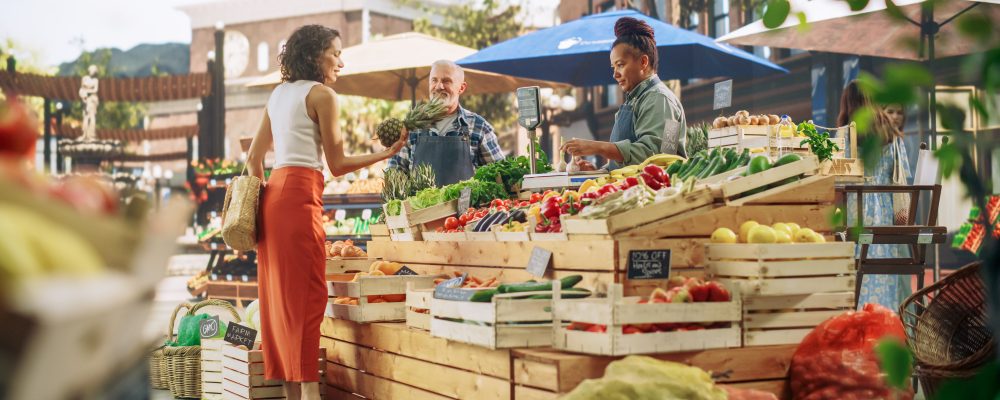

There is a place that exists in most cities and many towns across the country that operates by a completely different logic than the food system most people interact with every week.
It is open for a few hours, once or twice a week. It sells food that will not last as long as the food in a grocery store. The prices are sometimes higher than the supermarket equivalent. The selection changes from week to week and disappears entirely in winter in colder climates. There is no loyalty program, no convenient app, no guaranteed parking.
By every metric of modern retail convenience, the farmers market is an inferior shopping experience.
And yet the people who shop there regularly — who have made the farmers market a consistent part of their weekly rhythm rather than an occasional visit — describe the experience in terms that have almost nothing to do with convenience. They describe it as a relationship. As a practice. As one of the most grounding and most pleasurable regular activities in their week.
Understanding why requires understanding what the farmers market is actually offering — which is not primarily food.
The Direct Connection That Changes Everything
The farmers market is, at its most fundamental level, a place where the person who grew the food and the person who will eat it are in the same physical space at the same moment.
This sounds simple. It is, in the contemporary food system, extraordinary.
The supply chain that delivers most food from farm to table involves dozens of intermediaries — processors, distributors, wholesalers, retailers — each of whom adds handling, time, and distance between the moment of harvest and the moment of eating. The person who grew the food and the person who eats it are separated by hundreds of miles, dozens of transactions, and often weeks of transit and storage time.
At the farmers market, this chain is collapsed to nothing. The farmer who planted the seed, tended the soil, harvested the crop that morning, and drove it to the market is standing behind the table when the person who will eat it that evening reaches across and picks it up.
This directness has practical implications. The food is fresher than anything the supply chain can deliver — because it hasn’t traveled through it. The information available about the food is more complete — because the person who produced it is present to answer questions about how it was grown, what variety it is, when it was harvested, what it will do in the pan. And the relationship that develops over time between a regular customer and a specific farmer produces a quality of food knowledge that no label or certification can replace.
But the directness also has implications that go beyond the practical. It creates a relationship between the eater and their food — a specific knowledge of where it came from and who produced it — that changes the quality of attention brought to the eating. The tomato purchased from the farmer who grew it, who explained which variety it was and recommended how to serve it, is not the same eating experience as the tomato purchased from a bin in a grocery store, even if the two tomatoes are identical in every objective culinary measure.
The knowledge changes the experience. The relationship changes the taste.
What the Seasons Actually Look Like
The farmers market is one of the last places in contemporary food culture where the seasons are legible — where the change from week to week and month to month reflects the actual state of the land rather than the capabilities of the global supply chain.
In a grocery store, the seasons are largely invisible. The tomatoes are there in December. The asparagus is there in October. The strawberries are there in January. The illusion of constant availability — maintained at significant cost to the environment and at significant cost to flavor — makes it possible to shop without any reference to what is actually growing anywhere at any time.
At the farmers market, the seasons assert themselves. The first asparagus of spring appears and then, weeks later, disappears. The stone fruit arrives in July and is gone by September. The summer tomatoes — the ones that justify the entire seasonal waiting — appear in August and are finished by the first frost. The winter squash and the root vegetables and the hearty greens take their place.
This seasonal rhythm — experienced weekly, in the specific and immediate form of what is and is not on the tables at the market — produces a relationship with food and with time that the grocery store cannot replicate. The regular farmers market shopper develops a calendar of flavors — an anticipation of specific ingredients at specific times of year that gives the seasons a specific culinary texture.
The first ramps of April. The first corn of July. The last tomatoes of September. Each of these is an event — a specific, brief, anticipated pleasure that has a beginning and an end and that means something precisely because it doesn’t last.
This is what seasonality actually feels like as a lived experience rather than a concept. And the farmers market is one of the few places where it can be reliably encountered.
The Community That Forms Around the Market
There is a social dimension to the farmers market that is difficult to quantify but that regular shoppers consistently identify as one of its primary values.
The market is a public space — one of the increasingly rare public spaces in contemporary life where people from different backgrounds gather in the same place for the same purpose without the mediation of a commercial transaction that structures and limits the interaction. The grocery store is a commercial space where the purpose is purchasing and the interactions are instrumental. The farmers market is also a commercial space, but it operates at a pace and in a physical configuration — open air, table-lined, with the vendors facing the customers across a counter that invites conversation rather than discouraging it — that produces a different quality of social interaction.
Regular farmers market shoppers know the farmers whose tables they visit. They know which farm has the best strawberries in June and which is growing the unusual variety of winter squash that no one else at the market carries. They know the baker who gets to the market at seven and sells out by nine and whose sourdough is worth getting there early for. They know the cheese maker whose table has a rotating selection of aged cheeses and whose opinions about how to serve them are worth asking for.
These are relationships — not intimate ones, but genuine ones. The specific kind of relationship that forms around regular, repeated, purposeful interaction in a shared space. The relationship between a market customer and a market vendor is a minor but real form of community — and community, in the fragmented social landscape of contemporary life, is worth more than its scale suggests.
The Education That Happens Without Trying
The farmers market is one of the best food education environments available to any home cook — not because it offers classes or workshops or formal instruction, but because the people who know the most about the food are present and available and usually happy to talk.
The farmer who grew an unusual variety of dried bean can explain what it tastes like, how it cooks differently from a standard navy bean, and what preparations it is best suited for. The mushroom forager can explain the difference between the varieties on their table, which ones should be eaten cooked and which can be eaten raw, how to store them to prevent the moisture accumulation that causes rapid deterioration. The cheese maker can explain the process that produces the specific texture of their aged sheep’s milk cheese and recommend what to serve alongside it.
This is not information available in any other retail context. It is the specific, embodied knowledge of people who spend their lives working with specific ingredients — knowledge that exists in their experience rather than in any book or website, and that is available to anyone who asks.
The home cook who develops the habit of asking questions at the farmers market — who treats the market as an educational opportunity rather than just a shopping destination — accumulates food knowledge over months and years that changes how they cook and what they cook with in ways that no formal food education quite replicates.
The knowledge is specific, practical, and tied to specific ingredients at specific moments in their growing cycle. It is the best kind of food knowledge there is.
The Practice of Building a Market Relationship
The farmers market, like any relationship, becomes more valuable with time and consistency.
The shopper who visits occasionally — who comes when the mood strikes or when a specific recipe requires a specific ingredient — gets the benefits of freshness and seasonality but not the deeper benefits of the ongoing relationship. The shopper who comes every week, who buys from the same vendors consistently, who over time becomes a recognized and regular customer, gets something different.
The farmer who knows a regular customer will often set aside something unusual — a variety they grew in small quantity, a product they didn’t bring enough of to sell to the general crowd, a piece of knowledge about a preparation they’ve been experimenting with. The relationship produces access and information that the occasional shopper doesn’t receive.
Building a market relationship requires nothing more than consistency and curiosity — showing up regularly and asking questions. The rest develops naturally from those two practices.
The specific vendors worth developing relationships with vary by market and by individual preference. The starting point is finding the vendors whose product is consistently excellent — not perfect every week, because farming doesn’t work that way, but whose quality over time justifies the relationship investment — and returning to them consistently enough that the relationship has the opportunity to develop.
What the Market Can’t Be
The farmers market is not a solution to food access inequality. In many communities, farmers markets are expensive, inconveniently located, and reflect the demographics and preferences of a specific segment of the population that is not representative of the community as a whole.
This is a genuine limitation that the most enthusiastic advocates of farmers markets sometimes obscure. The experience of the farmers market as a community space, as an educational environment, as a source of peak-quality seasonal produce, is not equally available to everyone — and acknowledging this is important to an honest account of what the market is and what it is not.
The food system problems that the farmers market represents a partial solution to — the distance between production and consumption, the loss of seasonal awareness, the disconnection of most eaters from the sources of their food — require solutions at a scale and a level of systemic intervention that the farmers market, however valuable, cannot provide.
What the farmers market can provide, to those who have access to it, is a different way of relating to food — a practice of weekly engagement with seasonality, with producers, with the specific quality of what is actually good right now — that changes the experience of food and cooking in ways that are worth seeking out.
The Takeaway
The farmers market is not primarily a shopping destination. It is a practice — a weekly ritual of engagement with food, seasons, and community that produces a relationship with eating that the grocery store, for all its convenience, cannot replicate.
Go regularly. Ask questions. Follow what is at its peak rather than what is on a list. Build relationships with the vendors whose work you trust. Let the market teach you what the season is doing.
The food that results from this practice — seasonal, fresh, purchased from people who can tell you exactly what it is and how it grew — is not just better food in the culinary sense.
It is more alive.
And eating food that feels alive is one of the genuine pleasures of a life spent paying attention to what you eat.














