
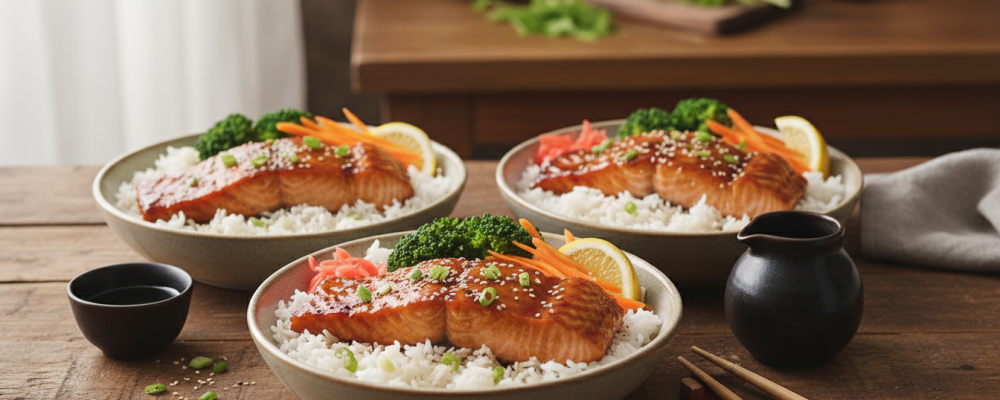

There is a bottle of teriyaki sauce in most refrigerators in America. It costs three or four dollars, lasts for months, and delivers a consistent, if somewhat flat, approximation of the flavor it’s named after. It gets the job done. It is also, compared to a homemade teriyaki sauce made from four ingredients in five minutes, noticeably inferior in every measurable dimension—depth, freshness, balance, and the way it behaves when heat is applied.
This is the recipe that makes the case for doing it yourself. The homemade teriyaki sauce here—soy sauce, mirin, sugar, ginger, garlic—takes less time to make than it takes to find the bottle in the back of the refrigerator, and what it produces is a glaze with genuine complexity: sweet and salty in proper balance, with the mirin’s subtle fermented depth running underneath both, and fresh ginger and garlic providing an aromatic sharpness that no commercial sauce can replicate because those aromatics don’t survive the pasteurization process. It’s a sauce that smells alive, because it is.
The strategic advantage of a from-scratch teriyaki sauce in a meal prep context is control. You control the sweetness. You control the salt level. You control the consistency, because the ratio of sugar to liquid determines how thickly the sauce reduces and glazes the salmon during cooking. A commercial sauce gives you one flavor profile and one consistency across the entire week, every week. A homemade one gives you a foundation you can understand, adjust, and make your own—and that understanding is what separates a meal prep recipe you return to from one you make once and forget.
─────────────────────────────────────────
The Inspiration Behind This Recipe
The design brief for this recipe was specific: a salmon-based meal prep bowl that avoids the two most common failure modes of refrigerated salmon—the dryness that comes from overcooking and the monotony that comes from underseasoning. Both problems are solved at the sauce level. Teriyaki sauce, when used as both a marinade and a finishing glaze, creates a protective sugar-and-soy coating on the exterior of the fillet that retains moisture during cooking and then sets into a lacquered, flavorful crust that keeps the salmon from drying out in the refrigerator in the way that simply seasoned protein always does.
The broccoli cooked in the same pan—in the residual sesame oil and the caramelized remnants of the teriyaki sauce left behind by the salmon—was not a convenience decision, though it is also that. It’s a flavor decision. Those pan drippings are concentrated teriyaki flavor in fat-soluble form, and the broccoli absorbs them as it sautés, taking on a savory, slightly sweet depth that makes it a far more interesting vegetable component than broccoli steamed separately and seasoned independently. The same pan does twice the work and produces a better result than two separate cooking processes would.
Sesame oil as the cooking fat and sesame seeds as the finishing garnish were chosen in tandem—sesame has a deep affinity for the soy-mirin-ginger flavor profile of teriyaki, and using it at both the cooking stage (where its flavor infuses the entire bowl) and the finishing stage (where the seeds add texture and visual distinction) creates a flavor coherence across the whole recipe that makes each component taste like it belongs to the same dish rather than a bowl of separately prepared items.
─────────────────────────────────────────
A Brief History of Teriyaki
Teriyaki is one of Japan’s most versatile and widely traveled cooking techniques, and its name describes both its method and its result: teri refers to the luster or shine of a glaze produced by the caramelization of sugar, while yaki means grilled or broiled. In its traditional Japanese form, teriyaki is a technique applied to fish—yellowtail, mackerel, and salmon being the most common—where the fish is basted repeatedly with a soy and mirin-based sauce during cooking until a deep, lacquered glaze develops across the surface.
Mirin—a sweet rice wine essential to authentic teriyaki—is the ingredient that separates a Japanese teriyaki sauce from its American adaptations. It contributes a subtle complexity and a natural sweetness with lower sugar intensity than refined sugar alone, and its alcohol content helps the sauce adhere to the surface of the fish during cooking, promoting the even glaze development that is teriyaki’s defining visual and textural characteristic. Its flavor is irreplaceable in this context; substituting plain sugar and rice vinegar produces a sauce that is technically similar but noticeably less nuanced.
The global spread of teriyaki—and its adaptation to chicken, beef, and vegetables in the American market—began in earnest in the mid-20th century and accelerated with the rise of Japanese restaurants in the United States. What arrived internationally was largely a simplified version of the technique, leaning more heavily on sugar and less on the fermented complexity of mirin. This recipe returns to the traditional balance: soy and mirin in proper proportion, supported by fresh aromatics that the original technique always used, applied to salmon—the fish that has been central to the teriyaki tradition since its earliest documented form.
─────────────────────────────────────────
Why This Cooking Method Works for Meal Prep
The marinade-and-reserve strategy is the technical decision that makes this recipe perform exceptionally well across multiple days of refrigeration. By dividing the teriyaki sauce into two portions—one used for the marinade, one held in reserve—the recipe ensures that the finishing glaze is uncontaminated by raw fish and retains its full flavor concentration for application after cooking. This reserved sauce, drizzled over the assembled bowl just before sealing the container, acts as a moisture barrier and a flavor reinforcement system: it keeps the rice from drying out at the point of contact with the salmon and delivers a fresh hit of teriyaki character each time the bowl is opened.
Pan-searing over medium heat rather than broiling or baking is the right method for meal-prep salmon specifically. A moderate pan temperature allows for precise control over the degree of doneness—four to five minutes per side produces salmon that is cooked through but still retaining internal moisture, which is the state from which it reheats most successfully. High-heat broiling produces a result that is excellent immediately but deteriorates more quickly in the refrigerator as the interior moisture continues to migrate outward. Medium-heat pan cooking produces a more evenly cooked fillet with a more consistent moisture distribution throughout.
Cooking the broccoli to tender-crisp rather than fully soft is a deliberate meal prep calibration. Vegetables that are fully cooked at the time of portioning will continue to soften in the refrigerator through residual heat and moisture exchange with surrounding components. Broccoli pulled from the pan while it still has a slight resistance at the center will arrive at the ideal tender texture by the time the bowl is eaten the following day—which is the correct target temperature for a vegetable that needs to survive refrigeration and a brief microwave reheating cycle without becoming limp.
─────────────────────────────────────────
Flavor Profile: What to Expect
This bowl operates in a concentrated, deeply savory register with sweet and aromatic notes that layer across every component:
- Sticky-sweet glaze – The teriyaki sauce caramelizes on the surface of the salmon during cooking into a lacquered, concentrated coating that delivers intense soy-sweet flavor in every bite of the protein
- Fermented depth – Mirin contributes a subtle, complex undertone beneath the sweetness—slightly wine-like, faintly tangy, and impossible to replicate with sugar alone
- Aromatic heat – Fresh ginger and garlic infuse the sauce with a sharp, warming aromatic layer that cuts through the richness of the salmon and keeps the overall profile from feeling cloying
- Rich, fatty salmon – The salmon itself provides a luxurious, buttery richness that carries the teriyaki glaze and gives every bite a satisfying, protein-forward depth
- Nutty sesame – Sesame oil permeates the entire bowl from the cooking stage, while sesame seeds add a toasty, slightly bitter crunch at the surface that ties the aromatic profile together
- Mild, fluffy rice – The rice base absorbs the reserved teriyaki sauce and provides a neutral, starchy counterpoint that balances the intensity of the glazed salmon above it
- Savory, lightly sweet broccoli – Pan-cooked in the salmon’s teriyaki residue, the broccoli tastes gently seasoned and savory rather than plain, making it a genuine flavor component rather than a neutral accompaniment
The flavors deepen and meld overnight as the reserved teriyaki sauce soaks into the rice and the broccoli absorbs further flavor from the surrounding components. Day two of this bowl is reliably the best day.
─────────────────────────────────────────
Tips for Making the Best Teriyaki Salmon Rice Bowls
Execution precision at two points—the sauce and the salmon—determines the overall quality of the finished bowl:
- Don’t skip the 10-minute marinade – Ten minutes is the minimum for the soy-mirin mixture to begin penetrating the surface of the salmon. Longer is better if time allows—up to 30 minutes in the refrigerator produces noticeably more deeply flavored fish. Beyond 30 minutes, the salt in the soy sauce begins to draw out too much moisture.
- Pat the salmon dry before searing – Remove the fillets from the marinade and pat the surface dry with a paper towel before they go into the pan. Excess marinade on the surface steams rather than sears, preventing the caramelized glaze from forming. Dry surface, direct heat, proper caramelization.
- Don’t move the salmon once it’s in the pan – Let it cook undisturbed for the full 4–5 minutes per side. Frequent flipping interferes with the glaze development and increases the risk of the fillet breaking apart.
- Watch the reserved sauce – If drizzling the reserved sauce over assembled bowls before refrigerating, bring it briefly to a simmer in the pan after removing the broccoli. This concentrates it slightly and, critically, ensures it’s been heated through—raw marinade that contacted the fish should not be used directly without cooking.
- Rinse the rice – As with any rice-based meal prep bowl, rinse the rice before cooking to remove excess surface starch. This produces a fluffier, less clumped base that holds its texture through refrigeration and reheating significantly better than unrinsed rice.
- Rest the salmon before portioning – Allow cooked salmon fillets to rest for 3–4 minutes before flaking or slicing for the bowl. This allows the internal juices to redistribute and keeps the fish from releasing excess moisture into the rice during refrigeration.
Optional: A drizzle of sriracha or a few drops of chili oil over the finished bowl adds a heat element that pairs exceptionally well with the sweet teriyaki glaze and the richness of the salmon—a small addition that adds significant flavor dimension.
─────────────────────────────────────────
Portioning and Container Suggestions
This recipe portions most efficiently into a two-component storage system: the rice and broccoli together in one container, the salmon fillets stored separately. Keeping the salmon separate prevents its moisture from migrating into the rice base overnight and allows each component to be reheated at its optimal time and temperature independently. The reserved teriyaki sauce can be drizzled over the assembled bowl just before sealing, or stored in a small separate container and added at serving.
For serving volume, a standard lunch portion is approximately 3/4 cup cooked rice, one salmon fillet (roughly 4–5 ounces), and a generous portion of broccoli. This produces a satisfying, protein-complete meal that doesn’t require supplementing with additional snacks to carry through the afternoon.
Wide-mouth glass containers with secure lids are the ideal choice for this recipe—they’re microwave-safe for efficient reheating, and their visual clarity makes it easy to see at a glance whether the teriyaki glaze has been evenly distributed across the assembled bowl before sealing. A bowl that looks well-glazed and intentional in the container is a bowl that will look and taste well-glazed and intentional at lunch—which, after the effort that went into making the sauce from scratch, is exactly the result this recipe deserves.
─────────────────────────────────────────
Storage, Reheating, and Shelf Life Tips
- Refrigerator storage: Cooked salmon keeps for 3 days in an airtight container. Rice and broccoli keep for 4–5 days. For best results, consume salmon portions within 3 days of cooking.
- Freezer storage: Cooked salmon freezes adequately for up to 1 month, though some texture change is expected upon thawing—the flesh becomes slightly more flaky and less firm. Freeze in individual portions and thaw overnight in the refrigerator. Rice freezes well for 2 months in portioned bags.
- Reheating the salmon: Microwave at 50–60% power for 60–90 seconds. Full-power microwaving tightens the protein fibers and dries out the fillet rapidly. Low power and a longer time produces a noticeably better result. Alternatively, warm in a covered skillet over low heat with a small splash of water for 2–3 minutes.
- Reheating the rice: Add a teaspoon of water to the container, cover loosely, and microwave at full power for 60–90 seconds, fluffing with a fork halfway through.
- Sauce refresh: If the bowl seems dry after refrigeration, a small drizzle of additional soy sauce or the reserved teriyaki sauce (if stored separately) refreshes both moisture and flavor immediately before eating.
- Broccoli note: The broccoli will soften slightly from its initial tender-crisp state after refrigeration—this is expected and desirable, as it arrives at an ideal texture after a brief reheat. If crispness is a priority, sauté a fresh batch of broccoli at serving time using the leftover teriyaki sauce as seasoning.
─────────────────────────────────────────
Why This Recipe Deserves a Spot in Your Meal Prep Rotation
Teriyaki Salmon Rice Bowls occupy a specific and valuable position in a weekly prep lineup: they are the recipe that delivers restaurant-quality flavor within a meal prep format that is genuinely achievable on a Sunday afternoon. The homemade teriyaki sauce is the defining factor—it requires five minutes and four pantry ingredients, and it produces a result that is measurably better than any commercial alternative while costing a fraction of what a restaurant bowl would. That combination of quality and efficiency is the core value proposition of meal prep done well, and this recipe delivers it without compromise.
From a nutritional standpoint, salmon twice a week represents a meaningful dietary investment—consistent omega-3 intake, high-quality complete protein, and a fat profile that supports rather than burdens long-term health goals. The rice provides efficient complex carbohydrate energy, the broccoli provides fiber and micronutrients, and the sesame adds a concentrated source of healthy fat at the finish. The bowl is complete in every sense of the word: complete flavor, complete nutrition, complete convenience. It earns a permanent spot on the prep list on those grounds alone.
─────────────────────────────────────────
Meal Prep Pairing Suggestions
Teriyaki Salmon Rice Bowls pair most naturally with other grain bowl formats that offer protein variety and flavor contrast across the week. Our Cilantro Lime Shrimp Rice Bowls are the ideal rotation partner—both are grain-based, both are built around a quickly cooked seafood protein, and both use a sauce as both a flavor vehicle and a moisture-preservation strategy. But where the shrimp bowl is bright, acid-forward, and Latin-inspired, this bowl is deep, sweet-savory, and rooted in Japanese culinary tradition. Alternating between them gives the week’s lunches genuine variety while maintaining the structural efficiency of the bowl format.
For a broader weekly spread, our Mediterranean Chickpea Couscous rounds out the protein rotation with a plant-based, no-cook option that requires almost no active kitchen time—making it a natural complement to the more involved salmon prep. A week anchored by teriyaki salmon on some days, shrimp bowls on others, and chickpea couscous filling the gaps represents a complete, varied, and nutritionally diverse lunch rotation that was assembled in a single Sunday session. That is the compounding efficiency that makes a well-designed meal prep system worth building—and worth returning to every week.
Teriyaki Salmon Rice Bowls
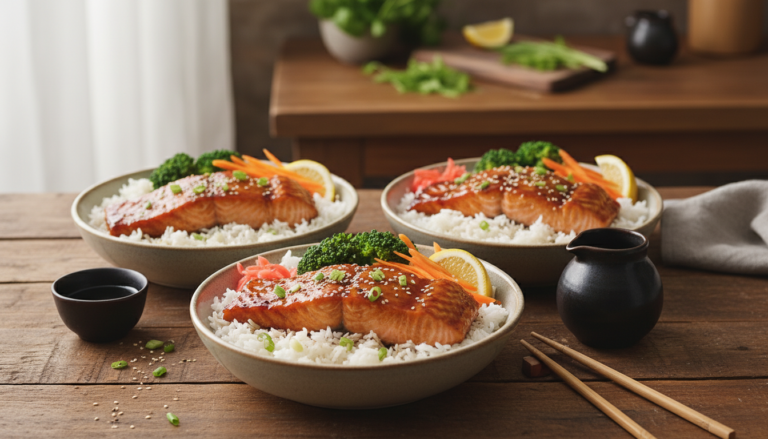
These Teriyaki Salmon Rice Bowls bring the sticky-sweet depth of a restaurant-quality teriyaki glaze to your weekly meal prep—pan-seared salmon over fluffy rice with tender-crisp broccoli, finished with sesame seeds and a final drizzle of homemade sauce..
4
servings15
minutes20
minutes450
kcal35
minutesIngredients
4 fillets salmon
1/2 cup soy sauce
1/4 cup mirin
1/4 cup sugar
1 tbsp ginger, minced
1 tbsp garlic, minced
2 cups rice, cooked
1 cup broccoli florets
1 tbsp sesame oil
1 tbsp sesame seeds
Directions
- In a bowl, mix soy sauce, mirin, sugar, ginger, and garlic to make the teriyaki sauce.
- Place salmon fillets in a shallow dish and pour half of the teriyaki sauce over them. Marinate for 10 minutes.
- Cook rice according to package instructions.
- Heat sesame oil in a pan over medium heat. Add salmon fillets and cook for 4-5 minutes on each side.
- Remove salmon and sauté broccoli in the same pan until tender-crisp.
- Serve salmon over rice, drizzling with remaining teriyaki sauce, and top with sesame seeds.
Nutrition Facts
- Total number of serves: 4
- Calories: 450kcal
- Cholesterol: 0mg
- Sodium: 620mg
- Potassium: 400mg
- Sugar: 8g
- Protein: 6g
- Calcium: 60mg
- Iron: 2mg
About This Author

Benjamin Brown
Recipe Developer
Benjamin is our flavor engineer. A classically trained chef turned recipe developer, he’s obsessed with balancing taste, texture, and creativity. He ensures that every recipe we publish is not only delicious but also reliable, approachable, and repeatable — even for beginners.
Favorite dish: Slow-braised short ribs with red wine reduction.
Kitchen motto: “Cooking is part science, part soul.”















