
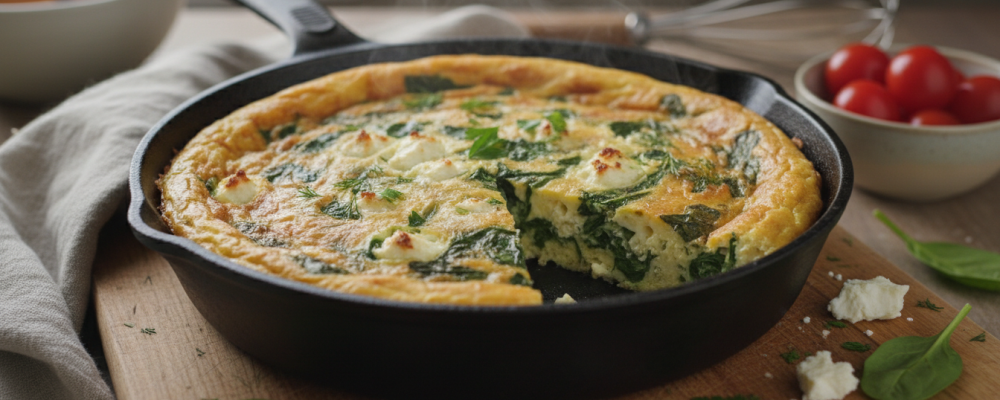

Frittatas represent efficient cooking: a complete meal prepared in a single pan with minimal technique required and excellent results virtually guaranteed. This Spinach and Feta Frittata demonstrates the format’s strengths—straightforward ingredient list, simple preparation, reliable outcome. The eggs provide protein structure, the spinach contributes vegetables and moisture, the feta adds salt and tang, the onion supplies aromatic base. Each component serves a specific function in creating a balanced, satisfying dish.
What makes frittatas successful is understanding the proper egg-to-filling ratio and achieving the correct texture—set but tender, not rubbery or watery. Too many fillings and the frittata won’t hold together when sliced. Insufficient cooking and the center remains liquid. Overcooking creates dry, tough eggs. The technique of starting on the stovetop and finishing in the oven provides optimal results: the direct heat sets the bottom and edges quickly, while the oven’s ambient heat cooks the center gently and evenly.
I appreciate frittatas for their versatility and practicality. They work for any meal—breakfast, lunch, or dinner. They’re excellent hot, warm, or at room temperature, making them ideal for entertaining or meal prep. They accommodate ingredient substitutions easily while maintaining structural integrity. This particular combination—spinach and feta—represents a classic pairing where the ingredients’ flavors and textures complement each other naturally. It’s simple Mediterranean cooking at its most accessible and effective.
─────────
The Inspiration Behind This Recipe
This recipe emerged from recognizing that the Italian frittata and Greek spanakopita share fundamental elements: eggs, spinach, and cheese baked together. By emphasizing feta rather than ricotta or mozzarella, you shift the flavor profile toward Greek cuisine while maintaining the frittata’s practical format. Spanakopita requires phyllo dough handling and layering—skills that intimidate many home cooks. A frittata delivers similar flavors with significantly less technical requirement.
The decision to keep the ingredient list minimal was deliberate. Frittatas can accommodate numerous additions—herbs, other vegetables, different cheeses, meats—but sometimes restraint creates better results. The spinach-feta-onion combination is classic for good reason: these ingredients have natural affinity. The spinach’s slight bitterness balances the feta’s salt, the onion provides aromatic sweetness, and the eggs bind everything into cohesive structure. Adding more ingredients would complicate rather than improve the dish.
What I wanted to create was a reliable recipe that home cooks could execute successfully while producing results that look and taste restaurant-quality. The technique is forgiving—difficult to ruin if you follow basic guidelines. The ingredients are accessible and affordable. The final dish is nutritious, satisfying, and appropriate for multiple meal contexts. These qualities make it genuinely valuable in a home cooking repertoire rather than just another recipe to try once and forget.
─────────
A Brief History of Frittatas
Frittatas originated in Italy, where they’ve been a staple of home cooking for centuries. The word “frittata” comes from “friggere,” meaning to fry—though modern frittatas typically finish cooking in the oven or under a broiler rather than being completely stovetop-cooked. Historically, frittatas served as practical meals that used leftover vegetables, cheese, or meat combined with eggs to create something substantial and satisfying.
The dish represents Italian cucina povera—peasant cooking that maximizes humble ingredients through thoughtful technique. Unlike French omelets, which require skilled folding and quick cooking, frittatas are deliberately simple: beat eggs, add fillings, cook slowly until set. This accessibility made them popular across all social classes, with wealthy households preparing elaborate versions while working families created simpler iterations based on available ingredients.
Frittatas gained popularity in America during the mid-to-late 20th century as Italian cuisine became mainstream and brunch culture expanded. The dish’s versatility—appropriate for breakfast, lunch, or dinner—made it valuable for home cooks and restaurants alike. The spinach and feta combination specifically represents Mediterranean fusion, combining Italian technique with Greek flavors. Today, frittatas appear on menus worldwide and in countless home kitchens as practical, nutritious, one-pan meals that deliver consistent satisfaction.
─────────
Why This Cooking Method Works
Sautéing the onion and spinach before adding them to the eggs serves multiple purposes. First, it removes excess moisture from the spinach—raw spinach contains significant water that would make the frittata watery and prevent proper setting. Second, it develops flavor through caramelization and the Maillard reaction. Third, it reduces the spinach’s volume dramatically, allowing you to incorporate more greens than you could with raw spinach. This preliminary cooking step is essential, not optional.
Whisking the eggs thoroughly incorporates air and ensures uniform texture throughout the frittata. Insufficient whisking leaves visible streaks of white and yolk in the finished dish and creates uneven texture. The eggs should be beaten until completely homogeneous—no distinct white or yolk visible. This creates the smooth, custard-like consistency that characterizes good frittatas.
The two-stage cooking process—stovetop followed by oven—creates ideal texture and doneness. Starting in the skillet sets the bottom and edges quickly, preventing sticking and establishing structure. Finishing in the oven provides gentle, ambient heat that cooks the center through without overcooking the edges. This method is significantly more reliable than attempting to cook the entire frittata on the stovetop, where achieving even doneness is difficult. The 350°F temperature is low enough to prevent toughening or overcooking while being high enough to complete cooking in reasonable time. The frittata is done when the center is just set—it should jiggle slightly when you shake the pan gently. Carryover cooking will finish it during the resting period.
─────────
Flavor Profile: What to Expect
This frittata delivers clean, Mediterranean flavors with satisfying balance:
- Tangy feta cheese – Salty, sharp, creamy pockets throughout providing flavor intensity
- Tender spinach – Mild, slightly earthy greens that add color and nutrition
- Sweet onion – Caramelized notes from sautéing, providing aromatic base
- Rich eggs – Custard-like texture with mild, satisfying protein flavor
- Olive oil richness – Fruity, peppery notes that signal Mediterranean cooking
- Black pepper heat – Subtle spice that enhances other flavors
- Savory depth – The combination creates umami-rich satisfaction
The overall experience is one of simple elegance—this tastes refined without being complicated, satisfying without being heavy. The feta provides essential salt and tang that prevents the eggs from tasting bland. The spinach adds visual appeal and textural variation. The texture should be tender and slightly creamy—firm enough to slice cleanly but soft enough to cut easily with a fork. It’s the kind of food that feels wholesome and nourishing, appropriate for any meal where you want something nutritious and delicious.
─────────
Tips for Making the Best Spinach and Feta Frittata
Use an ovenproof skillet—cast iron or stainless steel with metal handles work best for stovetop-to-oven cooking.
- Squeeze spinach thoroughly – After wilting, press it firmly to remove excess water
- Don’t skimp on salt – Eggs need adequate seasoning; taste the mixture before cooking
- Use room temperature eggs – They incorporate more smoothly and cook more evenly
- Distribute fillings evenly – Stir well before pouring to ensure uniform distribution
- Don’t overfill the pan – Leave at least half an inch of space at the top for expansion
- Watch for doneness carefully – The center should be barely set; it continues cooking as it rests
- Let it rest before slicing – 5-10 minutes allows the structure to firm up for cleaner cuts
- Serve at proper temperature – Frittatas are excellent warm or at room temperature, not piping hot
For variations, add fresh herbs like dill or oregano, include sun-dried tomatoes for extra Mediterranean flavor, or substitute goat cheese for a different tangy profile. The basic technique remains the same regardless of filling variations.
─────────
Serving Suggestions and Side Pairings
This frittata is substantial enough to be a complete meal, particularly when paired with complementary sides. For breakfast or brunch, serve with crusty bread or toast for textural contrast and to mop up any residual egg. A simple arugula salad with lemon vinaigrette provides peppery freshness and acidity that cuts through the eggs’ richness. Sliced tomatoes with olive oil and sea salt offer juicy, acidic complement.
For lunch or dinner service, the frittata pairs beautifully with roasted potatoes, a grain salad, or soup. Greek-inspired sides like tzatziki, olives, and hummus create a cohesive Mediterranean meal. The frittata’s room-temperature serving capability makes it excellent for picnics, potlucks, or packed lunches where refrigeration isn’t immediately available.
Presentation-wise, slice the frittata into wedges like a pie and serve directly from the skillet for rustic charm, or transfer to a cutting board for cleaner presentation. Garnish with fresh herbs, additional crumbled feta, or a drizzle of good olive oil. The golden-brown top and visible green spinach create natural visual appeal that requires minimal styling.
─────────
Storage, Reheating, and Make-Ahead Tips
- Cook vegetables ahead: Sauté onion and spinach up to 1 day ahead; refrigerate until ready to use
- Whisk eggs early: Prepare egg mixture up to 2 hours ahead; store covered in refrigerator
- Bake completely ahead: Make entire frittata up to 2 days ahead; serve at room temperature
- Store properly: Cover tightly and refrigerate for up to 4 days
- Reheat gently: Warm individual slices in microwave for 30-45 seconds or in 300°F oven for 10 minutes
- Serve at room temperature: Often tastes better than when reheated, making it ideal for meal prep
- Freeze in portions: Wrap individual slices and freeze for up to 2 months
- Thaw overnight: Move from freezer to refrigerator the night before serving
The frittata’s excellent room-temperature quality makes it particularly valuable for meal prep and entertaining. You can cook it hours before serving without compromising quality—a significant advantage over dishes that must be served hot immediately after cooking.
─────────
Why This Recipe Deserves a Spot in Your Rotation
This recipe earns its place because it solves multiple practical cooking challenges: it’s quick enough for weeknights, impressive enough for company, nutritious enough for regular consumption, and versatile enough for any meal. The ingredient list is short and accessible, the technique is straightforward, and the results are consistently good. These qualities make it genuinely useful rather than just another interesting recipe to try once.
Beyond practicality, this frittata delivers satisfying nutrition and flavor that makes healthy eating feel easy rather than restrictive. The combination of protein from eggs, vitamins from spinach, and calcium from feta creates a balanced meal that actually tastes good and leaves you satisfied. Food that’s both nutritious and delicious is valuable in any cooking repertoire—it makes maintaining healthy eating patterns sustainable long-term. This frittata accomplishes that while being simple enough to make regularly without special occasion justification.
─────────
Recommended Drink Pairing
The Mediterranean flavors and egg-based richness of this frittata pair well with beverages that provide either complementary or contrasting elements. For breakfast or brunch, coffee works well—a medium roast with enough body to stand up to the eggs and feta without overwhelming the delicate spinach. The coffee’s slight bitterness balances the feta’s salt and provides palate cleansing between bites.
Fresh-squeezed orange juice offers bright citrus acidity that cuts through the eggs’ richness and complements the Mediterranean flavor profile. For a more sophisticated brunch pairing, mimosas add sparkling wine and citrus that lighten the meal and provide celebration without heaviness. If serving at lunch or dinner, crisp white wine—particularly Sauvignon Blanc or Greek Assyrtiko—brings acidity and minerality that enhance the feta and spinach while cutting through the egg richness.
For non-alcoholic options beyond juice and coffee, herbal tea—particularly mint or chamomile—provides gentle, refreshing accompaniment that doesn’t compete with the frittata’s flavors. Sparkling water with lemon offers simple palate cleansing and hydration. Tomato juice brings savory, umami notes that complement rather than contrast, creating flavor harmony. Cold milk works for those wanting traditional breakfast beverage, though it adds richness to an already-rich dish rather than providing balance. Whatever you choose, the key is something with sufficient acidity or bitterness to balance the eggs and feta—beverages that refresh and cleanse the palate rather than adding more richness to a fundamentally rich dish.
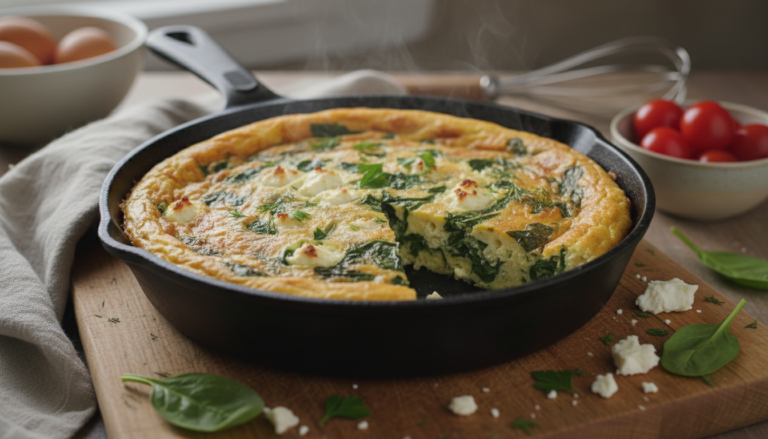
Spinach and Feta Frittata
This Spinach and Feta Frittata combines fluffy eggs with tender spinach and tangy feta cheese—a simple yet sophisticated dish that works equally well for elegant brunches or easy weeknight dinners.
4
servings10
minutes25
minutes250
kcal35
minutesIngredients
6 large eggs
1 cup fresh spinach
1 cup crumbled feta cheese
0.5 cup diced onion
1 tablespoon olive oil
0.25 teaspoon salt
0.25 teaspoon black pepper
Directions
- Preheat your oven to 350°F (175°C).
- In a skillet over medium heat, add olive oil and sauté the onion until translucent.
- Add the fresh spinach to the skillet and cook until wilted.
- In a bowl, whisk together the eggs, salt, and pepper.
- Add the sautéed onion and spinach to the egg mixture.
- Gently fold in the crumbled feta cheese.
- Pour the mixture into a greased ovenproof skillet or baking dish.
- Bake in the preheated oven for 20-25 minutes, or until the top is golden and the eggs are set.
- Let cool slightly before slicing and serving.
Nutrition Facts
- Total number of serves: 4
- Calories: 250kcal
- Cholesterol: 0mg
- Sodium: 620mg
- Potassium: 400mg
- Sugar: 8g
- Protein: 6g
- Calcium: 60mg
- Iron: 2mg
About This Author

Benjamin Brown
Recipe Developer
Benjamin is our flavor engineer. A classically trained chef turned recipe developer, he’s obsessed with balancing taste, texture, and creativity. He ensures that every recipe we publish is not only delicious but also reliable, approachable, and repeatable — even for beginners.
Favorite dish: Slow-braised short ribs with red wine reduction.
Kitchen motto: “Cooking is part science, part soul.”















