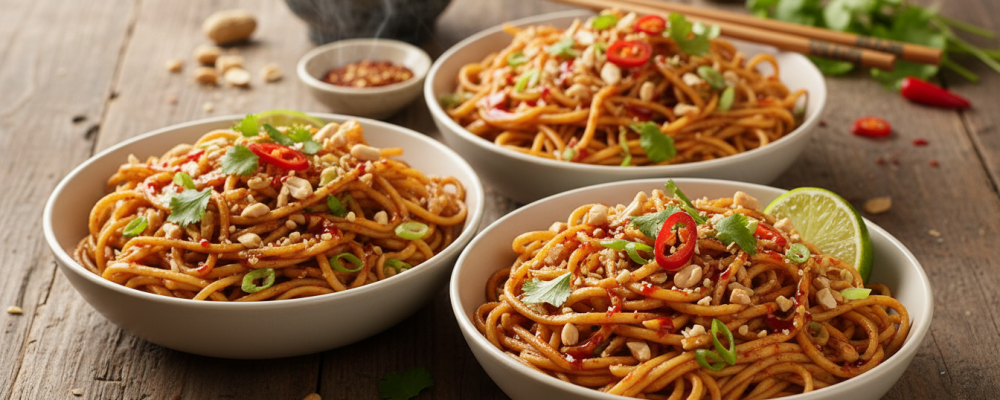

Most peanut sauce recipes are cold preparations—peanut butter whisked with liquids until smooth and drizzled directly onto noodles or salads without any heat applied. That approach produces a fine sauce. This recipe does something more deliberate, and the difference in the finished dish is substantial enough to be worth explaining.
Cooking the peanut sauce in a pan for five minutes—stirring constantly over moderate heat—accomplishes three specific things that cold preparation cannot. First, the heat blooms the garlic and ginger: raw minced garlic and raw grated ginger both contain sulfur compounds and volatile aromatics that are locked in cellular structures at room temperature. Gentle heat ruptures those structures and releases the compounds into the surrounding fat and liquid, producing a more fully developed, more evenly distributed garlic-ginger character throughout the sauce than the raw version delivers. Second, the heat allows the honey to caramelize slightly at the edges of the pan, adding a faint complexity to its sweetness that raw honey doesn’t have. Third, and most important for a meal prep context: cooking reduces the water content of the sauce, concentrating the flavor and producing a thicker, more adhesive consistency that coats noodles and clings to vegetable surfaces rather than pooling at the bottom of the container.
That last point is the meal prep argument. A cold peanut sauce is delicious immediately and separates into a watery pool of liquid and a dense peanut sediment by day two. A cooked, concentrated peanut sauce stays integrated and coating-level thick throughout the week, because the reduction has removed the excess free moisture that drives separation. It is a five-minute investment that pays back across every container for every day of the week.
─────────────────────────────────────────
The Inspiration Behind This Recipe
The design goal for this recipe was a noodle bowl that could credibly compete with restaurant-quality takeout on flavor while solving the specific problems that takeout peanut noodle preparations create in a meal prep context. Those problems are identifiable and consistent: the noodles clump into an impenetrable mass overnight, the sauce separates and requires aggressive re-emulsification at serving, and the fresh vegetable components wilt into the noodles and lose their textural contribution entirely.
Each of those failure modes has a specific solution that was built into this recipe’s design. The rice noodle choice addresses the clumping problem—rice noodles, because of their lower starch content relative to wheat noodles, are significantly less prone to the starch gelation that causes clumping during refrigeration, and they loosen more completely with minimal liquid when reheated. The cooked sauce addresses the separation problem, as described above. And the vegetable choice—carrot strips and bell pepper strips rather than leafy greens or softer vegetables—addresses the wilting problem, because both carrots and bell peppers have enough structural density to retain meaningful crunch through refrigeration even when they’ve been tossed in a warm sauce.
The resulting bowl is not a compromise version of peanut noodles—it’s a version engineered to perform at its best across four or five days, which the restaurant version was never designed to do. The flavor is bold, the sauce is integrated, the vegetables maintain their character, and the peanut and cilantro garnish adds fresh crunch and green aromatics at the moment of eating that make every serving feel newly assembled rather than reheated.
─────────────────────────────────────────
A Brief History of Peanut-Based Noodle Sauces
Peanut-based sauces applied to noodles have deep roots across Southeast Asian cuisines, where groundnut preparations have been a culinary staple for centuries following the introduction of peanuts to the region via Portuguese trade routes in the 16th century. In Indonesian cooking, peanut sauce—satay sauce—is one of the most fundamental preparations in the culinary repertoire, used as a marinade, a dipping sauce, and a noodle dressing across an enormous range of dishes. Gado-gado, a Indonesian vegetable and noodle salad dressed in peanut sauce, is perhaps the closest antecedent to the contemporary peanut noodle bowl format.
In Chinese-American cooking, the cold sesame noodle—wheat noodles dressed in a sesame-peanut sauce seasoned with soy, vinegar, and chili oil—became a fixture of restaurant menus throughout the 20th century and remains one of the most beloved noodle dishes in the American culinary landscape. The contemporary peanut noodle bowl that appears in meal prep contexts today is largely a descendant of this tradition: the sesame-peanut base translated into peanut butter for accessibility, the soy and acid preserved, the chili heat updated to sriracha, and fresh aromatics—ginger, garlic, lime—added in a nod to the broader Southeast Asian tradition from which peanut sauces originally emerged.
The use of rice noodles rather than wheat noodles in this recipe reflects the same pan-Asian culinary borrowing that characterizes the genre broadly. Rice noodles bring their own textural qualities and a gluten-free profile that makes the bowl accessible across a wider range of dietary needs—and their behavior under cold storage, as noted, makes them functionally superior to wheat noodles in a meal prep context. The format is the genre’s most logical contemporary expression: a fusion preparation that draws on centuries of culinary tradition and optimizes it for the practical requirements of a modern week.
─────────────────────────────────────────
Why This Cooking Method Works for Meal Prep
The balance of the peanut sauce is the central technical decision in this recipe, and it operates across five flavor dimensions simultaneously: fat (peanut butter), salt (soy sauce), sweet (honey), acid (lime juice), and heat (sriracha). Each dimension has a specific function in the finished sauce, and adjusting any one of them changes the behavior of all the others—which is why the ratio matters as much as the individual ingredients.
Fat carries the flavor of the garlic and ginger throughout the sauce, coating the noodle surfaces and ensuring even distribution of every other flavor note. Salt suppresses bitterness in the peanut butter and amplifies sweetness and umami. Honey’s sweetness balances the sriracha’s heat and the lime’s acidity, preventing either from dominating. The lime’s acidity prevents the sauce from tasting flat or one-dimensional and keeps the overall profile feeling bright despite the richness of the peanut base. The sriracha provides heat that builds rather than hits immediately, which means it doesn’t overwhelm at first taste but delivers a satisfying warmth that lingers. When these five dimensions are in proper balance, the sauce tastes simultaneously complete and complex—no single flavor dominates, and all of them are perceptible.
The water addition is the variable that controls sauce consistency, and its ratio to peanut butter determines whether the finished sauce coats noodles cleanly or sits in a pool at the base of the bowl. The cooking process reduces some of that water, so the initial sauce will appear slightly thinner than the finished product—this is intentional and correct. A sauce tossed with noodles at the proper post-reduction thickness will coat each noodle strand without excess pooling, and that coating is what produces the consistently sauced bowl on day four that looks and tastes as well-dressed as day one.
─────────────────────────────────────────
Flavor Profile: What to Expect
This bowl operates in a bold, multi-layered register where every component contributes a distinct and identifiable flavor note:
- Rich peanut depth – The cooked peanut butter base is the dominant flavor anchor: warm, roasted, and creamy, with a complexity that cold peanut butter alone doesn’t achieve
- Umami soy backbone – Soy sauce runs through the entire sauce as its savory foundation, adding saltiness and a fermented depth that extends the overall flavor well beyond the sum of its ingredients
- Building sriracha heat – The chili heat arrives gradually and lingers warmly at the back of the palate—present enough to be satisfying, measured enough not to overwhelm the more delicate flavors beneath it
- Bright citrus lift – Lime juice provides the essential acidity that keeps the rich peanut base from feeling heavy and makes every bite taste clean and vivid rather than dense
- Aromatic ginger and garlic – Cooked ginger and garlic infuse the entire sauce with a warm, aromatic complexity that is the flavor signature distinguishing this from a simple peanut butter and soy preparation
- Floral honey sweetness – Honey balances the salt and the heat with a rounded, natural sweetness that holds the whole sauce in equilibrium
- Fresh crunch and green – Chopped peanuts add a toasty, textural punctuation; cilantro leaves contribute a clean, aromatic herbaceousness that cuts through the richness at the surface of each bowl
The flavors deepen and integrate significantly overnight as the sauce permeates every noodle strand completely. Day two of this bowl is reliably its most cohesive and flavor-forward expression—a consistent and welcome quality in a meal prep recipe.
─────────────────────────────────────────
Tips for Making the Best Spicy Peanut Noodle Bowls
Precision in the sauce stage and proper noodle handling are the two variables that most determine the quality of this bowl across the week:
- Don’t overcook the rice noodles – Pull them from the water when they are just tender—slightly underdone is better than fully soft. They will continue to absorb moisture from the sauce after tossing and during refrigeration, reaching their ideal texture by serving time. Overcooked noodles will be mushy by day two.
- Rinse noodles in cold water immediately – After cooking, drain and rinse the noodles under cold water until completely cool. This stops the cooking process, removes excess surface starch, and significantly reduces the clumping that occurs during refrigeration.
- Toss noodles with a small amount of sesame oil after rinsing – A light coat of sesame oil on the cooled, rinsed noodles before adding the sauce creates a barrier that further prevents clumping in storage and adds a subtle nutty flavor that complements the peanut sauce perfectly.
- Taste and balance the sauce before tossing – Every peanut butter brand has a different fat content, salt level, and consistency. Taste the cooked sauce before adding the noodles and adjust: more lime for brightness, more sriracha for heat, more water for a looser consistency, more honey if the acid is too sharp.
- Add vegetables after tossing, not during cooking – The carrot and pepper strips are added raw and tossed with the sauced noodles rather than cooked in the sauce. This preserves their crunch and prevents them from releasing moisture into the sauce during the pan stage.
- Store garnishes separately – Chopped peanuts and cilantro are best added at serving rather than stored in the bowl. Peanuts soften against moist noodles overnight; cilantro wilts and loses its aromatic freshness. Two small separate containers take seconds to fill and produce a noticeably better result at every serving.
Optional: A drizzle of toasted sesame oil and a few drops of chili crisp over the finished bowl at serving adds an additional aromatic layer and a textural garnish that makes this feel like a restaurant-quality presentation with zero additional prep time.
─────────────────────────────────────────
Portioning and Container Suggestions
This recipe portions most efficiently into a two-component system: the sauced noodles and vegetables in one container, and the garnishes—chopped peanuts and cilantro—in small separate bags or containers. This separation ensures the noodles remain the focus of the main container without the garnishes degrading in quality or appearance, and it allows the crunch and freshness of the toppings to be delivered at their best at every serving.
For daily volume, a standard lunch portion is approximately one and a half cups of sauced noodles with vegetables—substantial enough to carry through the afternoon without requiring supplementation, but not so large that the noodle-to-sauce ratio tips out of balance. Wide, flat containers work better than tall, narrow ones for this recipe: noodles stored in a shallow layer separate more easily at reheating than noodles compressed into a deep container under their own weight.
Glass containers are the preferred vessel for both flavor and practical reasons—they don’t absorb the peanut sauce’s aroma or color over repeated uses the way plastic containers can, and they distribute microwave heat more evenly than plastic when reheating is the method of choice. A container wide enough to accommodate noodles in a single, loosely distributed layer rather than a compressed pile will produce the most consistent reheating result and the best visual presentation when the lid comes off at lunch.
─────────────────────────────────────────
Storage, Reheating, and Shelf Life Tips
- Refrigerator storage: Sauced noodle bowls keep for up to 4 days in airtight containers. The sauce continues to absorb into the noodles over time—day one is the sauciest; days two and three are the most flavorful and cohesive; day four is slightly drier and benefits from a small addition of water or soy sauce before reheating.
- Freezer storage: Not recommended. Rice noodles become mushy and lose their texture entirely upon thawing, and the emulsified peanut sauce breaks and separates irreversibly in the freezer. This is a refrigerator-only prep.
- Reheating: Add 1–2 tablespoons of water to the container before microwaving—the noodles have absorbed much of the sauce moisture during refrigeration and need reintroduced liquid to return to a properly sauced consistency. Microwave at full power for 90 seconds, stirring once halfway through.
- Cold serving option: These noodles are genuinely excellent served cold or at room temperature, particularly in warmer weather. The peanut sauce firms slightly when cold and adheres even more thoroughly to the noodle surface—producing a texture closer to cold sesame noodles than a warm noodle bowl, which is a distinct and equally appealing eating experience.
- Sauce refresh at day four: If the bowl seems under-sauced at day four, a small drizzle of soy sauce and a squeeze of lime juice stirred through before reheating immediately refreshes the flavor balance and restores the bright, acid-forward character that characterizes the freshly made version.
- Garnish: Always add chopped peanuts and cilantro after reheating, never before. Both lose their defining qualities—crunch and fresh aroma respectively—under microwave heat.
─────────────────────────────────────────
Why This Recipe Deserves a Spot in Your Meal Prep Rotation
From a pure flavor-per-effort standpoint, this recipe is one of the strongest in any meal prep collection. The peanut sauce requires ten minutes of active time and produces a result that rivals restaurant preparations of the same dish—bold, cohesive, and multi-dimensional in a way that most single-session home cooking can’t achieve. The rice noodle format keeps the prep fast and the dish accessible, and the vegetable components require no cooking whatsoever beyond the passive warming they receive when tossed with the hot sauce.
The deeper case for keeping this in regular rotation is its distinctiveness within a weekly lunch spread. Most meal prep bowls are grain-based—rice, couscous, quinoa—and noodle-based options provide a textural and format variety that keeps the rotation feeling genuinely different from meal to meal rather than structurally repetitive. A week that includes a noodle bowl alongside a grain bowl and a wrap covers the full range of lunch formats, which is the kind of variety that makes a meal prep routine sustainable across months rather than weeks. This recipe earns its place in that rotation not just because it’s good on Sunday, but because it’s still good on Thursday—and that, ultimately, is the only standard that matters.
─────────────────────────────────────────
Meal Prep Pairing Suggestions
Spicy Peanut Noodle Bowls pair most naturally with other bold, umami-rich meal prep options that share the same satisfying depth without overlapping in flavor profile. Our Teriyaki Salmon Rice Bowls are the ideal rotation partner—both are Asian-inspired, both are built around a sauce that does the primary flavor work, and both reward the patience of an overnight rest with a more integrated, more complex eating experience. But where the teriyaki bowl is sweet, lacquered, and protein-anchored by salmon, the peanut noodle bowl is spicy, creamy, and plant-forward. Alternating between them gives the week genuine variety within a cohesive flavor tradition.
For a broader weekly spread, our White Bean & Roasted Veggie Wraps provide a plant-based, European-inspired option that shifts the flavor register entirely—from bold and Asian-influenced to clean and Mediterranean—giving the lunch rotation enough tonal range to sustain genuine interest across five days. A week anchored by peanut noodles, teriyaki salmon, and balsamic-roasted veggie wraps covers three distinct culinary traditions, three different protein and carbohydrate formats, and three completely different flavor profiles—all assembled from a single Sunday session that delivers a week of lunches that never once feels like a repeat.
Spicy Peanut Noodle Bowls
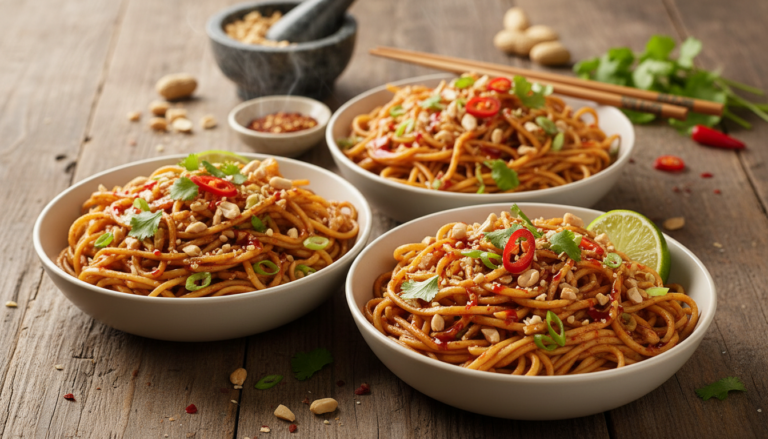
These Spicy Peanut Noodle Bowls bring a rich, ginger-forward peanut sauce together with tender rice noodles and crisp vegetables for a bold, satisfying meal prep lunch that holds up all week and gets better overnight.
4
servings15
minutes10
minutes500
kcal25
minutesIngredients
200 g rice noodles
100 g peanut butter
60 ml soy sauce
30 ml sriracha
15 g honey
2 cloves garlic
1 tbsp grated ginger
1 tbsp lime juice
50 g carrot strips
50 g bell pepper strips
30 g chopped peanuts
2 tbsp cilantro leaves
120 ml water
Directions
- Cook rice noodles according to package instructions and set aside.
- In a bowl, mix peanut butter, soy sauce, sriracha, honey, minced garlic, grated ginger, lime juice, and water.
- Heat the sauce mixture in a pan for 5 minutes, stirring constantly.
- Add cooked noodles, carrot strips, and bell pepper strips to the sauce; mix well.
- Serve in bowls topped with chopped peanuts and cilantro leaves.
Nutrition Facts
- Total number of serves: 4
- Calories: 500kcal
- Cholesterol: 0mg
- Sodium: 620mg
- Potassium: 400mg
- Sugar: 8g
- Protein: 6g
- Calcium: 60mg
- Iron: 2mg
About This Author

Benjamin Brown
Recipe Developer
Benjamin is our flavor engineer. A classically trained chef turned recipe developer, he’s obsessed with balancing taste, texture, and creativity. He ensures that every recipe we publish is not only delicious but also reliable, approachable, and repeatable — even for beginners.
Favorite dish: Slow-braised short ribs with red wine reduction.
Kitchen motto: “Cooking is part science, part soul.”