
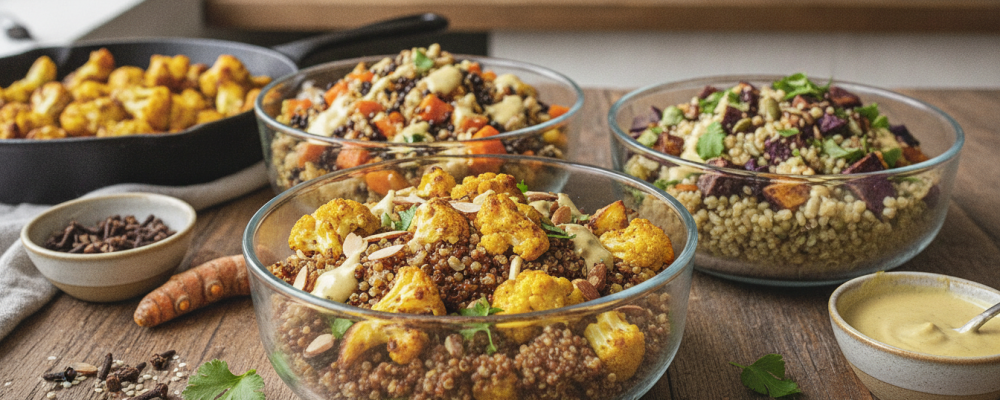

There is a kind of meal that goes beyond the practical business of eating—that delivers something that I can only describe as a sense of being genuinely taken care of. It’s not always the most elaborate preparation or the most impressive technique that achieves this. Sometimes it’s the warm, golden color of cauliflower that has been roasted with turmeric until it’s caramelized at the edges. Sometimes it’s the quiet, earthy satisfaction of lentils cooked in good vegetable broth until they’re completely tender. Sometimes it’s the way a squeeze of fresh lemon lifts a whole bowl of grain and vegetable into something that tastes, suddenly, alive.
This bowl does all three of those things, and the experience of eating it—particularly on a weekday, particularly when the week has been long—is genuinely restorative in a way that I find difficult to attribute entirely to its nutritional profile, though the nutritional profile is remarkable. It is the warmth, I think. The golden color that turmeric gives the cauliflower, and the earthy depth that lentils bring, and the fluffiness of the quinoa that absorbs the lemon juice and becomes fragrant with cilantro. These are not complex flavors. They are honest ones, and honest flavors, in my experience, are always the most satisfying.
I make this bowl when I want the week ahead to feel like it was planned with care—when I want to open the refrigerator on Wednesday and feel, for a moment, genuinely glad that I cooked on Sunday. It is the plant-based bowl in this collection that I return to most consistently, not because it is the most exciting or the most visually dramatic, but because it is the most reliably, completely nourishing in the fullest sense of that word. Some bowls feed you. This one takes care of you.
─────────────────────────────────────────
The Inspiration Behind This Recipe
This recipe was born from a simple observation about what plant-based meal prep most often gets wrong: it aims for variety when it should aim for depth. A bowl with too many competing ingredients, too many flavors pulling in different directions, satisfies the eye but rarely the appetite—it tastes like assembly rather than cooking. The most nourishing plant-based meals are usually the simplest ones, built around a small number of ingredients that are each treated with enough attention to develop their full character.
Turmeric-roasted cauliflower is an ingredient that develops genuine depth when given twenty-five minutes at 400°F. The cauliflower’s natural sugars caramelize at the cut surfaces; the turmeric’s curcumin compounds bloom in the olive oil’s fat and deepen into something warm and earthy rather than simply yellow; the edges take on a golden-brown crispness that is a completely different ingredient from raw or steamed cauliflower. Treating the cauliflower this way before it enters the bowl is what makes the difference between a vegetable that is present and a vegetable that contributes.
Green lentils cooked in vegetable broth—not water—absorb the broth’s savory depth as they simmer, arriving in the bowl with a flavor that is already more cohesive and more interesting than plain cooked lentils would be. And quinoa, the third ingredient that completes the bowl’s protein picture, cooks to a fluffy, slightly toasty finish that carries the lemon juice and cilantro evenly through every forkful. Together, these three ingredients produce a bowl that is greater than their individual qualities would suggest—one where the whole is genuinely more satisfying than the sum of its parts.
─────────────────────────────────────────
A Brief History of Lentil and Grain Cooking
Lentils are among the oldest cultivated crops in human history—evidence of their consumption appears in archaeological sites across the Middle East and Mediterranean dating back over nine thousand years, making them one of the first plants domesticated by human agricultural communities. They were prized across ancient Egyptian, Roman, Greek, and Levantine civilizations as a reliable, nutritionally dense food source that required no soaking, cooked relatively quickly, and provided protein and fiber in an era when animal protein was often scarce or expensive. The lentil’s place at the center of everyday eating in these cultures was so established that the ancient Egyptians are known to have included lentil preparations in tomb offerings, ensuring the dead had access to one of life’s most essential provisions.
The combination of lentils with grain—whether wheat, barley, millet, or more recently quinoa—reflects a nutritional understanding that predates modern science by millennia. Traditional diets across South Asia, the Middle East, North Africa, and the Mediterranean all feature legume-and-grain pairings as foundational meal structures—dal and rice in India, mujaddara (lentils and rice) across the Levant, ful medames with bread in Egypt—each arrived at independently by cultures that recognized through experience that legume-and-grain combinations produced a fullness and a sustained energy that neither ingredient provided alone.
Turmeric’s role in this culinary tradition is equally ancient. Used in South Asian and Middle Eastern cooking for at least four thousand years, turmeric’s combination of warm color, earthy flavor, and documented medicinal properties made it one of the most valued spices in the ancient trade routes that connected these food cultures. Applied to cauliflower in a modern oven, it honors a spice tradition that has been understood to transform vegetables—making them more beautiful, more flavorful, more valuable—for as long as cooking itself has been a deliberate act.
─────────────────────────────────────────
Why This Cooking Method Works for Meal Prep
Roasting the cauliflower at 400°F is the temperature that achieves the specific caramelization required for a vegetable that will survive four to five days of refrigerator storage with its character intact. Cauliflower roasted at lower temperatures softens evenly but develops minimal surface browning—it remains mild and one-dimensional in flavor, and that mild, one-dimensional character does not become more interesting over time in the refrigerator. Cauliflower roasted at 400°F develops a caramelized, slightly crisp surface with concentrated flavor that holds its character through storage, producing a bowl that still tastes specifically of golden, turmeric-spiced cauliflower on day four rather than simply of cooked vegetable.
Cooking the lentils in vegetable broth is the decision that makes the bowl taste seasoned from within rather than seasoned from without. Lentils cooked in plain water taste primarily of lentil—mild, slightly grassy, and nutritious without being particularly interesting. Lentils cooked in a well-seasoned vegetable broth absorb the broth’s complex vegetable depth during simmering, arriving in the bowl with a savory foundation that makes them a flavor component rather than simply a protein component. This is a small decision with a perceptible outcome in every single serving.
The assembly method—combining all three components with lemon juice and cilantro in a single large bowl rather than building layers in individual containers—produces a more evenly seasoned final bowl than separate storage and assembly at serving would achieve. The lemon juice’s acidity permeates all three components during the brief rest before portioning, brightening the quinoa’s slight nuttiness, lifting the lentils’ earthiness, and cutting through the cauliflower’s olive oil richness in a way that makes the whole bowl taste unified and considered rather than assembled. This is a bowl that benefits from being mixed together before being divided into containers.
─────────────────────────────────────────
Flavor Profile: What to Expect
This bowl is warm, earthy, and bright—a flavor profile built on simplicity and the depth that comes from treating each ingredient well:
- Golden, caramelized turmeric cauliflower – The defining visual and aromatic element of the bowl: warm, slightly earthy, with the concentrated sweetness that caramelization produces at the edges—present in every bite as both a flavor and a warmth that is specifically, pleasurably turmeric
- Earthy, savory green lentils – The bowl’s protein anchor: dense, slightly grassy, and deeply satisfying in the way that a well-cooked legume always is—made more flavorful by the vegetable broth that seasoned them during cooking
- Light, fluffy quinoa – The grain base that carries the lemon and cilantro through every forkful: mild, slightly toasty, and more aromatic than rice or couscous in the company of fresh citrus
- Vivid lemon brightness – The acidity that lifts everything: vivid, clean, and essential—the element that makes a warm, earthy bowl taste alive rather than dense
- Fresh cilantro herbal note – The finishing brightness that threads through every component and gives the bowl its herbal freshness—present everywhere as a background note and most vivid in the first bite
- Fruity olive oil richness – Carried from the roasting step through the cauliflower’s surface into every adjacent component, contributing a quiet, round richness that ties the whole bowl together
The flavors integrate and deepen over the first twenty-four hours as the lemon juice fully permeates all three components and the turmeric’s curcumin compounds distribute through the cauliflower’s olive oil into the surrounding grain and lentil. Day-two bowls are consistently more cohesive and more fully flavored than the freshly assembled version—a pattern that holds reliably across the full storage window.
─────────────────────────────────────────
Tips for Making the Best Turmeric Roasted Cauliflower & Lentil Grain Bowls
A few careful choices across the three cooking processes produce a meaningfully better bowl:
- Cut cauliflower into uniform, flat-sided florets – Florets with at least one flat cut surface develop the most contact caramelization during roasting. Round, uncut surfaces brown less effectively than flat ones because less surface area makes full contact with the hot pan. Cut larger florets in half to maximize flat surface area.
- Don’t crowd the cauliflower sheet pan – Florets touching each other steam rather than roast. A single, spacious layer with visible pan between each piece is the condition for proper caramelization. Use two sheet pans if the batch is large.
- Rinse quinoa until the water runs clear – Quinoa’s saponin coating produces a bitter, soapy flavor if not rinsed away. A thirty-second rinse under cold water is all that is required, but it is required.
- Season the lentil cooking broth – If using store-bought vegetable broth, taste it before adding the lentils. Under-seasoned broth produces under-seasoned lentils that need correction at assembly time; properly seasoned broth produces lentils that are flavorful throughout.
- Add lemon juice while the components are still warm – Warm cauliflower, lentils, and quinoa absorb the lemon juice and release the cilantro’s aromatic oils more receptively than cold components. Tossing while warm produces a more uniformly seasoned, more fragrant bowl than assembling cold.
- Taste before portioning – The three components combined may need additional salt, lemon, or black pepper to reach the correct balance. Taste the assembled bowl before dividing into containers and adjust; it is significantly easier to correct seasoning in the large bowl than in four individual ones.
Optional: A spoonful of good tahini stirred through the assembled bowl—or drizzled over each individual serving—adds a creamy, nutty richness that bridges the turmeric cauliflower and the lentils beautifully and makes the bowl taste more composed and more luxurious without any additional cooking.
─────────────────────────────────────────
Portioning and Container Suggestions
This recipe produces four generous bowls from a single batch—one per day across a four-day lunch or dinner rotation, with the option to scale by a quarter for a fifth serving. Because all three components are mixed together before portioning, the assembly step is simply dividing the finished bowl evenly—no component separation required, no daily assembly, no extra containers. This is one of the most straightforwardly portioned meal prep recipes in the collection, and the ease of that portioning is worth appreciating in the context of a Sunday session that may include multiple simultaneous preparations.
Wide, flat glass containers allow the golden cauliflower pieces and the green of the cilantro to remain visible through the sides—a small visual detail that makes the refrigerator shelf look genuinely well-stocked and makes each morning’s container retrieval a moment of quiet anticipation rather than simply a practical action. A generous portion—approximately one and a half cups of the combined bowl—is the right amount for a satisfying lunch that doesn’t require supplementing with additional snacks.
For serving, a small additional squeeze of fresh lemon over the reheated bowl and a pinch of fresh cilantro scattered over the top immediately before eating restores the brightness that storage can mellow slightly—a ten-second finishing touch that makes every bowl feel freshly made.
─────────────────────────────────────────
Storage, Reheating, and Shelf Life Tips
- Refrigerator storage: Assembled bowls keep in airtight containers for up to 5 days. The lemon and cilantro integrate more fully through days two and three; the cauliflower softens slightly but retains its turmeric character throughout the storage window.
- Freezer storage: All three components freeze well individually for up to 2 months. The assembled bowl also freezes adequately, though the cauliflower loses some of its roasted texture on thawing—still delicious, but softer. Freeze in individual portions and thaw overnight in the refrigerator.
- Reheating: Microwave at full power for 90 seconds to 2 minutes, stirring once halfway through. Add a teaspoon of water before reheating if the quinoa seems dry—it rehydrates quickly and restores the bowl’s original texture.
- Cold serving: This bowl is genuinely pleasant at room temperature and works well as a cold grain salad—the lemon and cilantro are actually more vivid without heat, and the lentil texture is at its most pleasant slightly below room temperature. A valid no-reheat option for desk lunches.
- Lemon refresh: If the bowl seems flat by days four or five, a fresh squeeze of lemon juice and a small additional pinch of salt stirred through before eating restores the brightness that has mellowed in storage.
- Cilantro tip: If fresh cilantro is important to you across the full week, store a small additional bag of fresh cilantro separately and add a pinch to each day’s reheated bowl. The cilantro stored in the assembled bowl remains flavorful but loses some of its vivid green color by day three—fresh added at serving restores both.
─────────────────────────────────────────
Why This Recipe Deserves a Spot in Your Meal Prep Rotation
The case for this bowl is both simple and, I think, genuinely important: it is one of the most completely nourishing plant-based meals available within a meal prep format. The lentil-quinoa protein combination is nutritionally equivalent to animal protein in amino acid completeness. The turmeric’s anti-inflammatory curcumin is present in meaningful quantity. The cauliflower’s fiber and micronutrients, the olive oil’s healthy fats, the lemon’s vitamin C—this is a bowl that is, by any reasonable nutritional measure, taking care of you.
But the reason I keep it on the weekly list isn’t the nutrition—it’s the feeling. Opening a container of golden cauliflower and green lentils and fluffy quinoa on a Wednesday afternoon and smelling the lemon and turmeric and cilantro is a specific and genuinely pleasant experience. It is the experience of eating something that was made for you—even when the person who made it was you, on a Sunday, while also making three other things. That quality—the feeling of being cared for by your own past effort—is the most honest and most valuable thing a meal prep recipe can deliver. This bowl delivers it completely, warmly, and without fail.
─────────────────────────────────────────
Meal Prep Pairing Suggestions
Turmeric Roasted Cauliflower & Lentil Grain Bowls pair most naturally with other legume-and-grain bowls that offer genuine contrast in flavor tradition and spice character. Our Coconut Curry Chickpea & Basmati Rice Bowls are the natural plant-based rotation partner—both are warmly spiced, deeply flavored plant-based bowls built around legumes and grain, but the curry bowl’s South Asian boldness and coconut richness are completely distinct from this bowl’s Mediterranean-inspired brightness and golden turmeric warmth. Alternating between them across the week provides two genuinely different plant-based experiences that share a nutritional logic without sharing a single flavor note.
For a complete three-bowl weekly spread, our Smoky Chipotle Black Bean & Farro Bowls round out the plant-based rotation with a boldly spiced, Latin-inspired alternative that covers the same legume-and-grain format in a completely different direction—smoky and heat-forward where this bowl is warm and lemon-bright. Three plant-based bowls covering Mediterranean, South Asian, and Latin American spice traditions: a week of lunches that is entirely plant-based, genuinely varied, completely filling, and built from a single Sunday session that takes less than an hour of active kitchen time. That is what a well-designed plant-based meal prep rotation should look like—and these three bowls achieve it together with the quiet, nourishing efficiency that good plant-based cooking has always been capable of.
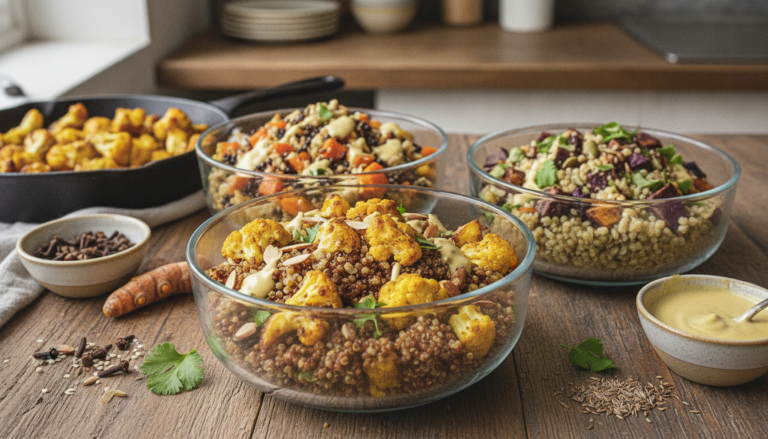
Turmeric Roasted Cauliflower & Lentil Grain Bowls
These Turmeric Roasted Cauliflower & Lentil Grain Bowls are a warmly golden, plant-based meal prep bowl that layers three powerhouse ingredients—roasted cauliflower, green lentils, and quinoa—into one of the most complete, deeply satisfying bowls in the collection.
4
servings20
minutes30
minutes450
kcal50
minutesIngredients
1 head cauliflower
1 tablespoon turmeric powder
2 tablespoons olive oil
1 cup green lentils
2 cups vegetable broth
1 cup quinoa
1 teaspoon salt
1 teaspoon black pepper
0.5 cup chopped cilantro
2 tablespoons lemon juice
Directions
- Preheat the oven to 400°F (200°C).
- Cut the cauliflower into florets and place on a baking sheet.
- Drizzle with olive oil, sprinkle turmeric, salt, and pepper. Toss to coat.
- Roast in the oven for 20-25 minutes until golden brown.
- While the cauliflower is roasting, rinse the lentils.
- In a pot, bring vegetable broth to a boil and add lentils.
- Reduce heat and simmer for 20 minutes or until tender.
- Rinse the quinoa under cold water.
- In a separate pot, combine quinoa with 2 cups of water and a pinch of salt.
- Bring to a boil, then reduce to a simmer, cooking for 15 minutes.
- Once the cauliflower is done, remove from the oven.
- In a large bowl, combine roasted cauliflower, cooked lentils, quinoa, chopped cilantro, and lemon juice.
- Mix well and serve immediately.
Nutrition Facts
- Total number of serves: 4
- Calories: 450kcal
- Cholesterol: 0mg
- Potassium: 400mg
- Sugar: 8g
- Protein: 6g
- Calcium: 60mg
- Iron: 2mg
About This Author

Amelia Grace
Editor-in-Chief & Culinary Director
The heart and guiding voice of Daily Dish, Amelia leads our editorial vision and recipe development. With a background in food journalism and over a decade spent in professional kitchens, she has a knack for blending gourmet technique with real-world accessibility. Her goal? To make every reader feel like a confident cook, one dish at a time.
Favorite dish: Creamy lemon risotto with a sprinkle of fresh thyme.
Kitchen motto: “Good food doesn’t have to be complicated — it just has to be made with heart.”















