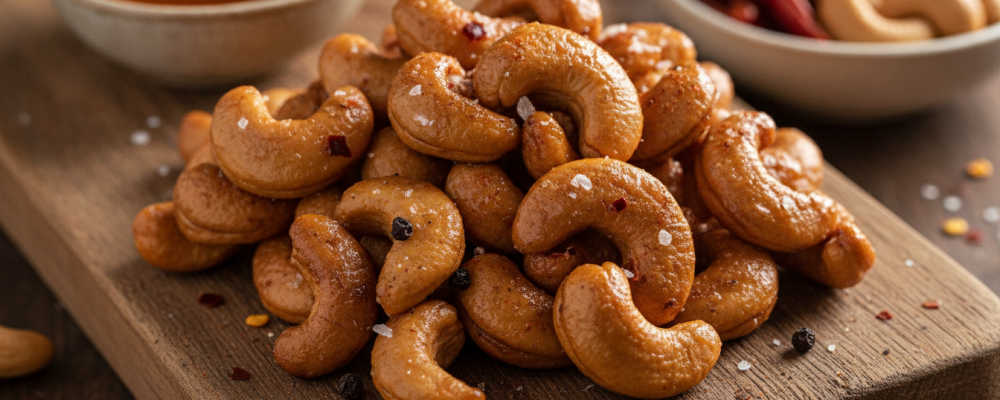

The chemistry of a roasted nut cluster is determined by three variables: the binder’s sugar composition, the fat content of the nut being coated, and the interaction between those two during the baking window. Change any one of these variables and the cluster behaves differently—sets at a different rate, develops a different texture, and holds together with a different structural integrity through cooling and storage. Understanding how cashews specifically behave in this framework is what explains why this recipe produces the specific cluster texture it does, and why a slightly longer baking time than you might expect is the correct choice for this particular nut.
Cashews have a higher fat content than most nuts—approximately 44% by weight—but it is the composition of that fat that matters most in a cluster context. Cashew fat is dominated by oleic acid, a monounsaturated fat that remains liquid at a higher temperature than the saturated fats more prevalent in macadamia or coconut. This means that during roasting, the cashew’s natural fat melts and mixes with the honey coating in the oven—creating a more fluid coating medium than a lower-fat nut would produce—and then resolidifies more slowly during cooling, giving the honey’s caramelized sugars more time to form bonds between adjacent nuts before the fat phase sets. The result is a cluster that bonds more thoroughly and more consistently than a cluster made from a drier nut like an almond or a peanut.
The olive oil in this recipe adds a second fat phase alongside the honey, and its specific contribution is thermal buffering. Olive oil’s smoking point is higher than the temperature at which honey’s sugars caramelize, which means it forms a protective layer between the honey and the hot parchment paper surface that prevents the coating from scorching at the base before the upper surface has finished caramelizing. The clusters baked with olive oil in the coating are more evenly caramelized from base to top than honey-only clusters, which tend to be darker at the bottom where direct pan contact accelerates browning.
─────────────────────────────────────────
The Inspiration Behind This Recipe
The design brief was a snack cluster built around cashews specifically—not because cashews were the default choice, but because cashews bring a specific and underappreciated quality to a roasted cluster format: a creaminess. Where almonds are crisp and firm when roasted, where pecans are brittle and fragile, where walnuts are slightly tannin-forward, roasted cashews are smooth and yielding at the center—a texture that is more akin to a confection than a nut preparation, and one that pairs with a honey-caramelized exterior in a way that produces a cluster with a genuinely interesting textural gradient: crisp at the surface, smooth within.
Chili powder was chosen as the heat component for its flavor compatibility with honey and cashew in a way that is distinct from hotter or more complex chili preparations. Commercial chili powder—a blend of dried chile, cumin, garlic powder, and oregano—delivers a warm, slightly earthy, moderately spiced heat that complements honey’s sweetness without overwhelming it or introducing the citrus-forward complexity of Tajín or the smoke complexity of chipotle. It is the most direct and most clean heat delivery available, which suits the simplicity of a five-ingredient recipe where clarity of flavor is the design goal rather than complexity.
Salt in this recipe is not simply a seasoning element—it is a flavor-unlocking agent that makes the sweet taste sweeter and the chili taste more vivid by suppressing the competing bitterness that both honey and chili carry in small amounts when unbalanced. A cluster without adequate salt tastes simultaneously flat and slightly harsh; a properly salted cluster tastes balanced, complete, and genuinely difficult to stop eating. The ratio of salt in this recipe is calibrated to achieve that balance rather than simply to season the nut.
─────────────────────────────────────────
A Brief History of Honey-Roasted Nuts
The tradition of coating nuts in honey or sweetened syrups and applying heat to produce a caramelized confection is one of the oldest in culinary history—versions of this preparation appear in ancient Mediterranean, Middle Eastern, and Asian food traditions stretching back thousands of years. Roman texts document nut-and-honey confections served at feasts; Middle Eastern pasteli (sesame and honey brittles) and praline antecedents in French confectionery both draw on the same fundamental chemistry of caramelized sugar as a nut-binding medium.
The cashew itself, however, is a relatively recent arrival in the global nut tradition. Native to northeastern Brazil, it was introduced to the rest of the world by Portuguese traders in the 16th century—first to India, then to Southeast Asia and East Africa, where it became an important agricultural crop and culinary staple over the following centuries. Its adoption into Western confectionery and snack formats is largely a 20th century development, though cashew-based preparations with honey and spices appear in Indian and Southeast Asian cooking traditions that predate the Western snack industry by centuries.
The specifically American tradition of the spiced and honey-roasted nut—sold at fairgrounds, in mall kiosks, and eventually packaged for grocery retail—is a mid-20th century commercial development that drew on these older confectionery traditions and made them accessible as everyday snack formats. The home roasted version, which this recipe represents, is the logical endpoint of that tradition: the same caramelization chemistry applied to better ingredients, in a home kitchen, for a fraction of the cost of the commercial equivalent and with direct control over every variable that determines the finished cluster’s quality.
─────────────────────────────────────────
Why This Cooking Method Works for Meal Prep
The 350°F baking temperature is calibrated for the specific interaction between cashew fat and honey caramelization. Honey’s primary sugars—fructose and glucose—caramelize at temperatures between 320°F and 356°F depending on concentration and water content. At 350°F, the oven temperature is high enough to achieve caramelization across a 20-25 minute window while remaining low enough to allow the cashew fat to gradually melt into the coating medium without scorching at the surface before the interior has had time to toast. A higher temperature would caramelize the honey faster than the cashew can develop its characteristic roasted flavor; a lower temperature would extend the baking time without achieving the depth of caramelization required for the cluster to set firmly on cooling.
The 20-25 minute window is longer than recipes using smaller seeds or lower-fat nuts require, and the reason is thermal mass. Cashews are significantly larger and denser than pepitas or sunflower seeds, and their high fat content means they require more time to heat uniformly to their core before the surface caramelization can proceed without creating the temperature differential between surface and center that produces uneven toasting. The halfway stirring step serves the same redistributive function it does in any cluster recipe—moving the more exposed pieces to the cooler center and the less-exposed pieces to the edges—but in a cashew cluster it is particularly important because the size differential between edge and center positions is greater than with smaller seeds.
The cooling process is where the cluster structure forms, and disturbing it too early is the most common error in any honey-roasted preparation. The honey’s caramelized sugars remain fluid above approximately 75°F and only set into their glass-like binding matrix as they cool below that threshold. A cashew cluster pulled apart at five minutes of cooling will not reattach cleanly; one that has cooled for a full fifteen to twenty minutes will break along natural fault lines into satisfying, irregular pieces that hold together confidently during handling and storage.
─────────────────────────────────────────
Flavor Profile: What to Expect
These clusters operate in a warm, direct, richly satisfying register—bold without being complex, and compelling in the specific way that the best simple preparations always are:
- Caramelized honey sweetness – The foundational flavor: deep amber sweetness with the slight bitterness of proper caramelization, more complex and more satisfying than the raw honey it began as—present as the coating on every surface of every cluster
- Warm chili heat – Commercial chili powder’s blend of mild chile, cumin, and garlic delivers a slow-building, earthy warmth that intensifies through the eating and lingers on the palate without overwhelming the honey’s sweetness
- Smooth, roasted cashew – The nut’s natural creaminess and the deep, rich flavor of a properly roasted cashew—nutty, slightly sweet, and smooth in a way that no other tree nut quite replicates at this preparation
- Fruity olive oil undertone – Most perceptible at the cluster’s edges where the oil has contributed to the surface browning—a quiet, slightly peppery richness that prevents the coating from reading as flat or purely sweet
- Salt clarity – The pinch of salt that makes every other flavor register at its maximum potential—present as a balancing element rather than a distinct taste, and immediately missed when absent
The chili and honey flavors become more cohesive and more evenly distributed through the cluster after an overnight rest at room temperature, as the caramelized coating’s flavor compounds continue to distribute into the cashew’s fat phase. Day-two clusters are reliably more balanced in flavor than freshly cooled ones—the chili’s heat more evenly present and the honey’s caramel depth more forward.
─────────────────────────────────────────
Tips for Making the Best Chili Honey Roasted Cashew Clusters
Execution precision at the coating, baking, and cooling stages determines the quality of the finished batch:
- Use raw cashews, not roasted – Pre-roasted cashews will over-toast in the oven before the honey coating has had time to caramelize fully, producing a batch with bitter, over-darkened nuts and under-developed coating. Raw cashews allow the nut and the coating to develop at the same rate.
- Coat thoroughly before spreading – Every cashew needs full coverage with the honey-olive oil-chili mixture before the pan goes into the oven. Toss for a full sixty seconds in the bowl—longer than seems necessary—to ensure no dry spots remain. Uncoated surfaces don’t caramelize and don’t contribute to cluster formation.
- Spread in a single layer with space – Cashews touching during roasting cook unevenly at the contact points and form clusters prematurely, before the honey has fully caramelized. Space on the pan produces more even browning and better-formed clusters.
- Watch the color, not the clock – Ovens vary. The cashews are done when they are deep golden—the color of a well-tanned surface rather than a pale wheat one—and the coating looks glossy and slightly bubbly at the edges. Pale cashews will not have developed their full flavor; dark cashews will be bitter at the coating’s edges.
- Don’t touch until fully cool – This cannot be stated firmly enough. The caramelized honey matrix is still liquid immediately out of the oven. Full cooling takes fifteen to twenty minutes at room temperature. The clusters set completely in that window and break cleanly afterward; clusters broken while warm produce crumbs rather than pieces.
- Store in an airtight container at room temperature – Refrigerator humidity softens the caramelized honey matrix and produces a sticky, soft result within twenty-four hours. Room temperature in a sealed container maintains the crunch for up to a week.
Optional: A very small pinch of smoked paprika added to the chili powder coating introduces a dry-smoke character that deepens the heat’s complexity and gives the clusters a second aromatic layer—detectable as something richer and more interesting than chili powder alone, without being identifiable as smoke.
─────────────────────────────────────────
Portioning and Container Suggestions
A standard batch yields approximately two to two-and-a-half cups of finished clusters—a generous handful (roughly one-quarter cup, approximately twelve to fifteen cashews) constitutes a satisfying snack serving, yielding eight to ten portions from a single batch. The larger size of cashews relative to seeds or smaller nuts means these clusters are more substantial per piece and more filling per serving—a quality that makes them particularly effective as a between-meal snack that actually addresses hunger rather than simply occupying it.
These clusters store best in an airtight glass jar or tin at room temperature—away from direct sunlight and away from any moisture source. The visual of a glass jar filled with golden, chili-dusted cashew clusters is one of the more appealing pantry or counter presentations in the snack category; a jar that looks good where it lives is a jar that gets used rather than forgotten.
For pre-portioned grab-and-go use, small zip bags or 4-ounce containers filled on Sunday provide a week’s worth of snacks that require nothing more than reaching for the bag. The clusters’ structural integrity—they hold together reliably and don’t shed crumbs the way more fragile preparations do—makes them one of the most genuinely portable snacks in the collection, suitable for gym bags, desk drawers, and commutes without any additional packaging consideration.
─────────────────────────────────────────
Storage, Reheating, and Shelf Life Tips
- Room temperature storage (required): Keeps in a sealed airtight container for up to 7 days. This is the only correct storage method—refrigerator humidity softens the caramelized matrix within twenty-four hours.
- Refrigerator storage: Not recommended for texture quality. If the kitchen runs very warm (above 80°F), refrigerator storage is acceptable for food safety, but allow clusters to return to full room temperature before eating for the best texture result.
- Re-crisping: If clusters have softened due to humidity exposure, spread on a parchment-lined baking sheet and warm at 300°F for 5 minutes. Cool completely before returning to storage—the honey matrix will re-harden as it cools and restore the original snap.
- Freezer storage: Freeze well for up to 2 months in an airtight bag. Thaw at room temperature for fifteen to twenty minutes—the caramelized matrix re-hardens completely within this window.
- No reheating required: These are a room-temperature snack by design. Heating beyond the re-crisping method above risks re-melting the honey matrix and losing the cluster structure.
- Moisture management: In particularly humid climates, a small food-safe silica gel packet inside the storage container extends crispness through the full week by absorbing ambient moisture before it can soften the coating.
─────────────────────────────────────────
Why This Recipe Deserves a Spot in Your Meal Prep Rotation
The argument for this recipe is the one that applies to every great snack cluster: it produces a result that is measurably better than its commercial equivalent, at a fraction of the cost, from ingredients simple enough to already be in the pantry, in a preparation that takes twenty-five minutes of largely passive oven time. The caramelized honey coating achieves a depth and a freshness that packaged honey-roasted cashews cannot match because commercial versions are processed for shelf stability in ways that compromise the specific, vivid sweetness that fresh caramelization produces. The chili heat is calibrated to your own preference rather than standardized for a mass audience. And the result—golden, warm, specifically delicious, and yours—is a snack that earns its return appearance on the Sunday prep list through the simple, effective argument of tasting better than what it would cost to buy instead.
From a practical standpoint: five ingredients, one bowl, one baking sheet, twenty-five minutes, a week of snacking. The cost per serving is among the lowest in the collection. The prep-to-result ratio is among the most favorable. And the flavor-per-ingredient efficiency—five inputs producing a result with identifiable sweetness, heat, richness, savoriness, and textural complexity—is a concise demonstration of what understanding ingredient chemistry can achieve in a simple preparation. This is a recipe that earns its place through the quality of what it makes from very little. That outcome is worth making every week.
─────────────────────────────────────────
Meal Prep Pairing Suggestions
Chili Honey Roasted Cashew Clusters pair most naturally with roasted seed and nut preparations that share a caramelized cluster format while offering genuine contrast in flavor character. Our Chili Lime Pepita Clusters make the obvious companion within the chili-and-honey cluster category—both are oven-roasted, sweet-heat preparations in a caramelized cluster format, but the pepita clusters’ Tajín-forward citrus brightness is completely distinct from the cashew clusters’ richer, deeper, olive oil-buffered warmth. The two cover the bold-and-roasted snack category from genuinely different flavor positions, making them complementary rather than redundant for any week that includes both.
For a broader snack rotation that introduces a milder, less heat-forward option alongside the clusters’ assertive chili warmth, our Honey Roasted Sunflower Seed Clusters provide the gentler sweet counterpoint—vanilla-scented and delicately caramelized where these cashew clusters are bold and warm. Two caramelized roasted snacks and one gentle sweet cluster covering the full range of sweet-roasted snack intensity from mild to bold: a snack week with genuine tonal variety within a cohesive preparation style. All three require under thirty minutes of combined active prep time and all three deliver across the full week from a single Sunday session—exactly the efficiency profile that a well-designed snack rotation should achieve.
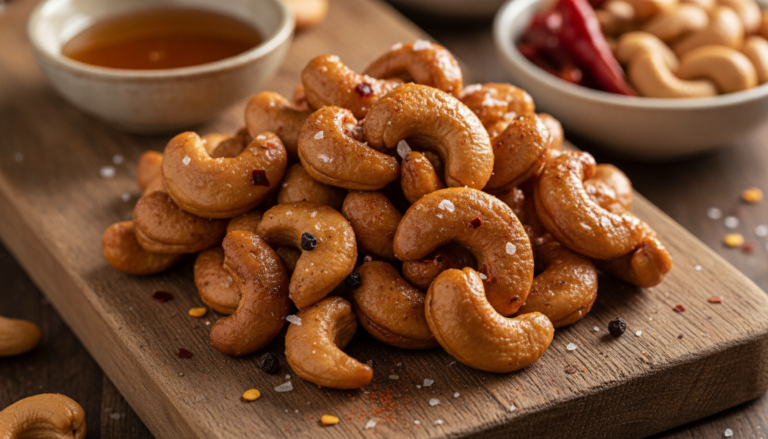
Chili Honey Roasted Cashew Clusters
These Chili Honey Roasted Cashew Clusters are a five-ingredient, oven-baked snack that delivers the best possible combination of sweet, spicy, salty, and richly nutty in every caramelized cluster—a bold, satisfying snack that preps in minutes and lasts all week.
4
servings15
minutes25
minutes350
kcal40
minutesIngredients
2 cups raw cashews
3 tablespoons honey
1 tablespoon olive oil
1 teaspoon chili powder
0.5 teaspoon salt
Directions
- Preheat oven to 350°F (175°C).
- In a large bowl, mix honey, olive oil, chili powder, and salt.
- Add cashews to honey mixture; stir until evenly coated.
- Spread cashews on a baking sheet lined with parchment paper.
- Roast in preheated oven for 20-25 minutes, stirring halfway.
- Let cool completely before breaking into clusters.
Nutrition Facts
- Total number of serves: 4
- Calories: 350kcal
- Cholesterol: 0mg
- Potassium: 400mg
- Sugar: 8g
- Protein: 6g
- Calcium: 60mg
- Iron: 2mg
About This Author

Benjamin Brown
Recipe Developer
Benjamin is our flavor engineer. A classically trained chef turned recipe developer, he’s obsessed with balancing taste, texture, and creativity. He ensures that every recipe we publish is not only delicious but also reliable, approachable, and repeatable — even for beginners.
Favorite dish: Slow-braised short ribs with red wine reduction.
Kitchen motto: “Cooking is part science, part soul.”