
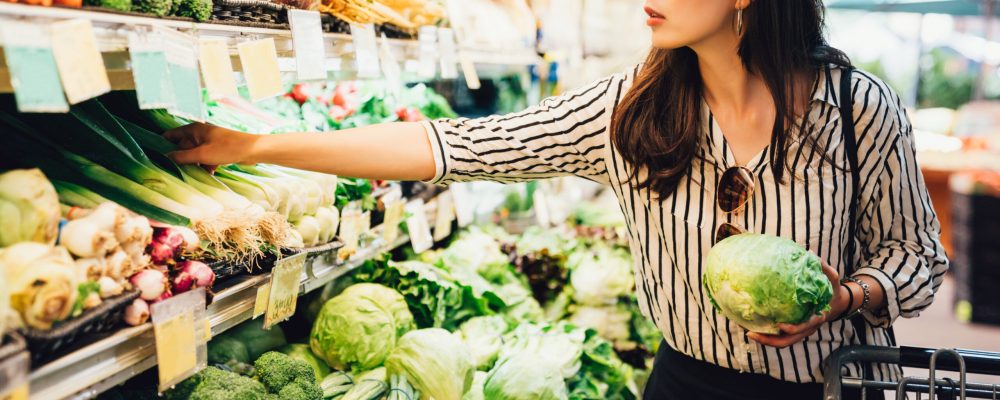

Most people shop for groceries the same way every week.
The list is made from the recipes. The recipes determine the ingredients. The ingredients get located on the usual shelves, checked against the list, and placed in the cart. The whole process is efficient, familiar, and almost entirely disconnected from the most important question anyone can ask in a grocery store or at a farmers market.
Not “do I have this on my list?”
But: “Is this actually good right now?”
The difference between those two questions is the difference between cooking with what’s available and cooking with what’s worth cooking with. And the gap between those two things — particularly for produce, seafood, and certain proteins — is wider than most home cooks realize, and more consequential for the quality of the finished meal than almost any technique decision made afterward.
The Grocery Store Is Not Organized Around Peak Quality
Understanding how to shop well starts with understanding what the grocery store is actually optimized for.
It is optimized for consistency, availability, and shelf life. The tomatoes are there in January because supply chains and growing operations have been engineered to make them available year-round. The apples on the shelf in spring were harvested the previous fall and held in controlled atmosphere storage for months. The fish in the case has traveled a supply chain of variable length and variable handling before arriving under the lights.
None of this is deceptive. It is simply the reality of a system built to ensure that a wide variety of products are available to a wide variety of consumers at all times — a goal that is genuinely valuable and that has nothing to do with whether any individual item is at its peak on the day you’re shopping.
The shopper who walks in with a fixed list is accepting whatever quality those items happen to be at on that particular day. The shopper who walks in with a flexible intention — a sense of what they want to cook rather than a fixed recipe — can select based on what’s actually good today and build the meal from there.
This is how the best home cooks shop. Not with a rigid list, but with a question: what’s worth buying today?
Produce: What Peak Actually Looks and Feels Like
For produce, peak quality is almost always detectable before purchase — through sight, touch, and smell — by a shopper who knows what to look for.
Tomatoes at peak are deeply colored, yield slightly to pressure without feeling soft, and smell unmistakably like tomatoes from the stem end. A tomato that has no smell has no flavor — the volatile aromatic compounds that create tomato flavor and its scent are the same compounds. A flavorless tomato announces itself before you buy it.
Stone fruit — peaches, nectarines, plums, cherries — should smell fragrant and give very slightly at the shoulder when pressed. Fruit that is rock hard has been picked before its sugars fully developed and will ripen to a mealy, disappointing texture rather than the yielding sweetness of tree-ripened fruit. Fruit that is soft all over is past its window.
Leafy greens should be crisp and upright, not wilted or yellowing at the edges. Herbs should smell intensely of themselves — a bunch of basil that requires effort to smell is a bunch of basil that will taste like very little. Root vegetables should feel firm and heavy for their size, without soft spots or excessive sponginess.
The single most important habit for produce shopping is to use your hands and your nose before making a decision — and to buy less of what’s genuinely good rather than more of what’s merely available.
Seafood: The Signals That Don’t Lie
Fish and seafood are the most quality-variable items in most grocery stores — and the ones where the gap between genuinely fresh and past-peak has the most impact on the finished dish.
Fresh fish does not smell like fish. This is the central, counterintuitive truth of seafood shopping that most home cooks either don’t know or have never fully internalized. Fish smell is the smell of decomposition — of trimethylamine produced as the proteins in fish break down. A fish at peak freshness smells like the ocean: clean, faintly briny, slightly mineral. The moment it smells like “fish,” the window of peak quality has passed.
Beyond smell, the eyes of a whole fish are the clearest freshness indicator available. Clear, bright, slightly protruding eyes indicate freshness. Cloudy, sunken, or flat eyes indicate a fish that has been out of the water too long. The gills should be bright red or pink, not brown or gray. The flesh should spring back when pressed rather than holding an indentation.
For fillets — where the eyes and gills aren’t visible — look for flesh that is translucent and firm, not opaque and soft. The surface should be moist but not slimy. Any browning at the edges of a white fish fillet is a sign of oxidation and age.
If the fish case doesn’t pass these tests, the honest choice is to change the plan — to buy what is fresh rather than forcing a fish dish with an ingredient that isn’t ready for it.
The Farmers Market Is a Different Kind of Shopping
The farmers market operates on a logic entirely different from the grocery store — and shopping it well requires a different approach.
At a farmers market, the selection changes weekly based on what is actually ready. The vendor selling strawberries this week may not have them next week because the season has moved on. The tomatoes that weren’t quite right two weeks ago are extraordinary today. The shopping is responsive rather than planned — which is the point, and which requires the shopper to be genuinely flexible.
The best approach to a farmers market is to arrive without a fixed menu and walk the entire market before buying anything. See what’s abundant — abundance at a farmers market almost always signals peak season and best price simultaneously. Talk to the vendors, who are also the growers, and ask what’s best this week. Ask what they’re eating themselves. The vendor selling brassicas who mentions that the hakurei turnips are extraordinary right now is giving you information no grocery store can provide.
Build the week’s cooking around what the market offers at its peak — not the other way around. This reversal of the usual planning logic produces meals that are consistently more flavorful than meals planned in advance and shopped for after the fact, because it ensures that the primary ingredient in every dish is at or near its best.
Storage Is Where Good Shopping Goes Wrong
Buying well is only the first half of the equation. What happens to produce, protein, and dairy between the market and the stove determines whether the quality survives to the plate.
Tomatoes should never go in the refrigerator. Cold temperatures halt the ripening process and convert the sugars and volatile compounds responsible for tomato flavor into starch and less aromatic compounds. A cold tomato is a permanently compromised tomato — a fact that cannot be reversed by bringing it back to room temperature. Tomatoes belong on the counter, away from direct sunlight, until they’re used.
Fresh herbs last significantly longer wrapped loosely in a slightly damp paper towel and stored in a container in the refrigerator — or, for hardier herbs like rosemary and thyme, simply placed in a glass of water on the counter. Herbs stuffed directly into a plastic bag and refrigerated wilt and deteriorate within days.
Fish should be used the day of purchase or the day after — not stored for a third day and hoped for the best. If that’s not possible, freezing on the day of purchase produces a better result than refrigerating and cooking a deteriorating product three days later.
Delicate greens — spinach, arugula, butter lettuce — should be stored with a paper towel in the container to absorb excess moisture, which is the primary driver of the sliming and wilting that makes greens unusable within days of purchase.
These are small habits. Their cumulative effect on the quality of what reaches the plate is not small.
Buying Less, More Often, Is a Professional Habit
There is one final shopping habit that professional kitchens operate by that home kitchens almost universally don’t: buying in smaller quantities, more frequently, rather than in large quantities less often.
A professional kitchen does not buy a week’s worth of fish on Monday and use it through Friday. It buys what it needs for two days and replenishes. The fish served on Thursday was purchased on Wednesday or Thursday morning. The quality of what reaches the plate is protected by the frequency of the purchase.
Home cooks who shop once a week and buy produce in quantities designed to last the full week are accepting significant quality degradation by the end of that week. The vegetables that were vibrant on Sunday are often considerably less so by Thursday — and the meals made on those later days are made with meaningfully lesser ingredients despite the same investment in shopping and money.
Shopping more frequently — even if the total quantity purchased is the same — produces better meals at the end of the week because the ingredients reaching the plate on Thursday were purchased closer to Thursday.
This is a logistics adjustment, not a culinary one. But logistics, as any professional kitchen will confirm, is where quality is protected or lost before cooking ever begins.
The Takeaway
Great cooking begins at the market, not the stove. The techniques, the seasoning, the care applied during cooking — all of it is bounded by the quality of what goes in.
Shop with a question rather than a list. Learn the signals of peak quality in the ingredients you use most. Use your hands and your nose before committing. Buy what’s genuinely good today and build the meal around that. Store with intention. Buy less and more often.
None of this costs more money. Most of it costs less — because the cook who buys what’s at peak buys less of what isn’t, wastes less, and produces better meals with fewer ingredients.
The best ingredient in the dish is the one that was worth buying.














