
Salt is the most important ingredient in your kitchen.
Not the most exciting. Not the most complex. The most important.
Every professional cook knows this with a certainty that borders on conviction. And yet the way most home cooks use salt — a pinch here, a shake there, a final adjustment at the table — bears almost no resemblance to the deliberate, layered, technique-driven relationship that professional kitchens have with it.
The difference isn’t about using more salt. It’s about using it differently. And understanding that difference changes not just how food tastes, but how cooking itself works.
Salt Is Not a Seasoning. It’s a Process.
In a home kitchen, salt is typically the last thing that happens. The dish is cooked, plated, and then adjusted — a shake from a shaker, a pinch from a bowl, a few turns of a grinder over the finished plate.
In a professional kitchen, salt is present at every stage of cooking. The water is salted before the pasta goes in. The aromatics get a pinch when they hit the pan. The protein is seasoned before it touches heat. The sauce is tasted and adjusted as it reduces. The finished dish gets a final evaluation before it’s plated.
Each of these moments does something different. Salt added to pasta water seasons from the outside in as the pasta absorbs the water during cooking. Salt added to aromatics early draws out moisture and accelerates the softening and flavor development process. Salt applied to protein before cooking begins to denature the surface proteins, improving both texture and the ability to form a crust.
Salt added only at the end sits on the surface of the food. It tastes salty without tasting seasoned — because there’s a difference. Seasoned food has salt woven into its structure. Salty food has salt on top of it. Professional cooks build the former. Most home cooks, by default, produce the latter.
The Type of Salt Changes How You Cook With It
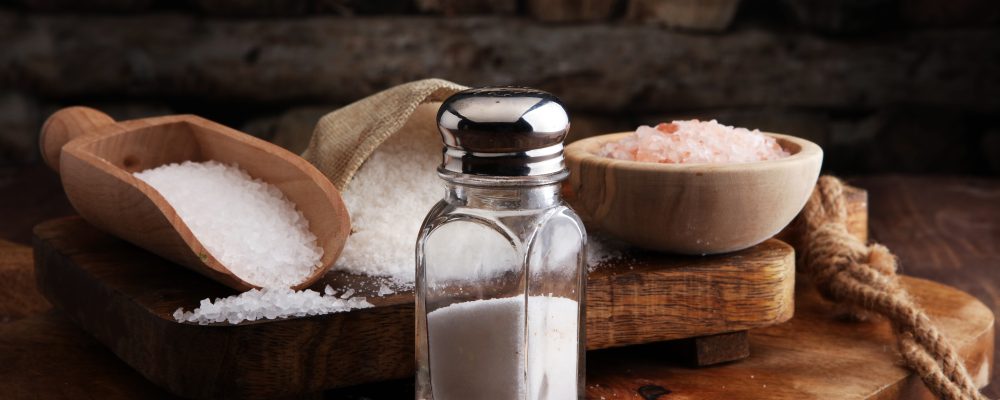
Ask a professional cook what salt they use and the answer will almost never be table salt — the fine, iodized, densely packed grains that come in a cardboard cylinder and occupy most home salt shakers.
The problem with table salt isn’t flavor. It’s control. Table salt is so fine and so dense that it’s extraordinarily easy to over-season with — a pinch of table salt delivers significantly more sodium than a pinch of kosher salt or flaky sea salt, because the smaller grains pack more tightly. Home cooks who season by feel with table salt are working with a less forgiving tool than they realize.
Professional kitchens almost universally use kosher salt for cooking — its larger, irregular crystals are easy to pinch and feel between the fingers, dissolve quickly into food and liquid, and provide a level of tactile control that fine salt simply doesn’t. Cooks who season by touch develop an intuitive sense of how much they’re adding because they can feel the quantity in their hand.
Flaky sea salt — Maldon being the most recognized — serves a different purpose entirely. Its delicate, brittle flakes provide a finishing texture as much as a flavor. It goes on at the very end, on top of finished dishes, where its crunch and clean salinity punctuate rather than permeate. Using it during cooking wastes its most valuable quality. Using it at the finish reveals why it exists.
The Right Amount of Salt Is More Than You Think
There is a persistent under-seasoning problem in home cooking. It comes from a reasonable place — the fear of over-salting, the awareness of sodium in the diet, the general caution that comes with not being entirely sure — but it produces food that is consistently flat, muted, and less satisfying than it could be.
Salt doesn’t just make food taste salty. At the right level, it suppresses bitterness, enhances sweetness, amplifies aroma, and brings forward flavors that were present but muffled. A tomato sauce seasoned correctly doesn’t taste like a salty tomato sauce — it tastes more intensely like tomatoes. A properly seasoned piece of chicken doesn’t taste like a salty piece of chicken — it tastes more completely like chicken.
The threshold at which salt starts to taste like salt — rather than simply enhancing what’s already there — is higher than most home cooks allow themselves to go. Professional cooks season to that threshold deliberately. They taste constantly, adjust incrementally, and stop when the food tastes fully like itself rather than when it tastes noticeably seasoned.
That distinction — food tasting fully like itself versus food tasting salty — is the entire goal. It takes repetition and attention to internalize. But once it’s understood, under-seasoned food becomes immediately recognizable for what it is.
Pasta Water Is the Most Wasted Seasoning Opportunity in the Home Kitchen
Here is a specific application of salt that professional kitchens treat as foundational and home kitchens almost universally get wrong: the pasta pot.
Pasta water should be salted aggressively — far more than most home cooks are comfortable with. The benchmark used in professional kitchens is water that tastes seasoned, not water that has a faint hint of salt. Some cooks describe it as tasting like a mild broth. Others use the phrase “as salty as the sea,” which is an overstatement — seawater is far saltier than pasta water should be — but it conveys the direction correctly.
Why does it matter? Pasta is a starch. It absorbs the water it cooks in. Pasta cooked in well-salted water is seasoned throughout its entire structure. Pasta cooked in lightly salted or unsalted water is bland at its core, no matter how much sauce goes on top. The sauce seasons the surface. The water seasons the pasta itself.
Most home cooks use a fraction of the salt that properly seasoned pasta water requires. The result is pasta that tastes like it needs more sauce — when what it actually needs is more salt in the water it was cooked in.
Tasting Is the Skill Everything Else Depends On
All of the technique in the world around salt is secondary to one foundational habit: tasting throughout the cooking process, not just at the end.
Professional cooks taste constantly. They taste the aromatics as they soften. They taste the sauce as it reduces. They taste before and after every addition. Tasting is not quality control — it’s the primary navigational tool for the entire cooking process. It tells the cook where the dish is and what it needs at every stage.
Home cooks who taste only at the end are navigating blind for most of the journey and then trying to correct course on a finished dish. Some adjustments can be made at the end. Many cannot. Salt added to a finished soup seasons the surface of every ingredient. Salt added during cooking becomes part of the dish’s structure.
The spoon should be in the cook’s hand throughout. Not occasionally. Throughout.
The Takeaway
Salt is not a finishing touch. It is a continuous process, applied with intention, at multiple stages, in the right form for the right moment.
Kosher salt for cooking, applied in layers from the beginning. Flaky salt for finishing, where its texture and brightness can be appreciated. Pasta water salted until it tastes like something. Tasting — constantly, deliberately — as the primary tool for knowing when enough is enough.
None of this requires a professional kitchen. It requires understanding what salt is actually doing — and treating it with the seriousness it deserves.