
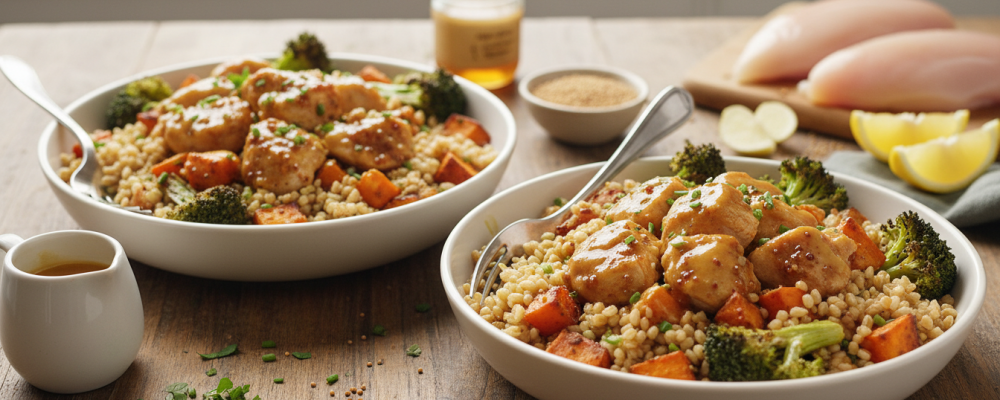

There’s a particular kind of recipe that I think of as a weekly anchor—the one that holds the center of a meal prep rotation together, the one you come back to not because it’s exciting or novel but because it’s reliably, deeply satisfying in a way that more inventive recipes sometimes aren’t. It’s the recipe that makes a Tuesday lunch feel like a genuine pause rather than a task. The recipe that smells so good reheating at your desk that the person across the room asks what you’re eating.
This Honey Mustard Chicken & Farro Bowl is that recipe for me. There is something about the combination of honey and Dijon—sweet and sharp and warm all at once, caramelizing in the oven into a sticky, fragrant glaze that coats the chicken in a layer of flavor rather than just seasoning the surface—that feels, to me, like the very definition of comforting without being heavy. It’s a flavor profile that belongs to no particular season and no particular occasion. It’s just good, consistently and honestly good, in the way that the best everyday recipes always are.
The farro is the detail that elevates this from a good recipe to a genuinely great one. Cooked in chicken broth rather than water, it absorbs a savory depth that makes it taste like an intentional component of the dish rather than a neutral base. It stays pleasantly chewy through the refrigerator—one of the most important qualities a grain can have in a meal prep bowl—and it carries the honey mustard pan drizzle beautifully when the bowl is assembled. Everything in this bowl belongs together, and that coherence is what makes it the kind of recipe you return to week after week without ever feeling like you’re settling.
─────────────────────────────────────────
The Inspiration Behind This Recipe
This recipe was inspired by a conviction I’ve held for a long time: that the most useful recipes in any home cook’s collection are the ones that feel like treats while functioning as fundamentals. A bowl of honey mustard chicken and farro is nutritionally complete, practically efficient, and genuinely satisfying—all the qualities a weekday meal needs to have. But it also tastes like something you chose rather than something you fell back on, and that distinction—between a meal prep recipe you make because it’s sensible and one you make because you actually want it—is the one that determines whether a recipe stays in the rotation for years.
The honey mustard marinade doubles as both a cooking medium and a finishing sauce, which was a deliberate recipe design decision rather than a happy accident. By reserving the pan drizzle after the chicken is cooked—the honey mustard that has caramelized in the baking dish, absorbed some of the chicken’s juices, and intensified in flavor under the oven’s heat—the bowl gains a finishing sauce that is far more complex than the marinade was going in. It has body from the reduced cooking liquid. It has a savory depth that the raw mixture doesn’t. Drizzled over the assembled bowl at serving, it ties every component together in a way that makes the whole greater than the sum of its parts.
Farro as the grain choice was as much an emotional decision as a practical one. There is something about farro—its earthiness, its chew, the way it holds itself together rather than clumping or softening into anonymity—that feels, to me, more purposeful than rice. It has the quality of a grain that was chosen specifically for this bowl rather than defaulted to, and that sense of intentionality in the grain choice communicates itself all the way through to the eating experience. Small decisions in recipe design have a way of being felt even when they’re not consciously noticed, and the decision to use farro here is one of them.
─────────────────────────────────────────
A Brief History of Honey Mustard and Farro
Honey and mustard have been paired together in cooking for centuries—a combination whose longevity speaks to something fundamental about how these two ingredients interact. Mustard’s sharp, pungent compounds soften and sweeten in the presence of honey’s sugars; honey’s sometimes cloying sweetness is grounded and given complexity by mustard’s bitterness. The result is a condiment that is simultaneously more interesting than either ingredient alone—an early example of what we now understand as flavor contrast producing a more compelling whole than either component could achieve independently.
Dijon mustard specifically—the smooth, sharp, wine-and-verjuice variety that originated in the Burgundy region of France—became the mustard of choice for this preparation for its clean heat and refined character. Where coarser mustards bring texture and rusticity, Dijon brings elegance and integration, blending into a smooth glaze that coats evenly and caramelizes without bitterness under oven heat. Its pairing with honey in vinaigrettes, marinades, and glazes is one of the most enduring and universally beloved combinations in contemporary American and French-influenced cooking.
Farro, meanwhile, is one of the oldest cultivated grains in human history—a variety of emmer wheat that fed the Roman legions, sustained Egyptian farming communities, and formed the dietary backbone of the ancient Mediterranean world for thousands of years before modern wheat varieties largely displaced it. Its recent revival in contemporary cooking is a return rather than a discovery: a rediscovery of a grain that the modern world set aside in favor of more easily cultivated varieties, only to find, when it came back, that it had been worth keeping all along. Cooked in the broth of a roasted chicken—the contemporary version of how this grain has always been prepared—it tastes like exactly what it is: ancient, nourishing, and entirely of a piece with the meal built around it.
─────────────────────────────────────────
Why This Cooking Method Works for Meal Prep
Oven-baking the chicken in its honey mustard marinade is the method that produces the best meal prep results, and the reasoning is straightforward: dry oven heat caramelizes the sugars in the honey at the surface of the chicken while the protein cooks evenly throughout, producing a glaze that is sticky, slightly burnished, and structurally sealed around each breast. That caramelized surface is what keeps the chicken moist through refrigeration—a protective layer that prevents the kind of surface drying that happens to plainly seasoned chicken stored in a container overnight.
Cooking the farro in chicken broth rather than water is a small decision with a disproportionate flavor payoff. Farro absorbs its cooking liquid as it simmers, and the difference between a grain that has absorbed plain water and one that has absorbed seasoned broth is perceptible in every bite. The broth-cooked farro tastes like part of the dish; the water-cooked farro tastes like a component that arrived separately. For a bowl where the grain is meant to be as satisfying as the protein above it, that difference matters.
Storing the bowl components separately—farro in one container, sliced chicken with its pan drizzle in another, fresh greens and vegetables in a third—is the assembly strategy that preserves the integrity of every element through the full week. The fresh greens in particular must never be stored in contact with the warm grain or the chicken: the heat and moisture would wilt them within hours, turning a crisp, fresh topping into a limp afterthought. Component storage takes an extra container but produces a bowl that tastes assembled rather than packed—a distinction that matters more than it might seem at every single lunchtime.
─────────────────────────────────────────
Flavor Profile: What to Expect
This bowl is warm, complete, and coherent—every component in proper conversation with every other:
- Sweet, sharp honey Dijon glaze – The marinade caramelizes into a sticky, slightly burnished coating that is simultaneously sweet from the honey, sharp from the Dijon, and deeply savory from the chicken juices it has absorbed during baking
- Aromatic garlic and onion warmth – Garlic powder and onion powder woven through the glaze add a quiet, grounding savoriness that makes the honey mustard taste more complex than a two-ingredient combination could achieve alone
- Earthy, nutty farro – The ancient grain provides a firm, chewy base with a mild, wheaty earthiness that is deepened by the chicken broth it was cooked in—substantial enough to carry the bowl without competing with the protein above it
- Bright, fresh salad contrast – Mixed greens, cherry tomatoes, and cool cucumber bring a crisp, verdant freshness that lifts the richness of the chicken and grain and keeps every bite tasting balanced rather than heavy
- Savory pan drizzle finish – The reserved honey mustard sauce, deepened by cooking, ties every layer of the bowl together at the final drizzle—acting as both a dressing for the greens and a second glaze for the chicken in each bite
The flavors integrate and deepen as the farro and chicken sit together overnight, with the pan drizzle gradually infusing both components. A bowl eaten on Wednesday has a more cohesive, deeply seasoned quality than one eaten immediately after assembly—one of those quietly rewarding meal prep improvements that makes the work of Sunday feel well worth it.
─────────────────────────────────────────
Tips for Making the Best Honey Mustard Chicken & Farro Bowls
A few thoughtful choices make this recipe perform at its best across the full week:
- Pound chicken breasts to even thickness – Uneven chicken breasts cook unevenly: the thin end overcooks while the thick end finishes. A quick pound with a rolling pin or meat mallet to an even 3/4-inch thickness ensures every part of every breast reaches the right temperature at the same time—moister chicken, every time.
- Let the chicken rest before slicing – Five minutes of resting after the oven allows the juices to redistribute throughout the meat rather than running out immediately when cut. Sliced rested chicken is noticeably more moist than sliced hot-from-the-oven chicken.
- Reserve the pan drizzle before it cools – Scrape the caramelized honey mustard from the baking dish while it’s still warm and liquid. Once cooled, it firms and is harder to pour evenly. A warm scrape produces a silky, pourable finishing sauce; a cold one produces a paste.
- Cook farro to al dente, not soft – Farro that is cooked until just tender—with a slight resistance at the center—will continue softening slightly in the refrigerator and arrive at the ideal texture by the time it’s eaten. Fully soft farro becomes mushy in storage. Pull it slightly early.
- Dress greens at serving, not at assembly – Store the mixed greens dry and undressed. Toss with a small drizzle of olive oil and a squeeze of lemon just before eating, or simply let the pan drizzle do the work of dressing everything when the bowl is assembled at lunchtime.
- Slice chicken across the grain – Identifying and cutting perpendicular to the muscle fibers produces significantly more tender slices than cutting with or at a random angle. The difference is perceptible even after refrigeration and reheating.
Optional: A small handful of crumbled goat cheese scattered over the assembled bowl at serving adds a creamy, tangy richness that pairs beautifully with the honey Dijon and the earthy farro—a finishing touch that makes a weekday lunch feel like it was plated with intention.
─────────────────────────────────────────
Portioning and Container Suggestions
This recipe produces four generous bowls from a single batch—one per lunch day Monday through Thursday, with the components scaling easily by a quarter for a fifth serving. A three-container storage system per day works best: the farro in a medium airtight container, the sliced chicken with its pan drizzle in a second container, and the fresh greens and vegetables together in a third. Assembly at lunchtime takes under two minutes and produces a bowl that looks and tastes freshly made.
Glass containers are the ideal storage choice for the chicken and farro—they reheat evenly, don’t absorb the honey mustard’s color or aroma, and hold up to the acidity of the lemon and tomatoes without any degradation. A flat, wide container for the farro allows it to cool and store in a single layer rather than compressing under its own weight, which helps maintain its texture through the refrigerator.
For the most convenient grab-and-go setup, pre-portion the farro and chicken into their daily containers on Sunday and store the fresh component container as a shared batch to draw from each day. This approach means four lunches are individually ready to grab, while the greens and vegetables stay fresh in a shared container—a small organizational detail that makes each morning slightly more effortless and each lunchtime slightly more satisfying.
─────────────────────────────────────────
Storage, Reheating, and Shelf Life Tips
- Chicken storage: Sliced, glazed chicken keeps in an airtight container for up to 4 days in the refrigerator. The honey mustard glaze continues to season the chicken during storage, deepening the flavor by day two and three.
- Farro storage: Keeps refrigerated for up to 5 days—one of the best grain shelf lives in any meal prep collection. Add a teaspoon of water or a small drizzle of olive oil before reheating to restore moisture.
- Fresh greens and vegetables: Mixed greens keep for 3–4 days stored dry in a sealed container with a paper towel to absorb excess moisture. Cherry tomatoes and cucumber keep for 4–5 days refrigerated.
- Pan drizzle: If stored separately, the honey mustard pan drizzle keeps refrigerated for up to 5 days and can be used as a dressing or drizzle across the full week’s bowls.
- Reheating the chicken and farro: Microwave together at full power for 90 seconds to 2 minutes, stirring the farro once halfway through. Alternatively, warm in a skillet over medium-low heat for 3–4 minutes with a small splash of chicken broth to restore moisture to both components.
- Serve the greens cold: The fresh components should always be added cold, directly from the refrigerator, after the chicken and farro are reheated. The contrast between warm grain and protein and cool, crisp greens is one of the best qualities of this bowl—don’t accidentally heat everything together.
─────────────────────────────────────────
Why This Recipe Deserves a Spot in Your Meal Prep Rotation
A good meal prep recipe is one that solves the practical problem of feeding yourself well across a busy week. A great one does that and also makes you genuinely glad it’s there—glad when you see it in the refrigerator on Monday morning, glad when you open the container at lunch on Wednesday, glad when the last portion on Thursday tastes as good as the first one did Sunday evening. The Honey Mustard Chicken & Farro Bowl is a great one.
It earns its place not through novelty or complexity but through the particular kind of dependability that only the best everyday recipes have. The chicken is always moist. The farro is always satisfying. The honey mustard is always exactly as good as you remembered it being. And the assembled bowl—with its warm grain base, its glazed protein, its drizzle of pan sauce, and its fresh green contrast—looks and tastes like something worth sitting down for, every single time. In a week that is always asking more than it gives, a lunch that quietly, consistently gives back is worth more than any amount of culinary novelty. This is that lunch.
─────────────────────────────────────────
Meal Prep Pairing Suggestions
Honey Mustard Chicken & Farro Bowls pair most naturally with other grain bowl formats that offer genuine protein and flavor variety across the week. Our Teriyaki Salmon Rice Bowls are the ideal rotation partner—both are oven-cooked proteins over a hearty grain base with a sauce that does double duty as marinade and finish, but the teriyaki bowl’s Japanese-inspired depth and the honey mustard bowl’s warm American character are distinct enough that rotating between them across the week creates genuine variety rather than repetition. Together they anchor a grain bowl rotation built on two of the most satisfying flavor traditions in the collection.
For a complete weekly lunch spread, our Mediterranean Chickpea Couscous rounds out the rotation with a plant-based, no-cook option that requires almost none of the active prep time that the chicken and salmon bowls do—making it an easy complement to a Sunday session that’s already running long. A week that moves between honey mustard chicken, teriyaki salmon, and Mediterranean chickpea couscous covers three different proteins, three different grain bases, and three entirely distinct flavor traditions—all assembled in a single afternoon and delivered to the week with the quiet, dependable satisfaction of a meal prep rotation that was genuinely designed to be lived in.
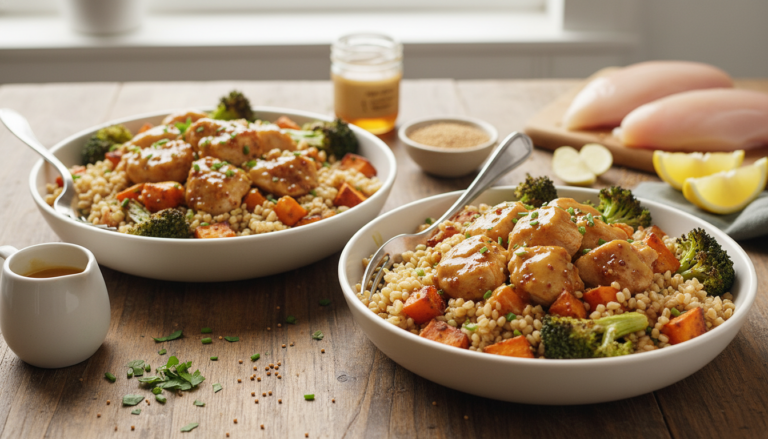
Honey Mustard Chicken & Farro Bowls
These Honey Mustard Chicken & Farro Bowls are a warmly glazed, oven-baked chicken bowl built on hearty farro and finished with fresh greens, cherry tomatoes, and cucumber—a complete, nourishing meal prep lunch or dinner that holds up beautifully all week long.
4
servings15
minutes30
minutes650
kcal45
minutesIngredients
1 lb chicken breasts
1/4 cup honey
1/4 cup Dijon mustard
2 tbsp olive oil
1 cup farro
2 cups chicken broth
1 tsp garlic powder
1 tsp onion powder
1 tsp salt
1/2 tsp black pepper
1 cup mixed greens
1 cup cherry tomatoes, halved
1 cup cucumbers, diced
Directions
- Preheat oven to 375°F (190°C).
- In a small bowl, mix honey, Dijon mustard, olive oil, garlic powder, onion powder, salt, and pepper.
- Place chicken breasts in a baking dish and pour honey mustard mixture over the chicken.
- Bake for 25-30 minutes, or until the chicken is cooked through.
- While chicken cooks, rinse farro under cold water. Combine with chicken broth in a saucepan and bring to a boil.
- Reduce heat and simmer farro for 20 minutes or until tender. Drain any excess liquid.
- To assemble bowls, divide farro among four bowls, top with sliced chicken, mixed greens, cherry tomatoes, and cucumbers.
- Drizzle with any remaining honey mustard sauce from the baking dish before serving.
Nutrition Facts
- Total number of serves: 4
- Calories: 650kcal
- Cholesterol: 0mg
- Sodium: 620mg
- Potassium: 400mg
- Sugar: 8g
- Protein: 6g
- Calcium: 60mg
- Iron: 2mg
About This Author

Amelia Grace
Editor-in-Chief & Culinary Director
The heart and guiding voice of Daily Dish, Amelia leads our editorial vision and recipe development. With a background in food journalism and over a decade spent in professional kitchens, she has a knack for blending gourmet technique with real-world accessibility. Her goal? To make every reader feel like a confident cook, one dish at a time.
Favorite dish: Creamy lemon risotto with a sprinkle of fresh thyme.
Kitchen motto: “Good food doesn’t have to be complicated — it just has to be made with heart.”















