
Store-bought hummus is convenient. It is also, measured against a properly made homemade version, noticeably inferior in every dimension that matters: flavor complexity, texture, freshness, and the particular richness that comes from emulsifying tahini into chickpeas at the right ratio rather than at the lowest cost-effective one. Commercial hummus is optimized for shelf stability and margin—good homemade hummus is optimized for flavor, and the difference between those two optimization targets is immediately perceptible in the first bite.
This recipe makes the case for doing it yourself with a specific and compelling argument: the entire process takes ten minutes, produces four to five times the volume of a standard store container for a fraction of the cost, and delivers a flavor profile—roasted red pepper, fresh garlic, cumin, real tahini, bright lemon—that commercial preparations can approximate but cannot replicate. The roasted red pepper is the ingredient that does the heaviest lifting in that flavor argument. It adds a smoky sweetness and a depth of color that transforms a good base hummus into something with a genuine identity, a reason to exist beyond generic dipping functionality.
Paired with a week’s worth of pre-cut vegetable sticks portioned into individual cups, the hummus becomes the anchor of one of the most efficient snack prep setups available: one batch, minimal equipment, and the result is a complete grab-and-go snack system that holds its quality across five days without any additional effort. The math of that exchange—ten minutes of Sunday prep, five days of effortless snacking—is the kind of return on investment that makes meal prep worth building around.
─────────────────────────────────────────
The Inspiration Behind This Recipe
The design goal for this recipe was to produce a snack prep system that solved the protein-and-fiber gap that most grab-and-go snacks leave behind. Chips, crackers, and packaged snack bars tend to deliver either carbohydrates or sugar—neither of which supports the sustained satiety that makes an afternoon snack worth eating in the first place. Hummus and vegetables, by contrast, deliver plant-based protein, soluble fiber, and healthy fat in a combination that genuinely delays the return of hunger for several hours—a meaningfully different physiological outcome from most snack alternatives.
The roasted red pepper variation was chosen over a plain hummus base specifically for its flavor durability in a meal prep context. Plain hummus, while excellent, is mild enough that its flavor can begin to feel monotonous by day three or four of the same batch. The roasted red pepper introduces a complexity—sweet, smoky, slightly caramelized—that keeps the hummus tasting interesting across the full week rather than fading into background-level familiarity. The cumin reinforces that depth with an earthy, aromatic warmth that makes the flavor profile feel fully developed rather than simply seasoned.
The veggie cup format—hummus portioned into individual cups with vegetable sticks arranged alongside—was chosen for the same reason that any component-based meal prep format is chosen: it prevents quality degradation between components. Vegetable sticks stored separately from the hummus retain their crispness independently, with no moisture transferring between them and the dip. The cucumber stays firm. The carrots stay snappy. The celery stays cool and taut. At snack time, the combination is exactly as satisfying as it was when it was portioned on Sunday.
─────────────────────────────────────────
A Brief History of Hummus
Hummus bi tahini—chickpeas ground with sesame paste, lemon, and garlic—is among the most ancient and most enduring prepared foods of the Mediterranean and Levantine world. Its origins are contested and genuinely complex: Lebanon, Israel, Syria, and Palestine each claim it as a defining part of their culinary identity, and historical evidence suggests that preparations combining ground legumes with sesame paste existed across the region for centuries before any national borders gave them a specific home. It is, in the most accurate sense, a dish that belongs to a place rather than to a country—the eastern Mediterranean, where chickpeas and sesame have been cultivated side by side for millennia.
The earliest documented recipes for a preparation closely resembling modern hummus date to 13th-century Arabic cookbooks from the Cairo and Damascus traditions, where ground chickpeas with vinegar and spices appear as a prepared dish rather than simply a mashed side. The tahini—ground sesame paste—that distinguishes modern hummus from a simple chickpea puree has been a staple of the Levantine pantry for at least as long, where its rich, slightly bitter fat and distinctive aromatic character have been used as both a condiment and a cooking ingredient across an enormous range of preparations.
The global spread of hummus through the latter 20th century—first through the diaspora communities of the Levant, then through the broader popularization of Mediterranean cuisine worldwide—transformed what had been a regional staple into one of the most consumed prepared dips in the Western world. The roasted red pepper variation is a more recent Western adaptation that takes the traditional base in a new flavor direction without altering its fundamental structure—a respectful extension of the tradition that adds its own character while honoring the original.
─────────────────────────────────────────
Why This Cooking Method Works for Meal Prep
The food processor method is the correct technique for hummus because it achieves emulsification—the even suspension of fat (from the tahini and olive oil) within the aqueous chickpea base—in a way that a blender, a fork, or a potato masher cannot. Emulsified hummus is smooth, cohesive, and stable over time; non-emulsified hummus separates, with fat pooling at the surface and a drier, grainier base below. For a snack that’s going to sit in the refrigerator for five days, structural stability is a functional requirement rather than a textural preference.
The order of operations in the food processor matters more than most hummus recipes acknowledge. Processing the tahini and lemon juice together before adding the chickpeas pre-emulsifies the tahini—breaking it into smaller droplets suspended in the acidic liquid—which makes it far easier for the chickpea mass to incorporate smoothly when added. Adding everything at once produces a less uniform emulsion; the sequential method produces the cohesive, almost fluffy texture that distinguishes excellent hummus from merely adequate hummus.
Scraping down the sides of the food processor bowl at least once during blending is not optional for a smooth result. Chickpea skins and larger pieces inevitably collect at the sides and corners of the bowl, where the blade doesn’t reach them consistently. A single scrape and second blend ensures every piece is processed to the same degree of smoothness—and smoothness, in hummus, is the quality that determines whether the dip feels luxurious or merely functional.
─────────────────────────────────────────
Flavor Profile: What to Expect
This hummus operates in a layered, complex register that rewards attention across every bite:
- Smoky, sweet red pepper – Roasted red pepper contributes a caramelized sweetness and a gentle smokiness that is the defining characteristic of this variation—immediately distinct from plain hummus and rich enough to anchor the entire flavor profile
- Nutty, slightly bitter tahini – Sesame paste provides the foundational richness of the hummus base—earthy, faintly bitter, and deeply savory in a way that makes every other flavor more coherent around it
- Sharp garlic bite – Fresh garlic delivers a clean, assertive heat that sharpens the dip’s overall profile and keeps it from tasting flat or one-dimensional
- Bright lemon acidity – Lemon juice cuts through the tahini’s richness with a clean acidity that keeps every bite tasting vivid rather than heavy
- Earthy cumin warmth – Ground cumin adds an aromatic, slightly smoky depth that reinforces the roasted red pepper’s character and gives the hummus a warm, spiced undertone
- Rich olive oil finish – Olive oil smooths the emulsion and adds a fruity, slightly peppery richness at the finish that distinguishes homemade hummus from any commercial version
- Crisp, cool vegetable contrast – Cucumber sticks bring a refreshing, watery crispness; carrot sticks add a firm, slightly sweet crunch; celery contributes a cool, faintly bitter snap that cleanses the palate between dips
The hummus’s flavor deepens and rounds out after an overnight rest in the refrigerator, as the garlic mellow slightly and the roasted red pepper’s smoky sweetness distributes more fully through the base. Day two is reliably the peak—the flavors are more integrated and more complex than they are immediately after blending.
─────────────────────────────────────────
Tips for Making the Best Roasted Red Pepper Hummus & Veggie Cups
Precision in the food processor stage and attention to the vegetable prep both determine the overall quality of the finished snack system:
- Process tahini and lemon first – Before adding chickpeas, combine the tahini and lemon juice in the food processor and blend for 60 seconds until pale and whipped. This pre-emulsification step is the single biggest technique upgrade available for smoother, fluffier hummus.
- Add ice water for lightness – A tablespoon or two of ice water added during blending produces a noticeably lighter, smoother texture by introducing air into the emulsion. Add it gradually while the processor is running, not all at once.
- Use jarred roasted red peppers if needed – Jarred roasted red peppers packed in water (not oil) are a perfectly reliable substitute for home-roasted, with a comparable smoky-sweet flavor and a convenient consistency that blends smoothly. Pat dry before adding to prevent excess liquid from thinning the hummus.
- Taste and adjust before portioning – Hummus flavor changes slightly once refrigerated. Season it slightly more aggressively at blending time than you think necessary—the cold will mellow the garlic and the lemon, and what tastes assertive at room temperature will taste balanced cold.
- Cut vegetables to a uniform length – Uniform vegetable sticks stand upright in the cup alongside the hummus more tidily, look more intentional, and are easier to grip for dipping. Aim for sticks approximately 3–4 inches long and 1/2 inch wide for the ideal dippable geometry.
- Pat vegetable sticks dry before portioning – Excess surface moisture from washing makes vegetable sticks release liquid into the bottom of the cup during storage. A quick pat with a paper towel before portioning keeps cups dry and prevents any pooling.
Optional: A drizzle of olive oil, a pinch of smoked paprika, and a few whole chickpeas arranged over the surface of the hummus in each cup before sealing transforms a functional snack container into something that looks genuinely considered—and the smoked paprika adds an extra layer of depth that plays beautifully against the roasted red pepper base.
─────────────────────────────────────────
Portioning and Container Suggestions
The most efficient portioning format for this recipe is a two-section system: hummus in a small sealed container or cup (approximately 3–4 tablespoons per serving), and vegetable sticks bundled together in a separate compartment or container alongside. This keeps the vegetables crisp and the hummus undiluted from any excess vegetable moisture released during storage.
A bento-style container with one large compartment for the vegetable sticks and one smaller compartment for the hummus is the ideal single-vessel solution—grab it from the refrigerator and it’s a complete snack with no additional assembly required. Alternatively, small 4-ounce glass jars work beautifully for the hummus, with the vegetable sticks stored in a separate flat container and paired at snack time.
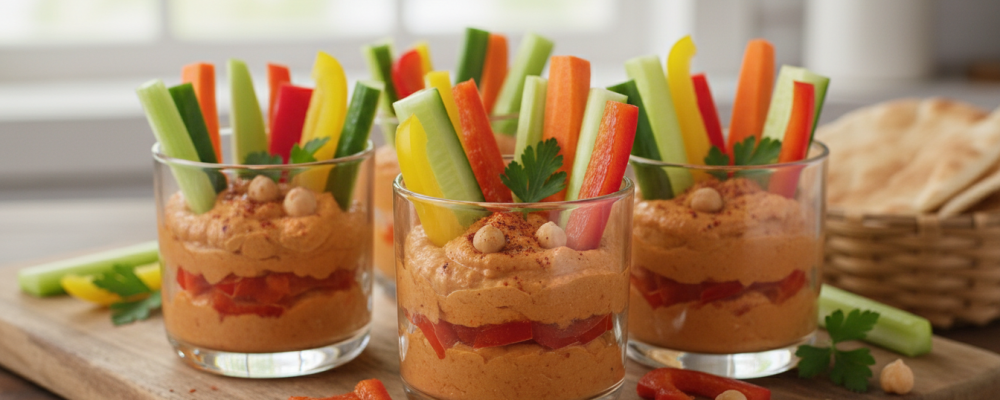
For a visually striking presentation, arrange the vegetable sticks vertically in a tall cup or jar with the hummus in a small container beside them—the three colors of cucumber (green), carrot (orange), and celery (pale green) standing upright together create a genuinely attractive snack display that looks as organized as it is practical. It’s the kind of detail that takes fifteen seconds and makes the refrigerator shelf look like someone thought about it.
─────────────────────────────────────────
Storage, Reheating, and Shelf Life Tips
- Hummus storage: Keeps in an airtight container in the refrigerator for up to 7 days. A thin layer of olive oil drizzled over the surface before sealing slows oxidation and keeps the surface from drying or discoloring.
- Vegetable stick storage: Cut vegetable sticks keep in airtight containers lined with a dry paper towel for 4–5 days in the refrigerator. The paper towel absorbs excess moisture and maintains crispness across the full storage window.
- Reviving hummus: If the hummus thickens significantly in the refrigerator, stir in a teaspoon of cold water or a small drizzle of olive oil and mix well before serving. The emulsion loosens easily at room temperature—a brief rest out of the refrigerator before serving also restores consistency.
- Freezer storage: Hummus freezes well for up to 3 months in an airtight container. Thaw overnight in the refrigerator and stir well before serving—the emulsion may separate slightly during freezing but re-emulsifies easily with vigorous stirring. Vegetable sticks do not freeze.
- No reheating required: Both hummus and vegetable sticks are served cold. If a warm hummus is preferred, microwave briefly at 30-second intervals until just warmed through—avoid overheating, which can cause the tahini to separate.
- Garlic intensity note: Fresh garlic continues to develop in intensity in the refrigerator over time—the hummus will taste noticeably more garlicky by day three or four than at day one. If a milder garlic profile is preferred for later in the week, use one clove rather than two at blending time.
─────────────────────────────────────────
Why This Recipe Deserves a Spot in Your Meal Prep Rotation
Roasted Red Pepper Hummus & Veggie Cups represent the kind of snack prep that compounds its value across the week rather than simply existing as a convenient option. The hummus itself is better than anything commercially available at the same price point—made from real ingredients in the correct ratios, blended to a texture that commercial production cannot match, and flavored with a roasted red pepper component that gives it a genuine identity rather than generic dippability. That quality baseline, established once on Sunday, holds through five days of snacking without significant degradation.
The vegetable component adds the nutritional argument: fiber, vitamins, and the satisfying crunch that makes this a snack that actually addresses hunger rather than just occupying it. Together—a properly made hummus and a selection of crisp, well-cut vegetable sticks—they constitute one of the most nutritionally complete and genuinely satisfying snack preparations available within a ten-minute prep window. In a snack landscape where convenience typically comes at the expense of quality, this recipe refuses that trade-off. That refusal is worth building around.
─────────────────────────────────────────
Meal Prep Pairing Suggestions
Roasted Red Pepper Hummus & Veggie Cups anchor a Mediterranean-inspired snack spread most naturally alongside recipes that share the same clean, vegetable-forward flavor ecosystem. Our Zucchini Hummus Roll-Ups are the obvious companion—both feature hummus as a central component, but where these cups are portioned for direct dipping, the roll-ups deliver the hummus already applied within a zucchini ribbon, making the two formats entirely complementary in a snack rotation that values variety. Together they give the Mediterranean snack category two different form factors without any redundancy in flavor experience.
For a broader weekly snack system, our Cucumber Cream Cheese Bites round out the fresh, vegetable-based snack rotation with a cool, herb-forward option that shares the same light, no-cook character as these cups while bringing an entirely different flavor profile—creamy and dill-forward where the hummus is smoky and earthy. Three vegetable-forward snack options covering different dipping formats, spreads, and flavor traditions means the week’s snacking is both nutritionally consistent and genuinely varied—and all three together require less than thirty minutes of combined Sunday prep to produce a snack lineup that is, by any reasonable measure, better than anything available in a store.
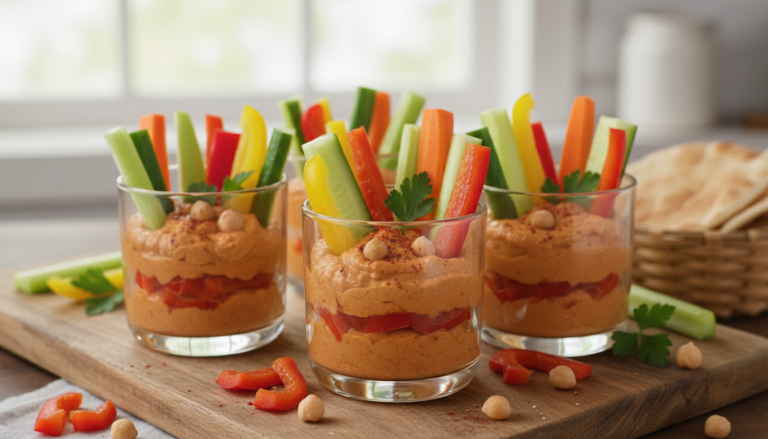
Roasted Red Pepper Hummus & Veggie Cups
These Roasted Red Pepper Hummus & Veggie Cups turn a single batch of bold, homemade hummus into a week’s worth of ready-to-grab snacks—portioned with crisp vegetable sticks and ready whenever hunger hits.
4
servings30
minutes40
minutes300
kcal1
hour10
minutesIngredients
1 cup canned chickpeas, drained and rinsed
1 large roasted red pepper
1 tablespoon tahini
2 tablespoons olive oil
1 clove garlic
1 tablespoon lemon juice
0.5 teaspoon cumin
to taste salt
to taste black pepper
0.5 cup cucumber sticks
0.5 cup carrot sticks
0.5 cup celery sticks
Directions
- Combine chickpeas, roasted red pepper, tahini, olive oil, garlic, lemon juice and cumin in a food processor.
- Blend until smooth, scraping down sides as needed.
- Season with salt and black pepper to taste.
- Serve hummus in small cups with cucumber, carrot, and celery sticks for dipping.
Nutrition Facts
- Total number of serves: 4
- Calories: 235kcal
- Cholesterol: 0mg
- Sodium: 620mg
- Potassium: 400mg
- Sugar: 8g
- Protein: 6g
- Calcium: 60mg
- Iron: 2mg
About This Author

Benjamin Brown
Recipe Developer
Benjamin is our flavor engineer. A classically trained chef turned recipe developer, he’s obsessed with balancing taste, texture, and creativity. He ensures that every recipe we publish is not only delicious but also reliable, approachable, and repeatable — even for beginners.
Favorite dish: Slow-braised short ribs with red wine reduction.
Kitchen motto: “Cooking is part science, part soul.”