
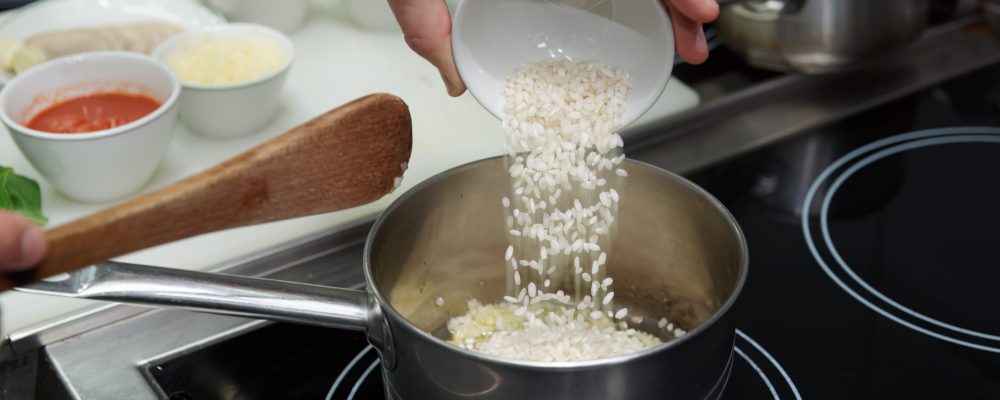

Rice is the most eaten food on the planet.
It’s also one of the most consistently disappointing things that comes out of a home kitchen.
Too sticky. Too mushy. Too dry. Grains that clump together in a mass or fall apart into something closer to porridge than the light, separate, fluffy result you were after. And the frustrating part is that rice seems like it shouldn’t be this hard — it’s two ingredients and one pot.
But walk into any serious restaurant kitchen, particularly one where rice is central to the cuisine, and you’ll find that the cooks there treat it with a level of precision and respect that most home kitchens never come close to applying.
The Rinse Is Not Optional
Ask a professional cook whether they rinse their rice before cooking and the answer, almost universally, is yes — and not just a quick pass under the tap.
Raw rice is coated in excess surface starch — a fine, powdery layer that accumulated during milling. If that starch goes into the pot with the rice, it dissolves into the cooking water and creates a thick, gluey paste that coats every grain as it cooks. The result is rice that clumps, sticks, and has a heavy, starchy texture rather than a clean, distinct grain.
Professional cooks rinse their rice in cold water, swirling and draining repeatedly, until the water runs nearly clear. This process removes the surface starch before it has the chance to interfere with the cooking. What’s left are grains that will cook separately, absorb liquid cleanly, and finish with the distinct, individual texture that makes great rice so satisfying.
It takes two minutes. It changes the result completely.
The Water Ratio Everyone Uses Is Wrong
The instruction on the back of a rice package — typically a two-to-one ratio of water to rice — is a generalization designed for convenience, not quality. It accounts for the widest possible range of pots, stoves, altitudes, and rice varieties, which means it’s optimized for none of them.
Professional rice cookery is more precise than that.
The correct water ratio for any given rice depends on the variety, the age of the rice, the size and material of the pot, and the intensity of the heat source. Aged rice, which has lost more moisture during storage, absorbs more water than freshly milled rice. A wide, shallow pot loses more steam than a narrow, deep one. A powerful burner boils off water faster than a weak one.
Serious restaurant kitchens often develop their own ratios through testing — and then stick to them with consistency. Home cooks who improve their rice invariably describe the same realization: once they found the right ratio for their specific pot and stove, everything changed.
A starting point for most long-grain white rice: closer to one and three-quarter cups of water per cup of rice, not two. Then adjust from there based on results.
The Heat Curve Is the Whole Game
Here is where most home rice cookery falls apart, even when the rinsing and ratio are right.
The standard home method — bring to a boil, reduce to low, cover, wait — sounds correct in outline. But the details of how that heat curve is managed determine everything about the final texture.
Professional rice cookery, whether on the stovetop or in purpose-built rice cookers used in restaurant kitchens, follows a specific arc: high heat to bring the water to a boil quickly, a reduction to a low, steady simmer the moment the boil is reached, and then an unwavering commitment to leaving the lid completely undisturbed until the rice is done.
Every time the lid comes off during cooking, steam escapes. That steam is part of the measured water in the pot — it was supposed to be absorbed by the rice, not lost to the air. Home cooks who lift the lid to check, stir, or adjust are unknowingly changing the water ratio mid-cook and wondering why the results are inconsistent.
The lid goes on. The lid stays on. The timer runs. That’s it.
The Steam Rest Is Where the Texture Is Made
The rice is done absorbing water — but it’s not done cooking.
This is the step that separates truly excellent rice from merely acceptable rice, and it’s almost never mentioned in home cooking instructions. After the water has been fully absorbed and the heat is turned off, the rice needs to sit, covered and undisturbed, for a minimum of ten minutes.
During this rest, residual steam continues to gently finish the interior of each grain. The texture firms and evens out. The bottom layer, which was in direct contact with the heat, has a chance to recover from any slight overcooking. What comes out of a properly rested pot is rice with a uniform texture throughout — not mushy at the bottom and undercooked at the top.
Restaurant rice kitchens — particularly in Japanese, Korean, Persian, and Indian cooking traditions — treat this rest period as non-negotiable. It’s not patience for its own sake. It’s the final phase of a controlled cooking process.
Fluffing Has a Right and Wrong Way
The moment the rest is done, how the rice is handled matters more than most people realize.
A fork or rice paddle dragged through the pot in a stirring motion compresses the grains and destroys the texture that the entire process was designed to produce. Professional cooks use a folding, lifting motion — turning the rice gently from the bottom up, separating grains without crushing them, allowing steam to escape evenly.
The goal is to aerate the rice, not work it. Thirty seconds of careful folding with a rice paddle produces a result that looks and eats entirely differently from thirty seconds of aggressive stirring.
It’s a small moment. In rice cookery, small moments are everything.
The Takeaway
Rice rewards precision in a way that few other ingredients do. The difference between rice made with professional habits — rinsed thoroughly, measured carefully, cooked with a steady hand and a lid that stays closed, rested properly, and folded gently — and rice made the standard home way is not subtle.
It’s the difference between a side dish you eat without thinking and one that makes you stop and wonder what changed.
Nothing changed except the attention you gave it.














