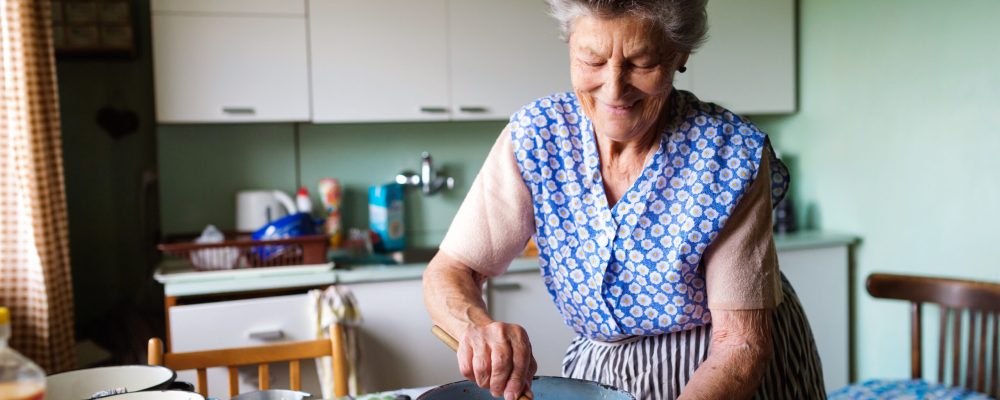

Almost everyone has one. A recipe card, or more often no card at all, just a memory of watching someone cook a dish that never seems to write down quite right. “A handful of this.” “Until it looks right.” “You’ll know.”
For years, this used to feel like a gap — something lost, a recipe that never got properly recorded. It’s worth reconsidering. That vagueness might be the most important part of the recipe, not something missing from it.
Cooking Before Measuring Cups Were Standard
Standardized measuring cups and spoons are a relatively recent addition to home kitchens, popularized in the early 1900s alongside the rise of published cookbooks.
Before that, cooking was taught by watching, tasting, and doing — passed from one person to another through repetition, not documentation. A pinch of salt meant whatever felt right in that person’s hand. “Enough flour” meant until the dough looked and felt a certain way.
Recipes weren’t written down because they weren’t meant to be read. They were meant to be absorbed.
What Gets Lost in Translation to a Recipe Card
Something changes the moment a recipe gets forced into exact numbers.
A dish that once responded to the specific tomatoes in season, the humidity in the kitchen, or how hungry everyone happened to be that day suddenly becomes fixed and rigid. The person cooking it stops adjusting and starts just following.
That’s not necessarily worse — it makes recipes shareable and repeatable in ways oral tradition never could. But it does trade something away: the built-in flexibility that let a dish adapt to whatever was actually available.
The Skill Hidden Inside Vague Instructions
“Cook until it smells right” sounds like a lack of precision. It’s actually a different kind of precision — one based on senses instead of numbers.
People who learned to cook this way often develop a stronger relationship with their food than people who learned from exact measurements. They notice when dough feels too wet before a recipe would ever tell them. They know a sauce needs more acid without tasting a specific pH.
That instinct doesn’t come from talent. It comes from repetition without a safety net of exact numbers to fall back on.
Why These Recipes Rarely Taste the Same Twice
Ask three siblings to make their grandmother’s dish and there’s a good chance you’ll get three slightly different results — and all three might be right.
This used to seem like a flaw in oral recipes. It might actually be closer to the truth of how the dish always existed. The version made in 1975 with whatever vegetables were on hand that week was never identical to the version made a decade later. The recipe was never fixed. It was always a living response to a specific moment.
Trying to lock it into one “correct” version may be solving a problem the dish never actually had.
How to Actually Preserve a Recipe Like This
Writing down grandma’s recipe with exact measurements might feel like preservation. It might be closer to embalming.
A few things worth capturing instead:
The order ingredients go in, and why
What it should look, smell, or feel like at each stage
The story behind the dish — where it came from, who taught it
A range instead of a number, when a number doesn’t feel honest
That combination preserves the spirit of the dish, not just a snapshot of one version of it.
The Takeaway
A recipe without exact measurements isn’t an incomplete recipe. It’s a different kind of document entirely — one built for a person, not a page.
The vagueness that once felt frustrating might be the clearest sign that a dish was never meant to be static. It was meant to be learned, adjusted, and passed on by hand.
Some of the best cooking in the world still can’t be written down. It has to be shown.