
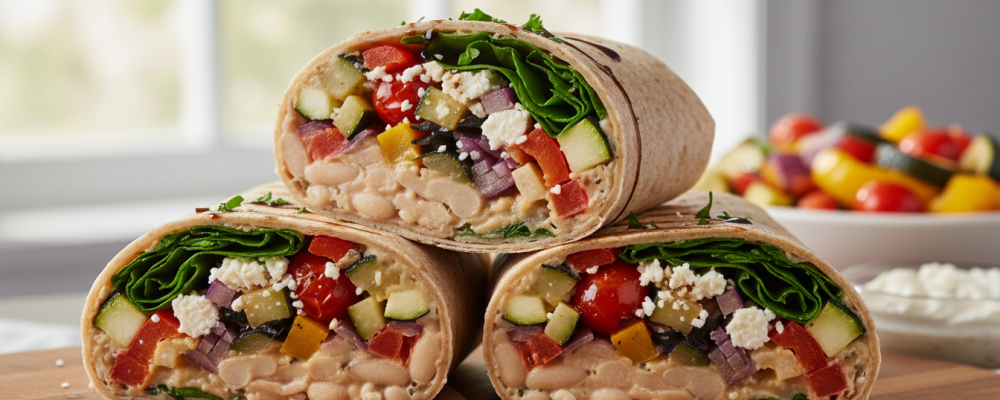

The most common failure mode of a plant-based wrap is the filling gap—the structural and nutritional void left by the absence of a dense protein that anchors the whole thing. Remove the chicken or the turkey from a standard lunch wrap and what remains is often a collection of vegetables and condiments that is, calorie for calorie and bite for bite, insufficient. The wrap is eaten, the afternoon arrives, and so does hunger—which is the outcome that a well-designed lunch is specifically supposed to prevent.
This recipe solves that problem at the structural level. Mashed white beans are not a protein substitute in the compromised sense—they’re a genuinely effective anchor ingredient that provides fiber, plant-based protein, and a creamy, spreadable body that binds the wrap’s components together in a way that hummus or a condiment alone never could. Spread across the interior of a whole wheat tortilla, the bean mash functions simultaneously as the binding agent, the protein layer, and the flavor base—carrying garlic notes from the roasted vegetables into every bite without needing its own separate seasoning beyond what it absorbs from the surrounding components.
The balsamic-roasted vegetables are the second structural decision that separates this from a standard veggie wrap. High-heat roasting at 400°F concentrates the moisture out of the bell peppers and zucchini and caramelizes the balsamic vinegar into a slightly sticky, deeply flavored glaze that adds sweetness, acidity, and a savory complexity that raw or lightly sautéed vegetables simply cannot produce. The result is a filling that holds its own against the bean mash in terms of flavor intensity—no component is overshadowed, and together they produce a wrap that is complete in every sense.
─────────────────────────────────────────
The Inspiration Behind This Recipe
The design problem this recipe addresses is one of the most persistent in plant-based meal prep: how to build a lunch that is portable, filling, structurally sound, and genuinely flavorful without relying on meat as the anchor component. Most plant-based wraps fail on at least one of those criteria. They’re flavorful but not filling, or filling but texturally monotonous, or structurally sound until they hit the refrigerator and the vegetables release their moisture into the tortilla overnight.
The white bean mash solves the filling and flavor problems simultaneously. White beans—cannellini in particular—have a naturally mild, creamy flavor that functions as a blank canvas for the stronger flavors around them: the balsamic vinegar’s acidity and sweetness, the garlic powder’s warmth, the roasted peppers’ caramelized depth. Mashed rather than left whole, they distribute evenly across the tortilla surface and prevent the structural gap that occurs when whole beans roll around inside a wrap and create pockets of empty tortilla. A spread fills; whole beans merely occupy.
The balsamic vinegar as the roasting liquid was chosen with meal prep flavor durability specifically in mind. Balsamic’s combination of sweetness, acidity, and concentrated grape flavor is one of the most refrigerator-stable condiment profiles available—it doesn’t fade, go flat, or develop off-flavors over three to four days the way lighter dressings often do. The caramelized balsamic coating on the roasted vegetables acts as a flavor sealant, keeping the vegetables tasting bold and intentional rather than faded and reheated on day three.
─────────────────────────────────────────
A Brief History of the Legume Spread
The practice of mashing legumes into a spread or paste and using that preparation as a base layer in flatbread-based dishes is one of the oldest and most geographically distributed culinary traditions in the world. Hummus—ground chickpeas with tahini and lemon—is the best-known contemporary expression of this tradition, but its antecedents extend across the ancient Mediterranean and Middle East, where every major legume grown in the region—lentils, fava beans, broad beans, white beans—was at various points mashed, seasoned, and used as both a dip and a spread for flatbreads. The nutritional logic was sound: combining a legume paste with a grain-based flatbread creates a complete amino acid profile, a fact intuited by necessity long before nutritional science had the vocabulary to articulate it.
White beans—the cannellini and Great Northern varieties most familiar in contemporary cooking—have deep roots in both Italian and broader Mediterranean culinary traditions. In Tuscan cooking specifically, white beans have been a staple ingredient for centuries, appearing in soups, stews, and side preparations that rely on their creamy texture and mild flavor to carry stronger aromatics. The Tuscans’ reputation for simple, ingredient-forward cooking made white beans one of the most valued legumes in their pantry, and that culinary tradition is reflected directly in the flavor logic of this recipe.
The contemporary whole wheat wrap format—fiber-dense, sturdy, nutritionally complete as a vehicle—is the modern iteration of flatbread’s ancient role in legume-spread preparations: a neutral, grain-based structure that carries and complements rather than competes with its filling. The format has changed; the underlying culinary wisdom has not.
─────────────────────────────────────────
Why This Cooking Method Works for Meal Prep
Roasting at 400°F rather than at a lower temperature is the critical technique decision for vegetables that need to survive meal prep conditions. At 400°F, the surface moisture of the bell peppers and zucchini evaporates quickly, concentrating their flavor and allowing the balsamic vinegar to caramelize rather than simply reduce. The result is a vegetable that is fundamentally drier and more flavor-dense than one roasted at a lower temperature—which matters enormously in a wrap that will be refrigerated and eaten over several days.
Moisture management is the central engineering challenge of any wrap-based meal prep recipe. Both bell peppers and zucchini contain significant water that is released under heat and continues to migrate through the wrap during refrigeration. High-heat roasting removes as much of that moisture as possible before assembly, dramatically reducing the amount of liquid available to saturate the tortilla in storage. Stirring the vegetables halfway through the roasting time ensures even moisture evaporation across the entire sheet pan rather than creating wet pockets where vegetables overlap.
The mashed white beans, spread thickly across the tortilla before the vegetables are added, function as a secondary moisture barrier as well as a flavor base. The bean paste absorbs a small amount of the residual moisture from the roasted vegetables rather than allowing it to pass directly into the tortilla. This is a functional layering decision—bean mash against the tortilla, vegetables against the bean mash—that produces a noticeably less saturated wrap by day two than the reverse layering order would. Structure and flavor are both determined by the sequence of assembly, and the sequence here is intentional.
─────────────────────────────────────────
Flavor Profile: What to Expect
This wrap operates in a savory, slightly sweet, and earthy register with a Mediterranean coherence that makes every component taste like it belongs to the same dish:
- Deep, caramelized sweetness – Balsamic-glazed roasted peppers develop a concentrated, jammy sweetness under high heat that gives the wrap a rich, almost wine-forward complexity
- Mild, savory earthiness – Mashed white beans provide a creamy, neutral base with a subtle earthy depth that anchors the brighter vegetable flavors without competing with them
- Herbal garlic warmth – Garlic powder—bloomed in the hot roasting liquid during the oven stage—infuses every element of the vegetable component with a warm, consistent savory note
- Bright, light acidity – The balsamic vinegar’s natural acidity, mellowed significantly by heat, provides a persistent brightness that keeps the overall flavor profile from feeling heavy
- Fresh, green contrast – Baby spinach adds a cool, slightly mineral freshness to each bite that cuts through the roasted richness of the vegetables and the creaminess of the beans
- Sturdy, wheaty wrap – The whole wheat tortilla contributes a mild nuttiness and structural integrity that complements the Mediterranean flavor profile rather than existing merely as a neutral vehicle
The flavors deepen and integrate noticeably after an overnight rest, as the balsamic continues to infuse the white bean mash through direct contact and the garlic note distributes throughout the wrap’s interior. Day two of this wrap is reliably its best day—a consistent pattern for balsamic-based preparations.
─────────────────────────────────────────
Tips for Making the Best White Bean & Roasted Veggie Wraps
Precision at the roasting and assembly stages determines the wrap’s quality and longevity across the week:
- Don’t overcrowd the sheet pan – Bell peppers and zucchini need space between pieces to roast rather than steam. A crowded pan traps moisture and produces soft, pale vegetables rather than caramelized, concentrated ones. Use two pans if necessary.
- Cut vegetables uniformly – Consistent slice thickness ensures every piece reaches the correct level of doneness at the same time. Thick pieces will be underdone when thin pieces are already caramelized; uniform cuts eliminate this variable entirely.
- Mash beans to a thick, spreadable consistency – The mash should be smooth enough to spread easily but thick enough to stay in place rather than flowing toward the edges of the tortilla under the weight of the vegetables. A fork produces a slightly textured mash; a potato masher produces a smoother one. Either works; the key is thickness.
- Season the bean mash directly – A pinch of salt, a crack of black pepper, and optionally a small drizzle of olive oil stirred into the bean mash before spreading adds significant flavor depth to what would otherwise be a neutral base layer.
- Warm the tortilla before wrapping – A briefly warmed tortilla—10 seconds in a dry skillet or 15 seconds in the microwave—is significantly more pliable than a cold one and wraps tightly without cracking, which is critical for a wrap that needs to hold its shape through refrigeration.
- Wrap and cut immediately, then wrap again – Cut each wrap in half on a diagonal immediately after rolling, then wrap the cut halves tightly together in plastic wrap or parchment before refrigerating. This holds the cut edge closed and maintains the wrap’s cross-section integrity for presentation and structural purposes.
Optional: A thin spread of pesto over the white bean mash before adding the vegetables adds a herb-forward complexity and a richness from the pine nuts and parmesan that pushes this wrap firmly into the category of something genuinely special.
─────────────────────────────────────────
Portioning and Container Suggestions
This recipe yields four complete wraps—one per serving day for a four-day lunch rotation, or four portions from a single prep session. Each wrap, cut in half on the diagonal, stores most efficiently in a flat, rectangular airtight container that accommodates both halves side by side without stacking. Stacking cut wraps compresses the filling toward the cut edge and can cause the tortilla to separate from the bean mash layer under sustained pressure—flat storage preserves the cross-section and keeps the halves intact.
For grab-and-go use, individual wraps wrapped tightly in parchment paper and then secured with a piece of tape or twine travel exceptionally well. Parchment holds the wrap together without introducing plastic contact, breathes slightly to prevent condensation buildup inside the wrapping, and can be partially unwrapped and held as you eat—a practical advantage that makes this a genuinely desk-friendly lunch that requires no utensils and no container to carry home.
For a complete midday meal, pair the wrap with a small container of the Zucchini Hummus Roll-Ups or a serving of Mediterranean Chickpea Couscous. The flavor profiles align closely enough to feel cohesive and intentional as a lunch spread, and the additional volume rounds out the meal for anyone with a larger appetite or a longer afternoon ahead.
─────────────────────────────────────────
Storage, Reheating, and Shelf Life Tips
- Refrigerator storage: Assembled wraps keep in airtight containers for up to 4 days. The tortilla softens slightly over time as it absorbs residual moisture from the vegetables—this is most noticeable at day four but does not significantly affect flavor.
- Component storage (recommended for days 4–5): If a fifth day is needed, store the roasted vegetables, white bean mash, and tortillas separately and assemble the final wrap fresh in under three minutes. This produces a significantly better result on days four and five than a pre-assembled wrap stored for the full duration.
- Freezer storage: Assembled wraps freeze well for up to 2 months. Wrap tightly in plastic wrap and then foil before freezing. Thaw overnight in the refrigerator—do not microwave from frozen, as the tortilla becomes unevenly heated and the filling goes from cold to overheated without a consistent middle ground.
- Serving temperature: These wraps are excellent at room temperature and equally good cold from the refrigerator. They do not require reheating—the roasted vegetables taste good cold, and the white bean mash is pleasant at any temperature.
- Warm serving option: If a hot lunch is preferred, unwrap the parchment, place the wrap seam-side down in a dry skillet over medium heat for 2–3 minutes per side. This warms the filling and lightly re-crisps the tortilla exterior—a significantly better result than microwaving.
- Moisture tip: If the tortilla has softened more than desired in storage, the skillet method above is the most effective way to restore some exterior texture. A 5-minute oven warm at 350°F, uncovered, produces a similar result.
─────────────────────────────────────────
Why This Recipe Deserves a Spot in Your Meal Prep Rotation
From a nutritional efficiency standpoint, this wrap is difficult to match in its category. The combination of white beans and whole wheat tortilla covers both complete protein and complex carbohydrate requirements for a sustained-energy lunch; the roasted vegetables and fresh spinach supply fiber, vitamins, and the kind of micronutrient density that processed lunch options simply cannot replicate. It is, by any reasonable nutritional metric, an excellent lunch—and it is also genuinely good to eat, which is the metric that determines whether a recipe stays in the rotation or gets made once and forgotten.
The plant-based format gives this recipe a versatility in a weekly prep lineup that is worth recognizing. It functions as a complement to protein-forward options like the Teriyaki Salmon Bowls or the Ham & Cheddar Egg Muffin Sandwiches—providing a lighter, vegetable-forward alternative on days when something less heavy is the right call. A rotation that includes both a substantive plant-based lunch and a protein-forward one is more nutritionally varied and more practically flexible than one that defaults to meat at every meal. This wrap earns its place by covering that ground without compromise.
─────────────────────────────────────────
Meal Prep Pairing Suggestions
White Bean & Roasted Veggie Wraps pair most naturally with other Mediterranean-inspired or plant-forward recipes that share the same clean, vegetable-rich flavor ecosystem. Our Mediterranean Chickpea Couscous is the ideal rotation partner—both are built on legumes and bright, herb-forward seasoning, but the couscous bowl is a no-cook grain format where this is an oven-roasted, hand-held wrap. Rotating between them across the week gives the plant-based lunch rotation genuine variety in format and preparation method while maintaining a cohesive flavor thread.
For a complete weekly lunch spread, the Turkey Taco Salad Bowls provide a protein-forward, bold-flavored counterpoint that gives the rotation a different character entirely on the days when something heartier is the right call. A week that alternates between a plant-based balsamic-roasted wrap and a taco-spiced turkey bowl, with the couscous filling the remaining days, covers the full range of flavor profiles and filling levels that a genuinely well-designed lunch rotation should provide—and all of it assembled in a single Sunday session that takes less than an hour of active kitchen time.
White Bean & Roasted Veggie Wraps
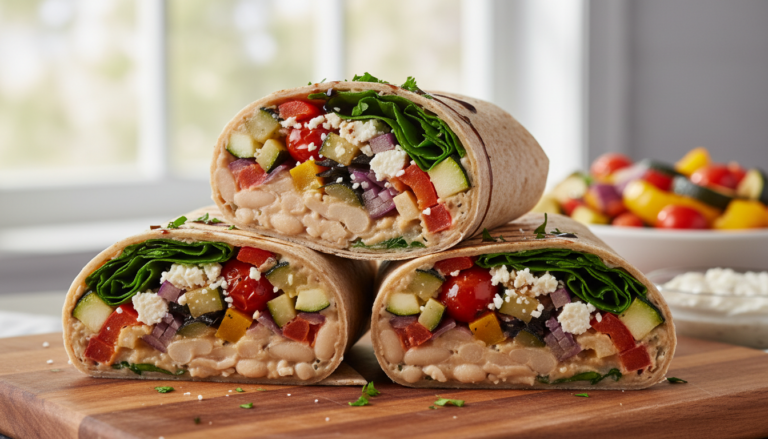
These White Bean & Roasted Veggie Wraps are a hearty, plant-based meal prep lunch built around a savory white bean mash and balsamic-roasted vegetables—satisfying, portable, and full of flavor all week long.
4
servings15
minutes30
minutes350
kcal45
minutesIngredients
1 can white beans, drained and rinsed
2 cups bell peppers, sliced
1 cup zucchini, sliced
1 tbsp olive oil
2 tsp balsamic vinegar
1 tsp garlic powder
4 pieces whole wheat tortillas
1 cup baby spinach
1 pinch salt
1 pinch black pepper
Directions
- Preheat the oven to 400°F.
- Toss the bell peppers and zucchini with olive oil, balsamic vinegar, garlic powder, salt, and pepper.
- Spread the vegetables on a baking sheet and roast for 20 minutes, stirring halfway.
- Mash the white beans in a bowl with a fork.
- Lay out the tortillas and spread a quarter of the mashed beans onto each one.
- Top with roasted vegetables and fresh spinach.
- Wrap tightly, cut in half, and serve.
Nutrition Facts
- Total number of serves: 4
- Calories: 350kcal
- Cholesterol: 0mg
- Sodium: 620mg
- Potassium: 400mg
- Sugar: 8g
- Protein: 6g
- Calcium: 60mg
- Iron: 2mg
About This Author

Benjamin Brown
Recipe Developer
Benjamin is our flavor engineer. A classically trained chef turned recipe developer, he’s obsessed with balancing taste, texture, and creativity. He ensures that every recipe we publish is not only delicious but also reliable, approachable, and repeatable — even for beginners.
Favorite dish: Slow-braised short ribs with red wine reduction.
Kitchen motto: “Cooking is part science, part soul.”















