
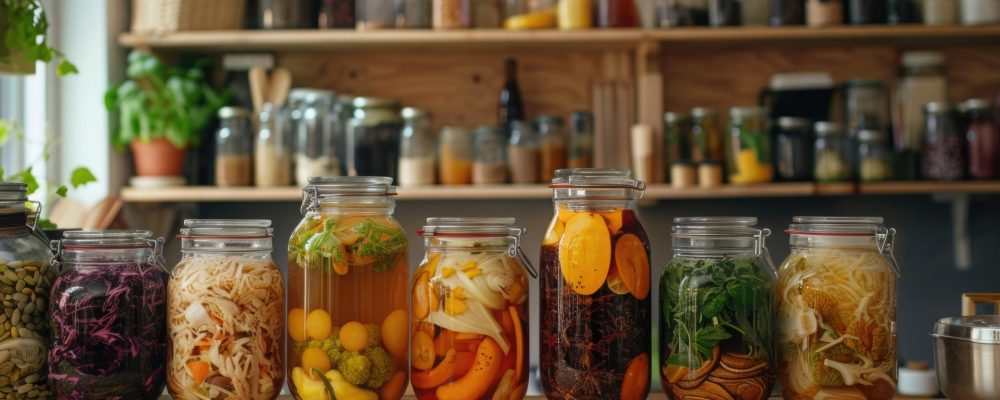

There is a transformation that happens to food that is unlike any other in the kitchen.
Not the transformation of heat — which browns and crisps and tenderizes and concentrates. Not the transformation of salt — which seasons and preserves and draws out moisture. Not even the transformation of time — which mellows and integrates and deepens in the ways that braising and aging produce.
This transformation is alive.
Fermentation — the process by which microorganisms convert the sugars and starches in food into acids, gases, and alcohols — is the oldest food technology in human history. It predates cooking with fire. It predates agriculture. It predates, in some form, the emergence of modern humans. And it has produced, across every culture and every era of human existence, some of the most complex, most flavorful, and most nutritionally significant foods available.
The yogurt in the refrigerator. The sourdough on the counter. The kimchi in the jar. The wine in the glass. The cheese on the board. The miso in the pantry. The soy sauce in the bottle. The vinegar in the cruet.
All of it alive. All of it the product of microorganisms doing work that no other process can replicate.
The Microorganisms Behind the Magic
Fermentation is not a single process. It is a family of related processes, each driven by different microorganisms, each producing different transformations and different flavor compounds.
Lactic acid fermentation — the process responsible for yogurt, kimchi, sauerkraut, sourdough, and aged cheese — is driven by lactic acid bacteria, a family of microorganisms that convert sugars into lactic acid. The acid they produce lowers the pH of the food, creating an environment inhospitable to harmful bacteria while preserving the food and producing the characteristic tang that defines fermented foods across cultures.
Acetic acid fermentation — the process responsible for vinegar — is driven by acetic acid bacteria, which convert alcohol into acetic acid. The wine that ferments further becomes wine vinegar. The apple juice that ferments into cider and then ferments again becomes apple cider vinegar. Each transformation adds a layer of complexity to what began as simple fruit sugar.
Alcoholic fermentation — the process responsible for wine, beer, sake, and every other fermented beverage — is driven by yeast, which convert sugars into ethanol and carbon dioxide. The carbon dioxide that escapes is what makes bread rise. The ethanol that remains is what makes wine wine.
And the complex mold fermentations of East Asian cooking — the koji molds responsible for miso, soy sauce, sake, and mirin — work differently again, producing enzymes that break down the proteins and starches in soybeans and rice into the amino acids and sugars that other microorganisms then ferment further.
Each of these processes is its own world — with its own microorganisms, its own conditions, its own flavor chemistry, its own history of human cultivation and refinement.
Why Fermented Food Tastes Different
The flavor complexity of fermented food is not incidental. It is the direct product of the biochemical transformations that fermentation produces — transformations that generate flavor compounds that do not exist in the raw ingredients and that no other cooking process can replicate.
Glutamates — the amino acids responsible for umami, the savory depth that makes food taste satisfying and complete — are produced in significant quantities during protein fermentation. This is why miso, soy sauce, aged cheese, and fish sauce are such powerful flavor enhancers: they are concentrated sources of glutamates produced by the fermentation and breakdown of proteins, and their addition to a dish activates umami receptors in a way that unfermented ingredients of equivalent nutritional content do not.
Organic acids — lactic acid, acetic acid, and others — produced during fermentation contribute not just their own flavor but interact with the other flavor compounds in food to produce brightness, complexity, and the particular quality of depth that fermented foods have. The sourness of a good sourdough is not just sourness. It is a complex interaction of multiple acids, each produced by different bacterial species, each contributing a slightly different character to the overall flavor profile.
Esters — the aromatic compounds responsible for the fruity, floral notes in wine, beer, and certain fermented dairy products — are produced as byproducts of yeast metabolism during alcoholic fermentation. The specific esters produced depend on the yeast strain, the fermentation temperature, and the substrate being fermented — which is why different wines made from the same grape variety taste different, and why the same grape fermented at different temperatures produces wines with distinct aromatic profiles.
The Ancient Technology That Never Left
Fermentation is often discussed as if it were a recent rediscovery — a trend in contemporary food culture, a response to modern interest in gut health and artisan production. In fact, fermentation never disappeared. It simply became invisible — industrialized, standardized, and removed from the direct experience of most consumers.
The yogurt made by lactobacillus cultures in a temperature-controlled industrial facility is fermented. The supermarket sourdough made with added acids and commercial yeast to simulate the flavor of genuine sourdough fermentation is not — or not in the same sense. The cheese aged in a controlled-atmosphere cave is fermented. The processed cheese food made with emulsifying salts is not.
The contemporary interest in fermentation is not the discovery of something new. It is the recovery of something old — the recognition that the industrialized version of fermented foods had traded the complexity and the nutritional benefits of genuine fermentation for consistency and shelf life, and that something worth recovering had been lost in that trade.
Every culture that has ever produced food has developed fermentation traditions. The Koreans developed kimchi and doenjang. The Japanese developed miso, soy sauce, and sake. The Indians developed yogurt, idli, and dosa batter. The Ethiopians developed injera. The Mexicans developed tepache and pulque. The Europeans developed wine, beer, cheese, and an extraordinary diversity of regional fermented products that reflect the specific microbiological environments of their places of origin.
These traditions were not developed independently because fermentation is fashionable. They were developed because fermentation solved specific problems — preservation, nutrition, safety, flavor — that every food culture needed to solve, and because the solutions it produced were more complex and more satisfying than the alternatives.
The Home Fermentation Renaissance
The past decade has seen a significant and genuine revival of home fermentation — of home cooks making their own kimchi, maintaining sourdough starters, culturing yogurt, fermenting vegetables, brewing kombucha, and experimenting with the miso and koji preparations that were, until recently, considered exclusively the province of professional producers.
This revival has been driven by several converging forces. The growing understanding of the gut microbiome and the role of fermented foods in supporting it. The desire for foods with greater flavor complexity than industrially produced alternatives provide. The appeal of a process that connects the home cook to the oldest food traditions in human history.
And the practical accessibility of fermentation as a home practice — which is, once the basic principles are understood, considerably less difficult than its mystique suggests.
Lacto-fermented vegetables — the simplest and most accessible category of home fermentation — require nothing more than vegetables, salt, water, and time. The salt creates the conditions that allow beneficial lactic acid bacteria, which are present on the surface of every vegetable, to thrive while suppressing harmful bacteria. The bacteria do the rest — converting the sugars in the vegetables into lactic acid, preserving the vegetables, and producing the complex flavors that distinguish genuinely fermented vegetables from vinegar-pickled ones.
A jar of sauerkraut, properly made, requires twenty minutes of active preparation. The fermentation that follows — three days to three weeks at room temperature, depending on the temperature of the kitchen and the desired level of sourness — requires no attention beyond an occasional check. The result is a living food with a complexity and a probiotic richness that no commercial product fully replicates.
Fermentation as Flavor Building
Beyond its value as a preservation technique and its nutritional significance, fermentation is worth understanding as a flavor-building tool — one that produces complexity in ingredients that no other technique can achieve.
The miso that has been fermented for three years has a depth and a complexity that six-month miso doesn’t approach. The aged cheese has umami and crystalline texture that fresh cheese cannot produce. The long-fermented sourdough has an aromatic complexity that commercial yeast bread doesn’t attempt.
But fermentation as a flavor tool doesn’t require years of aging or the production of complex fermented products from scratch. It can be incorporated into everyday cooking in simpler ways.
A splash of fish sauce — which is nothing more than fermented fish and salt, reduced over time to a concentrated liquid — adds umami depth to dishes that have nothing to do with Southeast Asian cooking, in quantities too small to be identifiable as fish sauce but large enough to make everything else in the dish taste more vivid and complete.
A spoonful of miso whisked into a salad dressing, a pasta sauce, a soup base — not enough to taste specifically of miso but enough to add the savory, fermented depth that makes the dressing or the sauce taste more complex than its ingredients alone would produce.
The kombucha used as a component in a vinaigrette — its mild acidity and slight effervescence contributing brightness in a way that plain vinegar doesn’t.
These are small additions. Their impact, to a cook who has experimented with them, is not small.
The Takeaway
Fermentation is not a trend and not a technique. It is a fundamental dimension of human food culture — the oldest technology we have for transforming ingredients into something more complex, more flavorful, and more nourishing than their raw state.
It is present in the most ordinary foods in every kitchen. It is accessible as a home practice in ways that most home cooks have never explored. And it produces flavors that no other process can replicate — the specific, living complexity of food transformed by microorganisms over time.
Start with something simple. A jar of lacto-fermented vegetables. A sourdough starter fed and maintained over a few weeks. A batch of yogurt cultured overnight.
Watch what happens.
What happens is alive — and it is extraordinary.














