
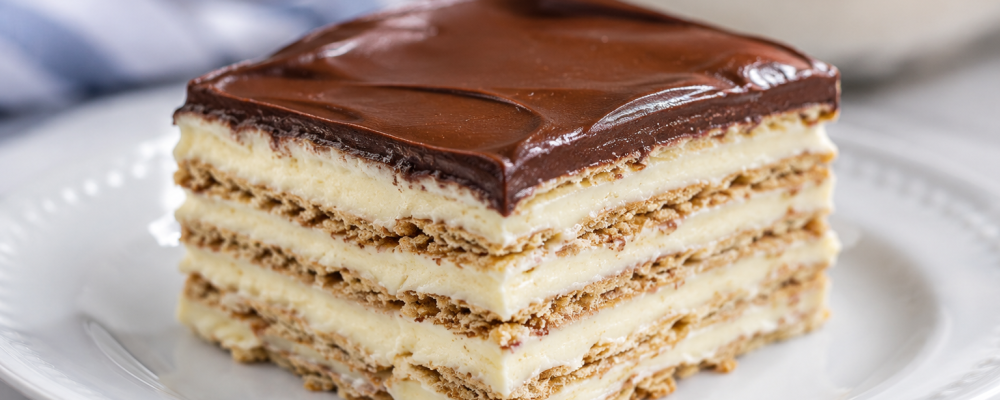

No-Bake Icebox Eclair Cake is one of those recipes that genuinely fascinates me from a food science perspective, because the most impressive thing about it requires zero technique—it just requires time. The transformation of crisp, dry graham crackers into tender, almost custard-like layers through moisture absorption from the surrounding pudding cream is a perfect example of osmosis and diffusion working in a dessert context. The crackers absorb liquid from the pudding, softening completely while simultaneously releasing starch that slightly thickens the surrounding cream. Each component changes the other, and what emerges after overnight refrigeration is something neither ingredient could produce alone.
As a pastry chef, I have enormous respect for the classic French éclair—choux pastry piped and baked until hollow, filled with pastry cream, dipped in chocolate glaze. It’s a genuinely demanding dessert that requires skill, precision, and experience. This icebox cake has absolutely nothing in common with that process. And yet, remarkably, it captures the essential éclair experience: tender pastry-like exterior, vanilla cream interior, chocolate on top. The graham crackers, once transformed by overnight refrigeration, genuinely mimic choux pastry’s texture in a way that seems almost impossible given how different the two ingredients are.
What makes this recipe particularly brilliant is how it exploits the limitations of its ingredients as features rather than bugs. Graham crackers are too crispy and brittle for most layered desserts—here that brittleness is necessary, because you need the initial structure to support the pudding during assembly, and the transformation happens gradually during refrigeration. Cool Whip’s stabilizers, which make it less interesting as a topping, make it perfect here—it maintains structure in the pudding mixture without weeping or deflating during the long refrigeration time. Every ingredient is exactly right for this specific application.
─────────
The Inspiration Behind This Recipe
Icebox cakes have a long history in American home baking, emerging in the early 20th century when refrigerators (then called “iceboxes”) became common household appliances. The icebox cake concept—layers of cookies or crackers with cream, refrigerated until the cookies soften—was initially promoted by Nabisco using their Famous Chocolate Wafers. The idea was elegant: refrigeration could “bake” a cake without any actual baking, using moisture transfer to transform crispy cookies into cake-like layers.
The éclair cake specifically emerged as a variation that evoked the beloved French pastry through clever ingredient substitution. Graham crackers stand in for choux pastry (they soften to a similar texture overnight), vanilla pudding mixed with whipped topping mimics pastry cream (lighter and more stable than actual pastry cream but similar in flavor), and chocolate frosting replicates the chocolate glaze that tops traditional éclairs. The name is aspirational—this doesn’t taste exactly like a professional éclair—but it captures the spirit and flavor profile in a way that’s genuinely satisfying and remarkably convincing.
What inspired the specific technique of microwaving store-bought frosting is pure practical genius. Canned frosting is too thick and stiff to spread over graham crackers without tearing them. Briefly microwaving it makes it pourable and spreadable—essentially creating an instant chocolate glaze without any cooking, tempering, or ganache-making. That small technique insight transforms a potentially frustrating step into a foolproof one.
─────────
A Brief History of Icebox Cakes & No-Bake Desserts
The icebox cake tradition dates to the 1920s and 1930s, when refrigerator ownership transformed American home cooking. Appliance companies and food manufacturers recognized that desserts requiring refrigeration would showcase the refrigerator’s capabilities—Jell-O promoted gelatin molds, pudding brands promoted chilled pies, and cookie companies promoted icebox cakes. These desserts weren’t just convenient; they were genuinely novel, producing textures and experiences that conventional baking couldn’t achieve.
Nabisco’s Famous Chocolate Wafer Cake—layers of chocolate wafers and whipped cream refrigerated overnight—became perhaps the most iconic icebox cake and remains popular today. The concept spread to countless variations: vanilla wafer cakes, graham cracker cakes, and eventually the pudding-based variations that became popular in the 1950s and 1960s as instant pudding mix made no-cook custard accessible to every home baker.
The éclair specifically holds a special place in American dessert imagination. Real éclairs—imported from French pastry tradition through restaurants and bakeries—were aspirational treats, associated with sophistication and European elegance. Creating an “éclair cake” that captured those flavors and associations without requiring professional technique democratized that sophistication, making it available to home bakers everywhere with pantry staples and a refrigerator.
Today, eclair cake and its variations appear throughout American food culture—in church cookbooks, food blogs, and family recipe collections—representing the best of practical American home baking: clever, resourceful, genuinely delicious, and accessible to everyone regardless of baking skill level.
─────────
Why This No-Bake Method Works Perfectly
Graham cracker moisture absorption creates the éclair effect. This is the recipe’s central magic. Dry graham crackers contain starch and some hygroscopic compounds that actively draw moisture from their surroundings. When layered with pudding cream, they absorb liquid gradually over several hours, softening from crispy to tender. After overnight refrigeration, they’ve absorbed enough moisture to become genuinely soft and slightly chewy—a texture remarkably similar to baked choux pastry. This transformation is irreversible and time-dependent; you can’t rush it with more liquid or higher temperature.
Cool Whip’s stabilizers make the pudding mixture structurally viable. Fresh whipped cream would deflate and weep during the 4-8 hour minimum refrigeration time, creating a watery, structureless mess. Cool Whip’s commercial stabilizers (carrageenan, modified food starch, and others) prevent this deflation, maintaining the cream’s light, airy structure throughout the long refrigeration period. This stability is essential—without it, the pudding layer would compress under the graham crackers’ weight and create dense, uniform filling rather than light, mousse-like layers.
Instant pudding thickens through starch hydration, not cooking. Modified food starch in instant pudding mix hydrates and swells when contacted with cold milk, creating a thick gel without any heat. This produces a pudding base that’s already at the right consistency for folding with Cool Whip. The pudding also continues to firm slightly during refrigeration as the starch granules complete their hydration, which is why the cake needs at least 4 hours to achieve proper sliceability.
Folding Cool Whip into pudding creates the right texture. Rather than using pudding or whipped topping alone, combining them creates a middle-ground texture—lighter than plain pudding (which would be too heavy and dense between crackers), more structured than plain whipped topping (which would be too light and wouldn’t maintain layers). This combination mimics the texture of lightened pastry cream—the traditional éclair filling—more accurately than either component alone.
Microwaving frosting creates instant chocolate glaze. Store-bought frosting contains significant amounts of fat (shortening and sometimes oil) that become fluid when heated. Brief microwaving (10-15 seconds at a time, stirring between) melts these fats, making the frosting pour-able and spread-able rather than thick and sticky. As it cools on the graham cracker top layer, it re-solidifies into a smooth, glossy layer that resembles professional chocolate glaze. This is clever practical chemistry: the same product, two completely different textures, based solely on temperature.
The layering sequence creates structural integrity. Starting with graham crackers on the bottom creates a stable foundation that won’t shift when the pudding layer is added. The pudding acts as adhesive between cracker layers, holding everything in place. The top cracker layer, pressed gently into the final pudding layer, adheres firmly after refrigeration—the cake becomes a unified structure rather than sliding layers.
Overnight refrigeration optimizes every component. Four hours is the minimum for basic softening and setting. Eight or more hours (overnight) allows complete transformation: crackers fully softened, pudding fully set, flavors fully melded, structure fully consolidated. The overnight-refrigerated version is dramatically superior to the minimum-time version—more cohesive, better texture, more integrated flavor. If you can plan ahead, always refrigerate overnight.
─────────
Flavor Profile: What to Expect
Vanilla cream dominates the interior in the most comforting, familiar way. The pudding-Cool Whip combination has sweet, pure vanilla flavor with that characteristic pudding richness—it’s milky, lightly sweet, and clean. It tastes like the best possible vanilla cream filling, which is exactly what it’s meant to evoke.
Softened graham cracker layers have lost their individual cracker flavor and become something different—mild, slightly sweet, almost neutral in flavor while providing that tender, slightly chewy texture that carries the vanilla cream between bites. These layers don’t taste like graham crackers anymore; they’ve transformed into something that genuinely evokes choux pastry’s neutral, tender character.
Chocolate frosting provides the rich, sweet, chocolate-forward top note that defines the éclair experience. The frosting’s sweetness is intense and immediate—it’s the first thing you taste in each bite. Store-bought chocolate frosting has a characteristic flavor profile (sweet, chocolatey, with a slight waxy quality from shortening) that’s nostalgic and crowd-pleasing.
The complete experience is greater than its parts. On their own, these five ingredients are unremarkable. Together, after overnight transformation, they create something that genuinely evokes a French éclair—creamy vanilla interior, tender pastry-like layers, chocolate exterior. The combination is sweet, creamy, chocolatey, and deeply satisfying in that comfort-food way that makes people go back for a second piece.
Temperature enhances everything. Served cold from the refrigerator, the chocolate frosting is slightly firm, the cream is cool and refreshing, and the graham cracker layers are fully softened. This cold serving temperature is essential—room temperature eclair cake loses the refreshing quality that makes it so appealing.
─────────
Tips for Making the Best No-Bake Icebox Eclair Cake
Preparing the Pudding Mixture:
- Whisk pudding and milk vigorously for a full 2 minutes until completely smooth with no lumps—under-mixed pudding won’t set properly.
- Use cold milk for best thickening—warm milk doesn’t activate the starch properly.
- Let pudding sit for 5 minutes after whisking to thicken before folding in Cool Whip.
- Fold Cool Whip gently using a large spatula with sweeping motions—preserve as much air as possible for a lighter final texture.
- Don’t stir or beat the mixture after folding—this deflates the Cool Whip and creates a denser, heavier filling.
Assembling the Layers:
- Use full graham cracker sheets for the most even layers—break them only as needed to fill gaps at the edges.
- Arrange crackers in a single layer with minimal gaps—small gaps are unavoidable and fine, but large gaps create structural weak points.
- Spread pudding mixture evenly using an offset spatula—consistent thickness ensures every slice has the same ratio of cream to cracker.
- Don’t press down on the crackers when adding pudding layers—let the pudding’s weight settle naturally to avoid cracking the crackers before they soften.
- The top cracker layer can be pressed very gently and evenly to create a flat surface for the frosting.
Applying the Chocolate Frosting:
- Microwave in 10-15 second intervals at medium power, stirring between each—overheating makes the frosting too runny and it won’t set properly.
- The right consistency: pourable but not watery—it should flow slowly off a spoon, not drip rapidly.
- Pour frosting in the center and spread gently to the edges using an offset spatula—avoid pressing too hard on the crackers.
- Work quickly once poured—frosting begins to set as it cools, making spreading increasingly difficult.
- A smooth, even top looks most professional, but slight texture is fine and looks homemade in a charming way.
Refrigeration Strategy:
- Minimum 4 hours—but this is really the minimum for a passable result.
- Overnight (8-12 hours) produces dramatically superior texture and flavor integration.
- Cover tightly with plastic wrap after the first 30 minutes (once the frosting has set enough not to stick) to prevent the cake from absorbing refrigerator odors.
- Don’t freeze to speed the process—freezing creates icy pudding texture rather than the creamy result refrigeration produces.
- The cake can be made up to 2 days ahead—it actually continues to improve over that time.
Cutting and Serving:
- Use a sharp knife dipped in hot water and wiped dry—the chocolate frosting layer cuts more cleanly with a warm blade.
- Score the frosting layer first with the tip of the knife before applying full pressure—this prevents the frosting from cracking and pulling away from the crackers.
- Wipe the knife clean after each cut for the neatest edges.
- Serve immediately after cutting—cut pieces held at room temperature will begin to soften too much within 30 minutes.
Flavor Variations:
- Chocolate éclair: Use chocolate pudding instead of vanilla for double chocolate intensity
- Strawberry: Add sliced fresh strawberries between the pudding layers for fruit éclairs
- Mocha: Mix 1 teaspoon instant espresso into the pudding mixture before folding in Cool Whip
- Lemon: Substitute lemon pudding and top with white chocolate frosting for a citrus variation
─────────
Serving Suggestions and Presentation Ideas
Classic Casual:
Cut into neat squares and serve directly from the dish on small dessert plates with forks. The chocolate frosting top makes these look neat and finished with no additional garnish needed. This is the most authentic presentation—simple, unfussy, and exactly what the recipe was designed for.
Elevated Plated Dessert:
Place a square on a white dessert plate with a small dollop of whipped cream alongside and a chocolate drizzle on the plate in an artistic pattern. Add a fresh strawberry or mint sprig for color. This transforms the humble icebox cake into something dinner-party presentable.
Garnished Top Layer:
Before refrigerating, pipe small dollops of extra Cool Whip across the chocolate frosting layer in a grid pattern. After refrigeration, the Cool Whip will have set and created a beautiful, professional-looking decoration. Add a chocolate sprinkle or mini chocolate chips over the Cool Whip dollops.
Parfait Style:
For individual servings, layer pudding mixture, crushed graham crackers, and chocolate sauce in clear glasses or mason jars for an icebox éclair parfait. Top with whipped cream and a chocolate drizzle. This format requires no cutting or serving dishes and looks beautiful through clear glass.
Potluck and Party:
Transport in the baking dish covered with plastic wrap. Provide a cake server or wide spatula for self-service alongside stacked small plates and forks. Label with a sign so guests know what to expect—”No-Bake Éclair Cake” on a label creates excitement before the first bite.
Kids’ Party:
Decorate the chocolate frosting layer with colorful sprinkles immediately after spreading (before it sets). Cut into smaller squares for age-appropriate portions. The sprinkles make it festive and signal “fun dessert” to children. This is genuinely one of the most universally child-approved desserts in existence.
─────────
Storage, Make-Ahead, and Serving Tips
Storage:
- Refrigerator: Store covered tightly for up to 4 days. The cake continues to improve through day 2 before very gradually softening further on days 3-4. Still delicious throughout.
- Freezer: Not recommended—freezing creates an icy, crystallized pudding layer that loses its creamy texture when thawed.
- Cut pieces: Store cut pieces covered in the refrigerator and consume within 2 days for best texture—cut edges can dry slightly over time.
Make-Ahead Strategy:
This cake is specifically designed for advance preparation:
- Assemble 1-2 days before serving—this is optimal, not just convenient
- The overnight transformation is what makes the recipe work—it cannot be rushed
- Garnish and cut just before serving for the freshest appearance
For parties and gatherings, assembling the night before eliminates all day-of dessert stress—the cake is completely finished and simply needs to be cut and served.
The improvement timeline:
- 4 hours: Crackers partially softened, flavors beginning to meld—minimum acceptable result
- 8 hours (overnight): Crackers fully softened, pudding fully set, flavors integrated—optimal result
- 24 hours: Further flavor integration, slightly softer structure—many people’s favorite stage
- 48 hours: Very soft throughout, more unified texture—still delicious, more mousse-like
Serving Temperature:
This dessert must be served cold from the refrigerator—room temperature serving causes the pudding to soften too much, the frosting to become sticky, and the overall structure to lose integrity. Keep refrigerated until the moment of serving.
Quantity Planning:
A 9×13 inch dish yields:
- 12 generous squares (3×4 grid)—appropriate for dessert portions
- 16 standard squares (4×4 grid)—appropriate for most gatherings
- 24 smaller squares (4×6 grid)—appropriate for dessert tables with multiple options
─────────
Why This Recipe Deserves a Spot in Your Rotation
No-Bake Icebox Eclair Cake represents something I genuinely value in the dessert world: a recipe that produces a result more impressive than its components and technique would logically suggest. Five pantry ingredients, no baking, no special equipment, minimal active time—and the result tastes like something that required pastry training to produce. That gap between effort and outcome is remarkable and rare.
From a food science perspective, this recipe is endlessly fascinating. The graham cracker transformation—crispy cookie becoming tender, pasta-like layer through moisture absorption—is osmosis and diffusion producing a culinary effect. The Cool Whip stabilization that makes long refrigeration viable, the instant pudding starch hydration that requires no cooking, the microwaved frosting that becomes a functional chocolate glaze—every element of this recipe uses food science deliberately, even if the original developers didn’t consciously frame it that way. Understanding why this recipe works makes you appreciate it more.
The absolute accessibility is genuinely valuable. This recipe requires no baking skill whatsoever. No creaming, no folding with precision, no temperature monitoring, no doneness testing. If you can whisk pudding, fold Cool Whip, and layer crackers in a dish, you can make this perfectly. That accessibility means this is appropriate for beginner bakers, for children learning to cook, for people who want to bring something impressive to a gathering without stressing about technique.
The crowd-pleasing reliability is exceptional. Vanilla cream and chocolate together appeal to almost everyone. The familiar, comforting flavor profile—reminiscent of convenience store éclairs and childhood desserts—generates genuine enthusiasm rather than polite appreciation. I’ve served this alongside elaborate, technically demanding desserts at gatherings, and this simple icebox cake gets equally enthusiastic responses.
The make-ahead requirement is actually an advantage. Unlike most desserts that peak when fresh, this cake requires advance preparation and gets better with time. For anyone who entertains, a dessert that’s fully finished the night before—with no day-of attention needed—is genuinely valuable. The refrigerator does all the work while you sleep.
If you’re looking for a recipe that delivers maximum crowd-pleasing impact with minimum skill and effort, that uses pantry staples to create something genuinely impressive, that must be made ahead (freeing you completely on serving day), and that demonstrates how refrigerator chemistry can produce results that seem to exceed the sum of their parts—this is it. No-Bake Icebox Eclair Cake proves that sometimes the most beloved recipes are the ones that make everyone feel like they can bake, regardless of skill level.
─────────
Recommended Drink Pairing
Cold Milk – Whole or 2%:
Ice-cold milk is the perfect, obvious pairing—vanilla cream and chocolate are both classic milk companions, and the cold milk cuts through the pudding’s richness while complementing every flavor element. This nostalgic pairing is universally appropriate and makes each bite taste like pure childhood comfort.
Coffee – Iced or Hot:
Iced coffee or hot dark roast provides bitter contrast that balances the sweetness beautifully. The coffee amplifies the chocolate frosting notes while cutting through the vanilla cream’s richness. An iced mocha creates the ultimate chocolate-vanilla-coffee combination that echoes every flavor in the cake.
Hot Chocolate:
Rich hot chocolate doubles down on chocolate while providing warm contrast to the cold cake. The temperature difference between warm drink and cold dessert is particularly pleasurable. Add a dash of vanilla to the hot chocolate to mirror the pudding’s vanilla flavor for cohesive pairing.
Chocolate Milkshake:
For total indulgence, a thick chocolate milkshake creates a dessert-within-a-dessert experience that chocolate lovers will adore. The milkshake’s cold, creamy texture mirrors the éclair cake’s interior, while its chocolate flavor harmonizes with the frosting. This is the unabashedly indulgent pairing for occasions when restraint isn’t on the menu.
Sparkling Water – Vanilla or Plain:
For a lighter option that cleanses rather than competes, vanilla sparkling water or plain sparkling water provides refreshing effervescence that cuts through richness and resets the palate between bites. The bubbles provide textural contrast to the soft, creamy cake. This is the elegant, understated pairing for when you want the cake to be the undisputed star.
No Bake Icebox Eclair Cake
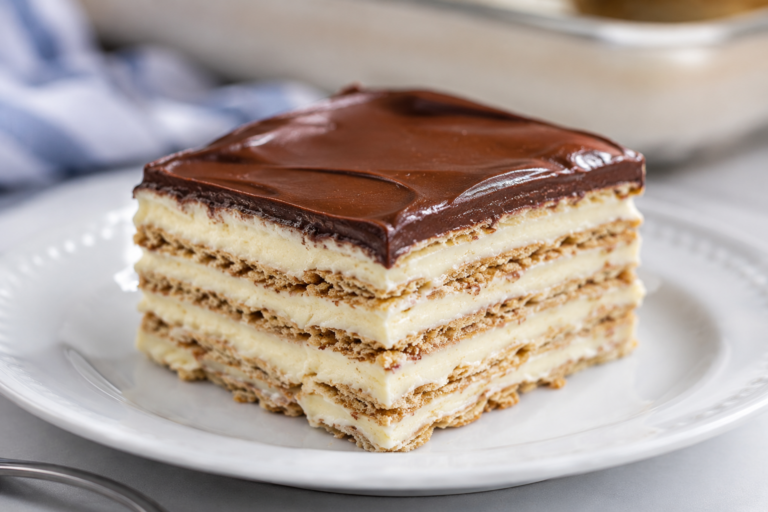
No-Bake Icebox Eclair Cake captures everything irresistible about classic cream-filled éclairs in an effortless layered cake—silky vanilla pudding cream between softened graham crackers, topped with glossy chocolate frosting for a dessert that tastes far more impressive than its five ingredients suggest.
4
servings30
minutes40
minutes300
kcal1
hour10
minutesIngredients
2 packages instant vanilla pudding mix
3.5 cups milk
8 ounces cool whipped topping
1 box graham crackers
1 cup chocolate frosting
Directions
- In a large bowl, whisk together pudding mix and milk until smooth.
- Fold whipped topping into the pudding mixture.
- Arrange a single layer of graham crackers on the bottom of a 9×13 inch baking dish.
- Spread half of the pudding mixture evenly over the graham crackers.
- Repeat with another layer of graham crackers and the remaining pudding mixture.
- Top with a final layer of graham crackers.
- Microwave the chocolate frosting on medium power until it is easily spreadable.
- Spread the chocolate frosting evenly over the top layer of graham crackers.
- Refrigerate the cake for at least 4 hours or overnight before slicing and serving.
Nutrition Facts
- Total number of serves: 4
- Calories: 370kcal
- Cholesterol: 0mg
- Sodium: 620mg
- Potassium: 400mg
- Sugar: 8g
- Protein: 6g
- Calcium: 60mg
- Iron: 2mg
About This Author

Aurora Wright
Pastry Chef & Dessert Editor
Aurora is the sweet side of Daily Dish. A trained pastry chef and dessert stylist, she’s responsible for our mouth-watering cakes, cookies, and confections. She brings precision, artistry, and a touch of whimsy to every recipe she creates — and taste-tests more chocolate than she’ll admit.
Favorite dish: Flourless dark chocolate torte.
Kitchen motto: “Life’s too short to skip dessert.”















