
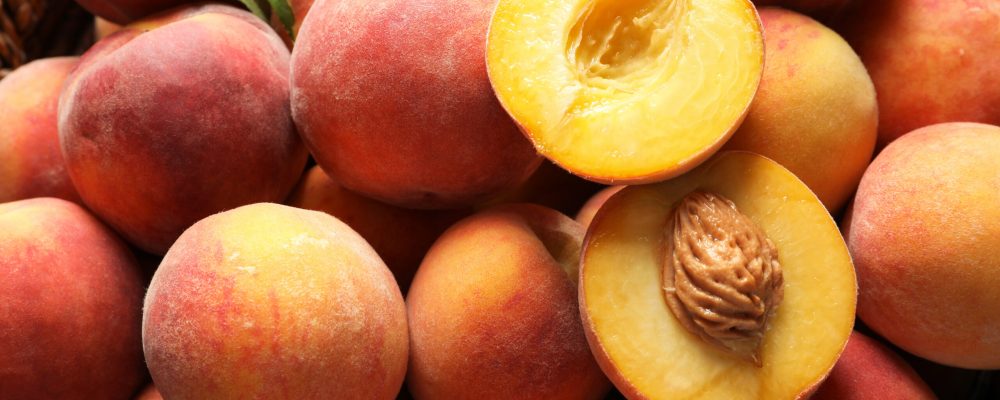

There is a problem that arrives every August with the specific quality of an embarrassment of riches.
Too many peaches.
Not the abstract too many of a produce section that always has more than any single person needs — the specific, urgent, personal too many of the flat of peaches purchased at the farmers market because the vendor said they were extraordinary and the price reflected the season’s abundance and the intention was to eat them slowly over the week.
The intention meets reality by Wednesday.
The peaches that seemed like a reasonable quantity on Saturday morning are, by Wednesday afternoon, past the moment of patient eating and approaching the moment of decisive action. The ones that were firm on Saturday have softened to the yielding, fragrant state that is peak ripeness and that lasts approximately eighteen hours before becoming something else entirely. The ones that were already ripe on Saturday are, on Wednesday, beginning the descent that peak ripeness always initiates.
This is the stone fruit reckoning — the specific moment every August when the abundance of the season and the perishability of its best produce arrive at the same time and demand a response.
The response, made well, produces some of the most satisfying cooking of the year. The response, made poorly or not at all, produces fruit flies and regret.
Reading the Peach Before Deciding What to Do With It
The first step in the stone fruit reckoning is assessment — understanding what specific stage each piece of fruit has reached, because the ideal preparation differs significantly depending on where the peach is in its ripeness trajectory.
The firm peach — the one that gives only very slightly when pressed at the shoulder, that still has some resistance at the flesh, that smells fragrant but not overwhelmingly so — is the peach that has the most options ahead of it. It can ripen further on the counter for a day or two. It can be grilled, which requires structural integrity that a softer peach cannot provide. It can be sliced into a salad or a grain bowl where its slight firmness is an asset rather than a liability.
The peak-ripe peach — the one that yields gently to pressure at the shoulder without being soft, that has reached the specific fragrance that indicates maximum sugar development, that releases a small amount of juice when cut — is the peach for immediate eating and for preparations that showcase the raw fruit. This is the peach for the simple dessert with cream. The peach for the Caprese-style salad with burrata and basil. The peach for eating over the sink in the specific way that only a perfectly ripe peach deserves.
The very ripe peach — the one that is soft when pressed, that has wrinkled slightly at the skin, that may have developed a small soft spot — is not a failed peach. It is the peach for cooking. Its high sugar concentration, further concentrated by the loss of water during the final stage of ripening, produces extraordinary caramelization when heat is applied. Its texture — which is a liability for raw eating — is an asset in the pan, where it collapses quickly into the concentrated, deeply flavored result that the firmer peach would take significantly longer to achieve.
And the overripe peach — the one that has passed the cooking stage, that has developed fermented notes, that has soft spots that have become genuinely compromised — is the peach for the blender. A smoothie, a sauce base, a coulis. The fermented note that makes it unpleasant to eat raw produces an interesting depth in a cooked preparation where other flavors balance it.
The Raw Preparations Worth Making Right Now
The peak-ripe peach that is eaten without cooking — in the form that most directly honors the specific quality of peak season fruit — deserves more culinary consideration than simply being sliced and served.
The peach with burrata is the raw stone fruit preparation that most completely demonstrates what happens when two excellent peak-season ingredients are placed alongside each other without intervention. The burrata’s specific creaminess and mild dairy flavor is the ideal textural and flavor counterpoint to the peach’s sweetness and acidity. A few torn basil leaves, a drizzle of good olive oil, a generous pinch of flaky salt, and a grind of black pepper — this is a dish that requires no cooking and that produces more pleasure than most dishes that do.
The peach in a grain salad — sliced ripe peaches combined with cooked farro or wheat berries, with arugula or watercress, with a sharp vinaigrette that provides acid against the peach’s sweetness — is the late summer grain salad at its most specifically seasonal. The peach’s sweetness and its softness provide both flavor and texture contrast to the grain’s chew and the greens’ bitterness, producing a salad that is complete and satisfying in the way that a composed salad with multiple well-chosen components achieves.
And the peach with prosciutto — the sweet-salt-fat pairing that works as reliably with stone fruit as it does with melon — is the simplest and most elegant of the raw peach preparations, requiring nothing from the cook beyond the selection of ripe peaches and good-quality cured meat and the willingness to place them on a plate together.
The Cooked Preparations Worth Making Before They’re Gone
The peach that is cooked — subjected to heat in one of its specific forms — undergoes a transformation that is distinct from the raw eating experience and that is worth pursuing specifically, not just as a response to abundance but as a preparation that the cooked peach does better than the raw one.
The skillet peach — the peach halved and placed cut-side down in a hot pan with butter until deeply caramelized, then finished with a splash of bourbon or brandy or simply left in its own caramelized state — is the most dramatic and most immediately satisfying transformation available from a ripe peach. The heat concentrates the peach’s sugars at the cut surface, developing the Maillard reaction compounds that produce the specific bittersweet depth of caramelization. The result — served alongside vanilla ice cream, or with yogurt and honey, or simply as itself — is a preparation that the raw peach cannot approximate.
The roasted peach — halved, drizzled with honey and perhaps a sprinkle of cardamom or cinnamon or a sprig of thyme, roasted in a moderate oven until completely soft and slightly collapsed — is the longer, gentler version of the same principle. The twenty-minute roast produces a peach that has concentrated in flavor, softened in texture, and developed a caramelized depth that transforms the fruit into a complete and versatile preparation. Roasted peaches served warm over yogurt are a breakfast. Served alongside a piece of grilled pork or duck, they are a sauce. Served with cream and something crunchy — a crumble topping, a piece of shortbread — they are a dessert.
The grilled peach — halved, pitted, placed cut-side down on a very hot grill until marked and slightly softened — is the outdoor version of the skillet preparation, adding the specific smokiness of the grill to the caramelization that the cut surface develops over direct heat. The grilled peach is the August cookout’s most specifically seasonal dessert contribution — made while the grill is still hot from the main event, served immediately, requiring nothing more than a scoop of ice cream alongside it.
The Preservations That Extend the Season
The peach that cannot be eaten or cooked this week — the abundance that exceeds even the generous capacity of the preparations described above — deserves preservation rather than waste. And the specific preserved peach is not a consolation for the fresh one but a different and genuinely excellent form of the ingredient.
The refrigerator jam — made from ripe peaches, sugar, and lemon juice, cooked until thick, stored in jars in the refrigerator for up to a month — is the preservation that most directly captures the specific flavor of peak-season peaches in a form that holds. Not the indefinite preservation of full canning — the refrigerator jam is a short-term preservation rather than a long-term one — but the specific, vivid flavor of August peaches maintained in a form that is available for weeks after the fresh fruit has passed.
The simplest refrigerator peach jam: two pounds of ripe peaches, peeled and roughly chopped, combined with one pound of sugar and the juice of one lemon in a heavy pan. Cooked over medium heat, stirring frequently, until the mixture reaches 220°F on a thermometer — or until a small amount placed on a cold plate wrinkles when pushed with a finger. Poured into clean jars and stored in the refrigerator.
The frozen peach — sliced, tossed with a small amount of lemon juice to prevent browning, spread on a sheet pan to freeze individually before being packed into bags — is the simplest and most versatile preservation of the season’s peach abundance. The individually frozen slices can be used through the winter in smoothies, in baked goods, in sauces, and in any preparation where the specific texture of fresh peach is less important than its flavor. They will not be what a fresh August peach was. They will be significantly better than any fresh peach available in February.
The peach shrub — the drinking vinegar made from peaches, sugar, and cider vinegar, discussed in the context of summer drinks in an earlier issue — is the preservation that produces the most unexpected and most versatile product from the season’s abundance. The concentrated syrup, diluted with sparkling water over ice, is one of the most refreshing summer drinks available. Diluted with still water and a squeeze of lime, it is an agua fresca. Used as a component in a vinaigrette, it provides both the sweetness and the acid that the dressing requires simultaneously.
The Galette: The Easiest Impressive Thing to Make
Of all the baked preparations available for the stone fruit reckoning, the galette — the free-form, single-crust pastry that requires no pie dish and no crimping skill and that accommodates any combination of stone fruit — is the one that most reliably produces an impressive result from a minimal investment of technique.
The galette is forgiving in ways that the pie is not. The crust that tears can be pressed back together. The filling that seems too wet can be thickened with an additional spoonful of starch. The shape that is irregular rather than perfectly round is the galette’s specific aesthetic rather than its failure. The galette that comes out of the oven imperfect still looks beautiful — because the free-form, slightly rustic presentation of the galette is exactly what the form is supposed to produce.
The specific preparation: a simple pastry dough — flour, cold butter, a small amount of sugar and salt, just enough ice water to bring it together — chilled for thirty minutes and then rolled into a rough circle. A filling of sliced stone fruit tossed with sugar and a small amount of starch and perhaps a splash of lemon juice and a pinch of cardamom or cinnamon. The filling mounded in the center of the pastry, the edges folded up and over the filling in rough pleats, the whole thing brushed with egg wash and sprinkled with coarse sugar.
Baked at 400°F until the crust is deeply golden and the filling is bubbling — forty to fifty minutes — the galette emerges looking specifically like something made with care and skill. The crust shatters at the edge and yields to the filling at the center. The fruit has collapsed and caramelized and its juice has thickened with the starch into a glossy, concentrated filling.
It requires thirty minutes of active preparation and produces something that looks like it required significantly more.
The Takeaway
The stone fruit reckoning is not a crisis. It is an invitation — the abundance of peak-season fruit demanding the specific response that honors what the season has produced.
Assess the fruit. Eat the peak-ripe ones immediately with burrata or prosciutto or over yogurt with honey. Cook the very ripe ones in the skillet with butter until caramelized. Roast the softest ones and serve them alongside protein or ice cream. Make the galette from the surplus. Jam and freeze what remains.
And the next time the flat of peaches appears at the farmers market at the end of the season, purchase it knowing that the response is fully prepared.
The stone fruit reckoning is the August cook’s most specifically rewarding challenge.
It deserves a fully developed response.














