
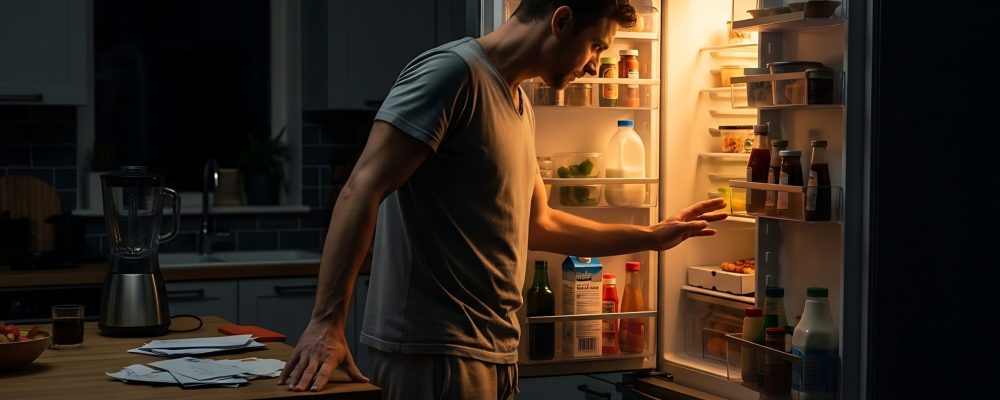

There is a cooking that happens after the dinner has been eaten and the kitchen has been cleaned and the reasonable hour for eating has passed.
It happens in the specific conditions of lateness — when the hunger that arrives at eleven or midnight or two in the morning is a different kind of hunger than the hunger that arrives at dinnertime. Not the social hunger of the shared meal, not the planned hunger of the scheduled dinner, but the private, uncurated hunger of a person who is awake when they probably shouldn’t be and whose body has decided, without consulting the day’s meal plan, that something is needed.
The midnight kitchen is the most honest cooking environment available to any cook. No audience. No occasion. No obligation to impress or to produce something that meets a standard other than the immediate satisfaction of a specific, private hunger.
What cooks make in the midnight kitchen reveals something that their public cooking doesn’t — a set of preferences and habits and instincts that exist below the layer of performance and intention that most cooking carries.
The Specific Hunger of Lateness
The hunger that arrives late at night is not simply delayed dinner hunger. It is a specific physiological and psychological state that produces specific cravings — and understanding what those cravings are and why they arise makes the midnight kitchen more interesting than it might appear.
The late-night hunger often arrives after the day’s cortisol levels have dropped, when the body’s appetite-regulating systems are operating in a mode different from the daytime. Research on circadian rhythms and eating patterns has found that late-night eating tends to be driven by reward-seeking rather than caloric need — by the brain’s desire for the specific pleasure of eating rather than by the body’s requirement for fuel.
This is why late-night eating tends toward specific categories of food. The salty. The fatty. The combination of the two that activates the brain’s reward circuitry in ways that plain carbohydrates or plain protein do not. The specific craving is not for a complete, nutritionally balanced meal — it is for a particular sensory experience that the day’s other eating didn’t provide.
The experienced midnight cook is familiar with this specific hunger — and has developed, over time, a repertoire of responses that satisfy it more completely and more honestly than whatever was left of the dinner or whatever the refrigerator’s most accessible contents suggest.
The Eggs That Belong to Midnight
Of all the foods that lend themselves to midnight cooking, eggs are the most universally and most specifically appropriate.
Not because eggs are a breakfast food — the association between eggs and morning is a cultural convention rather than a culinary one, and the egg that is fried or scrambled at midnight is not a lesser or inappropriate version of the egg fried at eight in the morning. But because the egg’s specific qualities — its speed of preparation, its ability to be cooked in a single pan with minimal preparation and minimal cleanup, its specific richness and protein content that produces genuine satiety, its compatibility with the salty and the fatty that late-night hunger specifically seeks — make it the ideal midnight ingredient.
The fried egg over leftover rice — the combination that is a breakfast staple in many Asian culinary traditions and a midnight staple in any kitchen that keeps cooked rice in the refrigerator — is one of the most satisfying midnight meals available. The rice, fried briefly in whatever fat is in the pan, seasoned with soy sauce or fish sauce or simply salt, topped with a fried egg whose yolk will break and run into the rice when cut — this is a complete meal that takes seven minutes and produces more satisfaction than its simplicity suggests it should.
The egg scrambled slowly — in the low-and-slow technique that produces small, soft curds rather than the large, slightly rubbery result of high-heat scrambling — over good bread that has been toasted and buttered generously, eaten at the counter rather than at the table because the table is too far from the stove and the hunger is too immediate to make the distance worthwhile — this is the midnight egg in its most essential form.
And the omelette — the French omelette made with care and speed, the filling minimal and chosen from whatever is in the refrigerator, the whole thing on the plate in three minutes — is the midnight cook’s most skillful expression, the moment when the technique developed in daylight cooking is applied in the dark kitchen of an unreasonable hour and produces something that tastes exactly like what was wanted.
The Toast That Exceeds Its Ingredients
There is a preparation that has existed in every kitchen in every era and that has never required a recipe and has never been written about with the seriousness it deserves.
Toast.
Not as a breakfast food or as the vehicle for avocado that it became briefly fashionable to discuss — but toast as the midnight cook’s most reliable and most satisfying medium. The specific qualities of good toast — the crisp exterior that gives way to the still-soft interior, the warmth that makes butter melt into it immediately, the slight char at the edges that adds a specific bitterness to what would otherwise be pure starch and fat — make it one of the most sensory-complete midnight foods available from the simplest possible ingredients.
The toast that exceeds its ingredients is the toast made from genuinely good bread — not supermarket sandwich bread, which toasts to something uniform and slightly sweet and forgettable, but sourdough or a good country loaf with a crumb that crisps properly and a crust that shatters and a flavor that has the complexity of actual fermentation. This toast, warm from the toaster, spread with cold butter that melts unevenly across its surface and pools in the holes left by the crumb structure, eaten standing at the counter with nothing else — is not a compromise or a makeshift meal. It is a genuinely excellent thing.
The additions that transform this toast into something more substantial follow the logic of the midnight hunger: the runny egg, the slice of good cheese that melts slightly on the hot surface, the leftover kimchi that provides acid and heat, the mashed avocado with salt and lemon that is actually about the toast as much as the avocado. Each of these is a midnight meal in the form of bread with something on it — and each is better than it has any right to be because the specific conditions of midnight eating make the simplest things taste more vivid than they do in any other context.
The Pasta at Midnight
There is a specific pasta that belongs to the midnight kitchen — not the elaborate pasta of the planned dinner but the pasta that is made from nothing, from what is in the pantry, in the twenty minutes between the arrival of hunger and the satisfaction of it.
Aglio e olio — the Roman pasta of garlic, olive oil, and pasta water, with perhaps some chili and some parsley — is the archetypal midnight pasta. It requires nothing from the refrigerator and almost nothing from the pantry except pasta and garlic and olive oil, all of which are permanent residents of any serious kitchen. It takes twenty minutes from the filling of the pot to the eating. And it produces, from three ingredients that cost almost nothing and require almost no technique, something that tastes entirely of the specific pleasure of good olive oil and perfectly cooked garlic and pasta cooked in properly salted water.
The midnight pasta differs from its daytime equivalent in one specific way that is worth noting: portion size is irrelevant. The daytime pasta is measured and portioned with at least some awareness of the meal’s place in the day’s overall eating. The midnight pasta is made in whatever quantity the hunger suggests — sometimes a full portion, sometimes barely half, sometimes enough for two because the person in the kitchen has found company in the person who also couldn’t sleep and wandered into the kitchen at the smell of garlic in olive oil.
The smell of garlic in olive oil is, in fact, one of the midnight kitchen’s most reliable social phenomena. It draws people from beds and from other rooms with a consistency that suggests it operates below the level of conscious decision.
The Cheese That Stands Alone
The midnight kitchen is where cheese reaches its highest culinary expression — not as a component of a composed cheese board or an element of a more complex preparation, but as the thing itself, eaten directly, at the temperature it happens to be because it has been pulled from the refrigerator in a state of hunger that doesn’t allow for the hour of tempering that proper cheese service requires.
The good cheese eaten at midnight — the wedge of aged Cheddar broken off rather than sliced, the piece of Gruyère taken from the block, the fresh chèvre spread on whatever cracker is in the cupboard or simply eaten from the container on a spoon — is cheese freed from the performance of the cheese board. No arrangement. No accompaniments. No curation. Just the cheese, eaten because it is what is wanted, at the moment when it is wanted.
This is the cheese in its most direct form — and the cook who eats it this way discovers, if they have not already, that some of the most sophisticated flavor available in any kitchen is available in a piece of aged cheese eaten in the dark from the refrigerator light.
The Drink That Belongs to the Kitchen After Dark
The midnight kitchen has its own beverage — not the wine of the dinner table or the coffee of the morning but the specific drink that belongs to the late-night kitchen and to the specific quality of mood that produces it.
For some cooks it is a glass of cold water — pure, simple, the most neutral possible accompaniment to whatever is being eaten, its coldness providing a counterpoint to the warmth of the food. For others it is the last of the wine from dinner, finished because finishing it felt right. For others it is a cup of something warm — tea, or warm milk with honey, or the specific herbal preparation that signals to the body that the eating is done and the night can continue.
The midnight drink is not about flavor in the way that the dinner wine is about flavor. It is about completion — the signal that the midnight kitchen episode is over, that the hunger has been addressed, that the private, uncurated cooking event of the evening has reached its natural conclusion.
What the Midnight Kitchen Teaches
The cooking that happens in the midnight kitchen teaches things that daytime cooking doesn’t — because the conditions are different in ways that reveal different aspects of the cook’s relationship with food.
The midnight kitchen teaches efficiency — because the hunger is immediate and the patience for elaborate preparation is limited, the midnight cook discovers which preparations satisfy most completely in the least time. These preparations, identified in the midnight kitchen, are worth knowing in any context where speed and satisfaction need to be balanced.
The midnight kitchen teaches honesty — because there is no audience and no occasion and no reason to cook anything other than what is actually wanted, the midnight cook discovers their genuine preferences in a way that social cooking obscures. The person who discovers at midnight that what they actually want is fried rice with a runny egg knows something about themselves that the person who always eats what is appropriate for the occasion does not.
And the midnight kitchen teaches the specific pleasure of cooking for nothing but the immediate satisfaction of it — no plan, no recipe, no performance, no agenda beyond addressing the hunger of the moment with whatever is available and whatever sounds right.
This is cooking at its most essential.
And it is, in its own specific way, some of the best cooking anyone does.
The Takeaway
The midnight kitchen is not where compromised cooking happens. It is where honest cooking happens — the cooking that reveals preference without performance, that satisfies a specific hunger without occasion or obligation, that produces some of the most vivid food memories in any cook’s life from the most ordinary of ingredients.
The next time hunger arrives at an unreasonable hour, don’t resist it with something inadequate.
Make the egg. Toast the bread. Cook the pasta. Eat the cheese standing at the refrigerator.
The midnight kitchen is one of the great pleasures of cooking life.
It deserves to be inhabited fully.














