
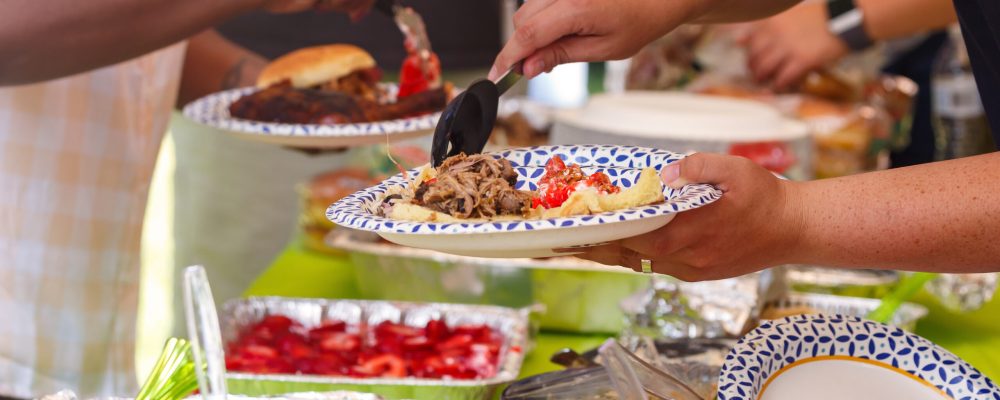

There is a dining tradition that has existed in America for longer than the country itself.
It has no dress code. No reservation system. No chef and no menu decided in advance. It has no single origin and no definitive form — it has appeared in church basements and community halls, on picnic tables and folding tables, in backyards and parking lots and living rooms cleared of furniture to make space for the thing that actually matters.
It is the potluck.
The word itself is old — its earliest recorded uses in English date to the sixteenth century, where it referred simply to whatever food happened to be available when a guest arrived unexpectedly. The pot luck was the luck of the pot — the chance that what was cooking that day would be worth eating, and the hospitality of sharing it regardless.
In America, the potluck evolved into something more deliberate and more democratic than its origin suggests — into a specific form of communal eating that reflects, in its structure and its values, something important about how communities eat together and what that eating is actually for.
The American Roots of Communal Eating
The tradition of bringing food to share at a gathering has roots in the practical realities of early American community life that predate any formal concept of the potluck.
In the agricultural communities of colonial and early America, the labor of the land required collective effort — barn raisings, harvests, quilting bees, and other community work projects that gathered large numbers of people in a single place for a single purpose. Feeding everyone who came was a necessity, and the solution was practical: everyone brought something.
This was not charity or performance. It was logistics — the recognition that no single household could or should bear the cost and labor of feeding an entire community, and that the distribution of that cost and labor across the community was the most equitable and most practical solution available.
The food that resulted from this distributed effort was, by its nature, a composite — a table of dishes that reflected the different households, different traditions, and different available ingredients of the people who brought them. The variety was not planned. It was the natural product of a community’s diversity, expressed through food.
This is the essential character of the potluck that has persisted through every subsequent iteration: the table as a representation of the community that assembled it.
The Church Supper and the Community Table
The most institutionalized form of American communal eating — the church supper or church potluck — developed as congregations found that the shared meal was one of the most effective tools for building and sustaining the social bonds that religious communities required.
The church supper was not just about food. It was about the particular quality of togetherness that a shared meal produces — the extended time in the same space, the conversations that happen across a table that don’t happen in a pew, the specific form of equality that occurs when everyone’s food is on the same table and the hierarchy of who brought what is deliberately, structurally erased.
In the church supper tradition, the casserole became iconic — not because it was the most sophisticated food available, but because it was the most practical. A casserole could be made in advance, transported without difficulty, served at a range of temperatures without significant quality loss, and produced in a quantity large enough to feed a crowd from a single dish. It was food designed for the specific constraints of communal eating, and its design was so well-suited to those constraints that it became inseparable from the tradition that produced it.
The green bean casserole. The funeral potatoes. The Jell-O salad. The seven-layer dip. These dishes are not celebrated in fine dining contexts — they are often actively dismissed in food writing that privileges sophistication over function. But they are the foods of a specific and important tradition, designed to meet specific and important requirements, and their persistence across decades of American potluck culture reflects the fact that they work — that they meet the requirements of communal eating better than many more sophisticated alternatives.
The Depression and the Covered Dish Supper
The economic pressures of the Great Depression gave new urgency and new meaning to communal eating in America. When individual households were struggling — when the resources for an abundant meal were uncertain and the isolation of financial hardship was itself a problem to be addressed — the communal meal became a form of mutual aid.
The covered dish supper — where each household brought whatever it could, covered against the journey, to be added to a communal table — was a mechanism for ensuring that communities ate together during a period when eating alone might mean eating too little or not at all.
The ethic of contribution that the covered dish supper required — everyone brings something, everyone eats together, the contribution is matched to ability and the eating is shared equally — was not just a logistical solution. It was a statement of values. The potluck as mutual aid was the potluck as community practice — a regular, repeated assertion that the community ate together and that the burden of feeding was shared.
This ethic persisted in American potluck culture long after the economic conditions that produced it had changed. The expectation that everyone contributes — that the guest who comes without a dish is doing something that transgresses the implicit social contract of the form — reflects the community-sustaining logic of the covered dish supper even when no one is consciously aware of that history.
The Potluck as Cultural Exchange
As American communities became more diverse through successive waves of immigration and migration, the potluck table became one of the primary sites where that diversity was expressed and encountered.
The dish a household brought to the potluck was the dish they knew how to make — the recipe from home, the food of their tradition, the preparation that carried the flavor of wherever they came from. And the potluck table, which placed those dishes alongside each other without hierarchy or explanation, created an encounter between traditions that no other dining format produced as naturally.
The Italian American family’s lasagna next to the Puerto Rican family’s pernil next to the Vietnamese family’s spring rolls next to the Midwestern family’s hot dish — this table, which no restaurant curator assembled and no food writer directed, was a document of the community that produced it. It was the community’s food biography, laid out on a table where anyone could eat from it.
This is the potluck’s most significant cultural function — not the distribution of cooking labor, not the community-building of eating together, but the specific form of cultural encounter that happens when people’s food meets other people’s food at a table where everyone is a host and everyone is a guest simultaneously.
The dish you bring carries information about who you are and where you come from. The dish you eat carries information about who your neighbor is and where they come from. The potluck table is a place where both kinds of information move freely, in a context that is relaxed and social and appetitive in ways that make the encounter more open and more genuine than more formal introductions allow.
The Decline and the Revival
The potluck’s central role in American communal life diminished somewhat in the second half of the twentieth century, as the conditions that had sustained it changed.
The restaurant economy grew. Catering became more accessible. The church supper declined alongside church attendance. The neighborhood social fabric that had made the regular community meal a natural feature of life became less dense in many communities as suburban sprawl, longer work hours, and the privatization of social life into individual households changed the conditions under which communal eating happened.
And yet the potluck never disappeared. It adapted — from the church basement to the office lunch, from the neighborhood picnic to the holiday gathering, from the formal covered dish tradition to the casual “everyone bring something” dinner party that doesn’t call itself a potluck but operates on the same principles.
In recent years, there has been a genuine and intentional revival of communal eating in American food culture — expressed in supper clubs, in community dinners, in the pop-up events and community table dinners that have become a feature of urban food culture, and in the specific return of the potluck as a deliberate choice rather than a default.
This revival reflects a recognition that something the potluck always provided — the specific quality of community and connection that comes from eating food that different people made, at a table where the making and the eating are both shared — is worth actively seeking rather than waiting to stumble into.
What the Potluck Understands About Food
The potluck is not sophisticated. It does not produce the most technically accomplished food or the most carefully considered menu or the most aesthetically unified table.
What it produces is something that sophistication cannot easily replicate: the specific pleasure of eating food made by the hands of the people you are eating with.
Every dish on a potluck table is an act of care — an expression of the effort someone made to produce something for a shared table. The casserole that took three hours to make. The pie that was attempted for the first time for this occasion. The family recipe that appears only at gatherings, carried from one generation to the next in the hands of the person who learned to make it.
The food at a potluck is personal in a way that restaurant food is not and catered food is not. It carries the evidence of specific people’s specific care, and eating it is an encounter with that care in a way that food produced by strangers for strangers cannot fully replicate.
This is the thing the potluck has always understood about food — the thing that has sustained it across centuries of American communal life, through the barn raising and the church supper and the covered dish and every subsequent iteration.
That the best meal is the one where the cooking was shared.
The Takeaway
The potluck is not a lesser form of dining. It is a specific form — one that serves specific purposes that no other dining format serves as well.
It distributes the labor of feeding a community across the community. It creates the particular equality of a table where everyone is both host and guest. It produces the cultural encounter of food from different traditions meeting at a shared table. And it generates the specific pleasure of eating food made by the hands of the people sitting beside you.
The next time an occasion calls for feeding people together, consider the potluck not as a convenience or a compromise but as what it has always been.
A form of community, expressed through food.














