
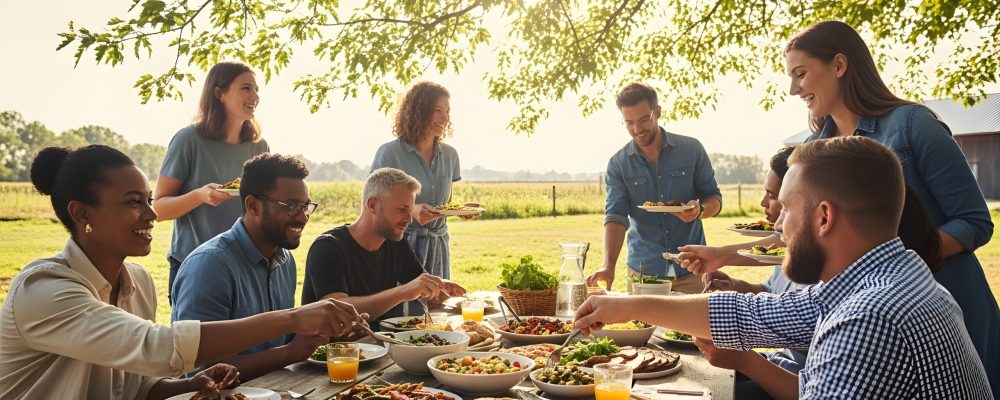

There is a quality to summer evenings that is unlike any other time of year.
The light stays longer than it has any right to. The air holds a warmth that doesn’t fully leave even after the sun does. The urgency that governs most of the year — the sense that time is finite and the list is long and the pace must be maintained — softens somehow, and the evening that was supposed to be like any other becomes something more elastic, more generous, more willing to accommodate the simple pleasure of being outside with good food and no particular agenda.
This is the time of year when the best cooking is often the most unhurried cooking. Not slow cooking in the technical sense — the braises and the stews that require hours — but cooking that is done without the pressure of a specific deadline, that can be extended or abbreviated based on the mood of the evening, that invites the people who are going to eat it to be part of the process rather than waiting at a table for the food to arrive.
The food of summer evenings is outdoor food, mostly. Food that moves between the kitchen and the garden or the porch or the table set up in the yard. Food that is assembled gradually, eaten in stages, that turns the meal into an occasion that unfolds over two hours rather than being consumed in forty-five minutes before everyone disperses.
The Aperitivo as a Philosophy
Before the main cooking begins — before the grill is lit or the pasta water is set to boil — there is a practice borrowed from Italian food culture that transforms the transition from the day to the evening into something worth savoring.
The aperitivo.
Not the complicated cocktail or the elaborate hors d’oeuvre spread. The simple, uncomplicated offering that signals the beginning of the evening — something to drink that is slightly bitter and appetite-stimulating, something small to eat that is not filling but interesting, a deliberate pause between the day and the meal.
A glass of something cold and slightly bitter — Campari and soda, a good Aperol spritz, a well-made Negroni, or for the non-drinker, a sparkling water with a squeeze of citrus and a dash of bitters — does something specific to the anticipation of the meal. The bitter compounds in these drinks stimulate digestive juices and genuinely increase appetite. The pause they represent — the fifteen minutes of sitting with a cold drink before cooking begins or continues — creates a mental boundary between the workday and the evening.
The food that accompanies the aperitivo is a gesture rather than a course. A small bowl of good olives. A few slices of salami or prosciutto. A handful of nuts. Something that occupies the hands without occupying the appetite — that makes the waiting for the meal pleasant rather than merely passive.
This is the aperitivo as a philosophy: the deliberate creation of the liminal space between the day and the meal, in which the transition from one to the other is honored rather than rushed.
The Long Table and the Gradual Meal
The food of summer evenings is best served at a long table — ideally outdoors, but the spirit of the long table can be achieved indoors with the right approach.
The long table is not primarily about the length. It is about the arrangement of food — the dishes that arrive gradually, that are placed at the center of the table and passed and shared rather than plated individually in the kitchen. The antipasto that precedes the pasta. The pasta that is followed by a simple protein. The fruit that appears at the end.
Each course arrives in its own time, without urgency, without the pressure of a restaurant meal that must be cleared before the next table is needed. The long table has no such constraint. The meal moves at the pace of the conversation, which moves at the pace of the evening, which moves at the pace that a summer evening invites.
This is the Italian Sunday lunch and the Spanish sobremesa and the French repas that are remembered not for the specific dishes but for the quality of time they produced — the specific ease of a meal that had nowhere it needed to be.
The cook who assembles this kind of meal is not necessarily doing more cooking than the cook who produces a single, complete dinner. They are spreading the cooking across the evening in a way that makes the eating a continuous pleasure rather than a single event.
The Pasta That Belongs to Summer Evenings
Within the summer evening meal, pasta has a specific and important role — not the long-cooked, rich ragù of winter, but the specifically summer pasta that is made in minutes from ingredients that are at their peak.
The pasta of summer evenings is bright, fresh, and barely cooked — the sauce assembled from raw or quickly warmed ingredients that carry the flavor of the season rather than the depth of long cooking.
The pasta al pomodoro crudo — the pasta with raw tomato sauce, made by combining the best summer tomatoes with good olive oil, torn basil, salt, and perhaps a clove of garlic, left to macerate for an hour until the tomatoes have released their juice and become a fragrant, uncooked sauce — is one of the most perfect summer preparations available. The pasta is cooked and drained and immediately combined with the raw sauce, which warms slightly in contact with the hot pasta without cooking further. The result is something that tastes entirely of fresh summer tomato — a flavor that no cooked sauce, however skillfully made, quite replicates.
The pasta with zucchini and ricotta — the summer squash sliced thin and quickly sautéed until just tender, combined with good ricotta and pasta water and finished with lemon zest and fresh herbs — takes fifteen minutes and tastes entirely of the specific quality of the vegetables and the specific brightness of the lemon.
The pasta with corn and basil — fresh corn kernels cut from the cob and briefly cooked in butter until just warmed through, combined with pasta and torn basil and Parmigiano — captures peak-season corn in a preparation so simple that it barely requires a recipe.
Each of these is a summer evening pasta: fast enough that it doesn’t require hours of preparation, specifically tied to summer ingredients that make it impossible and unnecessary at any other time of year.
The Grill as the Evening’s Focal Point
On summer evenings when the grill is part of the cooking, it functions not just as a cooking surface but as the social center of the gathering — the place where people congregate, where drinks are refilled, where the conversation happens while the food is cooking.
This social dimension of grilling is worth acknowledging and working with rather than treating the grill as a kitchen appliance that happens to be outdoors. The cook at the grill is not sequestered in the kitchen while the party happens around them. They are at the center of the evening, and the cooking and the socializing are happening simultaneously in a way that makes both better.
The food that works best for this kind of social grilling is food that can be managed without constant, focused attention — that can be checked periodically and left alone between checks without risk of disaster. Thick pieces of fish that cook in six to eight minutes over direct heat. Chicken thighs that are tolerant of a few extra minutes if the conversation demands it. Skewers of marinated vegetables and protein that can be rotated and assessed by feel. These are the foods of the social grill — robust enough to survive the cook’s divided attention, fast enough that the wait is not long, interesting enough that the result justifies the assembly.
The meats and vegetables that require precise, uninterrupted attention — the thin steak that must be pulled at exactly the right moment, the fish that goes from perfect to overcooked in ninety seconds — are better reserved for evenings when the cooking is the primary activity rather than one element of a larger social occasion.
The Dessert That Happens Without Planning
The food of summer evenings often ends in the most unplanned way — in whatever is in the fruit bowl, served simply, sometimes with nothing at all added.
A plate of sliced peaches at peak ripeness, passed around the table with a small pitcher of cream and a spoon for the sugar. A bowl of mixed berries from the farmers market, eaten as they are, needing nothing. A watermelon cut in wedges and eaten outside, the juice running down onto hands that wipe themselves on the grass.
This is the dessert that happens without planning — the ending of a summer evening meal that requires no recipe and no preparation and that is, in the specific conditions of high summer, exactly right.
The elaborate dessert of the dinner party — the properly constructed tart, the carefully assembled plated dessert — has its place. But the food of summer evenings is not primarily about technical accomplishment. It is about the pleasure of being outside with people worth being outside with, eating things that taste fully like themselves in the best possible conditions.
A ripe peach eaten at a table on a summer evening, with the light going and the day finally cooling, is not a simple pleasure.
It is one of the best pleasures available.
The Wine That Belongs to Summer Evenings
The specific wines of summer evenings — the ones that belong to outdoor tables and warm air and food that is fresh rather than rich — are worth knowing because they are different from the wines that belong to other seasons and other contexts.
Rosé, in its genuinely good forms — the dry, pale Provençal rosé with its specific mineral quality and restrained fruit, the Spanish rosado with its more direct berry character, the Italian Cerasuolo d’Abruzzo with its slightly deeper color and broader fruit — is the wine most specifically suited to summer evening drinking. It is cold enough to refresh, light enough not to overwhelm, food-friendly enough to work with the range of summer dishes from light antipasto to grilled fish to pasta with tomatoes.
Light, chilled reds — the Beaujolais served cool rather than at room temperature, the light Pinot Noir, the specific wines of the Loire Valley that are known for their refreshment rather than their weight — are the summer alternative for the red wine drinker who finds white too austere and rosé too obvious.
And the genuinely good sparkling wine — the Prosecco for the aperitivo, the Champagne for the celebration that summer evenings sometimes become without announcement — carries the specific effervescence and brightness that makes any food taste slightly better in its company.
The wine of summer evenings is not the wine of impressive bottles opened for special occasions. It is the wine of the table carafe and the second glass poured without ceremony — the wine that is part of the evening rather than a statement about it.
The Takeaway
The food of summer evenings is not primarily about recipes or techniques or the specific dishes that appear on the table. It is about the quality of time that the right food and the right pace and the right company produces.
Set the long table. Make the aperitivo. Cook the summer pasta with the best tomatoes available. Light the grill and let the cooking be part of the gathering rather than separate from it. End with the fruit that needs nothing added.
And stay at the table until the light is completely gone.
That is what summer evenings are for.
And the food that belongs to them is the food that makes staying easy.














