

There is a transformation that requires almost nothing from the cook.
No heat. No technique beyond the most basic preparation. No equipment beyond a jar and a weight to keep things submerged. No active attention during the most significant phase of the process.
Time. Salt. The specific microorganisms that are already present on every vegetable that has ever grown in soil, that have been doing this work without human assistance for longer than humans have existed, that need only the right conditions to produce one of the most complex and most satisfying flavor transformations available in any kitchen.
This is fermentation — specifically the lacto-fermentation that produces kimchi and sauerkraut and preserved lemons and the full range of fermented vegetables that appear in the culinary traditions of cultures that discovered, independently and millennia ago, that salt and time and the bacteria already present on food could produce something more interesting, more flavorful, and more durable than the fresh ingredient alone.
The fermentation project — the deliberate, patient practice of creating and maintaining fermented foods in the home kitchen — is one of the most rewarding activities available to any serious food person. Not because the results are always dramatically superior to purchased alternatives, though they often are. Because the process itself is instructive in ways that no other kitchen practice quite replicates — teaching patience, teaching observation, teaching the specific quality of attention to a living process that develops the cook’s relationship with food in ways that extend beyond the fermentation itself.
What Lacto-Fermentation Actually Is
The science of lacto-fermentation has been touched on in these pages before — in the context of the broader world of fermentation and in the specific context of sourdough bread. But the specific mechanism of vegetable fermentation is worth understanding in detail, because understanding it produces a cook who can troubleshoot and adapt rather than one who follows instructions without knowing why.
Every fresh vegetable carries on its surface a population of microorganisms — bacteria, yeasts, and other microbes that arrived there from the soil, the air, and the handling that occurred between field and kitchen. Among these microorganisms are lactic acid bacteria — a family that includes Lactobacillus, Leuconostoc, and Pediococcus species, among others — that are specifically adapted to the anaerobic, salty environments that lacto-fermentation creates.
When vegetables are salted — either by mixing directly with salt or by submerging in a salt brine — the salt draws moisture from the vegetable’s cells through osmosis, creating a liquid environment in which the salt concentration is high enough to suppress most harmful bacteria while allowing the salt-tolerant lactic acid bacteria to thrive.
As the lactic acid bacteria proliferate in this salty, oxygen-free environment, they consume the sugars in the vegetable and produce lactic acid as a metabolic byproduct. This lactic acid progressively lowers the pH of the fermentation environment, creating conditions that are increasingly inhospitable to harmful bacteria while supporting the continued growth of the lactic acid bacteria themselves.
The flavor of the fermented vegetable — the specific sourness, the depth, the complex character that distinguishes a properly fermented sauerkraut from a simply salted one — is the product of this lactic acid and of the hundreds of other metabolic byproducts that the bacterial community produces during the fermentation period.
The process is alive, and it continues to develop as long as the fermentation is active. The kimchi that is excellent on day three is different from the kimchi that is excellent on day ten — the longer fermentation producing a more sour, more complex, more deeply flavored result that is a different eating experience rather than simply a more extreme version of the earlier one.
The August Fermentation Opportunity
August is the most specifically opportune month for beginning fermentation projects — for two reasons that are directly related to the season.
The first is abundance. The summer’s peak produce is at its most plentiful in August — the cabbage, the cucumber, the pepper, the green bean, the tomato are all available in quantities that exceed immediate eating capacity. This abundance is the historical motivation for fermentation: the need to preserve the harvest, to extend the availability of peak-season vegetables into the months when they are no longer growing.
The home fermenter in August who makes a large batch of sauerkraut from the season’s best cabbage, or a jar of fermented peppers from the August abundance, or a crock of half-sour pickles from the week’s cucumber surplus, is practicing a form of preservation that has the specific advantage of producing something more interesting and more flavorful than the fresh vegetable in its preserved form.
The second reason August is specifically opportune for fermentation is temperature. Lacto-fermentation proceeds at a rate that is directly correlated with temperature — warmer temperatures producing faster fermentation, cooler temperatures producing slower fermentation. The August kitchen, with its ambient temperatures often in the high seventies or low eighties Fahrenheit, provides ideal fermentation conditions for most projects — warm enough to produce active fermentation within one to two days, cool enough not to overwhelm the process with excessive speed.
The same batch of sauerkraut that takes four to six weeks to develop fully in a fifty-five degree cellar takes two to three weeks in the August kitchen. The cucumber pickle that needs five days in October is ready in three in August. The fermentation projects that seemed to require patience in other seasons move at a pace in August that keeps the fermenter engaged and produces results quickly enough to maintain motivation.
The Sauerkraut: The Foundation of Everything
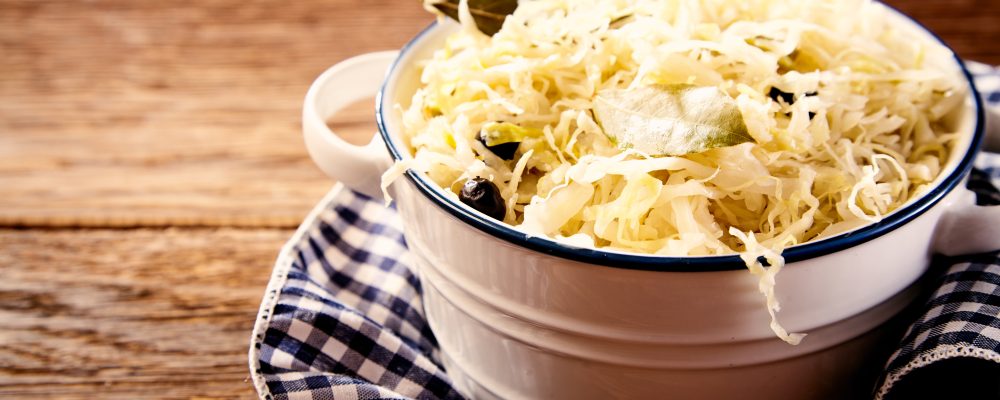
Of all the fermentation projects available to the home cook, sauerkraut is the most fundamental — the one that most directly demonstrates the principles of lacto-fermentation, that requires the fewest ingredients and the simplest technique, and that produces results of genuine excellence from nothing more than cabbage and salt.
The preparation is simple to the point of appearing inadequate: cabbage is shredded, salted at a ratio of approximately two percent salt by weight — twenty grams of salt per kilogram of cabbage — and massaged until the salt has drawn enough moisture from the cabbage to create a brine that will submerge the shredded leaves.
The massaging is the only active work the process requires. Five to ten minutes of firm kneading, the cabbage progressively softening and releasing its liquid, until there is enough brine to cover the cabbage completely when it is packed tightly into a jar. The packed cabbage is pressed below the brine and weighted — a small jar filled with water, a zip-lock bag filled with brine, a purpose-made fermentation weight — to keep it submerged in the anaerobic environment that the lactic acid bacteria require.
And then the jar is covered — with a cloth to allow gas to escape, or with a loosely fitted lid that will allow the carbon dioxide produced by fermentation to bubble out — and left at room temperature.
Within one to two days in the August kitchen, bubbles will be visible — the carbon dioxide produced by the bacterial fermentation creating the specific effervescence that signals active fermentation. The smell will change — from the sharp, fresh smell of raw cabbage to the specific sour, complex, alive smell of active lacto-fermentation.
The sauerkraut is ready to taste after three to five days, at which point it is sour and pleasantly crunchy and not yet at the complexity of a longer fermentation. It is genuinely excellent at this stage — the specific flavor of a fresh, active fermentation that is different from both raw cabbage and the deeply sour sauerkraut of a long fermentation. It continues to develop as the fermentation proceeds, becoming progressively more sour and more complex over weeks. Moved to the refrigerator at any point, the fermentation slows dramatically — the cold temperature suppressing the bacterial activity and essentially holding the sauerkraut at whatever stage of development it has reached.
The Cucumber: The Fastest Return
For the fermenter who wants to experience the transformation of lacto-fermentation with the shortest possible wait between preparation and result, the cucumber is the ideal starting point.
The half-sour pickle — the cucumber fermented in a salt brine for two to three days at room temperature — produces a result that is neither the raw cucumber nor the fully sour dill pickle of a long fermentation, but something specifically between the two: crunchy, lightly sour, deeply seasoned with the garlic and the dill that were added to the brine, with the specific effervescence of active fermentation present as a texture.
The specific preparation: cucumbers packed into a jar with garlic cloves, fresh dill, black peppercorns, and optionally red chili flakes or bay leaves or grape leaves — the tannins in grape leaves specifically helping to maintain the crunch that makes the half-sour pickle worth making. A brine of three to five percent salt — thirty to fifty grams of salt per liter of water — is poured over the cucumbers to cover completely. The jar is covered and left at room temperature.
In the August kitchen, within twenty-four hours, the brine may already show the first signs of fermentation. By forty-eight hours, the cucumbers are often at the half-sour stage — lightly sour, fully seasoned, with their crunch still intact. By seventy-two hours, they are approaching the fully sour pickle that most people associate with the finished product.
The speed of the August cucumber fermentation is one of its specific pleasures — the return on the minimal investment of preparation arriving quickly enough that the connection between the action and the result is immediate and instructive.
The Pepper: The Most Useful Fermented Product
Of all the fermentation projects that are specifically suited to the August abundance, the fermented pepper — the whole or halved fresh pepper fermented in a salt brine — produces the result that is most broadly useful across the widest range of cooking applications.
The fermented pepper is simultaneously a condiment, a sauce ingredient, a pizza topping, a sandwich component, and the starting material for a homemade hot sauce of genuine complexity. Its specific flavor — the fresh pepper’s character with the added depth and sourness of fermentation — is something that no purchased product fully replicates, because the fermentation is a living process that produces a result specific to the bacteria present in this kitchen, on these peppers, in this August.
The preparation: fresh hot or sweet peppers — jalapeños, serranos, banana peppers, or any combination — packed into a jar with garlic and optionally herbs or spices. Covered with a three percent salt brine. Weighted to keep the peppers submerged. Left at room temperature for five to ten days, tasting periodically to track the fermentation’s development.
The resulting fermented peppers can be eaten as is — as a condiment alongside grilled proteins or eggs or sandwiches. They can be blended with their brine into a hot sauce that has the specific complexity of lacto-fermentation alongside the fresh pepper’s heat. They can be used as a pizza topping or a pasta ingredient or a grain bowl component — anywhere that the specific combination of pepper flavor and fermented sourness adds interest.
And the brine — the liquid that remains when the fermented peppers have been used — is itself a valuable condiment. Acidic, deeply flavored, full of the probiotic bacteria from the fermentation, it can be used as a dressing component, as a finishing acid in place of vinegar, or as the liquid for a new fermentation.
The Observation Practice
The fermentation project’s most specific contribution to the cook’s education is the observation practice it requires — the daily or twice-daily checking of the fermentation’s progress that develops the specific quality of attention to a living process that other kitchen practices don’t require in the same form.
The fermenter who checks their sauerkraut every day — who observes the progression from raw to slightly sour to fully fermented, who notices the smell changing and the bubbles appearing and the color shifting — is developing an observational sensitivity to the signs of a biological process that transfers to other fermentation contexts and eventually to other cooking contexts.
The sourdough baker who has fermented vegetables understands the signs of active fermentation more intuitively. The cheese maker who has fermented vegetables has a more developed sense of the lactic acid character that fermentation produces. The cook who has fermented vegetables has a more complete and more embodied understanding of what fermentation is and what it produces than the one who has only read about it.
This understanding is one of the most valuable things the fermentation project provides — more valuable, in the long run, than any specific jar of sauerkraut or pickled pepper, however excellent.
The Takeaway
The fermentation project is one of the most accessible and most rewarding activities available in the late summer kitchen — requiring minimal equipment, minimal technique, and minimal active time, while producing results of genuine complexity and genuine nutritional value.
Start with the sauerkraut if the goal is to understand fermentation in its most fundamental form. Start with the cucumber pickle if the goal is the fastest return on the minimal investment. Start with the fermented pepper if the goal is the most broadly useful preserved product.
And observe the process — daily, with genuine attention — as it develops from raw ingredient to living fermentation.
The time is doing the work.
The cook’s job is to watch what it produces.














