

There is a specific kind of loss that happens quietly, without announcement, that most families experience at some point and that cannot be fully recovered from after the fact.
It is not the loss of a photograph or a letter or a piece of furniture — the tangible objects that represent a person or a period in a family’s history. It is the loss of the knowledge that lived in someone’s hands. The recipe that was never written down because it was never a recipe — it was just the way a specific person made a specific thing, accumulated through years of repetition and adjustment until it was second nature and therefore, in the logic of second nature, not worth documenting.
The grandmother who made the pierogies from memory, who knew by touch how the dough should feel and by smell when the filling was right and by years of practice how long they needed in the boiling water. The grandfather who made the sauce every Sunday, who could tell from the color and the smell when it had cooked long enough, who added the basil at a specific moment that he knew without thinking about it. The aunt who made the cake for every birthday, whose specific adjustment to a standard recipe was never communicated to anyone because the adjustment was unconscious and the cake was simply the cake.
When these people are gone, the knowledge they carried does not pass automatically to the people who loved them. It passes only if it was transmitted — and transmission requires both the person with the knowledge and the person who wants to receive it and the specific set of circumstances that brings both of them to the kitchen at the same time.
These circumstances are worth creating deliberately. And when they cannot be created — when the person is gone and the knowledge seems irretrievably lost — there are approaches worth knowing.
The Window That Is Open Right Now
Before the approach for recovering lost recipes, there is the more urgent approach for preserving the ones that are not yet lost.
The person who is alive and still cooking — the grandparent who still makes the dish every holiday, the parent who still produces the preparation that everyone in the family considers the definitive version, the aunt or uncle or family friend whose specific culinary knowledge exists in living form and has not yet been transmitted — represents an opportunity that is finite and not renewable.
The specific approach that most reliably captures embodied culinary knowledge is not the written recipe. It is the recorded cooking session — the afternoon spent in the kitchen with the person while they make the dish, with a phone or a camera recording the process, with questions asked about each step and each decision, with attention paid to the things that the cook does without thinking about them and that a written recipe would never include.
The specific questions worth asking during this session are the ones that go beneath the recipe to the knowledge that makes the recipe work. Not just “how much flour?” but “how does the dough feel when it’s right?” Not just “how long does it cook?” but “what does it look like when it’s done?” Not just “what spices?” but “when did you add them and why?”
The information that emerges from these questions is the specific embodied knowledge that makes the difference between a recipe that can be executed correctly and one that produces the dish as it actually is — with the specific quality that the person who made it spent years developing.
This information, recorded in whatever form, is irreplaceable once the person who carries it is no longer available to provide it.
The window is open right now for every cook who has a family member who still makes the dishes worth preserving.
It will not be open indefinitely.
The Approach for Recovering What Was Lost
When the person is gone and the recipe was never recorded, the work of recovery becomes significantly more difficult — but it is not impossible. It is archaeological rather than archival: reconstructing from evidence and memory what cannot be directly recovered from the source.
The first resource is sensory memory. The people who ate the dish regularly — who encountered it at every holiday or every Sunday or every birthday for decades — carry a specific memory of what it tasted like, what it looked, smelled, and felt like. This memory is not a recipe. But it is the standard against which any recovery attempt will be measured, and it is the most specific guide available to what the dish was.
The sensory memory of a dish is more specific than most people realize. A person who ate their grandmother’s pierogi every Christmas for thirty years carries a memory of the specific texture of the dough, the specific ratio of potato to cheese in the filling, the specific weight of the boiled pierogi in the hand, the specific flavor that distinguished it from every other pierogi they have ever eaten. This memory cannot be translated directly into a recipe — but it can guide the iterative process of approximation that recovery requires.
The second resource is the community of memory — the other people who ate the dish, who may carry different and complementary aspects of the sensory memory, and who may have had conversations with the cook that produced partial information about ingredients or techniques. The cousin who remembers being told that the recipe came from a specific region. The sibling who remembers watching the cooking process and retaining a specific visual detail. The family friend who remembers being given a vague description of an unusual ingredient.
Each of these partial memories is a piece of evidence. Combined, they provide a more complete picture than any single person’s memory provides alone.
The Reconstruction Process
With sensory memory and community memory as the guide, the reconstruction process begins. It is iterative — a series of attempts that progressively approach the target through successive approximations, each informed by the memory standard and adjusted toward it.
The starting point is a researched base. If the dish belongs to a specific culinary tradition — a regional Italian preparation, a specific Eastern European pastry, a particular Caribbean stew — the research into that tradition provides a baseline recipe from which the family-specific version diverged. The family version is always a variation — it begins somewhere, with someone, with a recipe that was then modified over years until it became specific to the cook who made it.
The baseline recipe from the culinary tradition provides the framework. The iterative process identifies and refines the modifications that made the family version what it was.
The first attempt follows the baseline recipe as closely as possible and is tasted against the sensory memory standard. The tasters — the people who carry the memory of the original — identify what is different. Not just “it’s not quite right” but specifically: is the dough too thick or too thin? Is there a flavor present in the original that is absent here? Is the texture of the filling different? Is something missing from the seasoning?
Each specific observation guides the adjustment for the next attempt. The process continues until the gap between the reconstruction and the memory closes to the degree that it can close — because the reconstruction will never be identical to the original, both because embodied knowledge cannot be fully recovered from memory and because the specific conditions that produced the original (the specific water, the specific flour, the specific hands of the specific cook) cannot be fully replicated.
But it can be close. Close enough that the people who carry the memory recognize it. Close enough that the dish can be made and passed to the next generation. Close enough that the loss is not total.
The Documentation That Makes Recovery Possible
The work of reconstruction, once completed, produces something that the original never had: a written record.
The recipe that emerges from the reconstruction process should be documented with more detail than conventional recipe writing provides — because the goal is not to produce a recipe that a skilled cook can interpret but a recipe that captures the specific knowledge that was nearly lost.
This means documenting not just ingredients and quantities and steps but the specific sensory cues that guide each stage. Not just “cook the onions until softened” but “cook the onions until they are completely translucent and beginning to turn golden at the edges and smell sweet rather than sharp.” Not just “knead the dough until smooth” but “knead until the dough feels silky and slightly tacky but doesn’t stick to the hands — about ten minutes by hand.”
These sensory descriptions are what make the recipe transmissible to someone who has never made the dish before — and they are what most recipes omit, because most recipes assume a level of cook’s intuition that the recipe’s reader may not have.
The documented recipe should also include the history — where the dish came from, who made it, how it traveled through the family, what occasions it was associated with, and what the specific version’s distinguishing characteristics were. This context is not culinary information — it is family history, and it belongs in the document because the dish carries the history as much as it carries the flavor.
The Gift of the Kitchen Conversation
Beyond the specific project of recovering or preserving specific recipes, there is a practice worth establishing in any family that values its culinary traditions — the regular kitchen conversation.
Not a formal documentation session, though those have value. The informal, ongoing exchange between generations that happens in the kitchen when the cooking is being done and the person watching is asking questions and the person cooking is answering — both of them present to the process in a way that makes knowledge transfer natural rather than deliberate.
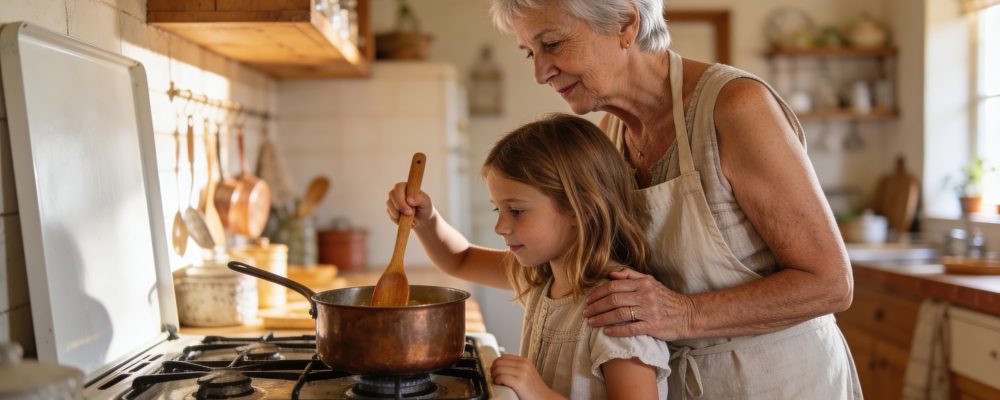
The child who stands at the counter while the grandparent makes the dough and asks why the dough is being handled this way rather than that way and receives the answer — not just the answer but the specific feeling of the right dough texture transmitted through a guiding hand — is receiving knowledge that no written record captures and that no video fully replaces.
This transmission is the original culinary education — the way all cooking knowledge was passed before cookbooks existed, and the way that the most specific and most personal culinary knowledge is passed even now.
Creating the conditions for it — bringing the generations into the kitchen together, making the occasions for cooking together rather than separately, cultivating the specific curiosity in the younger generation and the specific willingness to share in the older one — is the most sustainable form of culinary preservation available to any family.
The Community Dimension
The loss of family recipes is not only a family phenomenon. It is a community phenomenon — one that affects the specific culinary traditions of specific cultures and specific regions and specific communities in ways that represent a genuine form of cultural heritage loss.
The communities most at risk of this loss are the immigrant communities whose specific culinary traditions exist only in the memory and practice of the people who carried them from their place of origin — who had no cookbook to bring and no culinary school to attend and whose specific techniques and preparations were developed in the specific conditions of a specific place and adapted to the specific conditions of a new one.
The community organizations, cultural institutions, and food historians who are working to document these traditions — who are sitting in kitchens with elders and recording the knowledge that exists nowhere else — are doing work that is simultaneously culinary and archival, preserving both recipes and the cultural history they carry.
Participating in this work — by contributing family recipes to community recipe collections, by connecting with organizations doing food heritage documentation, by sharing what is known with people who want to preserve it — is a form of cultural contribution that any family with a distinctive culinary tradition can make.
The Takeaway
The recipes that were never written down are not always gone. They exist in sensory memory, in community memory, in the culinary traditions that the family-specific version grew from. They can be recovered — imperfectly, approximately, but meaningfully — through the iterative process of reconstruction guided by memory.
But the recovery is always harder and less complete than the preservation would have been. The kitchen conversation that happens while the cook is still alive and still cooking produces a more complete and more reliable transmission than any subsequent reconstruction can achieve.
Have the kitchen conversation. Record the cooking session. Document not just the recipe but the sensory knowledge that makes the recipe work.
The window is open right now for every dish that exists in living form.
It will not be open indefinitely.














