
There is a moment in professional cooking that reveals more about a cook’s training than almost anything else.
It happens when something finishes cooking — a roast comes out of the oven, a braise gets lifted from the pot, a pan of sautéed mushrooms gets plated. What happens next, in the seconds and minutes that follow, separates the professional from the amateur more clearly than any knife skill or seasoning instinct.
The amateur sees a finished dish. The professional sees a kitchen full of ingredients that still have work to do.
The drippings in the roasting pan. The braising liquid left in the pot. The browned bits stuck to the bottom of the sauté pan. The vegetable trimmings on the cutting board. The herb stems pulled from the leaves before chopping. The parmesan rind sitting next to the cheese grater.
In a home kitchen, almost all of it goes in the trash.
In a professional kitchen, almost none of it does.
The Roasting Pan Is Not Empty When the Roast Comes Out
When a roast comes out of the oven in a professional kitchen, the roasting pan goes directly onto the stovetop. Whatever is left inside it — the rendered fat, the caramelized drippings, the dark, sticky fond coating the bottom — is not the aftermath of cooking. It is the beginning of the next preparation.
A splash of wine or stock hits the hot pan. The liquid sizzles violently and the cook uses a wooden spoon to scrape every bit of the fond from the bottom, dissolving it into the liquid. The mixture reduces over high heat, concentrating rapidly, picking up every caramelized flavor compound that developed during the hours the roast was in the oven. Cold butter goes in at the end. The result is a pan sauce with a depth that took no additional ingredients to achieve — just the willingness to use what was already there.
Home cooks who lift the roast onto a cutting board and set the pan aside — to be soaked and scrubbed later — are discarding what is arguably the most flavorful thing the oven produced. The roast is good. The drippings, properly used, make the roast extraordinary.
Braising Liquid Is a Ready-Made Sauce
A braise that has been cooking for three or four hours contains something remarkable: a liquid that has absorbed collagen from the meat, fat from the marbling, aromatics from the vegetables, and the deep, complex flavors that develop only during long, slow cooking.
Professional cooks never discard braising liquid. They strain it, degrease it, and reduce it — sometimes significantly — into a sauce that accompanies the braised meat with a flavor so specific to that dish that nothing else could replicate it. The same liquid that cooked the short rib is what gets poured over the short rib at the table. Every element of flavor built during the braise is preserved and returned to the plate.
At home, braising liquid often gets poured out — or used as-is without the reduction that transforms it from a thin, slightly fatty cooking liquid into something glossy and intense. The reduction step takes fifteen to twenty minutes and produces a result that changes the entire dish. It requires knowing that the liquid in the pot is not a byproduct. It is the sauce.
Vegetable Trimmings Have a Second Life
In professional kitchens, almost no vegetable trimming is wasted without first being considered for another use.
Onion skins and ends, carrot peels and tops, celery leaves and root ends, leek tops, mushroom stems, herb stems — all of these end up in a bag or a container in the walk-in, accumulated over the course of prep, destined for the stockpot. When enough has accumulated, cold water goes in, the whole thing comes to a simmer, and what comes out is a vegetable stock that costs nothing but time and that forms the base of vegetable soups, cooking liquids for grains, and sauces that would otherwise require store-bought stock.
The herb stems that get pulled from parsley and cilantro before the leaves are chopped contain a significant portion of the herb’s flavor — in many cases, more than the leaves themselves. Professional cooks tie them into a bouquet garni and drop them into stocks, braises, and soups, where they infuse their flavor during the long cooking process. Parmesan rinds go into tomato sauces and minestrone, slowly releasing a deep, savory richness as they simmer.
Each of these is a zero-cost flavor addition that home kitchens throw away reflexively — not because they’re worthless, but because no one explained what they were worth.
The Fond Is Not Residue — It’s the Best Part of the Pan
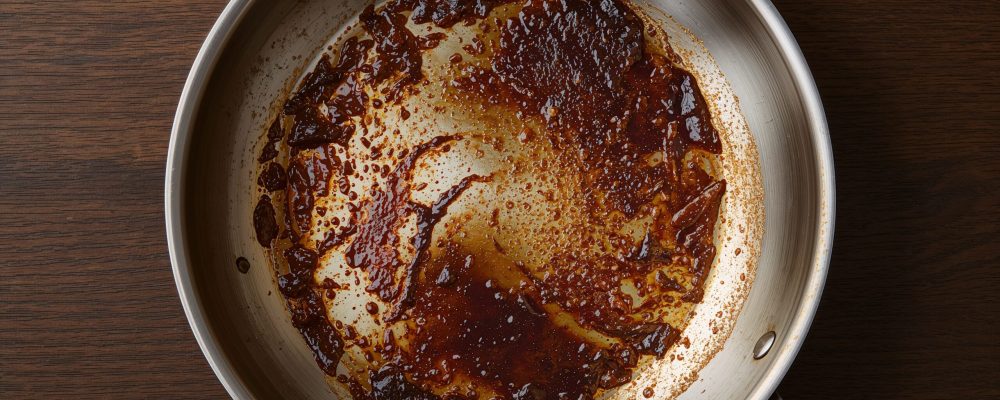
The browned material stuck to the bottom of a pan after searing or sautéing — the fond — is one of the most misunderstood and underused flavor resources in home cooking.
It looks like something that needs to be cleaned. It behaves, to a cook who doesn’t know what it is, like an inconvenience — the thing that makes pans harder to wash and that seems like evidence of cooking that went slightly too far.
In a professional kitchen, fond is treated as the most valuable thing the pan produced during cooking. When a liquid — wine, stock, water, even vinegar — is added to the hot pan and the fond dissolves into it, the result is a liquid that contains every flavor compound that developed during the Maillard reaction on the surface of whatever was seared. That liquid, reduced, becomes the foundation of a pan sauce that carries more flavor per tablespoon than almost anything else in the kitchen.
This is deglazing — one of the most fundamental techniques in professional cooking — and it’s what happens every time a professional cook finishes a sear and reaches for a liquid rather than a sponge. The technical step takes thirty seconds. What it produces takes hours of other cooking to approximate by any other method.
Cooking Fat Is an Ingredient With a Future
The fat that renders during cooking — from duck, from bacon, from chicken thighs roasted in a pan — is an ingredient that professional kitchens collect, store, and use deliberately.
Duck fat strained and stored in the refrigerator becomes the cooking medium for the finest roasted potatoes most people have ever eaten. Bacon fat collected in a jar next to the stove adds a depth to sautéed greens, cornbread, and pan sauces that neutral oil cannot replicate. Chicken fat — schmaltz — is a foundational ingredient in certain culinary traditions precisely because of the flavor it carries from the bird that produced it.
These fats are flavored. They carry the character of what rendered them, and that character transfers to whatever they cook next. Professional cooks understand that rendered fat is not a byproduct to be disposed of. It is an ingredient that the cooking process produced, and it belongs in a container in the refrigerator rather than poured down the drain.
The Takeaway
The most flavorful things in a professional kitchen are often the things that most home cooks throw away. Drippings, braising liquid, vegetable trimmings, fond, rendered fat, herb stems, parmesan rinds — each of these is a flavor builder waiting to be used rather than discarded.
The shift in perspective required is not complicated. It is simply the habit of looking at what’s left in the pan, pot, or cutting board and asking what it can do next — before assuming the answer is nothing.
The best restaurants aren’t just cooking better ingredients. They’re using more of every ingredient they have.