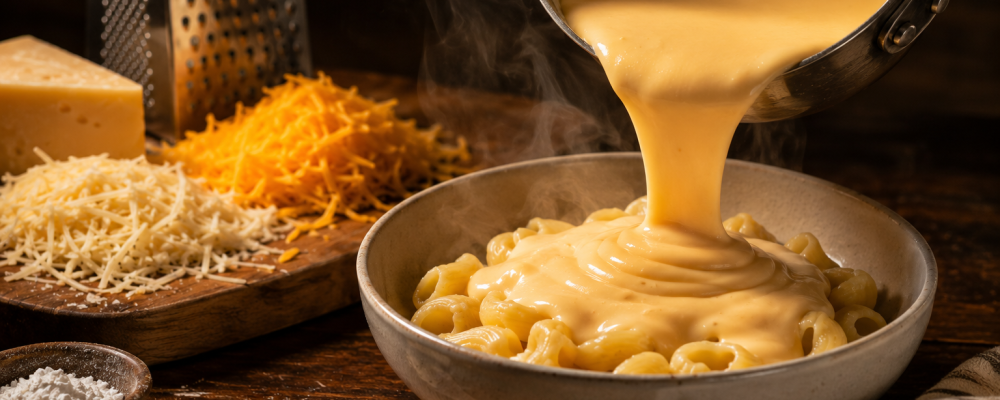

There is a preparation that appears in cuisines across the world — in the macaroni and cheese of the American table, the fondue of Switzerland, the mornay sauce of French cooking, the queso of Mexican-American tradition, the Welsh rarebit of British pub cooking — that is simultaneously one of the most beloved and one of the most consistently misunderstood preparations in any kitchen.
The cheese sauce.
Not the processed cheese product that melts without effort into something smooth and uniform. The genuine cheese sauce — made from real cheese, real dairy, real starch, real technique — that produces something far more complex and more satisfying than its processed alternative while requiring an understanding of the specific chemistry that makes it work.
The cheese sauce that breaks — that separates into a greasy pool of fat surrounded by grainy, clumped protein — is one of the most common cooking failures in home kitchens. And it is a failure that is entirely avoidable once the specific chemistry of what is happening in the pan is understood.
What Is Actually Happening in a Cheese Sauce
The cheese sauce is, at its most fundamental, an emulsion — a stable suspension of fat and water held together by protein and starch acting as emulsifiers and stabilizers.
Cheese itself is already an emulsion — fat distributed through a protein matrix in a structure that was established during the cheesemaking process. When cheese is melted into a sauce, this structure is disrupted by heat, and the fat and protein that were held in stable suspension must be reintegrated into the new liquid environment of the sauce.
The specific challenge is that the proteins in cheese — primarily casein — behave differently under heat than the proteins in other emulsions. When casein is heated too aggressively, the protein strands denature and aggregate — clumping together into the grainy, sandy texture that characterizes a broken cheese sauce. Simultaneously, the fat that was held within the protein matrix is released and pools separately — producing the characteristic greasiness that accompanies the grainy texture.
This is the chemistry of the broken cheese sauce. It is not a mystery and it is not unpredictable. It is the specific result of applying too much heat to proteins that cannot tolerate it — and it is entirely preventable through the application of the right technique and the right supporting ingredients.
The Starch That Prevents Breaking
The single most important ingredient in a cheese sauce that holds — that remains smooth and cohesive rather than breaking into grease and grain — is starch.
Starch gelatinizes when heated in liquid, forming a network of swollen starch granules that interfere with the protein aggregation that causes breaking. By surrounding the casein proteins with a starch network, the starch physically prevents the proteins from coming into contact with each other and clumping — maintaining the smooth, cohesive emulsion that a good cheese sauce requires.
This is the scientific basis for several of the most effective cheese sauce techniques. The béchamel base — the flour-thickened white sauce into which cheese is melted — uses the flour’s starch to stabilize the sauce before the cheese is added. The sodium citrate technique — the modernist approach that uses a specific salt to keep the proteins from aggregating — works through a different mechanism but achieves the same protective effect. And the pasta water and cornstarch method — used in the cacio e pepe tradition and in various quick pasta sauce applications — uses dissolved starch from the pasta cooking to provide the stabilization that prevents the cheese from breaking.
Each of these is a different expression of the same principle: starch protects cheese sauce from breaking by preventing protein aggregation.
The Temperature That Matters
Beyond starch, temperature management is the second most important variable in cheese sauce success — and the one most frequently mismanaged in home kitchens.
The specific temperature range in which cheese melts smoothly without breaking is narrower than most cooks realize. Too cool, and the cheese doesn’t melt evenly — clumps remain, the sauce is uneven. Too hot, and the proteins denature and aggregate — the sauce breaks into grease and grain.
The ideal temperature for melting cheese into a sauce is between 150 and 160°F — well above the melting point of the fat in the cheese but below the temperature at which aggressive protein denaturation occurs. This temperature range produces a smooth, cohesive melt in a properly stabilized sauce.
The practical implication: the sauce should never boil after the cheese has been added. The heat should be reduced to the lowest setting before the cheese goes in, and the cheese should be added gradually rather than all at once — giving the sauce time to integrate each addition before the next is added.
The cheese should also be at room temperature rather than cold from the refrigerator — because cold cheese added to a hot sauce creates a temperature differential that can cause the sauce to seize locally before the temperature equalizes.
The Cheese That Works and the Cheese That Doesn’t
Not all cheeses behave equally in a sauce — and understanding which cheeses melt smoothly and which are prone to breaking is as important as understanding the technique.
The cheeses that melt most smoothly are those with high moisture content and moderate fat content — young cheddar, Gruyère, Fontina, Gouda, Monterey Jack. These cheeses have a protein structure that disrupts relatively easily under heat and a fat content that distributes evenly through the melted sauce. They produce smooth, cohesive sauces without requiring extraordinary technique.
The cheeses that are most prone to breaking are those with very low moisture content — aged Parmesan, aged Pecorino, very aged Cheddar — and those with very high fat content — triple cream cheeses, some fresh cheeses. The low-moisture aged cheeses break because their concentrated protein network requires higher temperatures to disrupt and is more prone to aggregation when it does disrupt. The high-fat cheeses break because the excess fat cannot be fully absorbed into the emulsion.
The practical solution for including these more challenging cheeses in a sauce: use them in small quantities alongside a more stable melting cheese. The aged Parmesan that would break a sauce on its own contributes its specific flavor and complexity without causing instability when it constitutes a small percentage of the total cheese in a sauce that is primarily composed of Gruyère or young Cheddar.
The Sodium Citrate Method: The Modernist Solution
There is a technique, developed in modernist cooking and now widely adopted by professional kitchens and informed home cooks, that produces the smoothest and most stable cheese sauce available from any cheese — including the aged, low-moisture cheeses that conventional technique cannot melt smoothly.
Sodium citrate — a food-grade salt that is widely available online and in specialty stores — works by breaking the calcium bridges that hold the casein proteins in their aggregated state. When sodium citrate is added to a liquid before the cheese is melted in, it disrupts the protein-protein interactions that would otherwise cause breaking, allowing the cheese to melt into a completely smooth, cohesive sauce regardless of its age or its moisture content.
The technique: dissolve a small amount of sodium citrate — approximately one percent of the total weight of the sauce — in the liquid base before adding any cheese. Then add the cheese gradually over low heat, stirring continuously. The result is a sauce of extraordinary smoothness that holds its emulsion even when reheated — something that conventional cheese sauce cannot reliably do.
This technique produces the specific silky texture of the best queso fundido and the fondue that holds perfectly through an entire meal. It is not a shortcut — it is a specific tool that enables results that conventional technique cannot achieve from the same ingredients.
The Classic Applications and What Makes Each Distinct
The cheese sauce appears in its most celebrated forms across culinary traditions that arrived at the same basic preparation independently — each expressing the underlying technique through the specific ingredients and flavor preferences of their tradition.
The mornay sauce — the French béchamel enriched with Gruyère and Parmesan — is the cheese sauce in its most technically refined form. The béchamel base provides the starch stabilization. The Gruyère provides the primary flavor. The Parmesan provides the umami depth and the specific nuttiness of an aged cheese without the quantity that would cause instability. Used to gratinée vegetables, to enrich pasta, to coat the croque monsieur — the mornay is the cheese sauce as a culinary building block rather than a finished dish.
The American macaroni and cheese — in its best form, not the processed version — uses a béchamel or a direct roux-thickened milk base to stabilize a blend of sharp Cheddar and whatever other cheeses the cook chooses. The specific sharpness of aged Cheddar and the specific creaminess of the béchamel base produce the combination that makes this dish the comfort food it is — the sharpness providing the flavor complexity that mild cheese cannot, the béchamel providing the stability that aged cheese alone cannot.
The Swiss fondue — made from Gruyère and Emmental melted into a white wine base thickened by the wine’s tartaric acid, which helps prevent breaking through a mechanism similar to sodium citrate — is the cheese sauce as communal ritual. The specific combination of the two cheeses produces a flavor that is more complex than either alone, and the white wine provides both flavor and the chemical stability that allows the fondue to remain smooth through the extended period of communal eating.
And the Welsh rarebit — sharp Cheddar melted into a sauce of beer and mustard and Worcestershire, poured over toast and briefly broiled — is the cheese sauce in its most assertive and most specifically flavored form. The beer provides liquid and a slight bitterness that balances the cheese’s richness. The mustard and the Worcestershire provide depth and the specific savory complexity that makes rarebit more interesting than simple melted cheese on toast.
The Quick Cheese Sauce Without a Roux
For the weeknight cook who wants an excellent cheese sauce without the specific preparation of a béchamel, there is a technique that produces genuinely smooth results without a separate roux — using pasta water or another starchy liquid as the stabilizer.
The pasta water method: cook pasta in well-salted water. Before draining, reserve at least a cup of the starchy cooking water. In a separate pan, reduce a small amount of the pasta water until slightly concentrated. Remove from heat. Add grated cheese gradually, tossing the pasta with the cheese and adding pasta water in small additions to maintain the right consistency. The dissolved starch in the pasta water provides the stabilization that prevents breaking.
This is the technique of cacio e pepe and of the quick pasta al formaggio — the weeknight pasta sauce that requires nothing from the pantry except pasta and cheese and produces something smooth and cohesive through the application of pasta water’s starch rather than a separately prepared roux.
The Takeaway
The cheese sauce that breaks is not a failure of the cheese. It is a failure of technique — the specific, preventable result of insufficient starch, excessive heat, or the wrong cheese in the wrong application.
Stabilize with starch — through a béchamel base, through pasta water, through sodium citrate for the most demanding applications. Keep the temperature below boiling after the cheese is added. Add the cheese gradually and at room temperature. Choose the cheese that suits the application.
The smooth, cohesive, deeply flavored cheese sauce is available from any kitchen that understands the chemistry.
It is one of the most satisfying preparations in any culinary tradition.
It deserves to be made well.