
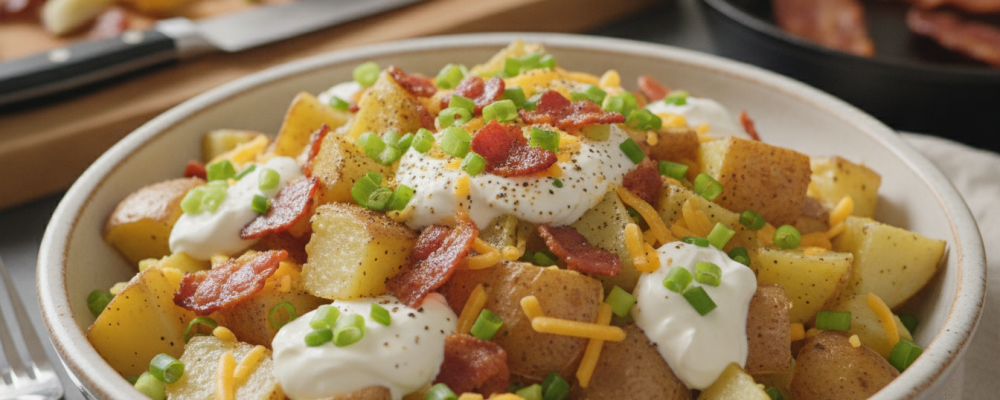

There are potato salads that exist as a side dish, and there are potato salads that exist as the reason people show up to the cookout in the first place. Loaded Baked Potato Salad is firmly the second kind. It takes everything beloved about a fully loaded baked potato—the sour cream, the melted cheddar, the crispy bacon, the fresh green onion—and turns it into a creamy, scoopable salad that disappears from every table it appears on. The combination of sour cream, mayonnaise, and butter in the dressing creates something richer and more cohesive than a standard mayo-based potato salad, and the result tastes exactly like the best parts of a steakhouse baked potato in every single bite.
What I love about this recipe is its complete honesty about what it is. There’s no pretense here, no attempt to lighten or modernize the flavor combination that makes a loaded baked potato so universally beloved—just butter, sour cream, mayonnaise, cheddar, bacon, and green onion, combined with care and chilled until the flavors have fully melded. It’s the kind of recipe that proves restraint and confidence in a flavor combination will always outperform unnecessary creativity.
The butter in the dressing is the detail most people skip, and it shouldn’t be skipped. Melted into the warm-cooling potatoes before the sour cream and mayonnaise go in, it adds a richness that no amount of additional sour cream or mayo can replicate, and it coats the potato pieces in a way that helps the rest of the dressing adhere more evenly.
The Inspiration Behind This Recipe
This recipe was inspired by the steakhouse baked potato bar tradition—the loaded baked potato piled with butter, sour cream, cheddar, bacon, and chives that has been a staple of American steakhouse dining for decades. Translating those same flavors into a chilled, scoopable salad format makes them accessible for potlucks, cookouts, and any gathering where a baked potato bar isn’t practical but the flavor combination is exactly what the menu needs.
A Brief History of the Loaded Baked Potato
The loaded baked potato as a steakhouse staple emerged in American dining culture in the mid-20th century, as baked potatoes became a standard side at the same restaurants serving the country’s beloved cuts of beef. Sour cream, butter, cheddar, bacon bits, and chives became the standard toppings bar, and the combination proved so popular that it migrated into potato salad, soup, and casserole formats across American home cooking in the decades that followed. This salad belongs to that lineage—translating a beloved restaurant tradition into a practical, make-ahead format for home gatherings.
Why This Dressing Combination Works
The three-fat dressing—butter, sour cream, and mayonnaise—produces a richer, more rounded result than any single fat could achieve alone. Butter adds nutty depth and helps the dressing coat the potatoes while they’re still slightly warm. Sour cream adds tang and lightness that balances the richness. Mayonnaise adds body and the classic potato salad creaminess that holds everything together. Together, they create a dressing that tastes layered rather than flat.
Flavor Profile: What to Expect
- Tender, buttery potato chunks that have absorbed the warm butter before the cooler dressing components are added
- Tangy, rich sour cream and mayonnaise that create a creamy, cohesive coating throughout
- Sharp, melted-in cheddar that adds salty, tangy richness in every bite
- Smoky, crispy bacon that provides essential textural contrast and savory depth
- Fresh green onion that adds a clean, sharp brightness that cuts through the richness
Tips for Making the Best Loaded Baked Potato Salad
- Cut potatoes into uniform pieces: Even cooking and even bites depend on consistent sizing.
- Add butter while potatoes are still warm: This is the key step that gives the salad its rich, cohesive base flavor.
- Cook bacon until very crisp: Soft bacon loses its textural contribution once mixed into a creamy salad.
- Don’t overmix: Potatoes break down easily. Fold gently to keep distinct, tender chunks intact.
- Chill for the full 30 minutes minimum: This allows the flavors to meld and the dressing to set into the potatoes properly.
Serving Suggestions and Side Pairings
- Alongside grilled burgers, steaks, or chicken at any cookout
- As part of a full BBQ spread with pulled pork or ribs
- With a simple green salad for a lighter, balanced meal
Storage and Make-Ahead Tips
- Refrigerate in an airtight container for up to 4 days. The flavors deepen overnight.
- Add green onions fresh if making more than a day ahead, as they lose their crispness over time.
- This salad does not freeze well due to the dairy-based dressing.
Why This Recipe Deserves a Spot in Your Rotation
Loaded Baked Potato Salad earns its place as the side dish that turns a cookout into an event. It’s rich, familiar, and crowd-pleasing in the most reliable possible way—proof that the best recipes are sometimes the ones that simply commit fully to a beloved combination.
Recommended Drink Pairing
The rich, creamy potato salad calls for something bright to cut through it. A Cranberry Orange Whiskey Sour brings citrus acidity that balances the richness beautifully, while a cold lager is the effortless, crowd-friendly companion for any cookout spread.
Loaded Baked Potato Salad
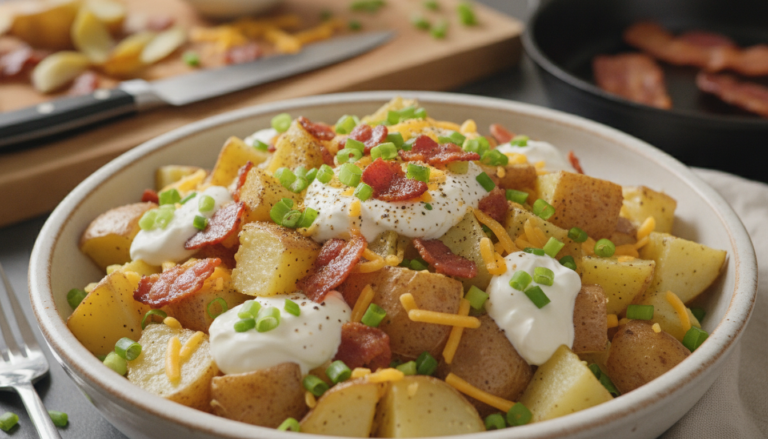
Loaded Baked Potato Salad combines tender potato chunks with a rich sour cream, mayonnaise, and butter dressing, sharp cheddar, crispy bacon, and fresh green onion for the cookout side dish that disappears fastest every single time.
8
servings15
minutes20
minutes350
kcal35
minutesIngredients
4 large russet potatoes
1 cup sour cream
1 cup cheddar cheese, shredded
1 cup cooked bacon, crumbled
1 bunch green onions, sliced
0.5 cup mayonnaise
2 tbsp butter
to taste salt
to taste pepper
Directions
- Boil potatoes in salted water until fork-tender, about 15-20 minutes.
- Drain potatoes and let cool to room temperature.
- Cut potatoes into bite-sized pieces and place in a large bowl.
- In a separate bowl, mix sour cream, mayonnaise, and butter.
- Add sour cream mixture to potatoes and toss to coat evenly.
- Add cheddar cheese, crumbled bacon, and green onions. Mix gently.
- Season with salt and pepper to taste.
- Chill in the refrigerator for at least 30 minutes before serving.
Nutrition Facts
- Total number of serves: 4
- Calories: 350kcal
- Cholesterol: 0mg
- Sodium: 620mg
- Potassium: 400mg
- Sugar: 8g
- Protein: 6g
- Calcium: 60mg
- Iron: 2mg
About This Author

Amelia Grace
Editor-in-Chief & Culinary Director
The heart and guiding voice of Daily Dish, Amelia leads our editorial vision and recipe development. With a background in food journalism and over a decade spent in professional kitchens, she has a knack for blending gourmet technique with real-world accessibility. Her goal? To make every reader feel like a confident cook, one dish at a time.
Favorite dish: Creamy lemon risotto with a sprinkle of fresh thyme.
Kitchen motto: “Good food doesn’t have to be complicated — it just has to be made with heart.”















