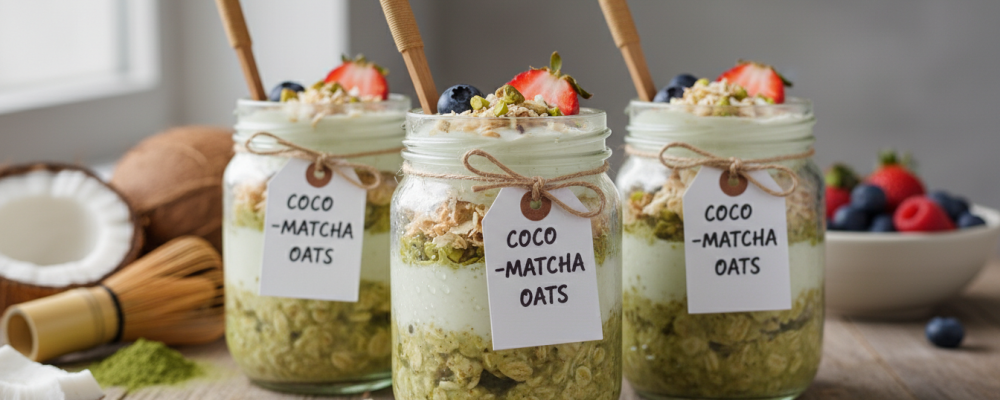

I have a specific and well-documented weakness for ingredients that are also colors—the kind of ingredient whose presence in a preparation transforms what you’re looking at before you’ve even tasted what you’re eating. Matcha is, in this regard, perhaps the finest ingredient in the known breakfast universe. It is the most vivid, specific, irreplaceable shade of jade green—not the dull, muted green of spinach or the yellow-green of avocado, but a bright, saturated, almost luminescent color that looks like it was formulated by someone who cared very much about what the finished dish would look like in a jar.
When you stir a teaspoon of matcha powder into a bowl of rolled oats and almond milk and coconut yogurt, the entire mixture transforms—from white and beige into that extraordinary green, shot through with the texture of chia seeds and the small flecks of oat, topped with a cloud of shredded coconut that sits against the color like snow against grass. It is one of the most beautiful things a refrigerator can hold. And when you open that jar in the morning—when the lid comes off and the matcha fragrance reaches you before the first bite does—it feels, unreasonably but genuinely, like a small occasion.
This is not incidental to the recipe’s value. In my professional experience, a breakfast that is beautiful to look at is a breakfast that gets eaten—that gets made again the following Sunday, that earns its permanent place on the prep list not just because it is nutritious and convenient but because it is something you actually want to encounter at seven in the morning. These jars are that breakfast. The color is doing work, and so is everything else in them.
─────────────────────────────────────────
The Inspiration Behind This Recipe
This recipe was born from the specific challenge of bringing matcha—one of the most distinctive and visually compelling flavors in the Japanese culinary tradition—into a meal prep breakfast format without losing any of the qualities that make it extraordinary. Matcha in a latte is wonderful; matcha in a baked preparation loses some of its vegetal brightness to heat; matcha in a cold, no-cook overnight oat jar is, it turns out, the format that suits it best of all.
The pairing with coconut was the flavor decision that completed the recipe. Matcha’s slightly bitter, earthy, intensely grassy character is balanced most naturally by sweetness and richness—traditional matcha preparations have always featured either sweetened milk or sweet confection alongside them for this reason. Coconut yogurt provides that balance in a form that is simultaneously rich and lightly sweet, adding a tropical creaminess that softens matcha’s edges without obscuring its distinctive character. The shredded coconut topping reinforces that tropical note and adds the textural contrast—slightly chewy, faintly sweet—that makes the surface of a jar overnight oats as interesting to eat as its interior.
Chia seeds were added for both their nutritional contribution and their functional role in the jar’s texture development. Overnight, chia seeds absorb liquid and expand into a gel that thickens the oat base into a denser, more pudding-like consistency than oats alone would achieve. In a coconut yogurt-based jar specifically, this thickening produces a result that is closer in texture to a well-set coconut chia pudding than to a conventional overnight oat—rich, spoonable, and substantial in a way that makes the jar feel genuinely indulgent rather than merely practical.
─────────────────────────────────────────
A Brief History of Matcha
Matcha—finely ground, shade-grown green tea—has a history in Japan that stretches back to the 12th century, when the Buddhist monk Eisai returned from China with tea seeds and the practice of grinding and whisking powdered tea in hot water. The powdered tea preparation Eisai brought back from Song Dynasty China was adopted and refined over the following centuries into what became the Japanese tea ceremony—chado, or the Way of Tea—a practice of ritual preparation and contemplative consumption that elevated matcha from a beverage to a philosophical and aesthetic tradition.
The specific qualities that make matcha so distinctive—its vivid color, its umami depth, its slightly bitter grassy character—are the result of a cultivation practice developed in Japan over centuries. Matcha tea plants are shade-grown for approximately three to four weeks before harvest, a process that forces the plant to produce more chlorophyll (responsible for the vivid green color) and more L-theanine (responsible for its characteristic calm-energy effect) than sun-grown tea plants. The youngest leaves are then hand-harvested, dried, deveined, and stone-ground into the fine powder that produces the intensity of flavor and color no other tea preparation can replicate.
Matcha’s recent global adoption into lattes, pastries, ice creams, and now overnight oats reflects a broader appreciation for its extraordinary versatility—a flavor that is simultaneously distinctive enough to carry an entire preparation and compatible enough to pair with dairy, coconut, vanilla, and oats without conflict. In overnight oats specifically, the cold infusion method preserves the full spectrum of matcha’s volatile aromatic compounds in a way that heat cannot, producing a breakfast whose matcha character is more vivid and more nuanced than any warm preparation of the same ingredient could achieve. This jar is, in the most literal sense, matcha at its most alive.
─────────────────────────────────────────
Why This Preparation Method Works for Meal Prep
The cold overnight infusion is the preparation method that suits matcha most completely for a meal prep context, and the reasoning is both practical and chemical. Heat degrades many of matcha’s most delicate flavor compounds—the volatile grassy aromatics that give it its characteristic freshness and depth. Cold infusion over six to eight hours preserves those compounds intact while still allowing the matcha to fully distribute through the oat base, producing a jar where the matcha flavor is present in every spoonful rather than concentrated at the surface where it was first stirred.
The coconut yogurt plays a dual structural role that plain almond milk alone could not fulfill. Its acidity—from the fermentation that produces yogurt—partially gelatinizes the chia seeds’ outer coating more quickly than a neutral liquid would, initiating the thickening process that gives the jar its pudding-like consistency by morning. And its fat content, significantly higher than almond milk’s, distributes through the oat base and produces the creamy, rich mouthfeel that makes these jars taste indulgent rather than merely nutritious. The almond milk provides volume; the yogurt provides structure and richness.
Mixing the matcha powder into the dry ingredients—oats, chia seeds, salt—before adding the liquids is the technique decision that produces the most even matcha distribution in the finished jar. Matcha powder is hydrophobic at the surface level and tends to clump when added to liquid directly, producing uneven green patches rather than a uniformly tinted base. Pre-mixing with the dry ingredients coats the powder in a fine layer of starch and fiber that prevents clumping when the liquids are added, producing the consistent, vivid jade color throughout that makes these jars so visually striking when the lid comes off.
─────────────────────────────────────────
Flavor Profile: What to Expect
These jars are complex and distinctive—a flavor profile that is unlike any other breakfast in the collection:
- Earthy, grassy matcha depth – The defining flavor of the jar: slightly bitter, deeply vegetal, intensely aromatic, and utterly unlike any other ingredient—present throughout every spoonful as both a flavor and a fragrance that is most vivid when the jar is first opened
- Creamy, tropical coconut richness – Coconut yogurt provides a lush, slightly sweet creaminess that softens matcha’s bitterness into something balanced and deeply satisfying, while the shredded coconut topping adds a chewy, faintly sweet surface texture
- Gentle vanilla warmth – Vanilla extract rounds the matcha’s slight bitterness with a soft, bakery-like warmth that makes the jar taste more composed and intentional without competing with the matcha’s prominence
- Floral honey sweetness – Honey balances the matcha’s natural bitterness with its characteristic floral complexity—sweetening without flattening, complementing the coconut’s tropical note with a natural depth that plain sugar cannot replicate
- Chia pudding body – Expanded chia seeds produce a slightly gel-like texture throughout the jar that makes it feel closer to a set pudding than a conventional overnight oat—substantial, spoonable, and genuinely satisfying
- Wholesome oat foundation – Rolled oats provide the mild, grassy base that grounds the matcha’s more intense character and gives the jar its filling, sustaining quality
The matcha flavor deepens and the coconut and vanilla integrate more fully after eight or more hours of refrigeration. A jar that rests for a full overnight produces a noticeably more cohesive, more deeply flavored result than one eaten after only four hours—the full resting time is worth planning around.
─────────────────────────────────────────
Tips for Making the Best Coconut Matcha Overnight Oat Jars
A few technique decisions make a significant difference in both the flavor and the visual quality of the finished jar:
- Use ceremonial or premium culinary grade matcha – Matcha quality varies enormously, and low-quality matcha produces a dull, yellowish-green color and a bitter, flat flavor that neither the honey nor the coconut can fully compensate for. A good culinary-grade matcha produces the vivid jade color and the characteristic grassy-sweet depth that makes this jar worth making. The quality of the matcha is the quality of the jar.
- Sift the matcha before mixing – Matcha clumps easily in storage. Sifting through a fine-mesh sieve before adding to the dry ingredients produces a more evenly distributed, smoother base with no bitter green clumps. A thirty-second step with outsized impact.
- Use full-fat coconut yogurt – Reduced-fat or light coconut yogurt has a higher water content and produces a thinner, less creamy jar that lacks the richness that makes these distinctive. Full-fat is the correct choice.
- Stir thoroughly before sealing – The matcha, chia seeds, and yogurt need to be fully incorporated before the jar is sealed. A brief, thorough stir immediately before sealing—even after the initial mixing—ensures uniform color and flavor distribution through the overnight rest.
- Reserve the coconut topping until morning if possible – Shredded coconut stored on top of the jar overnight absorbs moisture from the oat base and softens from a pleasantly chewy texture to a damp, slightly gummy one. Added fresh in the morning (keep a small bag of shredded coconut in the pantry), it provides the textural contrast the jar is designed around.
- Taste and adjust sweetness before sealing – Matcha’s bitterness varies by brand and grade. Taste the mixture after mixing and add a small additional drizzle of honey if the matcha’s bitterness seems too assertive. The sweetness should balance the bitterness rather than suppress it entirely.
Optional: A light dusting of additional matcha powder over the coconut topping just before eating adds a vivid, concentrated hit of color and flavor at the surface that makes the jar look as if it came from somewhere very sophisticated—which, in the context of your refrigerator on a Tuesday morning, it genuinely has.
─────────────────────────────────────────
Portioning and Container Suggestions
This recipe fills four jars perfectly—one per day for a four-day breakfast rotation, or five days when scaled by a quarter for an additional serving. Wide-mouth 16-ounce mason jars are the ideal vessel: the wide opening accommodates easy stirring and eating directly from the jar, the glass allows the full matcha jade color to be visible through the walls, and the standard lid seals tightly enough to prevent any flavor absorption from neighboring refrigerator contents.
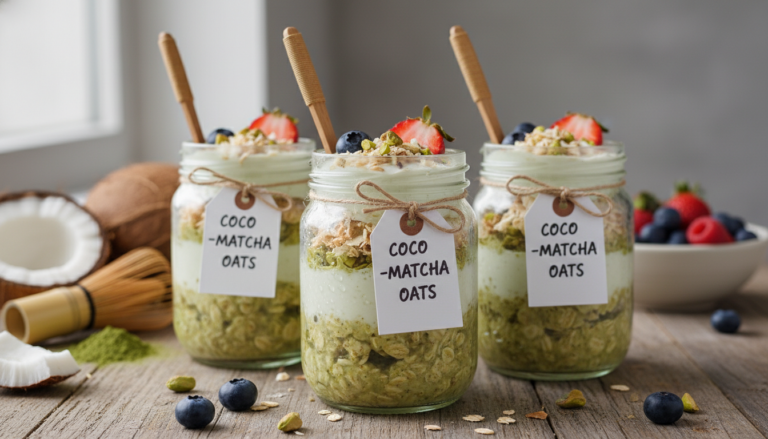
The color story of these jars through glass is genuinely one of the collection’s most striking—a line of four jade-green jars topped with white coconut on the refrigerator shelf is the kind of meal prep visual that makes Sunday afternoon feel like an investment rather than a chore. For this recipe specifically, clear glass jars are not just a practical choice but an aesthetic one: the matcha’s color is part of what makes these jars special, and it deserves to be seen.
For a particularly composed presentation—whether for a weekend brunch or simply for the personal satisfaction of a well-staged refrigerator—layer the jar in thirds before sealing: oat base as the foundation, a thin stripe of additional coconut yogurt in the middle, and the remaining oat base on top before the shredded coconut crown. The layered cross-section visible through the glass is genuinely beautiful and requires no additional ingredients or effort beyond a moment of assembly intention.
─────────────────────────────────────────
Storage, Reheating, and Shelf Life Tips
- Refrigerator storage: Sealed jars keep for up to 4 days. The matcha flavor deepens through days two and three; the oat and chia texture thickens progressively over time—some prefer the firmer day-three jar, others the slightly looser day-one version.
- Consistency management: If the jar has thickened more than desired by days three or four, stir in a splash of almond milk before eating to restore the original creamy consistency without diluting the flavor significantly.
- Shredded coconut: If topping the jars before refrigerating, the coconut will soften overnight—still pleasant, but less texturally distinct than fresh-added. Store a small bag of shredded coconut separately and add a fresh tablespoon at serving for best texture results.
- Freezer storage: Not recommended for assembled jars—the coconut yogurt separates upon thawing and the chia gel texture is compromised. The dry oat-matcha-chia mixture can be pre-portioned and frozen in individual bags with liquids and yogurt added the night before eating.
- No reheating required: These jars are designed to be eaten cold and are at their best served directly from the refrigerator. The matcha’s flavor is most vivid without heat.
- Matcha oxidation: Matcha begins to oxidize and lose some of its vivid color when exposed to light and air over time. Sealed in a jar, this process is minimal—but jars left open on a counter will dull slightly. Keep sealed until the moment of eating.
─────────────────────────────────────────
Why This Recipe Deserves a Spot in Your Meal Prep Rotation
Every meal prep collection needs a breakfast that is genuinely, unmistakably distinctive—one that has a flavor identity so specific that it couldn’t be confused with anything else in the rotation. The Coconut Matcha Overnight Oat Jar is that recipe. Matcha is not a background flavor; it is not one note in a chord. It is the whole chord, and every element of this jar is arranged around it in service of bringing it forward as clearly and as beautifully as possible. The result is a breakfast that tastes specifically, memorably of itself—something you’d request by name rather than describe as “the green one,” even though the green is genuinely extraordinary.
It also earns its practical credentials without compromise: five minutes of prep, four days of refrigerator stability, zero morning effort, and a nutritional profile—matcha’s L-theanine and antioxidants, chia’s omega-3s, oat’s beta-glucan fiber, coconut yogurt’s probiotics—that makes this one of the most genuinely nourishing jars in the collection. A breakfast that looks this remarkable, performs this well nutritionally, and asks this little of a weekday morning is a breakfast that deserves a permanent place on the Sunday list. It earns that place every week it appears.
─────────────────────────────────────────
Meal Prep Pairing Suggestions
Coconut Matcha Overnight Oat Jars pair most naturally with other prepped breakfasts that provide genuine contrast in flavor character and temperature—ensuring that the week’s mornings offer variety rather than returning to the same cool, creamy format every day. Our Peach Ginger Overnight Oat Jars are the obvious companion within the overnight oat category itself: both are cool, jar-based, and no-cook, but the warm, spiced, stone-fruit character of the peach ginger version is completely distinct from matcha’s earthy, tropical depth. Alternating between the two across the week covers the full range of what overnight oats can achieve without any flavor repetition.
For a complete three-breakfast rotation, our Savory Herb & Goat Cheese Egg Bake Cups provide the warm, savory counterpart that rounds out the morning spread for days when something protein-forward and herb-bright calls more compellingly than anything sweet and creamy. Together—jade-green and coconut-fragrant, warm and herb-forward, and the third breakfast option of the week—these three preparations cover every possible morning mood with equal make-ahead ease and equal commitment to making the first meal of the day genuinely worth waking up for. That is, in the most practical and pleasurable sense, exactly what a well-designed breakfast rotation should do.
Coconut Matcha Overnight Oat Jars
These Coconut Matcha Overnight Oat Jars are a vibrant, no-cook breakfast that layers earthy matcha, creamy coconut yogurt, and rolled oats into a jar that looks extraordinary, tastes even better, and requires nothing more than five minutes and a night in the refrigerator.
4
servings30
minutes40
minutes300
kcal1
hour10
minutesIngredients
2 cups rolled oats
2 tablespoons matcha powder
2 cups almond milk
1 cup coconut yogurt
4 tablespoons shredded coconut
2 tablespoons chia seeds
2 tablespoons honey
1 teaspoon vanilla extract
1 pinch salt
Directions
- In a large bowl, combine rolled oats, matcha powder, chia seeds, and salt.
- Stir in almond milk, coconut yogurt, honey, and vanilla extract until well mixed.
- Divide the mixture evenly among four jars.
- Top each jar with a tablespoon of shredded coconut.
- Seal jars with lids and refrigerate overnight.
- Enjoy chilled in the morning, or take on the go for a quick breakfast.
Nutrition Facts
- Total number of serves: 4
- Calories: 250kcal
- Cholesterol: 0mg
- Sodium: 620mg
- Potassium: 400mg
- Sugar: 8g
- Protein: 6g
- Calcium: 60mg
- Iron: 2mg
About This Author

Aurora Wright
Pastry Chef & Dessert Editor
Aurora is the sweet side of Daily Dish. A trained pastry chef and dessert stylist, she’s responsible for our mouth-watering cakes, cookies, and confections. She brings precision, artistry, and a touch of whimsy to every recipe she creates — and taste-tests more chocolate than she’ll admit.
Favorite dish: Flourless dark chocolate torte.
Kitchen motto: “Life’s too short to skip dessert.”