
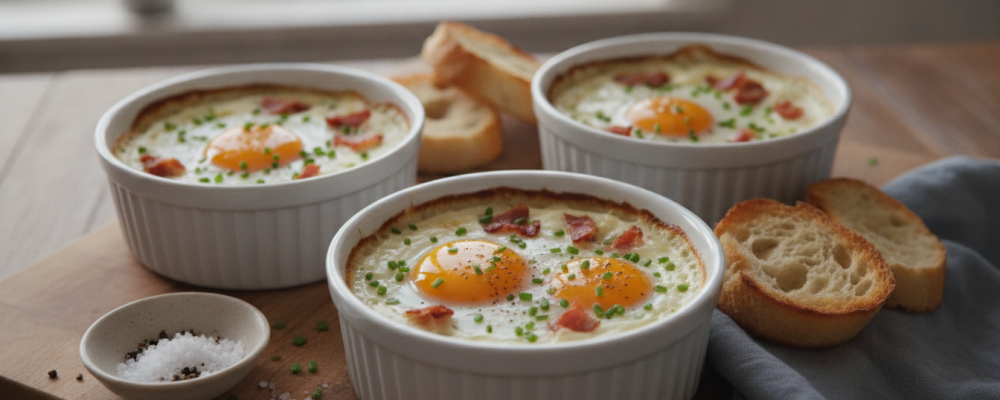

Oeufs en cocotte—baked eggs in cream—is one of those French preparations that reveals something important about classical cooking: extraordinary results don’t require extraordinary complexity. You’re working with eggs, cream, butter, cheese, and a pinch of nutmeg. The technique involves buttering ramekins, adding ingredients in a specific order, and baking in a water bath. That’s the entirety of it. Yet the result—silky, barely-set whites, yolks that remain liquid beneath a thin film, cream that has thickened into something approaching a sauce, Parmesan developing a delicate golden crust—is genuinely remarkable. The gap between ingredient simplicity and result sophistication is what makes this dish worth understanding.
The water bath is the technical heart of the recipe, and it’s worth understanding precisely why it works. Eggs are protein networks that coagulate when heat causes their proteins to unfold and bond together. Too much heat too quickly creates tight, rubbery protein networks—the texture of overcooked scrambled eggs. Gentle, indirect heat from the water bath moderates the temperature reaching the ramekins, allowing the egg proteins to coagulate slowly and evenly into the silky, tender texture that defines properly made oeufs en cocotte. This isn’t culinary mysticism—it’s applied thermodynamics serving a specific textural goal.
I return to this recipe repeatedly because it demonstrates a principle I consider fundamental: technique multiplies ingredient quality. You could serve these same eggs scrambled and they’d be good. Poached and they’d be better. But baked in cream with Parmesan in a properly maintained water bath, they become something that feels genuinely elegant and considered—a dish that rewards the cook’s understanding of what’s actually happening in the ramekin during those 15 minutes in the oven.
─────────
The Inspiration Behind This Recipe
This recipe emerges directly from the French culinary tradition of cocotte cooking—using small, covered vessels to cook ingredients gently in their own moisture or added liquid. The egg application, oeufs en cocotte, appears in foundational French cookbooks including Escoffier’s Le Guide Culinaire, where it’s presented as a classic preparation requiring precise technique and quality ingredients. My interest was in making that classical technique genuinely accessible to home cooks without compromising the result.
The specific combination of cream, Parmesan, and nutmeg reflects the flavor logic of classic French cuisine, where these three ingredients appear together frequently—in gratins, in béchamel-based preparations, in various egg dishes. Nutmeg’s role is worth particular attention: used in pinch quantities, it doesn’t taste like nutmeg. Instead, it functions as a flavor enhancer that amplifies the cream’s richness and rounds out the Parmesan’s sharpness without announcing its presence. This is the kind of ingredient interaction that makes classical cooking so interesting to analyze.
What I wanted to achieve was a recipe where home cooks could understand not just what to do but why each step matters. The buttered ramekin isn’t just about preventing sticking—it adds flavor and creates a barrier that affects how the egg white sets against the ramekin wall. The cream quantity affects both texture and cooking time. The water bath depth matters. These aren’t arbitrary instructions; they’re technical specifications that produce a specific, reproducible result when followed correctly.
─────────
A Brief History of Oeufs en Cocotte
Oeufs en cocotte belongs to the classical French egg canon alongside oeufs pochés, oeufs mollets, and oeufs brouillés—each preparation defined by its specific technique and the distinct texture it produces. The cocotte preparation takes its name from the small earthenware or porcelain vessels traditionally used for individual portion cooking in French cuisine. These vessels appear in French cooking records from the 18th century, used for everything from terrines to custards to the egg preparations that bear their name.
The dish gained particular prominence in 19th century French bourgeois cooking—the cuisine of prosperous middle-class households that formed the backbone of French culinary culture. Escoffier codified numerous variations in his foundational texts, with additions ranging from cream alone to truffles, foie gras, and various sauces reflecting the dish’s adaptability to available ingredients and occasion. The water bath technique (bain-marie) that defines proper oeufs en cocotte was already established practice in French professional kitchens for custards and terrines—applying it to eggs was a natural extension of the same thermodynamic logic.
American cooks encountered oeufs en cocotte primarily through Julia Child’s Mastering the Art of French Cooking, which introduced the dish to a generation of American home cooks in the 1960s. The dish’s simplicity and elegance made it a natural entry point into French cooking technique, though it remained somewhat specialized knowledge compared to French toast or scrambled eggs. Today, renewed interest in classical French cooking and brunch culture’s emphasis on elegant, restaurant-quality preparations at home has given oeufs en cocotte well-deserved renewed attention.
─────────
Why This Cooking Method Works
Buttering the ramekins generously accomplishes more than preventing sticking. The butter creates a fat barrier between the egg and the ramekin wall that moderates heat transfer slightly, contributing to more even cooking around the circumference of the egg. It also contributes flavor to the portion of egg white that comes into direct contact with the ramekin surface—a subtle but meaningful addition to the overall flavor profile. Insufficiently buttered ramekins produce eggs that stick, tear when unmolded, and lack the clean, rounded presentation that makes the dish attractive.
The specific order of assembly—eggs first, then cream, then seasonings, then cheese—is technically deliberate. Placing eggs directly on the buttered ramekin surface means the whites begin setting against the fat-coated vessel rather than against the cream, which promotes more even white coagulation. The cream poured over the top will flow around and beneath the eggs as heat builds, eventually creating the sauce-like consistency that distinguishes properly made oeufs en cocotte. Seasonings and cheese go on last so they sit on the surface where they’re most effective—the nutmeg perfuming the cream as it heats, the Parmesan forming a crust rather than dissolving into the cream.
The water bath’s water level—halfway up the ramekin sides—is a specific specification, not an approximation. Too shallow and the temperature moderation is insufficient; the ramekin bottom overheats and the egg whites toughen. Too deep and heat transfer to the upper portion of the egg is excessive, overcooking the cream surface before the whites below are properly set. Hot water rather than cold is specified because cold water would delay the cooking process significantly and unevenly, producing unpredictable results. The 10-15 minute window reflects genuine variation based on oven calibration and preferred yolk doneness—10 minutes for running yolks, 15 for more set results.
─────────
Flavor Profile: What to Expect
These baked eggs deliver classical French elegance with layered, subtle complexity:
- Silky egg white – Tender, barely set, with none of the rubbery quality of overcooked eggs
- Liquid or semi-set yolk – Rich, creamy, almost sauce-like when broken into the surrounding cream
- Thickened cream – No longer pourable but not fully set—something between cream and custard sauce
- Parmesan crust – Golden, slightly crispy, with concentrated salty-nutty flavor
- Butter richness – Subtle but present, rounding out the cream and adding depth
- Nutmeg warmth – Almost imperceptible as a distinct flavor but essential to the dish’s completeness
- Fresh chive brightness – Clean, mild onion flavor that cuts through the cream’s richness
The overall experience is one of restrained luxury—this is not a bold or assertive dish. It rewards attention and appreciation rather than demanding them. The textures are the story: that silky white, the barely-set yolk that breaks and mingles with the cream, the Parmesan providing textural contrast and flavor punctuation. Eaten with crusty bread or toast points for scooping, it becomes one of the most satisfying and complete breakfast experiences classical French cooking has produced.
─────────
Tips for Making the Best Baked French Eggs
Use the freshest eggs available—in a preparation this simple, egg quality is directly and immediately detectable in the final result.
- Bring eggs to room temperature – Cold eggs from the refrigerator require longer cooking and cook less evenly
- Use hot water in the bain-marie – Cold water significantly delays and unevens the cooking process
- Don’t cover the ramekins – Steam buildup creates condensation that drips back and dilutes the cream surface
- Watch timing carefully – The difference between perfect and overcooked is often just 2 minutes
- Check doneness by jiggle – The whites should be set with no transparency remaining; yolks should still move slightly
- Use quality Parmesan – Freshly grated Parmigiano-Reggiano behaves and tastes significantly better than pre-grated
- Season assertively – The cream needs adequate salt to bring all flavors forward; taste-test if uncertain
- Serve in the ramekin – The vessel retains heat and is part of the elegant presentation
For variations, add a spoonful of crème fraîche beneath the eggs, lay a slice of smoked salmon in the ramekin before cracking the eggs, or add a teaspoon of truffle oil to the cream for an occasion that warrants genuine indulgence.
─────────
Serving Suggestions and Side Pairings
These baked eggs are best served in their ramekins, which retain heat and present beautifully on individual plates. Toast points—thin-sliced bread toasted and cut into strips—are the traditional accompaniment, providing the vehicle for scooping up cream and breaking into yolks without losing any of the precious sauce. Crusty baguette slices work equally well. The bread element is functional as much as aesthetic; this dish genuinely needs something for scooping.
For a complete brunch, balance the richness of the baked eggs with lighter, fresher accompaniments. A simple green salad with sharp vinaigrette provides acidic contrast that cleanses the palate. Sliced prosciutto or smoked salmon adds protein variety without competing flavors. Fresh fruit—particularly citrus or berries—provides brightness and color that make the table feel abundant and considered.
This dish is ideally suited to intimate brunches where individual ramekins can be served and appreciated properly. It rewards slow eating and good conversation—the kind of brunch where the food is an occasion rather than fuel. It’s particularly appropriate for occasions that warrant elegance without complexity: a birthday breakfast, a holiday morning, or simply a Sunday when you want to cook something that demonstrates real care and understanding.
─────────
Storage, Reheating, and Make-Ahead Tips
- Butter ramekins ahead: Prepare up to 1 day ahead; cover and refrigerate until needed
- No advance assembly: Eggs should be cracked into ramekins immediately before baking
- Leftovers don’t keep well: The delicate texture degrades significantly when refrigerated and reheated
- Make cream mixture ahead: Season cream with salt, pepper, and nutmeg up to 1 day ahead
- Grate Parmesan early: Can be done up to 3 days ahead; store airtight in refrigerator
- Stagger baking for groups: Prepare ramekins in batches; the bain-marie accommodates four ramekins reliably
- Keep water bath hot: For successive batches, use the same water bath with hot water added as needed
- Accept freshness requirement: This dish is designed for immediate consumption; plan accordingly
The honest assessment is that oeufs en cocotte is not a make-ahead dish. Its entire appeal lies in the texture achieved through precise, timed cooking—a texture that cannot be replicated by reheating. The preparation is fast enough (under 20 minutes total) that advance cooking offers no practical benefit worth the quality compromise. Cook to order, serve immediately.
─────────
Why This Recipe Deserves a Spot in Your Rotation
This recipe earns its place because it teaches the water bath technique—a fundamental cooking method that applies to custards, terrines, cheesecakes, and numerous other preparations requiring gentle, even heat. Mastering it through oeufs en cocotte, where the results are immediately apparent and the stakes are relatively low, builds technical confidence that transfers directly to more complex recipes. You’re not just learning to make baked eggs; you’re learning a technique that will improve your cooking across multiple categories.
Beyond the technical education, this dish consistently produces results that exceed what its ingredient list suggests should be possible. That gap—between humble inputs and elegant output—is what makes it valuable as a regular recipe rather than a one-time experiment. When you can produce something this refined and satisfying from eggs, cream, and cheese on any given Sunday morning, you have a recipe that earns its permanent place in your repertoire. Few dishes deliver that combination of technical insight, genuine elegance, and everyday accessibility as effectively as properly executed oeufs en cocotte.
─────────
Recommended Drink Pairing
The delicate, cream-rich flavors of baked French eggs demand beverages with sufficient acidity or complexity to provide balance without overwhelming the dish’s intentional subtlety. French press coffee—with its full-bodied, slightly sediment-rich character—is the natural companion, providing enough flavor presence to complement without competing. The coffee’s natural acidity cuts through the cream while its warmth mirrors the ramekin’s temperature, creating a pairing that feels cohesive and considered.
For tea, a quality Darjeeling—often called the champagne of teas for its muscatel character and delicate complexity—provides elegant accompaniment that honors the dish’s French sensibility. Earl Grey’s bergamot brings citrus brightness that cuts through cream richness in the most natural, pleasing way. Both options feel appropriately restrained for a dish that rewards understatement.
For celebratory brunches, a glass of quality Chablis or white Burgundy is the canonical French pairing—the wine’s mineral-driven acidity and lean fruit profile cut through the cream and Parmesan beautifully while honoring the dish’s classical origins. Champagne works equally well, with bubbles providing mechanical palate cleansing alongside the wine’s characteristic acidity and toasty notes that complement the Parmesan crust. Fresh-squeezed grapefruit juice offers a non-alcoholic alternative with sufficient acidity and slight bitterness to balance the cream’s richness. Still or sparkling water with lemon is the simplest and perhaps most honest choice—allowing the dish’s delicate flavors full attention while providing the palate cleansing that cream-rich food genuinely requires between bites.
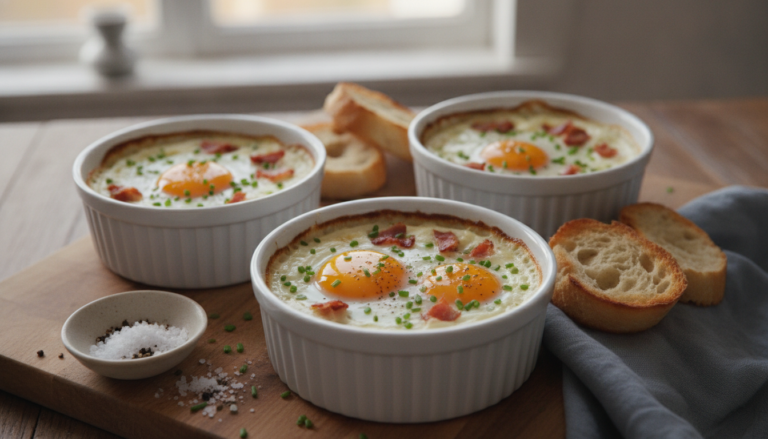
Baked French Eggs
These Baked French Eggs nestle eggs in buttered ramekins with rich cream, nutmeg, and Parmesan, then bake in a water bath until silky and just set—an elegant, classic French preparation that delivers extraordinary results from the simplest possible ingredients.
4
servings30
minutes40
minutes300
kcal1
hour10
minutesIngredients
8 large eggs
1 cup heavy cream
0.25 cup grated Parmesan cheese
1 tbsp butter
1 pinch nutmeg
to taste salt
to taste black pepper
2 tbsp fresh chives
Directions
- Preheat the oven to 350°F (175°C).
- Butter four ramekins generously.
- Crack two eggs into each ramekin.
- Pour an equal amount of cream over the eggs.
- Sprinkle salt, pepper, and a pinch of nutmeg over each.
- Top with grated Parmesan cheese.
- Place the ramekins in a baking dish and fill with hot water halfway up the sides.
- Bake for 10-15 minutes until the eggs are set.
- Garnish with chopped fresh chives and serve immediately.
Nutrition Facts
- Total number of serves: 4
- Calories: 250kcal
About This Author

Benjamin Brown
Recipe Developer
Benjamin is our flavor engineer. A classically trained chef turned recipe developer, he’s obsessed with balancing taste, texture, and creativity. He ensures that every recipe we publish is not only delicious but also reliable, approachable, and repeatable — even for beginners.
Favorite dish: Slow-braised short ribs with red wine reduction.
Kitchen motto: “Cooking is part science, part soul.”















