
Calabrian chili paste is not interchangeable with any other chili preparation in the pantry, and understanding what specifically distinguishes it from red pepper flakes, from sriracha, from harissa, and from generic chili paste is what explains why this bowl tastes the way it does and why a substitution would produce a categorically different result.
Calabrian chilies—peperoncini piccanti—are small, thin-walled, intensely red chili peppers grown in Calabria, the toe of the Italian boot, where the Mediterranean climate and volcanic soil produce a chili with a distinctive flavor profile: fruity and sweet at the initial hit, building to a persistent, moderate heat, with a specific fermented depth that results from the traditional oil-packing preservation method. This preservation method—packing fresh or dried chilies in olive oil and salt, often with added vinegar and spices—is not simply a storage technique. It is a flavor transformation process. The chilies’ capsaicin compounds migrate into the surrounding oil, carrying the pepper’s aromatic complexity with them; the salt draws moisture from the pepper tissue and concentrates flavor; and the mild acidity of any added vinegar provides a brightness that is built into the paste rather than applied separately.
The result is a chili preparation that delivers heat, acidity, fruitiness, and umami depth simultaneously—all in a fat-soluble form that distributes through the cooking oil immediately and evenly when the paste is added to a hot pan. Red pepper flakes deliver only dry heat. Sriracha delivers heat and acidity in a water-based form that steams rather than blooms in oil. Harissa delivers North African spice complexity without the Italian pepper’s fruity sweetness. Only Calabrian chili paste delivers the specific combination that makes this bowl what it is, and it is worth sourcing specifically rather than substituting.
─────────────────────────────────────────
The Inspiration Behind This Recipe
The design brief for this bowl was to produce a Mediterranean seafood-and-grain preparation that had a flavor identity as specific and as recognizable as the Peruvian green sauce bowl or the chermoula salmon bowl—something that tasted specifically of a place and a tradition rather than generically of well-seasoned food. The challenge with Italian-inspired meal prep in a bowl format is that the most compelling Italian flavor preparations—pasta al pomodoro, puttanesca, peperonata—were designed around sauces that cling to pasta rather than coating grain bases, and their translation to a meal prep bowl context requires an ingredient that can carry those flavors into a format that is portable, refrigerator-stable, and complete without a long sauce-building process.
Calabrian chili paste is the ingredient that resolved this challenge. Applied directly to shrimp in a hot pan, it does in four minutes what a long simmered chili-tomato sauce takes thirty minutes to achieve: it coats the protein’s surface with fully developed, fat-soluble chili character; it leaves the pan’s oil phase seasoned with its compounds for the subsequent vegetable cook; and it produces a finished dish that tastes specifically of the southern Italian chili tradition rather than generically of shrimp in tomato sauce.
Farro was the grain choice for the same reasons it earns its place in every farro-based bowl in this collection: its texture advantage over rice and couscous in a refrigerated context is significant and specific. Farro’s cell wall structure resists the softening that rice undergoes in prolonged contact with a sauced preparation, and its slightly nutty chew holds up through four days of refrigerator storage in a way that makes the Thursday bowl nearly indistinguishable in texture from the Sunday bowl. In a preparation with cherry tomatoes—which release liquid during both cooking and refrigerator storage—this grain durability is a functional requirement rather than a preference.
─────────────────────────────────────────
A Brief History of Calabrian Chili
Calabria—the southernmost mainland region of Italy, extending into the Mediterranean as the toe of the Italian boot—has one of the most distinctive and most fiery culinary traditions in a country not typically associated with chili heat. The region’s relationship with chili pepper is ancient by Italian standards: chili peppers arrived in southern Italy from the Americas in the late 16th century and were adopted with particular enthusiasm in Calabria, where the poor agricultural conditions, intense summer heat, and proximity to the spice-trading ports of the Mediterranean made a pungent, preserving, calorie-dense condiment immediately valuable. By the 17th century, chili pepper had become central to Calabrian cooking in a way it never achieved in the cooler, more prosperous northern regions of Italy.
The oil-packing preservation tradition that produces Calabrian chili paste is itself an ancient Mediterranean practice—olive oil has been used as a preservation medium in the region for millennia, and the specific application to chili peppers reflects the Calabrian cook’s recognition that the chili’s flavor compounds dissolved into olive oil produced a condiment that was more versatile, more stable, and more deeply flavored than the dried pepper alone. The paste’s fermented depth, developed over weeks and months of salt-and-oil preservation, is a function of the same microbial activity that produces the complexity of aged cheese and cured meat—a flavor transformation that cannot be replicated by fresh or simply dried chili.
The global availability of Calabrian chili paste in its jarred commercial form—produced primarily by Calabrian cooperatives and distributed internationally through specialty food channels—is a relatively recent development that has made this regional Italian product one of the most rapidly adopted specialty ingredients in contemporary home cooking. Its specific flavor profile—the fruity heat, the fermented depth, the olive oil richness—has no adequate substitute, which is why every serious food publication that has introduced it to a home cooking audience has immediately placed it on a “pantry staples” list. It earns that designation.
─────────────────────────────────────────
Why This Cooking Method Works for Meal Prep
The staggered cooking sequence—shrimp cooked first, removed, vegetables cooked in the same pan, shrimp returned at the end—is the technique decision that most distinguishes this bowl’s quality from a simpler all-at-once approach, and it serves three specific functions simultaneously.
First, it prevents the shrimp from overcooking during the vegetable’s longer sauté window. Shrimp proteins coagulate at 120°F and begin to tighten into their characteristic rubbery texture above 145°F; zucchini, bell pepper, and cherry tomatoes require five to seven minutes of medium heat to develop proper tenderness. Adding shrimp and vegetables simultaneously means the shrimp will be significantly overcooked by the time the vegetables reach their target texture. Removing the shrimp after their four-to-five-minute cook and returning them only at the final moment of assembly means every component is cooked to its correct degree of doneness independently.
Second, the pan after shrimp removal contains something more valuable than a clean cooking surface: the fond—the caramelized protein and Calabrian chili-infused oil deposits at the pan’s base—that concentrates the shrimp and chili’s flavor into a form that the subsequent vegetable sauté will deglaze and incorporate. Vegetables added to a pan that held Calabrian chili shrimp absorb the fond’s flavor compounds as they cook and release their own moisture to deglaze it, producing vegetables that taste specifically of the chili and the seafood preparation rather than of simply sautéed vegetables. This is the technique that makes the whole bowl taste unified rather than assembled.
Third, returning the shrimp at the end, after the lemon juice and farro have been added and the heat reduced, prevents the acid from continuing to cook the shrimp’s surface proteins—a process that produces an unpleasant, rubbery texture when lemon juice is applied to hot shrimp on a high-heat surface. The shrimp warm through during the final assembly stir without any additional protein tightening, arriving at the portioning stage at their optimal texture for refrigerator storage.
─────────────────────────────────────────
Flavor Profile: What to Expect
This bowl is bold, complex, and specifically Italian in character—a flavor profile with more layers than its preparation time would suggest:
- Fruity, fermented Calabrian chili – The bowl’s defining character: immediately fruity and sweet at the surface of each shrimp, building to a persistent moderate heat, with the fermented depth that is the paste’s most distinctive quality and the one that most clearly distinguishes this bowl from any other chili-shrimp preparation
- Olive oil richness – The fat phase that carries the Calabrian chili’s compounds through every component: present as a quiet, fruity richness underlying every other flavor and binding the bowl’s elements into a unified whole
- Sweet, concentrated cherry tomato – Sautéed in the shrimp-and-chili-infused pan fond, the tomatoes develop a concentrated sweetness that balances the chili’s heat and provides the acidic brightness that keeps the bowl tasting vivid rather than heavy
- Tender, mild zucchini and bell pepper – The vegetable base’s clean, slightly sweet character—mildly absorbing the pan’s chili oil flavor while providing the textural variety and fresh quality that prevents the bowl from feeling uniformly rich
- Earthy, chewy farro – The grain base that carries everything with satisfying resistance: nutty, slightly grassy, and specifically more interesting than rice or couscous as a carrier for an oil-based, chili-forward preparation
- Bright lemon finish – Applied at the end to preserve its volatile aromatic character, the lemon juice provides the acid note that lifts every other flavor and keeps the bowl tasting as vivid on day three as on day one
- Fresh parsley brightness – The herbal finish that introduces green freshness at the surface and provides the visual and flavor contrast that makes the assembled bowl feel complete
The Calabrian chili’s fat-soluble compounds continue distributing through the olive oil phase during refrigerator storage. Day-two bowls are more evenly and more deeply chili-flavored than the freshly cooked version—the paste’s character having had time to permeate the farro and vegetables as thoroughly as the shrimp.
─────────────────────────────────────────
Tips for Making the Best Calabrian Chili Shrimp & Farro Bowls
Execution at the staggered cooking and chili-application stages determines the bowl’s quality most significantly:
- Source proper Calabrian chili paste – This is the ingredient most worth seeking specifically. Calabrian chili paste is available at specialty Italian grocery stores, at Trader Joe’s (as a jarred product), and increasingly at mainstream grocery stores in the international foods section. Substituting red pepper flakes or another chili preparation produces a different bowl—not a worse one necessarily, but not this bowl. The fruity, fermented character is irreplaceable.
- Bloom the Calabrian paste in the oil before adding shrimp – Adding the chili paste to the pan simultaneously with the shrimp means the paste’s oil-suspended compounds are competing with the shrimp’s moisture for the pan’s heat. Adding the paste thirty seconds before the shrimp—allowing it to sizzle briefly in the hot olive oil—blooms its fat-soluble compounds and distributes them through the oil phase before the shrimp arrives, producing more even chili flavor throughout each piece.
- Remove shrimp while still slightly underdone – Shrimp continue cooking from residual heat after removal; shrimp that appear perfectly done in the pan will be slightly overcooked by the time they return to the assembled bowl. Pull them when opaque but still slightly translucent at the thickest part of the curve.
- Don’t deglaze the fond before adding vegetables – The caramelized shrimp-and-chili fond at the pan base is the most concentrated flavor element in the entire preparation. Adding the vegetables directly to this fond and allowing their released moisture to deglaze it naturally produces a far more flavorful vegetable component than deglazing with water or wine first.
- Add lemon juice off heat – This instruction is consistent across every recipe in this collection where acid is a finishing element: citric acid’s volatile aromatic compounds begin degrading within seconds of heat contact. Add the lemon juice after removing the pan from the burner to preserve the brightest possible citrus character in the finished bowl.
- Store parsley separately – Fresh parsley stored on the assembled bowl darkens and loses its aromatic freshness within twenty-four hours in direct contact with the chili oil. A small separate bag of parsley added at serving maintains its color and its specific herbal contribution throughout the week.
Optional: A small spoonful of good ricotta or burrata placed over the finished bowl at serving introduces a cool, creamy counterpoint to the Calabrian chili’s heat that is specifically Italian in character—the combination of spicy and creamy is one of southern Italian cooking’s most effective flavor strategies, and it makes the bowl taste notably more composed and restaurant-quality for thirty seconds of effort.
─────────────────────────────────────────
Portioning and Container Suggestions
This recipe produces four generous bowls from a single batch — one per day for a four-day lunch or dinner rotation. The all-combined storage approach — farro, shrimp, and vegetables stored together — is appropriate for this bowl because the Calabrian chili oil acts as a continuous flavor-distribution medium between the components during refrigerator storage rather than as an acid that would degrade adjacent proteins. Unlike lemon-dressed preparations, this bowl actively improves with component contact in storage.
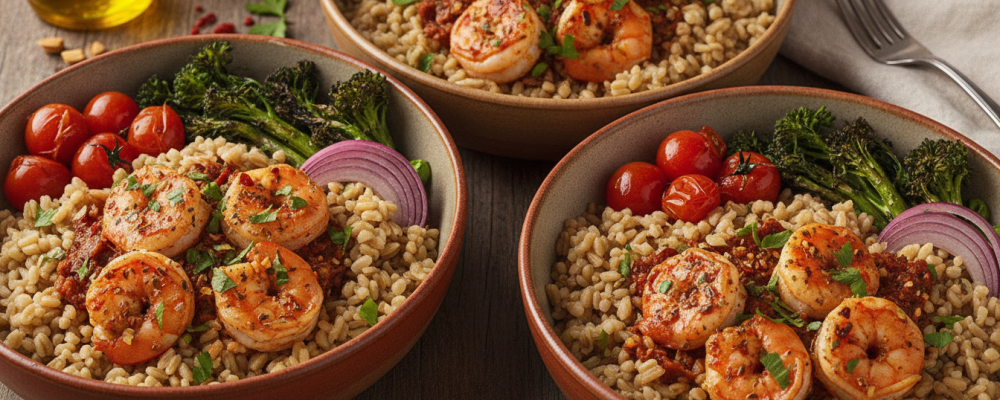
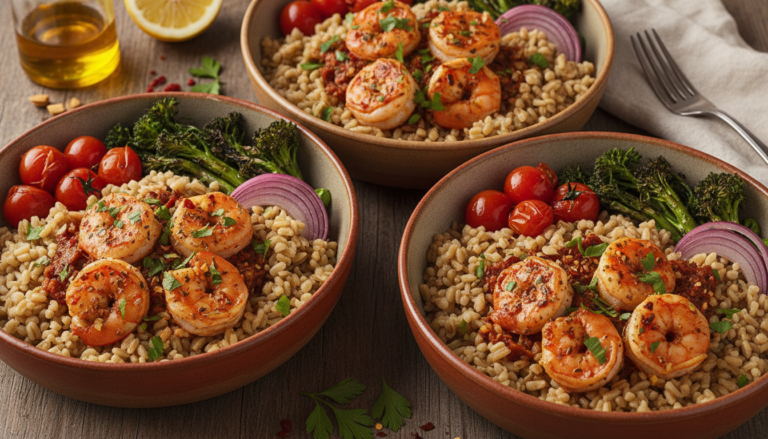
Wide, flat glass containers are the preferred vessel — they allow the preparation to rest in a single layer, which distributes reheating heat more evenly and prevents the farro from compressing under weight into a mass that is difficult to separate at serving. The bowl’s visual in storage — the deep red of the Calabrian chili-stained shrimp against the farro’s golden-beige, the ruby of the cherry tomatoes, the green-and-yellow of the parsley and pepper — is one of the more visually compelling refrigerator contents in the collection, and glass allows it to remain visible.
Fresh parsley and the optional lemon wedge — stored separately and applied at serving — take thirty seconds and restore the bowl’s full aromatic profile at the moment of eating, which is the most practical way to account for the volatile herb and acid character that refrigeration mellows.
─────────────────────────────────────────
Storage, Reheating, and Shelf Life Tips
- Combined bowl storage: Keeps in an airtight container for up to 3–4 days in the refrigerator. The Calabrian chili oil continues distributing through the farro and vegetables during storage — day-two and day-three bowls are the flavor peak. Consume within four days for the best shrimp texture.
- Farro durability note: Unlike rice or couscous, farro maintains its texture in contact with the chili-oil preparation during storage — one of the primary practical advantages of this grain choice for this specific bowl.
- Freezer storage: The shrimp and vegetable component freezes adequately for up to 1 month with some texture change to the shrimp expected on thawing. Farro freezes well for up to 2 months separately. Thaw overnight in the refrigerator before reheating.
- Reheating: Microwave at 50–60% power for 90 seconds, stirring once halfway through. The olive oil in the preparation reheats the farro and shrimp more evenly than full-power microwaving; high power concentrates heat unevenly in an oil-containing preparation. Alternatively, warm in a lightly oiled skillet over medium-low heat for 3–4 minutes — the skillet method slightly re-activates the Calabrian chili’s surface compounds and produces a result noticeably closer to the freshly cooked version.
- Lemon refresh: The lemon juice applied during original cooking mellows during refrigerator storage. A fresh squeeze over the reheated bowl immediately before eating restores the acidity that keeps the chili’s richness in balance.
- Parsley: Always add fresh at serving. Store in a sealed bag refrigerated. Never store on the assembled bowl.
─────────────────────────────────────────
Why This Recipe Deserves a Spot in Your Meal Prep Rotation
This bowl’s argument for regular rotation rests on two pillars that reinforce each other. The first is the ingredient: Calabrian chili paste is a pantry staple that rewards every meal prep cook who discovers it, not just in this bowl but in every preparation where a fruity, fermented, oil-based chili heat would improve the outcome — which is a surprisingly large number of preparations. A jar of Calabrian chili paste purchased for this bowl will find its way into pasta, into eggs, into vinaigrettes, into every context where the cook reaches for red pepper flakes and recognizes that something more interesting is available. The initial sourcing investment compounds across every use.
The second is the cooking logic: the staggered-component sequence and the fond-based vegetable cook are techniques that produce a restaurant-quality flavor outcome from a thirty-minute preparation without any specialized equipment or culinary training. A bowl that tastes like the product of considered Italian cooking knowledge — the specific chili, the specific cooking sequence, the specific grain — and that was produced on a Sunday afternoon in under thirty minutes is a bowl that justifies its place on the weekly prep list on both practical and qualitative grounds simultaneously. That combination — flavor complexity and preparation efficiency at the same level — is the standard that every meal prep recipe should aspire to. This bowl meets it specifically and completely.
─────────────────────────────────────────
Meal Prep Pairing Suggestions
Calabrian Chili Shrimp & Farro Bowls pair most naturally with Mediterranean and seafood-forward grain bowls that offer genuine contrast in spice tradition and protein format. Our Chermoula Roasted Salmon & Couscous Bowls are the natural rotation partner — both are Mediterranean-tradition, herb-and-spice-paste seafood preparations over a grain base, but chermoula’s North African aromatic complexity over salmon and couscous is a completely different flavor experience from Calabrian chili’s Italian-fermented heat over shrimp and farro. Alternating between them across the week delivers two genuinely different Mediterranean seafood traditions without any flavor or technique overlap.
For a complete three-bowl weekly spread, our Lemongrass Coconut Shrimp & Jasmine Rice Bowls provide a second shrimp preparation that covers the same protein in a Southeast Asian aromatic direction — delicate, coconut-rich, and lemongrass-forward where this bowl is bold, chili-rich, and Italian-spiced. Two shrimp bowls from opposite ends of the culinary world, plus a salmon bowl from North Africa in between: a weekly protein rotation of exceptional geographic and flavor range assembled from a single Sunday session that speaks specifically to the power of a well-considered marinade or paste to give a simple protein a complete and specific culinary identity.
Calabrian Chili Shrimp & Farro Bowls
These Calabrian Chili Shrimp & Farro Bowls are a boldly flavored, Italian-inspired meal prep bowl built around Calabrian chili paste—the fermented, oil-packed, fruity-hot chili preparation of southern Italy—applied to shrimp over hearty farro with a bright, vegetable-forward base that keeps the bowl tasting vivid across the full week.
4
servings15
minutes30
minutes480
kcal45
minutesIngredients
1 cup farro
2 tablespoons olive oil
1 pound shrimp, peeled and deveined
2 tablespoons Calabrian chili paste
1 cup cherry tomatoes, halved
1 zucchini, diced
1 bell pepper, sliced
2 cloves garlic, minced
0.5 teaspoon salt
0.25 teaspoon black pepper
1 tablespoon lemon juice
2 tablespoons fresh parsley, chopped
Directions
- Cook farro according to package instructions, then set aside.
- Heat olive oil in a large pan over medium heat.
- Add garlic and sauté until fragrant, about 1 minute.
- Add shrimp and Calabrian chili paste, cooking until shrimp are opaque, about 4-5 minutes.
- Remove shrimp from the pan and set aside.
- In the same pan, add cherry tomatoes, zucchini, and bell pepper. Sauté for 5-7 minutes.
- Return shrimp to the pan and mix well with vegetables.
- Add cooked farro, salt, black pepper, and lemon juice. Stir to combine.
- Garnish with parsley before serving.
Nutrition Facts
- Total number of serves: 4
- Calories: 480kcal
About This Author

Benjamin Brown
Recipe Developer
Benjamin is our flavor engineer. A classically trained chef turned recipe developer, he’s obsessed with balancing taste, texture, and creativity. He ensures that every recipe we publish is not only delicious but also reliable, approachable, and repeatable — even for beginners.
Favorite dish: Slow-braised short ribs with red wine reduction.
Kitchen motto: “Cooking is part science, part soul.”