
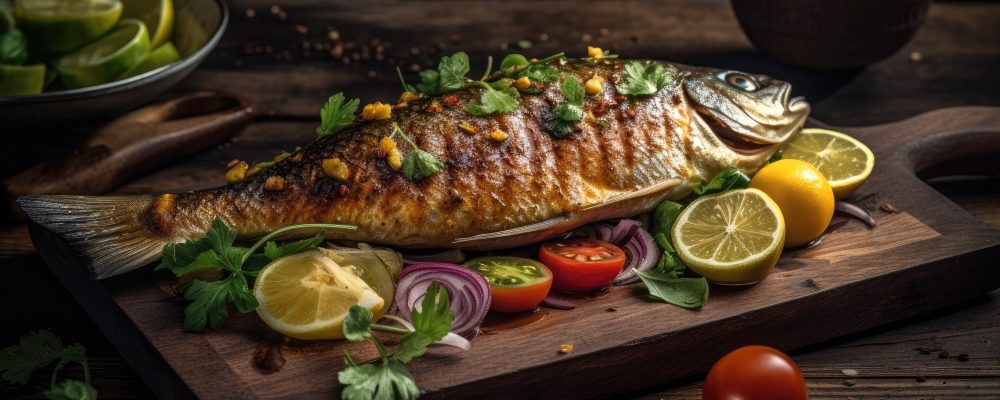

There is a way of cooking fish that most home cooks have largely abandoned — that requires more engagement with the ingredient than the boneless fillet allows and that produces, in exchange for that engagement, a result that the fillet cannot match.
The whole fish.
Not the convenience of the skinless, boneless portion — the fish reduced to its most manageable and most approachable form, requiring nothing from the cook beyond cooking it and nothing from the eater beyond eating it. The actual fish — head intact, bones intact, skin intact — cooked as the animal it was rather than as the processed portion it has become.
The whole fish is not a harder preparation than the fillet. In some respects it is easier — the bones and the skin protect the flesh during cooking, providing a buffer against the overcooking that destroys fillets and producing a more forgiving window of doneness than the exposed fillet’s narrow tolerance allows.
What the whole fish requires is not skill but willingness — the willingness to engage with the ingredient in its complete form, to carve at the table rather than plate in the kitchen, to encounter the fish as an animal rather than as a product.
And what it provides in exchange for that willingness is one of the most satisfying cooking and eating experiences available from any seafood preparation.
Why the Bone Makes the Difference
The specific superiority of fish cooked on the bone — the quality that makes the whole fish or the bone-in fillet a fundamentally different eating experience from the boneless portion — is not primarily about flavor compounds released from the bone during cooking, though that contributes something.
It is about moisture retention.
The bone conducts heat differently than the surrounding flesh — more slowly, more evenly, in a way that moderates the cooking of the flesh immediately adjacent to it. The flesh closest to the bone in a whole roasted fish or a bone-in fillet is the last flesh to reach serving temperature, remaining slightly more moist and more tender than the flesh at the exterior of the fish.
This gradient — from the slightly more cooked exterior to the perfectly cooked flesh adjacent to the bone — is the specific quality of bone-in fish cookery that boneless preparation cannot replicate. The bite taken from the flesh immediately beside the backbone of a whole roasted fish is a different and better eating experience than any bite of a boneless fillet cooked to the same doneness, because the bone’s moderating effect on the heat has preserved a specific moisture and tenderness that direct heat cannot.
The skin provides a complementary protection — a barrier between the direct heat of the pan or the oven and the delicate flesh beneath, allowing the exterior to develop color and crispness while the flesh inside remains protected.
Together, the bone and the skin create the specific cooking environment that produces genuinely excellent fish — one that no boneless, skinless alternative can replicate regardless of technique.
The Whole Roasted Fish
Of all the whole fish preparations available, the roasted whole fish is the most accessible for the home cook — requiring no special equipment, no specific technique beyond basic oven management, and producing a result that is simultaneously impressive in presentation and excellent in eating quality.
The preparation: the fish — a branzino, a snapper, a sea bass, a trout, any fish of appropriate size for the oven and the number of people eating — is scaled and gutted, which the fishmonger will do on request. The cavity is seasoned generously with salt and filled with aromatics — sliced lemon, fresh herbs, garlic, whatever combination suits the flavor direction of the meal. The exterior is dried thoroughly, drizzled with good olive oil, and seasoned with salt. Scored with three or four diagonal cuts through the skin on each side — cuts that allow heat to penetrate more evenly and that prevent the skin from curling during roasting.
Roasted in a hot oven — 425 to 450°F — on a bed of sliced aromatics or directly on a lightly oiled sheet pan. The cooking time depends on the size of the fish — a one-pound fish needs approximately twelve to fifteen minutes; a two-pound fish needs eighteen to twenty-two minutes. The fish is done when the flesh at the thickest part — tested by inserting a thin knife or a cake tester and holding it there for a moment, then touching the tip to the sensitive skin beneath the wrist — feels warm rather than cold.
The whole roasted fish brought to the table is one of the most visually impressive presentations available from any simple preparation — and the carving, done at the table with a fork and a spoon rather than a knife, produces the specific pleasure of engagement with the ingredient that plated fillets deny.
The Carving That Isn’t Difficult
The specific anxiety that most home cooks feel about cooking whole fish centers not on the cooking itself but on the carving — the specific fear of bones, of the unknown architecture of the fish’s skeleton, of producing something that is awkward to serve and awkward to eat.
This anxiety is disproportionate to the actual difficulty of carving a whole fish — which, once the basic anatomy is understood, is one of the most straightforward carving tasks available from any animal protein.
The whole fish has a simple skeletal structure: a central spine with ribs extending from it, a series of pin bones running from the spine through the upper portion of the flesh, and the head and tail at either end. The flesh on each side of the spine — the two fillets that constitute the eating — is separated from the skeleton by a specific and consistent seam that a fork and spoon can navigate without difficulty.
The technique: insert a fork along the top edge of the fish, just above the dorsal fin, and use it to gently separate the top fillet from the spine. Slide a spoon under the fillet to lift and transfer it to a plate. Then lift the spine from the bottom fillet by gripping the tail and peeling the skeleton away — it comes free in a single piece if the fish is properly cooked. The bottom fillet is then available to be lifted from the skin.
This two-minute process, performed once, produces two clean fillets with minimal bones remaining — and produces, for the person who performs it, the specific knowledge of fish anatomy that makes every subsequent whole fish carving faster and more confident.
The Grilled Whole Fish
The grilled whole fish is the outdoor cooking preparation that most specifically demonstrates what the grill does to fish that no indoor cooking method replicates.
The combination of direct flame, smoke, and high heat applied to a whole fish — its skin and its bones providing the protection that allows the flesh to cook through without drying — produces a specific charred, smoky exterior with a moist, perfectly cooked interior that the indoor oven cannot achieve in the same form.
The specific technique challenge of grilling a whole fish is sticking — the fish adhering to the grill grate at the skin and tearing when an attempt is made to turn it. This is the specific failure that most discourages home cooks from grilling whole fish, and it is entirely preventable through a combination of a properly oiled, properly preheated grill grate and the patience to leave the fish undisturbed until it releases naturally.
The fish stuck to the grill grate is a fish that has not yet developed the crust that will allow it to release. The fish that releases cleanly — that can be slid from the grate without tearing — has developed the specific crust that comes from sufficient contact time with a properly hot surface. The cook who waits for this release rather than forcing the turn produces a whole grilled fish with intact skin and a specific char that is one of the defining pleasures of outdoor summer cooking.
The Salt-Crusted Fish: The Most Ancient Method
Of all the whole fish preparations available, the salt-crusted fish is the one that most dramatically demonstrates what the whole fish format makes possible — a cooking method that is simply not available for boneless fillets and that produces a specific result that no other technique achieves.
The salt crust — a mixture of coarse salt, egg white, and optionally fresh herbs — is packed around the entire exterior of a whole, ungutted fish, encasing it completely in a thick shell of salt that hardens during cooking into a solid, sealed environment.
Inside this sealed environment, the fish steams in its own moisture — the salt drawing liquid from the exterior of the fish that then circulates within the sealed crust, creating a self-basting cooking environment that is simultaneously the most gentle and the most complete available from any cooking method. The fish is protected from direct heat by the salt shell. It is cooked by the steam of its own moisture. It is seasoned gradually and evenly by the salt that surrounds it without becoming oversalted — because the salt crust seasons primarily through the steam it generates rather than through direct contact with the flesh.
The salt-crusted fish cracked open at the table — the dramatic reveal of the intact, perfectly cooked fish beneath the broken shell — is one of the most specifically theatrical presentations available from any simple preparation. The flesh inside is the most moist, the most evenly cooked, and the most specifically flavored of any whole fish preparation.
The Whole Fish at the Table
The whole fish served at the table — whether roasted or grilled or salt-crusted — produces a specific quality of shared engagement that the plated fillet does not.
The carving happens at the table. People watch. Someone helps. The skeleton is lifted away with the satisfying completeness of a preparation that reveals its own structure. The fish is distributed directly from the carving — portions placed on plates from the whole rather than arriving pre-portioned from the kitchen.
This shared engagement with the preparation — the communal carving, the shared revelation of the fish beneath its skin or its salt crust — produces the specific quality of occasion that the whole fish most naturally creates. It is a meal format that requires presence and participation rather than simply reception.
The whole fish is not just better to eat than the fillet. It is better to serve — because the serving is part of the occasion in a way that plating a fillet is not.
The Takeaway
The whole fish is one of the most rewarding preparations available in any summer kitchen — producing superior eating quality through the specific protection that bone and skin provide, while creating a shared occasion at the table that the portioned fillet cannot generate.
Ask the fishmonger to scale and gut it. Season it simply and generously. Roast it hot or grill it over direct flame or encase it in salt. Bring it to the table whole and carve it there.
The bone makes the difference.
The table makes the occasion.
Both are worth the engagement.














