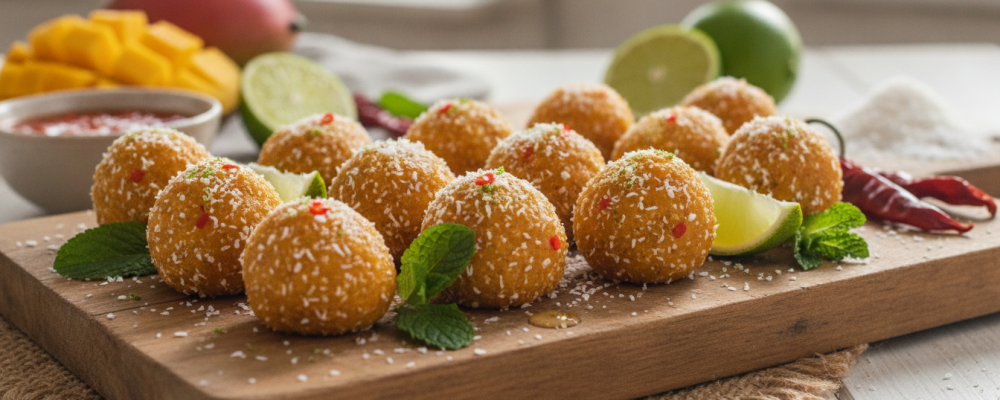

There are snacks that sustain you, and snacks that please you, and occasionally—if you are lucky and paying attention—snacks that actually transport you. These bites are that third kind. They are small and unassuming and take about ten minutes to make, and when you eat one in the middle of a grey Thursday afternoon, something specific happens: the dried mango’s concentrated tropical sweetness reaches you first, warm and slightly honeyed; then the lime zest’s floral brightness cuts through; then the chili’s warmth arrives at the back of your palate and lingers there, making the whole combination taste more vivid and more alive than any of its parts would suggest on their own. For a moment, the Thursday is less grey.
I think about what I want a snack to do—actually do—and the answer is usually some version of this: interrupt the ordinary enough to make the ordinary feel less relentless. A snack that tastes specifically and memorably of something good, that requires no decision-making or effort at the moment you reach for it, and that delivers a genuine sensory pleasure rather than merely managing hunger. These bites do all of that in a package the size of a small truffle, and the fact that they’re made from six pantry ingredients and a ten-minute Sunday afternoon only makes them more satisfying to eat.
The coconut is what makes the texture possible—the shredded coconut’s natural oils and fiber structure provide the binding capacity that allows the mango and honey and lime to come together into a ball that holds its shape and its chew without requiring any cooking or refrigeration-set binder. The bites are chewy and slightly sticky in the way that makes them satisfying rather than messy, with just enough structural integrity to be picked up and eaten cleanly while still having that yielding, give-under-the-tooth quality that makes a snack feel indulgent rather than merely portable.
─────────────────────────────────────────
The Inspiration Behind This Recipe
This recipe was inspired by a very direct observation: the combination of mango, chili, and lime is one of the most inherently satisfying flavor pairings available, and it exists almost exclusively in fresh fruit formats that don’t travel, don’t last, and don’t translate to a prep-ahead context without significant compromise. Fresh mango with Tajín is extraordinary; by the next morning it has softened and released its juice and lost the crispness that made it so good. What this recipe does is take that same flavor logic—tropical sweetness, chili warmth, citrus brightness—and find it in an ingredient that is already shelf-stable, already concentrated, and already chewy in a way that makes it better suited to the ball format than fresh fruit ever could be.
Dried mango was the pivot that made everything work. The dehydration process that produces dried mango concentrates its natural sugars into something more intensely flavored than fresh—the sweetness is deeper, more honeyed, with a specific chewiness that is the opposite of fresh mango’s juicy crispness but equally satisfying in its own register. Combined with shredded coconut’s tropical richness and the lime’s vivid brightness, the dried mango becomes the anchor of a bite that is specifically and memorably of its flavor combination rather than generically sweet.
The honey is the detail that makes the whole preparation come together as a cohesive mixture rather than a bowl of loosely combined ingredients. Honey’s natural stickiness—its high sugar concentration producing a hygroscopic, adhesive quality at room temperature—binds the mango pieces and coconut shreds into a mixture that can be pressed and rolled into balls that hold their shape through the chilling step and through the refrigerator’s storage window. It is doing structural work as much as sweetening, and the right amount of honey is the amount that makes the mixture feel like something that will hold together when pressed—tacky but not wet, cohesive but not dense.
─────────────────────────────────────────
A Brief History of Tropical Fruit and Chili Pairings
The combination of tropical fruit with chili and lime is deeply rooted in the culinary traditions of Mexico and Central America, where the abundance of both tropical fruit and dried chili pepper created a flavor pairing that is instinctively understood across generations of home cooks and street food vendors. Mango with chili and lime is one of the most beloved expressions of this tradition—appearing on street carts, in markets, and at family tables throughout Mexico in a form that has changed very little over centuries because it requires no improvement. The sweetness of the mango, the heat of the chili, and the brightness of the lime together produce a flavor combination that the palate recognizes as complete in a way that none of the three elements achieves independently.
Dried mango’s specific role in this tradition is worth noting. Long before refrigeration made fresh fruit available year-round, the preservation of seasonal mango through sun-drying was a practical technology that extended the fruit’s availability and concentrated its flavor in a form that could be carried, traded, and stored. Dried mango with chili and salt—sold in small packets at markets throughout Mexico—is itself a centuries-old street snack with deep cultural roots in the same tradition that the fresh mango-and-chili combination represents. These bites draw directly from that tradition while adapting it to a contemporary no-bake snack format.
Coconut’s role in tropical cuisine and snack preparations has equally deep roots across the broader tropics—from Southeast Asia to the Caribbean to the Pacific Islands, where coconut in its fresh, dried, and pressed forms has been a staple ingredient in everything from daily cooking to festive confections. The combination of dried mango with shredded coconut reflects the natural geographic and flavor compatibility of two tropical crops that have been understood as complementary across multiple food cultures for centuries.
─────────────────────────────────────────
Why This Preparation Method Works for Meal Prep
The no-cook format of this recipe is not a shortcut—it is the preparation method that best preserves the flavor qualities that make these bites worth eating. Dried mango’s concentrated flavor compounds are most vivid in their uncooked state; heat applied to dried mango produces further caramelization and a stickier, denser result that is less distinctly fruity and more uniformly sweet. The lime zest’s essential oils—the most volatile and most aromatic part of the lime—survive a no-cook preparation intact but would begin to degrade immediately in a cooked one. The chili’s capsaicin is fully effective at room temperature and requires no heat activation. Every ingredient in this recipe is at its functional best without cooking.
The chilling step—a minimum of one hour in the refrigerator—is the structural setting process that makes these bites portable and handleable rather than merely shaped. At room temperature, the honey’s adhesive structure is soft enough that gentle pressure can deform the bites; refrigerated, the honey’s sugars firm and the coconut’s fat solidifies around the mango pieces, producing a bite that holds its shape cleanly when picked up and eaten. The chill is not optional—it is the manufacturing step that transforms a sticky mixture into a snack.
The lime juice and lime zest serve distinct and complementary functions in the mixture, and both are necessary. The lime juice’s citric acid interacts with the honey’s natural sugars and the mango’s fruit acids to create a slight tenderizing effect on the dried mango pieces—softening them just enough to make the finished bite’s chew more yielding and more pleasant than rehydrated dried mango alone would be. The lime zest’s essential oils distribute through the coconut’s fat and provide the aromatic, floral citrus character that makes the bite smell as good as it tastes. One without the other produces a bite that is either bright but not fragrant or fragrant but not fresh.
─────────────────────────────────────────
Flavor Profile: What to Expect
These bites are chewy, tropical, and specifically bright—a flavor profile that reveals itself in sequence rather than all at once:
- Concentrated dried mango sweetness – The foundational flavor: warm, intensely fruity, and specifically tropical in a way that distinguishes dried mango from any other dried fruit—more honeyed and more complex than fresh mango, present in every bite as the primary flavor event
- Tropical coconut richness – The textural and aromatic companion: mild, slightly sweet, and carrying the lime zest’s essential oils through its own fat phase—present as a background tropical creaminess that deepens the mango’s sweetness
- Floral lime zest brightness – The aromatic note that elevates the combination: citrusy, slightly floral, and fat-carried through the coconut so it’s distributed throughout every bite rather than concentrated at the surface
- Clean lime juice acidity – The sharpening acid that prevents the concentrated sweetness from tipping into cloying and keeps every bite tasting fresh and vivid rather than heavy
- Building chili warmth – The heat that arrives after the tropical sweetness and lingers on the palate—slow, gentle, and specifically motivating in the way that makes you reach for another bite before the current one has finished
- Floral honey binding – Present throughout as the adhesive that holds the mixture together and the sweetener that rounds the lime’s acidity into something cohesive and balanced
The chili and lime flavors integrate more fully with the mango and honey during the chilling period and the subsequent refrigerator storage. A bite eaten immediately after chilling is good; a bite eaten the following morning is noticeably more cohesive—the chili’s heat more evenly distributed, the lime more fully integrated, the whole combination tasting more specifically of itself rather than of individual components combined.
─────────────────────────────────────────
Tips for Making the Best Mango Chili Lime Coconut Bites
Six ingredients means each one is fully visible and fully consequential in the finished bite:
- Use unsweetened shredded coconut – Sweetened coconut will make the bites significantly sweeter than intended and can tip the balance away from the chili-lime contrast that makes them interesting. Unsweetened coconut contributes fat and texture without additional sugar, allowing the honey and mango to do all the sweetening.
- Chop the dried mango finely but not uniformly – Small, irregular pieces—some slightly larger, some almost minced—produce a bite with more textural variety than uniformly processed mango. The larger pieces provide a chewy mango hit; the smaller pieces bind into the coconut matrix and distribute flavor throughout.
- Add chili powder gradually and taste – Chili powder varies in heat level between brands. Start with half the intended amount, form a small test ball, and taste before adding more. The heat should be present and building but not overwhelming—the mango’s sweetness should still be the first flavor that arrives.
- Use both lime juice and lime zest – Neither alone produces the full citrus character these bites require. The juice provides acid; the zest provides fragrance. Both are necessary.
- Wet your hands before rolling – Slightly damp hands prevent the sticky mixture from adhering aggressively during rolling and allow each ball to be formed smoothly rather than stickily. A small bowl of water nearby makes this easy.
- Chill for the full hour before serving – The structural setting that occurs during chilling is what makes these bites portable rather than merely pressed into shape. Bites served before full chilling are soft and deform easily; fully chilled bites hold their form and their texture through handling.
Optional: A small bowl of additional shredded coconut for rolling the finished balls before chilling adds a snowy, textured exterior that makes each bite look like a confection from a specialty shop and provides an additional layer of mild coconut flavor at the surface. It takes thirty seconds and produces a result that looks genuinely intentional.
─────────────────────────────────────────
Portioning and Container Suggestions
A standard batch yields approximately twelve to sixteen bites depending on the size formed—three to four bites per serving as a satisfying snack, or two as a lighter portion. The compact, uniform size of each bite makes these among the most space-efficient snack preps in the collection: sixteen bites take up no more refrigerator space than a small jar, and their compact format makes individual daily portioning into small zip bags or containers entirely effortless.
These bites store best in a sealed container in the refrigerator where the honey and coconut fat maintain their firm, handleable structure. At room temperature for more than twenty to thirty minutes in a warm kitchen, the honey softens and the bites can become slightly tacky—still delicious, but less structurally confident than when cold. A cold bite picked up cleanly from its container and eaten in two satisfying chews is the intended experience, and the refrigerator is what makes that experience consistent across the full week.
For an entertaining presentation—these bites are appropriate for a gathering as much as for a solo snack rotation—arrange in a small bowl or on a plate alongside a pile of additional shredded coconut, a wedge of lime for squeezing, and a small pinch of additional chili powder dusted over the surface. The warm gold of the mango against the white coconut and the orange-red chili is a naturally beautiful combination that requires no additional arrangement skill to look genuinely considered.
─────────────────────────────────────────
Storage, Reheating, and Shelf Life Tips
- Refrigerator storage: Keeps in a sealed airtight container for up to 7 days. The chili, lime, and honey flavors continue to integrate through the storage window — day-two and day-three bites are the flavor peak.
- Freezer storage: Freeze well for up to 2 months in a single layer before transferring to a sealed bag. Thaw in the refrigerator for thirty minutes or at room temperature for fifteen — the honey and coconut fat firm back to their original consistency within this window.
- Room temperature handling: Bites at room temperature for more than thirty minutes in warm conditions will soften slightly. They remain delicious but become sticky to handle. Return to the refrigerator for fifteen minutes to restore their firm, portable texture.
- No reheating required: These are a cold snack by design. The mango and lime flavors are most vivid from the refrigerator; heat would soften the honey’s structure and make the bites too soft to handle cleanly.
- Chili intensity over time: The chili’s heat distributes more fully through the mixture during refrigerator storage — a bite on day four may be marginally warmer than one eaten on day one. This is a feature rather than a flaw; the heat becomes more cohesive and more pleasantly integrated as it distributes.
- Coconut coating tip: If rolling the bites in additional shredded coconut before chilling, the coating will remain adhered throughout the storage window. No additional coating is needed before serving.
─────────────────────────────────────────
Why This Recipe Deserves a Spot in Your Meal Prep Rotation
The case I want to make for these bites is the simplest one I ever make for any recipe: they taste like something worth eating and they take ten minutes to make and the week is measurably better for having them in it. That is the whole argument. Everything else—the six-ingredient simplicity, the seven-day shelf life, the freeze-ahead option, the genuinely impressive nutritional profile for something that tastes like a confection—is supporting evidence for a conclusion that any honest snack rotation should be willing to draw: some things earn their place not by being the most efficient or the most optimized but simply by being genuinely good.
There is a version of a Tuesday afternoon that has these bites in it and a version that doesn’t. In the version that does, the Tuesday has a specific moment—a small one, barely enough to describe—where the chili reaches the palate and the lime zest cuts through the mango’s warmth and the whole combination tastes, briefly, like somewhere the sun is already out. In the version that doesn’t, Tuesday is just Tuesday. I make these bites to make Tuesday the first kind of Tuesday. That is enough.
─────────────────────────────────────────
Meal Prep Pairing Suggestions
Mango Chili Lime Coconut Bites pair most naturally with snack preparations that share their tropical, Tajín-adjacent flavor tradition while offering genuine contrast in texture and format. Our Mango Tajín Fruit Cups make the ideal companion within the mango-and-chili snack category — both are mango-forward, chili-lime preparations built on the same fundamental flavor instinct, but the fresh mango cups deliver hydrating, crisp fruit in a ready-to-eat cup format while these bites deliver the concentrated, chewy intensity of dried mango in a fully portable, no-assembly ball. Together they give the tropical snack rotation two genuinely different mango-chili-lime experiences in the same week without any redundancy.
For a snack rotation that extends the chili-lime tradition beyond mango specifically, our Tajín Watermelon & Cucumber Bites provide the cool, fresh, dual-fruit counterpoint that gives the week’s snacking genuine variety — light and hydrating where these bites are rich and concentrated, fresh and crisp where these are chewy and warm. Two snack preparations covering the tropical-and-chili flavor tradition from opposite textural and intensity positions — concentrated-and-portable versus fresh-and-cool — means the week’s snacking has both the option for something restorative and the option for something specifically indulgent, ready without effort every afternoon they’re needed.
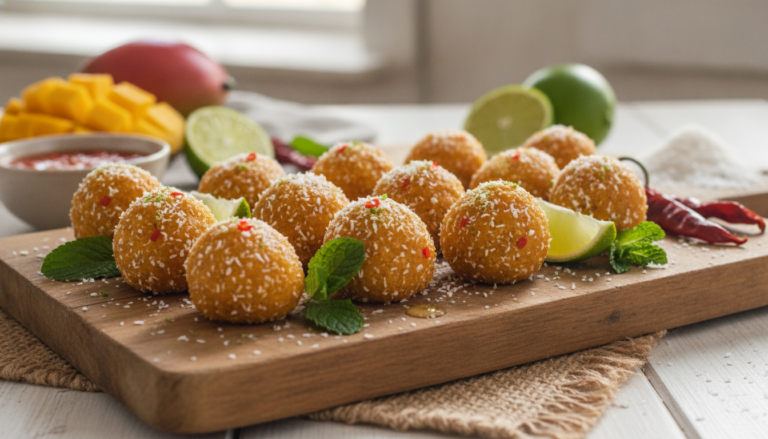
Mango Chili Lime Coconut Bites
These Mango Chili Lime Coconut Bites are a no-bake, six-ingredient snack that brings the bold, sun-warmed flavor combination of tropical fruit, citrus, and chili into a chewy, portable bite—the snack that tastes like somewhere wonderful and takes almost no effort to make.
4
servings30
minutes40
minutes300
kcal1
hour10
minutesIngredients
1 cup dried mango
1 cup shredded coconut
2 tablespoons lime juice
1 teaspoon lime zest
1 teaspoon chili powder
2 tablespoons honey
Directions
- Chop dried mango into small pieces.
- In a bowl, combine the mango, coconut, lime juice, and lime zest.
- Sprinkle chili powder over the mixture and mix well.
- Add honey and stir until the mixture is sticky and well combined.
- Form into bite-sized balls using your hands.
- Chill for at least 1 hour before serving.
Nutrition Facts
- Total number of serves: 4
- Calories: 150kcal
- Cholesterol: 0mg
- Potassium: 400mg
- Sugar: 8g
- Protein: 6g
- Calcium: 60mg
- Iron: 2mg
About This Author

Amelia Grace
Editor-in-Chief & Culinary Director
The heart and guiding voice of Daily Dish, Amelia leads our editorial vision and recipe development. With a background in food journalism and over a decade spent in professional kitchens, she has a knack for blending gourmet technique with real-world accessibility. Her goal? To make every reader feel like a confident cook, one dish at a time.
Favorite dish: Creamy lemon risotto with a sprinkle of fresh thyme.
Kitchen motto: “Good food doesn’t have to be complicated — it just has to be made with heart.”